

Phase 1: Empathy (Story-Driven Opening)
안녕하세요! 매일한글 에디터입니다.
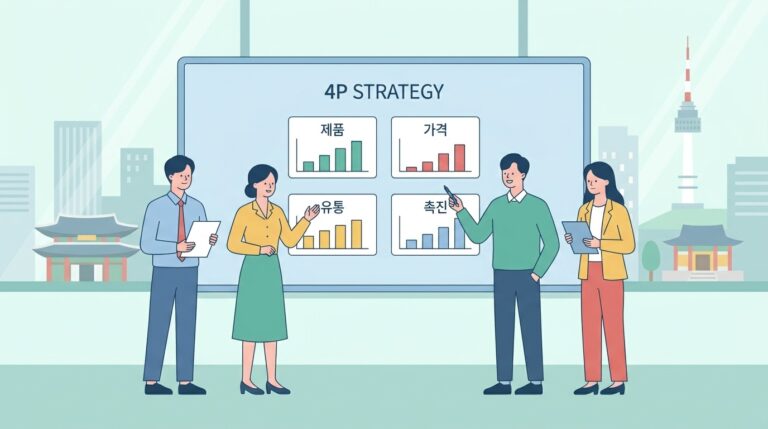
Imagine standing in a high-tech boardroom overlooking the bustling Gangnam skyline. You are presenting your brand’s entry strategy into the Korean market to senior directors. You’ve mastered basic business Korean, but as the discussion turns to positioning your product, pricing structures, placement, and promotional campaigns—the classic Marketing 4Ps—you hesitate. Should you translate “Product” directly as 상품 (sangpum) or discuss 제품력 (jepum-ryeok)? How do top-tier Korean strategists frame competitive pricing without sounding overly transaction-oriented?
Navigating C2-level business Korean requires more than lexical accuracy; it demands an intuitive grasp of how strategic value, organizational consensus, and cultural nuance intersect in the modern Korean corporate ecosystem. Based on real feedback from global marketing executives working in Seoul, this deep dive will elevate your executive vocabulary, fine-tune your pragmatic competence, and ensure you speak the persuasive language of Korean decision-makers.
Phase 2: Core Expressions Deep Dive
1. 제품력 (製品力)
- Pronunciation: [Jepum-ryeok] (Think of “je-poom” blended smoothly into “ryeok”, where the ‘m’ and ‘r’ transition naturally without a sharp stop)
- Meaning: Literal translation: “Product power.” Actual nuance: Product competitiveness, intrinsic value, or product superiority.
- K-Culture Moment: Seen frequently in Korean business dramas like Start-Up or Search: WWW, where tech founders debate whether marketing flash or core product utility wins long-term market share.
- Editor’s Insight: C2 speakers rarely say “이 제품은 매우 좋습니다” (This product is very good) in executive briefings. Instead, framing the discussion around 제품력 demonstrates that you evaluate a product based on its fundamental market performance and technical edge.
- Situation Spectrum: Casual 🚫 | Semi-formal ⚠️ | Formal ✅
- 🤔 Think About It: How does your native language express the balance between raw product quality and overall market viability? In Korean business culture, 제품력 carries an implicit promise of customer trust.
2. 가격 경쟁력 (價格 競爭力)
- Pronunciation: [Gagyeok Gyeongjaeng-ryeok] (Flows like “gah-gyeok gyeong-jaeng-nyeok” with fluid nasalization on the final syllable)
- Meaning: Literal translation: “Price competitiveness.” Actual nuance: Delivering high value-to-cost ratio (가성비) or strategic pricing edge against industry rivals.
- K-Culture Moment: Frequently analyzed in K-Beauty documentary features explaining how roadshop cosmetics brands rapidly scale by offering department-store quality at accessible price points.
- Editor’s Insight: In Korean pricing strategy discussions, 가격 경쟁력 isn’t just about being cheap (싸다); it implies strategic positioning that optimizes consumer value perception while safeguarding profit margins.
- Situation Spectrum: Casual 🚫 | Semi-formal ⚠️ | Formal ✅
- 🤔 Think About It: Is “cheapness” viewed positively or negatively in your country’s corporate culture? Notice how Korean business Korean uses 경쟁력 (competitiveness) to elevate price discussions.
3. 유통 채널 다변화 (流通 채널 多邊化)
- Pronunciation: [Yutong Chaeneol Dabyeon-hwa] (Pronounced as “yoo-tong chae-neol dah-byeon-hwa”)
- Meaning: Literal translation: “Distribution channel diversification.” Actual nuance: Expanding Place strategy across omnichannel networks (e.g., Coupang, Naver Smart Store, offline pop-up stores).
- K-Culture Moment: Essential vocabulary when discussing how K-Food brands expand from local convenience store chains (CU, GS25) into global e-commerce fulfillment systems.
- Editor’s Insight: Using 다변화 (diversification) shows strategic foresight. Rather than simply listing sales outlets, you communicate a dynamic, multi-channel approach suitable for high-level board meetings.
- Situation Spectrum: Casual 🚫 | Semi-formal ⚠️ | Formal ✅
- 🤔 Think About It: How does the rapid pace of digital delivery in Korea influence consumer expectations around distribution accessibility?
Phase 3: Textbook Korean vs. Real Native Korean
Situation 1: Emphasizing Product Quality in a Pitch
- 📖 Textbook Korean: 우리 제품은 성능이 아주 좋습니다.
(Uri jepumeun seongneungi aju joshumnida.) — “Our product performance is very good.” - 🗣️ Real Native C2 Korean: 우리 제품은 독보적인 제품력을 바탕으로 시장 입지를 구축하고 있습니다.
(Uri jepumeun dokbojeogin jepumryeogeul batang-euro sijang ipji-reul guchuk-hago isseumnida.) — “Our product is establishing a market stronghold based on unmatched product competitiveness.” - 💡 Why the Difference? While the textbook version is grammatically correct, native C2 business communication relies on concise Sino-Korean vocabulary (독보적, 입지 구축) to sound authoritative and persuasive.
Situation 2: Proposing a Promotional Campaign
- 📖 Textbook Korean: 홍보 행사를 많이 해서 고객에게 알립시다.
(Hongbo haengsareul mani haeseo gogaekege allipsida.) — “Let’s do many promotional events to inform customers.” - 🗣️ Real Native C2 Korean: 공격적인 타깃 프로모션을 통해 브랜드 인지도를 제고할 필요가 있습니다.
(Gonggyeokjeogin tagit peuromosyeoneul tonghae beuraendeo injidoreul jego-hal pil-yoga isseumnida.) — “We need to enhance brand awareness through an aggressive targeted promotion.” - 💡 Why the Difference? Professional Korean replaces generic verbs like 알리다 (to inform) with executive action terms like 인지도를 제고하다 (to elevate awareness).
Phase 4: K-Culture Deep Dive & Non-Verbal Etiquette
4-1. Boardroom Nunchi (눈치) & Strategic Gestures
When delivering a 4P strategy pitch in Korea, vocal tone and body language carry equal weight to your slides. Maintain structured posture with slight forward inclination when proposing tactical pivots. Avoid over-gesticulating; keep hands open and waist-level when referring to charts. When executive peers offer feedback, practice 경청 (active listening) by nodding subtly without interrupting—this demonstrates confidence and respect for corporate hierarchy.
4-2. Cultural Code: The K-Beauty 4P Playbook
Consider how Korean beauty conglomerates master the 4Ps:
* Product: Rapid R&D cycles focusing on innovative formulations (e.g., cushion compacts).
* Price: Tiered pricing strategies targeting Gen Z through roadshops while reserving premium lines for duty-free channels.
* Place: Strategic integration of Seongsu-dong offline pop-up spaces linked directly to KakaoTalk Gift shopping.
* Promotion: High-engagement ambassador campaigns paired with micro-influencer viral unboxings.
Understanding this holistic framework equips you to discuss complex go-to-market strategies naturally in business meetings.
Phase 5: Interactive Business Roleplay
Scenario: You are discussing the market launch strategy for a premium organic beverage line with Director Park (박 이사) in a Gangnam conference room.
- Director Park: 이번 신제품의 4P 전략, 핵심 방향은 어떻게 잡고 계십니까?
(Ibeon sinjepum-ui sah-P jeonlyak, haeksim banghyangeun otteoke japgo gyesimnikka?)
“What is our core direction for this new product’s 4P strategy?”
🎭 Behavioral Cue: Looking at you attentively while tapping his pen on the agenda. -
You (Turn 1): 차별화된 제품력을 최우선 과제로 삼았습니다.
(Chabyeolhwa-daen jepumryeogeul choe-useon gwaje-ro sam-asseumnida.)
“We have prioritized differentiated product strength as our top task.”
🎭 Behavioral Cue: Maintaining steady eye contact with a confident nod. -
Director Park: 좋습니다. 그렇다면 가격 경쟁력과 유통망은 어떻게 가져갈 생각입니까?
(Joshumnida. Geureotamyeon gagyeok gyeongjaengryeok-gwa yutongmangeun otteoke gajyeogal saenggangnimnikka?)
“Good. Then how do you plan to handle price competitiveness and distribution networks?”
🎭 Behavioral Cue: Leaning back slightly, adjusting his glasses. -
You (Turn 2): 프리미엄 포지셔닝을 유지하되, 온라인 직영 몰을 통해 유통 단가를 낮출 계획입니다.
(Peurimieom pojisyeoning-eul yujihade, onla-in jigyeong-moll-eul tonghae yutong dangareul natchul gyaehoegimnida.)
“We plan to maintain premium positioning while reducing distribution unit costs through our direct online store.”
🎭 Behavioral Cue: Gesturing calmly toward the digital slide presentation. -
Director Park: 초기 프로모션 방안은 준비되었나요?
(Chogi peuromosyeon bang-aneun junbi-doe-eonnayo?)
“Is the initial promotion plan prepared?”
🎭 Behavioral Cue: Turning the page of his notebook. -
You (Turn 3): 인플루언서 체험단과 팝업스토어를 연계한 바이럴 마케팅을 구상했습니다.
(Inpulleuen-seo cheheomdan-gwa papeop-seuto-eoreul yeon-gye-han baireol maketing-eul gusang-haesseumnida.)
“We have designed viral marketing linking influencer experience groups with offline pop-up stores.”
🎭 Behavioral Cue: Presenting a clear, upbeat voice projection. -
Director Park: 훌륭합니다. 이 방향대로 상세 실행안을 작성해 보시죠.
(Hullyunghamnida. I banghyang-daero sangse silaeng-aneul jakseong-hae bosijo.)
“Excellent. Please draft the detailed execution plan following this direction.”
🎭 Behavioral Cue: Smiling approvingly and closing his notebook.
🔀 Interactive Decision Point
How do you respond to Director Park’s request for the detailed execution plan?
- Option A: “네, 알겠습니다. 내일까지 만들겠습니다.”
- Option B: “네, 팀원들과 세부 실천 과제를 검토한 후 금주 내로 보고드리겠습니다.”
- Option C: “가격 전략이 조금 불안한데 더 고민해 보겠습니다.”
Feedback on Options:
- Best Choice — Option B: Professional, structured, and realistic. It demonstrates executive teamwork and clear timeline management.
- Risk Choice — Option A: Shows willingness, but setting an overly rushed headline deadline (“tomorrow”) without consulting team deliverables can compromise plan depth.
- Bad Choice — Option C: Expressing foundational hesitation without offering alternative data compromises executive confidence during a presentation sign-off.
Phase 6: 10-Second Emotional Shadowing Drill
Practice these business sentences emphasizing accurate pausing (/) and executive emotional tone:
- [😊 Confident & Persuasive]
우리 제품은 / 독보적인 제품력을 바탕으로 / 시장 점유율을 확대할 것입니다.
(Uri jepumeun / dokbojeogin jepumryeogeul batang-euro / sijang jeomyuyureul hwagdaehal geosimnida.)
“Our product / based on unmatched product strength / will expand market share.” -
[🧐 Analytical & Strategic]
유통 채널 다변화를 통해 / 리스크를 분산시키는 전략이 / 필요합니다.
(Yutong chaeneol dabyeonhwareul tonghae / riseukeureul bunsansikineun jeonlyagi / pil-yohamnida.)
“Through distribution channel diversification / a risk-mitigating strategy / is necessary.” -
[🤝 Professional & Collaborative]
타깃 고객층에 맞춘 / 공격적인 프로모션을 / 제안드립니다.
(Tagit gogaekcheong-e matchun / gonggyeokjeogin peuromosyeoneul / je-andeurimnida.)
“Tailored to our target customer demographic / an aggressive promotion strategy / is proposed.”
Phase 7: K-Culture Business Dictionary
-
타깃층 (Tagit-cheong)
- Translation: Target Demographic.
- Usage: Essential in market segmentation analysis (e.g., 2030 타깃층 = 20s and 30s target age group).
- 시너지 (Sineoji)
- Translation: Synergy.
- Usage: Commonly used when evaluating cross-promotions or brand collaboration campaigns (e.g., 콜라보 시너지 효과).
- 진입 장벽 (Jinit Jangbyeok)
- Translation: Entry Barrier.
- Usage: Crucial in competitive market evaluation when assessing threat of new competitors.
- 박리다매 (Bangni-Damae / 薄利多賣)
- Translation: High-volume, low-margin sales model.
- Usage: Used when discussing competitive penetration pricing strategies in high-density consumer markets.
Phase 8: Corporate Executive Survival Kit
Top 3 Executive Phrases
- 시장 점유율을 제고하겠습니다.
(Sijang jeomyuyureul jego-hagesseumnida.)
“We will elevate our market share.”
Pro Tip: Use 제고하다 instead of 높이다 for formal presentations. -
손익분기점 달성이 가능합니다.
(Sonik-bungi-jeom dalsoeng-i ganeung-hamnida.)
“Achieving the break-even point is attainable.”
Pro Tip: Critical metric when pitching price structures to financial controllers. -
옴니채널 구축이 시급합니다.
(Omni-chaeneol guchugi sigeub-hamnida.)
“Establishing an omnichannel framework is urgent.”
Pro Tip: High-frequency buzzword in Korean retail technology strategies.
Editor’s Corporate Note
When navigating business trips in Korea, leverage local infrastructure apps for high efficiency. For seamlessly locating pop-up store venues or corporate headquarters across Seoul, navigate using Naver Maps. For seamless transportation between regional offices and meetings, arrange executive taxis via Kakao T.
Phase 9: Deep Cultural Insight
In Korean corporate discourse, strategy formulation is deeply intertwined with collective alignment, often referred to as 공감대 형성 (consensus building). While Western business frameworks frequently prioritize individual analytical pitch defense, Korean executive presentations place high value on showing how your 4P strategy honors brand legacy, respects market relationships, and guarantees stability for business partners. Masterful C2 communication balances decisive strategic metrics with language that signals shared organizational success.
💬 Your Turn: How does your country’s corporate culture balance aggressive pricing with long-term brand equity? Share your executive thoughts in the comments below!
Phase 10: FAQ & Mistake Prevention
Q: Can I use basic vocabulary like ‘좋다’ or ‘싼 가격’ in high-level business presentations?
A: While understood, using everyday adjectives in formal corporate settings can diminish executive authority. Opt for analytical Sino-Korean terminology such as 우수하다 (superior), 합리적인 가격 (reasonable pricing), or 가격 경쟁력 (price competitiveness).
Q: What is the difference between ‘상품’ (Sangpum) and ‘제품’ (Jepum)?
A: 제품 refers specifically to manufactured products highlighting R&D and engineering capabilities. 상품 refers to merchandise positioned for retail sale and trade.
Q: Is ‘프로모션’ widely accepted in Korean corporate meetings?
A: Yes, English loanwords like 프로모션, 마케팅, and 타깃 are standard in modern Korean business language, alongside Sino-Korean terms like 판촉 (sales promotion).
🚨 Common Mistakes Checklist
- ❌ Mistake: Using informal speech honorifics incorrectly during presentations (e.g., ~했어 instead of ~했습니다).
- ✅ Correct Action: Maintain crisp -bnida/sumnida verb terminations in formal meetings.
- ❌ Mistake: Translating “Place strategy” literally as 장소 전략.
- ✅ Correct Action: Use the professional industry term 유통 채널 or 유통망.
- ❌ Mistake: Overusing dictionary-translated terms that sound archaic in modern tech or retail sectors.
- ✅ Correct Action: Balance precise Sino-Korean business nouns with contemporary industry loanwords.
Phase 11: Action Missions
- Bronze Mission: Record yourself reading the 3 shadowing sentences from Phase 6 with proper pauses (
/) and clear executive tone. - Silver Mission: Write a 3-sentence 4P summary of your favorite Korean brand or product using 제품력 and 가격 경쟁력.
- Gold Mission: Participate in a practice business pitch or leave a paragraph in our comment section presenting a sample launch strategy in C2-level Korean.
🎮 K-Culture Mission: Watch a scene from a business K-Drama (such as Search: WWW) and spot 2 marketing terms discussed in today’s lesson!
Phase 12: Interactive Quiz Challenge
1. Situation Judgment
You are presenting to senior managers and want to say your pricing strategy is competitive without using casual language. Which phrase is most appropriate?
– A) 가격이 진짜 싸요.
– B) 가격 경쟁력이 우수합니다.
– C) 값싸게 팝시다.
🔍 See Answer & Explanation
Correct Answer: B
Explanation: Option B uses formal Sino-Korean vocabulary (가격 경쟁력, 우수합니다) fitting for an executive presentation. Options A and C use overly informal/casual phrasing.
2. Fill in the Blank
우리 회사는 온라인과 오프라인을 아우르는 (_______) 다변화를 추진하고 있습니다.
– A) 제품력
– B) 유통 채널
– C) 손익분기점
🔍 See Answer & Explanation
Correct Answer: B
Explanation: Distribution channel diversification is expressed as 유통 채널 다변화 in business Korean.
3. True / False Culture Quiz
In Korean corporate presentations, using terms like 제품력 and 인지도 제고 helps convey professional expertise compared to generic descriptive verbs.
– [ ] True
– [ ] False
🔍 See Answer & Explanation
Correct Answer: True
Explanation: C2 business Korean relies on precise Sino-Korean terminology to project strategic authority and clarity.







