

Phase 1: Empathy (Story-Driven Opening)
안녕하세요! 매일한글 에디터입니다.
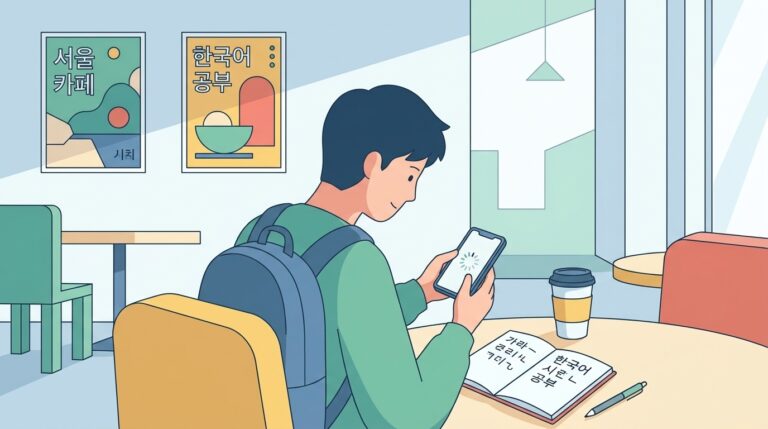
Imagine this scene: You are sitting in a sleek, aesthetic cafe in Seongsu-dong, sipping an iced Americano. You open your smartphone to book ticket reservations for a popular pop-up store or check a train schedule. You tap the button, but instead of instantaneous loading, a tiny spinning wheel appears. One second… two seconds… three seconds…
Around you, you hear subtle sighs (Ah…), rapid tapping on screens, and muttered complaints. Welcome to Korea’s iconic Pali-Pali (빨리빨리 – Hurry-Hurry) culture! In a country with some of the fastest internet speeds on the planet, waiting even four seconds for a webpage to render feels like an eternity.
As a B2 intermediate learner, simply saying “인터넷이 느려요” (The internet is slow) doesn’t capture the real drama or emotional nuance of the moment. By mastering natural tech-frustration expressions, you will not only articulate your feelings accurately but also connect deeply with Korean native speakers over shared everyday experiences. This guide is crafted directly from real student experiences and native feedback—let’s dive in!
Phase 2: Deep Dive into 3 Core Expressions
1. 답답해 죽겠어요 (Dapdaphae jukget-eoyo)
- Pronunciation: [dahp-dahp-hae jook-get-eyo] (Rhymes with ‘dock dock’ + ‘hey’ + ‘jook’ + ‘get’ + ‘eyo’)
- Meaning: Literal: “I’m suffocating to death!” / Real Nuance: “I’m so frustrated / driving me crazy!”
- K-Culture Moment: Seen in K-Dramas whenever a character is trying to score concert tickets during a high-stakes ticketing war (피케팅) and the screen freezes.
- Editor’s Insight: ‘답답하다’ describes physical or emotional stuffiness. When applied to slow loading speeds, it highlights your internal impatience.
- Situation Spectrum: Casual: ✅ | Semi-formal: ✅ | Formal: ⚠️
- 🤔 Think About It: How does your native culture express technological impatience? Do you use dramatic physical metaphors like “suffocating”?
2. 왜 이렇게 안 떠요? (Wae ireohge an tteoyo?)
- Pronunciation: [wae ee-ruh-gae ahn ttuh-yo] (Soft double ‘tt’ sound like in ‘steam’)
- Meaning: Literal: “Why isn’t it floating up like this?” / Real Nuance: “Why isn’t this page loading/popping up?”
- K-Culture Moment: Office workers hovering over a desktop monitor waiting for company announcements or registration portals to render.
- Editor’s Insight: In Korean tech slang, elements coming up on screen are described as ‘뜨다’ (to float/pop up).
- Situation Spectrum: Casual: ✅ | Semi-formal: ✅ | Formal: ⚠️
- 🤔 Think About It: Why do you think Korean uses spatial verbs like “float up” for screen loading?
3. 먹통이 됐어요 (Meoktong-i dwaesseoyo)
- Pronunciation: [muhk-tong-ee dwae-sseo-yo]
- Meaning: Literal: “It turned into an ink pot / blocked pipe.” / Real Nuance: “It’s completely frozen / unresponsive.”
- K-Culture Moment: Someone standing in front of a busy kiosk during lunch hour while the payment app screen turns black or locks up.
- Editor’s Insight: ‘먹통’ historically meant a traditional carpenter’s ink marker, but today it exclusively means a completely unresponsive system or unresponsive person.
- Situation Spectrum: Casual: ✅ | Semi-formal: ✅ | Formal: 🚫
- 🤔 Think About It: What everyday historical objects transformed into modern tech slang in your language?
Phase 3: Textbook Korean vs Real Native Korean
Situation 1: Expressing high web server traffic
- 📖 교과서 한국어: 웹사이트 접속자가 많아서 느립니다. (Websaiteu jeobsokjaga man-a-seo neurimnida.)
- 🗣️ 진짜 한국어: 서버 터졌어요! / 접속자 몰렸나 봐요. (Seo-beo teo-jyeos-seo-yo! / Jeobsokja mol-ryeon-na bwa-yo.)
- 💡 왜 다를까? Natives rarely use formal explanations in real life. Instead, they metaphorically say the server “exploded” (터지다) due to traffic.
Situation 2: Talking about video/game lag
- 📖 교과서 한국어: 화면 재생이 지연되고 있습니다. (Hwamyeon jaesaeng-i jiyeon-doego isseumnida.)
- 🗣️ 진짜 한국어: 완전 렉 걸렸어요! (Wanjeon rek geol-ryeoss-eo-yo!)
- 💡 왜 다를까? Koreans adapted the English word “lag” into ‘렉’ and combine it with ‘걸리다’ (to catch/get caught).
Phase 4: K-Culture Deep Dive & Non-verbal Manners
4-1. Nunchi (눈치) & Gestures
When a site fails to load in Korea, native body language speaks volumes:
1. The Double-Tap Sigh: Tapping the smartphone screen twice quickly with an index finger followed by a short, quiet breath out (“아…”).
2. The F5 Hover: In PC Bangs (gaming cafes), resting your index finger continuously on the F5 key while tilting your head slightly.
3. Manner Check: Never yell loudly at cafe staff if the Wi-Fi slows down; express frustration toward your device, not the people around you!
4-2. Culture Code Analysis: Pali-Pali Speed Mythos
Korea’s internet infrastructure is built around speed. Because digital services like food delivery, tax filing, and mobile payments are hyper-integrated, high speed is viewed as basic courtesy. Expressing annoyance at slow sites shows you share the local pace of life.
Phase 5: Practical Roleplay Scenario
Setting: Hongdae PC Bang (Gaming Cafe). You and your Korean friend Minjun are attempting to buy high-demand train tickets for the Chuseok holiday.
- Turn 1 (Minjun): 어? 웹사이트 접속 왜 이러지? (Eo? Websaiteu jeobsok wae ireoji?) 🎭 [Squinting nervously at the monitor]
- Turn 2 (You): 왜요? 페이지가 안 떠요? (Wae-yo? Pae-i-ji-ga an tteoyo?) 🎭 [Leaning in close to inspect the screen]
- Turn 3 (Minjun): 응, 로딩만 계속 돌아가네. (Eung, ro-ding-man gye-sok dor-a-ga-ne.) 🎭 [Sighs and clicks the mouse rapidly]
- Turn 4 (You): 아, 답답해 죽겠네요! 시간 다 됐는데! (A, dapdaphae jukget-eoyo! Sigan da dwaenneunde!) 🎭 [Pouting playfully in annoyance]
- Turn 5 (Minjun): 맞지? 완전 서버 터진 것 같아. (Mat-ji? Wanjeon seo-beo teo-jin geot gat-a.) 🎭 [Shaking head in disbelief]
- Turn 6 (You): 새로고침 한번 해볼까요? (Sae-ro-go-chim han-beon hae-bol-kka-yo?) 🎭 [Reaching toward the F5 keyboard key]
- Turn 7 (Minjun): 잠깐만! 지금 새로고침 하면 대기 순번 리셋돼! (Jam-kkan-man! Jigeum sae-ro-go-chim hamyeon dae-gi sun-beon ri-set-dwae!) 🎭 [Raising a palm urgently]
- Turn 8 (You): 아, 맞다! 렉 걸렸을 땐 참고 기다려야 하죠. (A, mat-da! Rek geol-ryeoss-eul ttaen cham-go gi-da-ryeo-ya ha-jo.) 🎭 [Nodding knowingly]
🔀 Interactive Choice Point
What would you do next if the screen turns completely blank?
* Option A: “에이, 답답한데 그냥 폰으로 다시 접속할게요!” (A: Switch to mobile instantly)
* Option B: “저기요! 여기 컴퓨터 고장 났어요! 교환해 주세요!” (B: Shout at staff that computer is broken)
* Option C: “서버 다운인가 봐요. 오늘 표 예매는 포기할까요?” (C: Give up immediately)
Feedback:
* Option A (Best!): Perfect! Switching multi-devices is the ultimate local Pali-Pali strategy.
* Option B (Bad!): Risky! Screaming system fault when it’s just traffic lag causes unnecessary public embarrassment.
* Option C (Risk!): Too passive! A true Pali-Pali master tries at least two more tabs before giving up!
Phase 6: 10-Second Emotion Shadowing Drill
Practice reading these out loud with rhythm and emotional markers!
[😤 짜증스럽고 답답하게]아… / 왜 이렇게 / 안 떠? (Ah… / wae i-reoh-ge / an tteo?)[😱 놀라고 당황스럽게]완전 / 렉 걸렸어! / 어떡해? (Wan-jeon / rek geol-ryeoss-eo! / eo-tteok-hae?)[😮💨 해탈한 듯한 어조로]서버 / 터졌네, / 나중에 다시 보자. (Seo-beo / teo-jyeos-ne, / na-jung-e da-si bo-ja.)
Phase 7: K-Culture Mini Dictionary
- 로딩창 (Roding-chang): Loading screen / The iconic spinning progress wheel.
- 새로고침 (Saero-gochim): Web page refresh (F5 action).
- 대기 순번 (Daegi sunbeon): Online queue line number during high traffic ticketing.
- 광클 (Gwang-keul): “Crazy fast clicking” (Combining 광/Mad + 클/Click).
Phase 8: Traveler’s Survival Kit
Survival Expressions TOP 3
- Wi-Fi 비밀번호가 뭐예요? (Wi-Fi bimil-beon-ho-ga mwo-yeo-yo?) – What is the Wi-Fi password?
- Pro Tip: Look at the bottom printed on your coffee shop receipt before asking!
- 인터넷이 너무 느린데 확인해 주시겠어요? (Inteonet-i neomu neurinde hwaginhae jusigesseoyo?) – The internet is quite slow, could you check it?
- 와이파이 연결이 자꾸 끊겨요. (Wa-i-pha-i yeongyeol-i jakku kkeun-kyeo-yo.) – Wi-Fi keeps dropping.
Editor’s Travel Note
For frictionless travel navigation, make sure to set up essential mobile applications beforehand. Use Naver Map App Download for real-time subway/bus schedules and check Kakao T Taxi Service when traveling late at night.
Phase 9: One Step Deeper
Korea’s rapid digital infrastructure evolved alongside a deep cultural value: respect for time efficiency. When a Korean complains about slow load speeds, it is rarely personal anger; it is a shared social expectation of mutual promptness. Embracing Pali-Pali language helps you align with this vibrant, energetic rhythm of modern Korean society.
💬 Your Turn: Have you ever experienced tech lag while traveling or living in Korea? What did you do? Share your story in the comments below!
Phase 10: FAQ & Common Mistakes
Q: Is saying “답답해 죽겠어요” rude to use in public?
A: Not at all! When directed at situations, inanimate objects, or digital loading screens, it sounds expressive and natural rather than offensive.
Q: What is the exact difference between ‘렉 걸리다’ and ‘먹통되다’?
A: ‘렉 걸리다’ means stuttering, lag, or temporary delay. ‘먹통되다’ means the system is completely unresponsive, frozen, or blacked out.
Q: Can I use ‘터지다’ (explode) for other technology problems?
A: Yes! It is widely used for server crashes (서버 터지다) or viral social media popularity (대박 터지다).
🚨 Common Mistakes Warning Board
- Mistake: Saying “웹사이트가 죽었어요” (Literal translation of ‘website is dead’).
- Correct Action: Say “서버가 터졌어요” or “웹사이트가 먹통이 됐어요”.
- Mistake: Pronouncing lag as “라그” (Ra-geu).
- Correct Action: Pronounce it clearly as “렉” (Rek).
- Mistake: Using stiff formal ~습니다 endings when venting frustration to close friends.
- Correct Action: Use natural endings like ~네요 or ~어/아.
Phase 11: Action Missions & Engagement
Action Mission 3-Steps
- 🥉 Bronze: Say “아, 렉 걸렸어!” out loud three times with emotional conviction.
- 🥈 Silver: Take a screenshot of a slow loading screen and caption it with “답답해 죽겠어요!” on your social media study account.
- 🥇 Gold: Use “왜 이렇게 안 떠요?” in your next natural conversation or tutoring session with a native speaker.
🎮 K-Culture Mission: Watch a recent K-Drama episode involving office workers or students and spot at least one person tapping their phone impatiently!
Phase 12: Interactive Quiz Challenge
Test your knowledge below!
Q1. Situation Judgment: Your payment screen freezes completely black at a convenient store kiosk. What is the most natural native phrase?
A) 접속이 승인되었습니다.
B) 완전히 먹통이 됐어요.
C) 서버를 구축했습니다.
Q2. Fill in the Blank: 인터넷 접속자가 너무 많아서 서버가 ________.
(The server crashed due to heavy traffic.)
Q3. True/False: ‘렉 걸리다’ comes from the English word ‘Lag’. (T/F)
🔍 Click here to reveal Answers & Explanations!
- Q1 Answer: B) 완전히 먹통이 됐어요. (It’s completely frozen!)
- Q2 Answer: 터졌어요 (teo-jyeos-seo-yo – exploded/crashed).
- Q3 Answer: True! ‘렉’ is derived from lag and combined with ‘걸리다’.







