

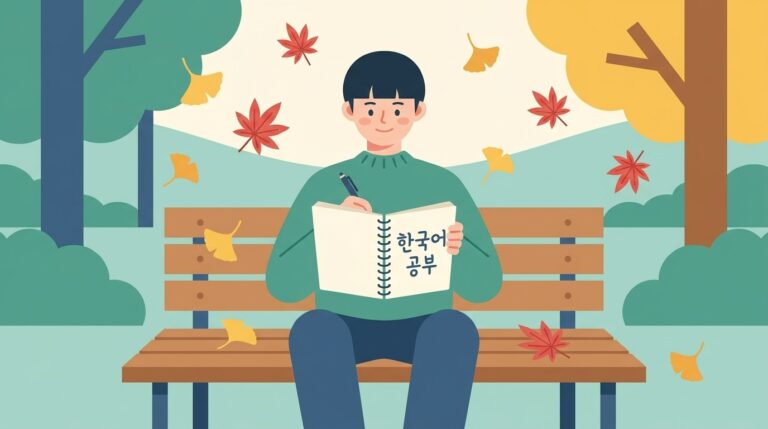
Phase 1: Empathy & Cultural Context
안녕하세요! I’m your Daily Hangul editor, your 10-year resident Korean culture navigator! Have you ever taken a stroll through Seoul in October, watching golden ginkgo leaves gently fall onto the pavement, only to notice your Korean male friend staring blankly into his coffee cup with a deep sigh? You ask him if something is wrong, and he shakes his head with a wistful smile, saying, “아, 나 요즘 가을 타나 봐…” (Ah, I guess I’m riding autumn…).
If you felt confused—wondering whether he is literally mounting a season like a horse or experiencing a quarter-life crisis—you are not alone! Many B1 intermediate Korean learners hit a wall when encountering seasonal emotional idioms. In Korea, autumn isn’t just a weather transition; it’s a profound emotional state. Today, we will unlock the authentic Korean mindset behind autumn melancholy, master the subtle emotional nuances used in K-Dramas, and learn how to express your own seasonal mood shifts with effortless fluency!
Phase 2: Deep Dive into 3 Essential Expressions
1. 가을 타다 (Gaeul tada)
- Pronunciation: [Gae-ul ta-da] (Sounds like “Get all” + “Tah-dah!” minus the final ‘t’)
- Meaning: Literal: To ride autumn | Actual: To feel autumn melancholy / To be emotionally affected by the autumn season.
- K-Culture Moment: Seen in classic K-Dramas when the male lead puts on a long trench coat, walks aimlessly under maple trees, and acts unusually sentimental.
- Editor’s Insight: “타다” (tada) means “to ride,” but when paired with seasons or moods, it means your emotional body is sensitive to environmental changes. Men are traditionally said to “ride autumn” (가을 타다), while women are said to “ride spring” (봄 타다)!
- Situation Spectrum: Casual ✅ | Semi-formal ✅ | Formal ⚠️ (Best used in casual or friendly conversations)
- 🤔 Think About It: Does your native language link specific seasons to gendered emotional shifts?
2. 쓸쓸하다 (Sseulsseulhada)
- Pronunciation: [Sseul-sseul-ha-da] (Imagine the soft sweeping sound of dry leaves blowing across concrete: “Sseul… sseul…”)
- Meaning: Literal: To be lonely/chilly | Actual: Feeling a bittersweet, quiet loneliness caused by an empty atmosphere.
- K-Culture Moment: Listening to acoustic indie ballads at a quiet cafe in Samcheong-dong while looking at falling leaves.
- Editor’s Insight: Unlike “외롭다” (oeropda – feeling isolated from people), “쓸쓸하다” describes a moody, aesthetic loneliness brought on by your surroundings.
- Situation Spectrum: Casual ✅ | Semi-formal ✅ | Formal ✅
- 🤔 Think About It: How is feeling quiet room loneliness different from feeling isolated?
3. 마음이 헛헛하다 (Maeumi heotheothada)
- Pronunciation: [Mae-um-i heo-theot-ha-da] (Pronounce ‘heot’ like ‘hut’ with an airy exhale)
- Meaning: Literal: Heart feels hollow | Actual: Feeling an inexplicable emotional void or empty spot in one’s heart.
- K-Culture Moment: Eating a late-night warm bowl of fishcake soup (어묵탕) after work because warm food comforts a hollow heart.
- Editor’s Insight: This phrase beautifully captures the sensation where you aren’t necessarily sad, but your heart feels hollow—a classic autumn feeling.
- Situation Spectrum: Casual ✅ | Semi-formal ✅ | Formal 🚫 (Intimate emotional expression)
- 🤔 Think About It: Is there a single word in your language that describes a heart feeling physically hollow?
Phase 3: Textbook Korean vs. Real Native Korean
Situation 1: Expressing Seasonal Mood Shifts
- 📖 Textbook Korean: 저는 가을이 되어서 조금 우울합니다. (I am a bit depressed because it became autumn.)
- 🗣️ Real Native Korean: 나 요즘 약간 가을 타는 것 같아. (I think I’m riding autumn a bit lately.)
- 💡 Why the Difference? Real Koreans rarely diagnose themselves with clinical sadness (“우울하다”) for seasonal changes. Using “가을 타다” sounds relatable, soft, and culturally natural.
Situation 2: Describing an Emotional Void
- 📖 Textbook Korean: 제 마음이 외롭고 빈 것 같습니다. (My heart feels lonely and empty.)
- 🗣️ Real Native Korean: 괜히 마음이 헛헛하네. (My heart feels inexplicably hollow for no reason.)
- 💡 Why the Difference? The adverb “괜히” (for no clear reason) paired with “헛헛하다” captures the poetic randomness of autumn emotions without sounding dramatic.
Phase 4: K-Culture Deep Dive & Non-Verbal Manners
4-1. Nunchi (눈치) & Gestures
When a friend says they are “가을 타다”, avoid trying to immediately fix their problem with hyper-active positivity! Instead, demonstrate 눈치 (Nunchi – social tact):
* Slight Nod & Sigh: Nod slowly, match their eye contact, and offer a soft sigh of agreement (“맞아, 날씨가 쌀쌀해지니까…”).
* The Trench Coat Collar Pull: Gently pulling your jacket collar close while sighing softly is the universal Korean visual signal for feeling autumn’s chilly breeze.
4-2. Cultural Code Analysis: “가을은 남자의 계절” (Autumn is the Season for Men)
In Korea, there’s a popular phrase: “봄은 여자의 계절, 가을은 남자의 계절” (Spring is for women, autumn is for men). As sunlight drops and autumn foliage peak, Korean men are culturally permitted to drop their tough exterior and express vulnerability under the umbrella of “가을 타다”. You’ll see this everywhere in K-Dramas—male characters wearing oversized trench coats, sipping hot Americanos, walking through Deoksugung Palace Stone Wall Path, lost in thought.
Phase 5: Interactive Practical Roleplay Scenario
Setting: A cozy coffee shop near Namsan Tower. Golden leaves flutter outside. Your friend Minjun is staring out the window.
- Turn 1 (Minjun): (🎭 Sighs softly, swirling his hot coffee) 날씨가 제법 쌀쌀해졌지?
(Nalssiga jebeob ssalssalhaejeotji? / The weather has gotten pretty chilly, right?) - Turn 2 (You): (🎭 Pulling your scarf slightly tighter) 맞아, 진짜 가을이 왔나 봐.
(Maja, jinzza gaeuri wannaba. / True, it feels like autumn is really here.) - Turn 3 (Minjun): (🎭 Gazing blankly at the falling leaves) 나 요즘 괜히 마음이 헛헛하고… 가을 타나 봐.
(Na yojeum gwenhi maeumi heotheothago… gaeul tana ba. / Lately my heart feels hollow for no reason… I guess I’m riding autumn.) - Turn 4 (You): (🎭 Looking sympathetically with a warm smile) 민준 씨도 가을 타? 어떤 느낌인데?
(Minjun ssideoga eul ta? Eotteon neukkiminde? / You ride autumn too, Minjun? What does it feel like?) - Turn 5 (Minjun): (🎭 Chuckling awkwardly) 그냥… 이유 없이 쓸쓸하고 그래.
(Geunyang… iyu eopsi sseulsseulhago geurae. / Just… feeling lonely and wistful for no particular reason.) - Turn 6 (You): (🎭 Handing him a hot bakery treat) 이럴 땐 따뜻한 라떼랑 단팥빵이 최고야!
(Ireol ttaen ttatteut-han latterang danpatppangi choegoya! / In times like this, a hot latte and sweet red bean bread are the best!) - Turn 7 (Minjun): (🎭 Taking a bite and smiling comfortably) 와, 고마워. 마음이 좀 따뜻해지네.
(Wa, gomawo. Maeumi jom ttatteut-haejine. / Wow, thanks. My heart feels a bit warmer now.) - Turn 8 (You): (🎭 Clinking cups gently) 가을 바람 쐬면서 같이 산책하자!
(Gaeul baram ssoemyeonseo gathi sanchaekhaja! / Let me get some autumn air and take a walk together!)
🔀 Interactive Branching Choice
When Minjun says, “나 요즘 가을 타나 봐…”, how do you respond?
- Choice A: “왜 우울해? 병원에 가봐!” (Why are you depressed? Go see a doctor!)
- Choice B: “가을 타는구나! 날씨가 쌀쌀할 땐 따뜻한 차 마시면서 쉬자.” (Ah, you’re riding autumn! When it gets chilly, let’s drink warm tea and rest.)
- Choice C: “남자다운 모습이 아니야. 힘내!” (That’s not manly. Cheer up!)
Feedback:
* 🚫 Choice A (Risk): Treating a normal seasonal mood as a severe medical issue kills the sentimental vibe.
* ✅ Choice B (Best): Validates his cultural feeling with deep empathy and offers a cozy, comforting solution!
* ⚠️ Choice C (Bad): Invalidates his emotional vulnerability, ignoring the cultural acceptance of “가을 타다”.
Phase 6: 10-Second Emotion Shadowing Drill
Practice saying these lines with the indicated emotional rhythm! (/ indicates a short pause)
[🥺 Wistful & Soft]나 요즘 / 약간 / 가을 타는 것 같아…
(Na yojeum / yakgan / gaeul taneun geot gata…)[☕ Warm & Comforting]날씨도 쌀쌀한데 / 따뜻한 라떼 / 한 잔 할까?
(Nalssido ssalssalhande / ttatteut-han latte / han jan halkka?)
Phase 7: K-Culture Mini Dictionary
- 가을타다 (Gaeul-tada) | Verb | To experience seasonal melancholy or emotional sensitivity during autumn.
- 트렌치코트 (Turenchi-koteu) | Noun | Trench coat; the iconic fashion item symbolic of Korean autumn aesthetics.
- 단풍 (Danpung) | Noun | Autumn foliage/red maple leaves. A major topic for autumn travel discussions.
- 감성 (Gamseong) | Noun | Emotional vibe/sensibility. Highly used when referring to autumn cafes and music.
Phase 8: Traveler’s Survival Kit
Top 3 Autumn Phrases
- 단풍구경 가요! (Danpung-gugyeong gayo!) — Let’s go see the autumn foliage!
- 날씨가 쌀쌀해요. (Nalssiga ssalssalhaeyo.) — The weather is crisp/chilly.
- 가을 분위기 있네요. (Gaeul bunwigi inneyo.) — It really has an autumn vibe.
Editor’s Travel Note
When traveling Korea in autumn, make sure to check the peak foliage forecast. To easily navigate to famous foliage spots like Namsan Park or Asan Ginkgo Tree Road, make sure you download Naver Map app before heading out, as international maps are less detailed in Korea!
Phase 9: One Step Deeper (Reflective Essay)
In many Western cultures, emotional shifts in autumn are often viewed purely as seasonal affective disorder or simple blues. However, Korean culture embraces “가을 타다” as an aesthetic experience—a poetically celebrated right of passage that honors nature’s changes. It provides a rare cultural window where Korean men are encouraged to express emotional vulnerability without judgment.
💬 Your Turn: Do people in your home country celebrate seasonal mood changes, or do they try to shake them off? Share your thoughts in the comments below!
Phase 10: FAQ & Avoiding Misunderstandings
Q: Can women use “가을 타다”?
A: Absolutely! While there is a popular saying that men ride autumn and women ride spring, anyone of any gender can say “나 가을 타” when feeling autumn melancholy.
Q: Is “가을 타다” considered a negative mental health term?
A: No! It is a normal, poetic, and transient feeling caused by the changing season. It is not viewed as clinical depression.
Q: What is the difference between “외롭다” and “쓸쓸하다”?
A: “외롭다” focuses on feeling lonely due to lack of companions, whereas “쓸쓸하다” describes a lonely, quiet mood created by the surrounding weather or cold air.
🚨 Common Mistakes TOP 3
- Mistake: Saying “나는 가을을 타고 있다” (Literal present continuous).
- 👉 Correct Action: Use the habit/state expression: “가을 타나 봐요” or “가을 타요”.
- Mistake: Saying “가을을 운전해요” (Confusing ride/drive).
- 👉 Correct Action: Never substitute “타다” with other driving verbs.
- Mistake: Telling a friend “가을 타지 마!” (Don’t ride autumn!).
- 👉 Correct Action: It sounds unnatural to command someone not to feel a season. Instead, offer hot tea or tea time!
Phase 11: Action Mission & Engagement
- 🥉 Bronze Mission: Say “가을 타나 봐” out loud 3 times with a wistful expression.
- 🥈 Silver Mission: Post an autumn foliage photo on Instagram with the caption: “약간 가을 타는 중 🍁”.
- 🥇 Gold Mission: Use “날씨가 쌀쌀한데 따뜻한 거 마실래요?” with a Korean friend or tutor this week!
🎮 K-Culture Mission: Watch an episode of a autumnal K-Drama (like Goblin) and spot characters wearing trench coats while sighing in the autumn breeze!
Phase 12: Interactive Quiz Challenge
Q1. Situation Quiz
Your Korean friend is staring at fallen leaves and says, “나 요즘 가을 타나 봐.” What is the most empathetic response?
1)







