

Phase 1: 공감 (Empathy)
안녕하세요! (Annyeonghaseyo!) I’m your Daily Hangul editor!
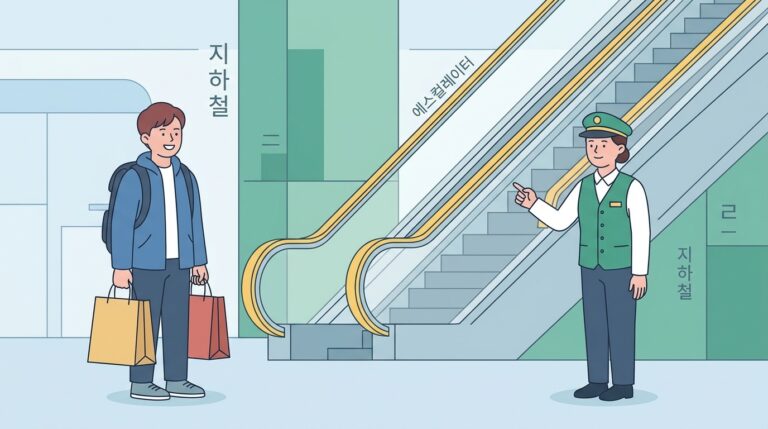
Imagine stepping out of a subway train at COEX Mall or Dongdaemun Station in Seoul. You’ve walked miles through underground shopping arcades, carrying heavy shopping bags, and your feet are aching. All you want is to find an escalator to get up to the surface without climbing endless stairs!
You look around, but in a multi-level Korean subway hub, finding the right way can feel like a maze. Don’t panic! With just a couple of simple phrases like “에스컬레이터 타세요” (Please take the escalator) and “어디에 있어요?” (Where is it?), you’ll be navigating Korean transit and department stores like a seasoned Seoulite. Based on real feedback from thousands of beginner learners, this guide gives you the exact practical phrases you need for stress-free traveling in Korea!
Phase 2: 핵심 표현 3선 심층 분석 (3 Key Expressions)
1. 에스컬레이터 타세요 (Eseukeolleito taseyo)
- Pronunciation: Eh-seu-keol-lei-teo tah-seh-yo (Sounds like ‘escalator’ + ‘ta-say-yo’)
- Meaning: Literal: “Ride the escalator.” / Actual Nuance: “Please take the escalator.”
- K-Culture Moment: You will hear station staff or mall concierges say this when guiding crowds during peak hours in Gangnam.
- Editor’s Insight: The ending ‘-세요’ (seyo) turns a verb into a polite, warm suggestion or instruction.
- Situation Spectrum: Casual ⚠️ | Semi-formal ✅ | Formal ✅
- 🤔 Think About It: Why does Korean use ‘타다’ (to ride) for escalators instead of ‘가다’ (to go)? Because you get on a moving mechanism!
2. 어디에 있어요? (Eodie issoyo?)
- Pronunciation: Oh-dee-eh it-so-yo? (Rhymes with ‘Oh-dear’ + ‘it-so-yo’)
- Meaning: Literal: “At where does it exist?” / Actual Nuance: “Where is it?”
- K-Culture Moment: Asking staff inside a massive Olive Young flagship store or a subway station platform.
- Editor’s Insight: In Korean, you can place the location noun right in front: “에스컬레이터 어디에 있어요?” (Where is the escalator?).
- Situation Spectrum: Casual ⚠️ | Semi-formal ✅ | Formal ✅
- 🤔 Think About It: Notice how Korean doesn’t require explicit subject pronouns like “it” or “the escalator” when context is clear!
3. 저쪽으로 가세요 (Jeojjogeuro gaseyo)
- Pronunciation: Jeoh-jjoh-geu-roh gah-seh-yo
- Meaning: Literal: “Go toward that way.” / Actual Nuance: “Please go over that way.”
- K-Culture Moment: A helpful local or information officer guiding you toward an exit corridor.
- Editor’s Insight: ‘저쪽’ (jeojjok) refers to a direction away from both you and the speaker, while ‘-으로’ (euro) means “towards”.
- Situation Spectrum: Casual 🚫 | Semi-formal ✅ | Formal ✅
- 🤔 Think About It: How does pointing direction differ when using honorific verbs versus plain verbs?
Phase 3: 교과서 한국어 vs 진짜 한국어 (Textbook vs. Real Korean)
Situation 1: Asking where the escalator is
- 📖 교과서 한국어: 에스컬레이터가 어디에 있습니까? (Eseukeolleitoga eodie isseumnikka?)
- 🗣️ 진짜 한국어: 에스컬레이터 어디에 있어요? (Eseukeolleito eodie issoyo?)
- 💡 왜 다를까? Textbook Korean uses strict subject markers (-가) and ultra-formal endings (-습니까). Real native speakers drop the marker and use the comfortable ‘-요’ (yo) ending in daily speech.
Situation 2: Directing someone to use the escalator
- 📖 교과서 한국어: 에스컬레이터를 이용하십시오. (Eseukeolleiteoreul iyonghasipsio.)
- 🗣️ 진짜 한국어: 에스컬레이터 타세요! (Eseukeolleito taseyo!)
- 💡 왜 다를까? Official signage uses ‘이용하십시오’ (Please utilize), but real people speak warmly using ‘타세요’ (Please ride/take).
Phase 4: K-Culture 딥다이브 & 비언어적 매너 (Culture & Body Language)
4-1. 눈치 (Nunchi) & Gestures
- Open-Hand Directional Gesture: When Koreans give directions, pointing with a single index finger can feel sharp. Instead, extend your whole hand with the palm facing slightly upwards towards the direction.
- Escalator Etiquette: On Korean subway escalators, stand on the right side if you want to stand still. Leave the left side clear for people walking or rushing up!
4-2. 문화 코드 분석 (Cultural Code)
Seoul subway stations are world-famous for their scale, cleanliness, and subterranean shopping world. Navigation is a core daily skill in K-Dramas and reality shows where characters rush through stations like Express Bus Terminal or Hongdae.
Phase 5: 실전 롤플레이 시나리오 (Real Roleplay Scenario)
Setting: Inside a busy Seoul subway station hub.
Characters: Alex (Foreign Traveler) & Minjun (Subway Station Staff)
- Alex: 저기요, 에스컬레이터 어디에 있어요?
(Jeogiyo, eseukeolleito eodie issoyo? / Excuse me, where is the escalator?)
🎭 (Looks around holding bags, looking slightly lost) - Minjun: 아, 에스컬레이터요?
(Ah, eseukeolleitoyo? / Oh, the escalator?)
🎭 (Smiles brightly and steps forward) - Alex: 네, 다리가 너무 아파요.
(Ne, dariga neomu apayo. / Yes, my legs hurt a lot.)
🎭 (Smiles sheepishly) - Minjun: 저쪽으로 가세요. 바로 있어요.
(Jeojjogeuro gaseyo. Baro issoyo. / Please go that way. It’s right there.)
🎭 (Gently extends an open hand pointing left) - Alex: 엘리베이터도 있어요?
(Ellibeiteodo issoyo? / Is there an elevator too?)
🎭 (Asks curiously) - Minjun: 엘리베이터는 저 뒤쪽에 있어요. 하지만 에스컬레이터가 더 빨라요.
(Ellibeiteoneun jeo dwijjoge issoyo. Hajiman eseukeolleitoga deo ppallayo. / The elevator is back there. But the escalator is faster.)
🎭 (Nods gently) - Alex: 아, 그렇군요! 에스컬레이터 타게요!
(Ah, georeokgunyo! Eseukeolleito tageyo! / Ah, I see! I’ll take the escalator!)
🎭 (Nods appreciatively) - Minjun: 네, 에스컬레이터 타세요! 조심히 가세요!
(Ne, eseukeolleito taseyo! Joshimhi gaseyo! / Yes, please take the escalator! Take care!)
🎭 (Waves warmly)
🔀 인터랙티브 분기점 (Interactive Choice)
How should you ask a station worker where the escalator is?
* Option A: “저기요, 에스컬레이터 어디에 있어요?” (Jeogiyo, eseukeolleito eodie issoyo?)
* Option B: “야, 에스컬레이터 줘!” (Ya, eseukeolleito jwo!)
* Option C: “에스컬레이터 어디냐?” (Eseukeolleito eodinya?)
Feedback:
* Option A (Best): Perfect! Polite, natural, and friendly for beginner level.
* Option B (Bad): Risk! ‘줘’ means “give me”. You cannot ask someone to give you an escalator!
* Option C (Risk): ‘어디냐’ is informal plain speech used only with close personal friends or younger children. Never use it with strangers!
Phase 6: 10초 감정 섀도잉 드릴 (10-Second Shadowing Drill)
[😊 Polite & Asking]저기요 / 에스컬레이터 / 어디에 있어요? (Jeogiyo / eseukeolleito / eodie issoyo?)[👍 Helpful & Directing]저쪽으로 / 가세요! (Jeojjogeuro / gaseyo!)[✨ Bright & Relieved]감사합니다! / 에스컬레이터 / 타게요! (Gamsahamnida! / eseukeolleito / tageyo!)
Phase 7: K-Culture 미니 사전 (Mini Dictionary)
- 출구 (Chulgu) | Exit | Crucial for exiting Korean stations (e.g., 3번 출구 = Exit 3).
- 엘리베이터 (Ellibeiteo) | Elevator | Useful when carrying heavy luggage or suitcases.
- 안내소 (Annaeso) | Information Desk | Look for this sign inside shopping centers and train stations.
- 환승 (Hwanseung) | Transit / Transfer | Essential keyword when changing lines in Seoul Metro.
Phase 8: 여행자를 위한 생존 키트 (Traveler’s Survival Kit)
Survival TOP 3
- 에스컬레이터 어디예요? (Eseukeolleito eodieyo?) – Short & fast version!
- 저쪽이에요? (Jeojjogieyo?) – Is it over that way?
- 몇 층에 있어요? (Myeot cheunge issoyo?) – Which floor is it on?
Editor’s Travel Note
Before wandering Seoul’s underground, make sure to perform a Naver Map app download to check real-time exit map layouts and indoor navigation features!
Phase 9: “한 발 더 깊이” (One Step Deeper)
Korean navigation phrases carry built-in politeness. Adding ‘-세요’ (seyo) shows care for the listener while giving clear advice. In dense urban spaces like Seoul, using polite language creates smooth, pleasant encounters even during crowded rush hours.
💬 Your Turn: Have you ever gotten lost inside a massive foreign transit station? Leave a comment below and share your experience!
Phase 10: FAQ & 오해 방지 (FAQ & Common Mistakes)
Q: What is the difference between ‘가세요’ and ‘타세요’?
A: ‘가세요’ (Gaseyo) means “please go”, while ‘타세요’ (Taseyo) means “please ride/take” (used for escalators, elevators, buses, and trains).
Q: Can I drop ‘어디에’ and just say ‘에스컬레이터 어디예요?’
A: Yes! ‘어디예요?’ (Eodieyo?) is a very common, natural, shorter way to ask “Where is…?”
Q: Is it okay to use ‘타세요’ to people younger than me?
A: Yes! ‘-세요’ is polite and appropriate for all strangers regardless of age.
🚨 Common Mistakes TOP 3
- Mistake: Saying “에스컬레이터 가세요” when directing someone to ride an escalator.
- Correct Action: Say “에스컬레이터 타세요” (Take the escalator).
- Mistake: Standing on the left side of escalators without moving during rush hour.
- Correct Action: Stand on the right side if you want to stand still.
- Mistake: Using informal speech like “어디 있어?” to subway station staff.
- Correct Action: Always use polite form ending in ‘-요’ (“어디에 있어요?”).
Phase 11: 액션 미션 & 참여 유도 (Action Missions)
- 🥉 Bronze: Say “에스컬레이터 어디에 있어요?” out loud 3 times right now.
- 🥈 Silver: Record your voice shadowing Phase 6’s drill and check your intonation.
- 🥇 Gold: Use this exact phrase at a Korean mall or airport during your trip!
🎮 K-Culture Mission: Watch a Seoul travel vlog on YouTube and comment below whenever you hear someone say “타세요”!
Phase 12: 인터랙티브 퀴즈 챌린지 (Interactive Quiz)
Q1. How do you politely ask where the escalator is?
* A) 에스컬레이터 어디에 있어요?
* B) 에스컬레이터 줘요.
* C) 에스컬레이터 가요.
Q2. Fill in the blank: “저쪽으로 _____.” (Please go that way)
* A) 타세요
* B) 가세요
* C) 있어요
Q3. True/False: In Korea, commuters stand on the right side of the escalator to let others pass on the left.
Click to reveal answers & explanations!
- Q1 Answer: A! (“에스컬레이터 어디에 있어요?” is polite and clear.)
- Q2 Answer: B! (“가세요” means ‘please go’.)
- Q3 Answer: True! Standing on the right leaves the left lane open for walking.







