

Phase 1: Empathy (Story-Driven Opening)
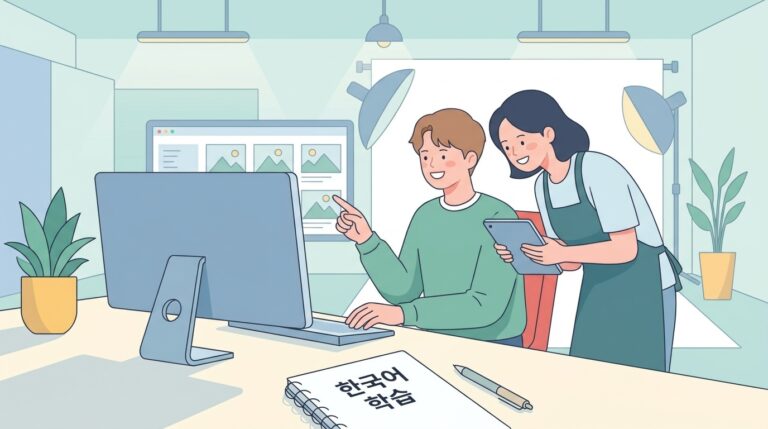
안녕하세요! I’m your Daily Hangul editor and favorite Korean culture navigator! Have you ever stepped into a trendy Korean photo studio in Hongdae or Seongsu, thrilled to get those famous Korean-style studio shots, only to freeze when the photographer asks, “어떻게 보정해 드릴까요?” (How would you like me to edit your photo?). You sit next to the photographer at the editing station, watching them zoom in on your face. You want your skin to look a bit smoother or your jawline slightly touch-ups, but you don’t want to look like a completely different person! You end up nodding nervously and saying “Okay, okay,” only to get a photo that looks nothing like you—or worse, totally unedited with every tiny pore on display. Don’t worry! Retouching is an art form in Korea, and studio editors want your input. Learning just a few simple A2-level Korean phrases will transform your photo session from awkward to amazing. Today, based on real feedback from hundreds of foreign learners, I’m going to give you the exact playbook to ask for photo retouching politely and naturally!
Phase 2: Core Expressions (Top 3 Deep Dive)
1. 자연스럽게 보정해 주세요 (Jayeon-seuroep-ge bojeong-hae ju-se-yo)
- Pronunciation: [zah-yuhn-seuh-rohp-geh boh-jung-hae joo-seh-yoh] (Sounds like “natural-like editing please”)
- Meaning: “Please touch it up naturally.”
- K-Culture Moment: You see this in K-dramas whenever characters get their profile photos taken for job applications or acting portfolios. They want to look polished yet authentic.
- Editor’s Insight: ‘보정’ (bo-jeong) means retouching/editing, which is much preferred over ‘수정’ (su-jeong – modification/correction) in photo studios.
- Situation Spectrum:
- Casual: 자연스럽게 보정해 줘 ⚠️
- Semi-formal: 자연스럽게 보정해 주세요 ✅
- Formal: 자연스럽게 보정해 주시겠어요? ✅
- 🤔 Think About It: In your home country, is asking for photo retouching considered taboo or totally normal? In Korea, it is seen as a thoughtful service to show your best self!
2. 피부 톤 좀 밝게 해주세요 (Pibu ton jom balg-ge hae-ju-se-yo)
- Pronunciation: [pee-boo ton jom bahl-geh hae-joo-seh-yoh] (Sounds like “skin tone a bit bright please”)
- Meaning: “Please brighten my skin tone a bit.”
- K-Culture Moment: K-pop idol photos often have soft, bright lighting. Asking for ‘피부 톤’ (skin tone) brightening helps remove harsh shadows without altering your features.
- Editor’s Insight: Adding ‘좀’ (jom – a bit/slightly) is the magic word in Korean! It softens your request and makes you sound super polite.
- Situation Spectrum:
- Casual: 피부 톤 밝게 해줘 ⚠️
- Semi-formal: 피부 톤 좀 밝게 해주세요 ✅
- Formal: 피부 톤을 좀 밝게 부탁드립니다 ✅
- 🤔 Think About It: Why do you think adding the small word ‘좀’ (a bit) changes the whole tone of a command in Korean?
3. 여기 좀 갸름하게 해주세요 (Yeogi jom gyareum-hage hae-ju-se-yo)
- Pronunciation: [yeoh-gee jom gyah-reum-hah-geh hae-joo-seh-yoh] (Sounds like “here a bit slim please”)
- Meaning: “Please make this area (jawline) a bit slimmer.”
- K-Culture Moment: While pointing at your jawline on the monitor, saying ‘여기’ (here) alongside ‘갸름하게’ (slimming/sleek) is the ultimate Korean photo studio magic spell.
- Editor’s Insight: ‘갸름하다’ specifically describes a smooth, slender oval face shape highly favored in Korean portrait aesthetics.
- Situation Spectrum:
- Casual: 여기 갸름하게 해줘 ⚠️
- Semi-formal: 여기 좀 갸름하게 해주세요 ✅
- Formal: 이쪽을 좀 갸름하게 보정해 주시겠어요? ✅
- 🤔 Think About It: Pointing at a screen while speaking is completely natural in Korean photo studios. Does body language play a big role in your culture too?
Phase 3: Textbook Korean vs Real Native Korean
Situation 1: Asking for natural edits
- 📖 Textbook Korean: 사진을 성의껏 수정해 주시겠습니까? (Will you meticulously modify the photo?)
- 🗣️ Real Native Korean: 자연스럽게 보정해 주세요~ (Please edit it naturally~)
- 💡 Why the difference?: Textbook phrases sound like a formal legal contract! Natives use ‘보정’ (retouching) with a soft ending ‘주세요’.
Situation 2: Asking to slim down the jawline
- 📖 Textbook Korean: 제 턱을 얇게 만들어 주십시오. (Please make my chin thin.)
- 🗣️ Real Native Korean: 턱선 좀 살짝만 다듬어 주세요! (Please trim/smooth my jawline just a tiny bit!)
- 💡 Why the difference?: ‘만들어 주십시오’ is overly robotic. Using ‘살짝만 다듬어 주세요’ (smooth out just a bit) sounds gentle and shows respect for the photographer’s expertise.
Phase 4: K-Culture Deep Dive & Non-Verbal Manners
4-1. Nunchi (눈치) & Gestures
When reviewing your photos on the screen with the editor, sitting right next to them requires good ‘Nunchi’ (quick cultural tact):
* The Point & Smile Gesture: Gently point your index finger at the screen where you want edits, maintaining a soft smile.
* The Pinch Gesture: Use two fingers in a pinching motion to show you only want a tiny change (“살짝만요~” – just a little bit).
* Nod of Approval: When they make the edit, give a quick double nod and say “좋아요!” (Looks good!).
4-2. Culture Code: The “ID Photo” (증명사진) Culture
In Korea, taking a ‘증명사진’ (Jeungmyeong-sajin – ID/Profile photo) is a major self-care ritual. Studios offer custom background colors matching your personal color palette, and 1-on-1 live Photoshop editing where you sit right next to the designer. It’s not just a photo; it’s a boosted confidence boost!
Phase 5: Real-Life Roleplay Scenario
Setting: A trendy photo studio in Hongdae. You are sitting next to Min-jun, the friendly studio editor, reviewing your shots.
- Min-jun (Photographer): 사진 찍느라 수고하셨어요! 이제 보정작업 같이 볼게요. (Sajin ggigneura sugohasyeosseoyo! Ije bojeong-jageop gathi bolgeyo.)
- 🎭 Action: Smiles warmly and turns the monitor toward you.
- Translation: Great job with the photo shoot! Let’s review the editing together now.
- You (Customer): 감사합니다! 잘 부탁드려요. (Gamsahabnida! Jal 부탁deuryeoyo.)
- 🎭 Action: Bows slightly and sits closer to the screen.
- Translation: Thank you! Please take good care of me.
- Min-jun (Photographer): 어떤 부분을 제일 신경 써 드릴까요? (Eotdeon bubuneul jeil sin-gyeong sseo deurilggayo?)
- 🎭 Action: Clicks the mouse on your raw photo.
- Translation: Which area would you like me to focus on the most?
- You (Customer): 피부 톤 좀 밝게 해주시고, 자연스럽게 보정해 주세요. (Pibu ton jom balgge hae-jusigo, jayeon-seuroep-ge bojeong-hae ju-se-yo.)
- 🎭 Action: Points softly at the face area.
- Translation: Please brighten my skin tone a bit and retouch it naturally.
- Min-jun (Photographer): 네, 알겠습니다. 턱선도 좀 정리해 드릴까요? (Ne, algetseumnida. Teokseondo jom jeongrihae deurilggayo?)
- 🎭 Action: Draws a circle around the jawline with the mouse cursor.
- Translation: Yes, understood. Should I smooth out the jawline a bit too?
- You (Customer): 네, 여기 좀 갸름하게 해주세요. 하지만 너무 많이는 말아주세요! (Ne, yeogi jom gyareumhage hae-juseyo. Hajiman neomu manyineun marajuseyo!)
- 🎭 Action: Makes a tiny pinching gesture with fingers.
- Translation: Yes, please make this area a bit slimmer. But not too much please!
- Min-jun (Photographer): 걱정 마세요! 짜잔, 어떠세요? (Geokjeong maseyo! Jjajan, eotteoseyo?)
- 🎭 Action: Clicks ‘Before & After’ rapidly to show the edit.
- Translation: Don’t worry! Ta-da, how is this?
- You (Customer): 와, 완전 마음에 들어요! 감사합니다! (Wa, wanjeon maeume deureoyo! Gamsahabnida!)
- 🎭 Action: Claps hands lightly with joy.
- Translation: Wow, I completely love it! Thank you!
🔀 Interactive Choice Points
When the editor asks: “턱선도 많이 깎아드릴까요?” (Should I slim down your jawline a lot?)
- Option A: “네! 완전 딴 사람으로 만들어 주세요!” (Yes! Make me a completely different person!)
- Feedback: ⚠️ Risk! The editor might laugh, but your photo won’t look like you at all for official IDs!
- Option B: “아니요, 자연스럽게 살짝만 해주세요.” (No, please do it naturally and just a little bit.)
- Feedback: ✅ Best Choice! Polite, clear, and ensures a gorgeous, natural result.
- Option C: “마음대로 하세요.” (Do whatever you want.)
- Feedback: 🚫 Bad Choice! Sounds blunt and uninterested. Always communicate your preference!
Phase 6: 10-Second Emotion Shadowing Drill
Practice saying these lines with full emotional expression!
- [😊 Friendly & Polite Request]
- 피부 톤 / 좀 밝게 / 해주세요! / (Pibu ton / jom balgge / hae-juseyo!)
- [🥺 Soft & Gentle Asking]
- 여기 좀 / 갸름하게 / 해주실 수 있나요? / (Yeogi jom / gyareum-hage / hae-jusil su itnayo?)
- [✨ Excited Approval]
- 와! / 너무 자연스럽고 / 예뻐요! / (Wa! / neomu jayeon-seuroepgo / yeppeoyo!)
Phase 7: K-Culture Mini Dictionary
- 보정 (Bo-jeong) | Retouching / Editing
- Usage: Refers specifically to photo editing in photography studios.
- 포토샵 (Pho-to-syap) | Photoshop / Photo editing magic
- Usage: Used as a verb like “포토샵 잘 해주세요” (Please photoshop it nicely!).
- 증명사진 (Jeung-myeong-sa-jin) | ID / Passport photo
- Usage: High-quality small photos used for resumes, passports, or personal keepsakes.
- 인생네컷 (In-saeng-ne-cut) | Life Four Cuts (Korean Photo Booths)
- Usage: Self-operated photo booth strips popular among youth culture.
Phase 8: Traveler Survival Kit
Top 3 Survival Phrases
- 원본도 받을 수 있나요? (Eonbon-do badeul su itnayo?) – Can I get the unedited original photos too?
- 출력 몇 장 돼요? (Chulryeok myeot jang dwaeyo?) – How many printed copies do I get?
- 이메일로 보내주세요. (I-mail-ro bonae-juseyo.) – Please send them to my email.
Editor’s Travel Note
Before heading to popular studio hubs like Hongdae, Seongsu, or Gangnam, make sure to complete your Naver Map App Download to easily find top-rated studio reservations! Most studios accept credit cards, but keeping your email address typed out on your phone notepad helps transfer high-res digital files fast.
Phase 9: One Step Deeper (Korean Mindset Essay)
In many Western cultures, asking someone to edit your facial features might feel overly vain or secretive. However, in Korea, photo retouching (‘보정’) is viewed as a collaborative art form between the photographer and the subject. It is considered a courtesy to present a neat, bright, and positive image for official documents and memories. By participating in the editing process with polite requests, you are engaging in a shared cultural value: putting your best foot forward with confidence and mutual respect.
💬 Your Turn: Have you ever tried a Korean photo studio or photo booth? What is your favorite style of photo memory? Share your thoughts in the comments below!
Phase 10: FAQ & Common Mistakes
Q: Is photo editing included in the basic price at Korean studios?
A: Yes! Almost all specialized ID and studio photo packages include 1-on-1 live photo editing and printed copies.
Q: What if I don’t speak fluent Korean during editing?
A: Don’t panic! Pointing at the screen and using simple words like “자연스럽게 해주세요” (Naturally, please) or “좋아요” (Good) is more than enough!
Q: Can I ask for extra edits if I’m not satisfied?
A: Absolutely. You can politely say, “여기 살짝만 더 수정할 수 있을까요?” (Could we tweak this part just a little bit more?).
🚨 Common Mistakes TOP 3
- Saying “얼굴 바꿔주세요” (Change my face)
- ❌ Sounds like you want facial surgery!
- ✅ Correct Action: Use “자연스럽게 보정해 주세요” (Please touch it up naturally).
- Using overly command-like verbs without ‘좀’ (jom)
- ❌ “턱 깎아라” (Chop my chin) sounds rude.
- ✅ Correct Action: Use “턱선 좀 살짝 다듬어 주세요” (Please smooth my jawline a bit).
- Staying completely silent during review
- ❌ Photographers will assume you don’t care or dislike the work.
- ✅ Correct Action: Smile, nod, and give input like “좋아요!” (Looks good!).
Phase 11: Action Mission
- Bronze Level: Practice saying “자연스럽게 보정해 주세요” 3 times out loud in front of a mirror!
- Silver Level: Record a video shadow-practicing the Phase 5 roleplay dialogue and post it on your Instagram story tagging
@DailyHangul! - Gold Level: Visit a local photo booth (like Life Four Cuts) or a Korean photo studio and use at least two Korean editing expressions in real life!
🎮 K-Culture Mission: Watch a scene from a Korean vlog or drama set in a photo studio (e.g., Record of Youth) and spot how people talk to the photographer!
Phase 12: Interactive Quiz Challenge
Quiz 1. Situation Judgment
You want the editor to make your skin look brighter without looking fake. What do you say?
* A) 얼굴 다 지워주세요 (Eolgul da jiwo-juseyo)
* B) 피부 톤 좀 밝게 해주세요 (Pibu ton jom balgge hae-juseyo)
* C) 사진 다시 찍어주세요 (Sajin dasi ggig-eo-juseyo)
🔍 Click to view Answer & Explanation
Answer: B
Explanation: “피부 톤 좀 밝게 해주세요” (Please brighten my skin tone a bit) is the exact polite way to request natural skin tone enhancement!
Quiz 2. Fill-in-the-Blank
“Please retouch it naturally.” -> “( ) 보정해 주세요.”
* A) 이상하게 (Isang-hage)
* B) 자연스럽게 (Jayeon-seuroep-ge)
* C) 복잡하게 (Bokjap-hage)
🔍 Click to view Answer & Explanation
Answer: B
Explanation: ‘자연스럽게’ means “naturally”.
Quiz 3. True or False Culture Quiz
In Korea, sitting next to the photo editor and giving live feedback during editing is considered rude. (True / False)
🔍 Click to view Answer & Explanation
Answer: False
Explanation: It is a standard and welcomed practice in Korean photo studios! Photographers encourage collaborative live editing for customer satisfaction.







