

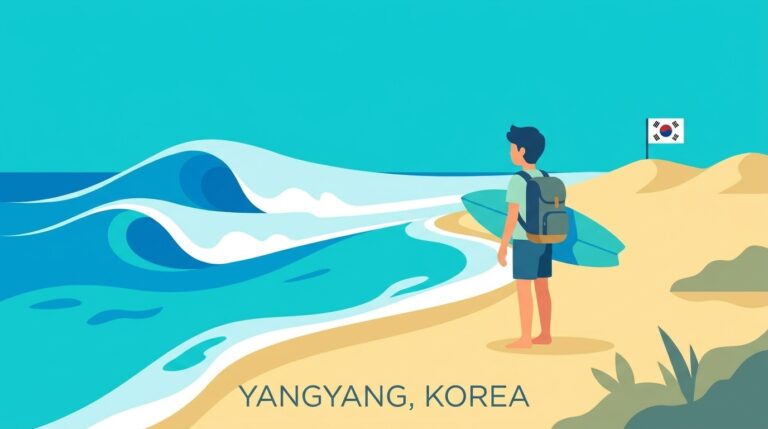
Catching the Perfect Wave in Yangyang: Master Advanced Korean Surfing Nuances
Phase 1: 공감 (Storytelling Opening)
안녕하세요! 매일한글 에디터입니다. Picture this: You are standing on the golden sands of Jukdo Beach in Yangyang, Gangwon Province—the beating heart of South Korea’s vibrant surf culture. The ocean mist rolls in, and you hear local surfers in the lineup shouting cues to each other as rolling swells form on the horizon. You’ve mastered advanced Korean grammar, but as you step into the water, you realize textbook phrases like “수영을 합니다” (I swim) sound oddly out of place here.
Surfing in Korea isn’t just a sport; it is a booming subculture with its own vivid, metaphor-rich vocabulary. Advanced Korean speakers at the C1 level know that native surfers don’t just talk about waves; they talk about “reading momentum,” “riding trends,” and maintaining line-up etiquette through unspoken Nunchi (눈치). Whether you are navigating the actual waves or discussing modern social trends in a Gangnam boardroom, expressions born from wave reading are deeply embedded in modern Korean discourse. Based on real feedback from advanced learners experiencing Korea’s coastal culture, this guide will elevate your Korean from grammatically precise to culturally magnetic!
Phase 2: 핵심 표현 3선 심층 분석
1. 파도를 타다 (Pado-reul tada)
- Pronunciation: [Pado-reul tada] (Sounds like “Pah-doh-leul tah-dah”, rhythmically flowing like ‘paddle-tah’)
- Meaning: Literally “To ride a wave.” Metaphorically, it means taking advantage of a strong trend, momentum, or social movement at just the right time.
- K-Culture Moment: Frequently used in Korean business shows or pop culture documentaries when describing a K-pop group capitalizing on global popularity or a start-up catching a market boom.
- Editor’s Insight: While beginners use “타다” solely for vehicles (차를 타다), C1 learners must grasp how “타다” combines with natural elements like waves (파도), wind (바람), or mood (분위기) to signify riding a flow effortiessly.
- Situation Spectrum: Casual ✅ | Semi-formal ✅ | Formal ✅
- 🤔 Think About It: How does your native language express the concept of capitalizing on momentum? Is it water-based like riding a wave, or wind-based like having wind in your sails?
2. 타이밍을 잡다 (Taiming-eul japda)
- Pronunciation: [Taiming-eul japda] (Sounds like “Tie-ming-eul jahp-dah”)
- Meaning: Literally “To catch the timing.” It refers to pinpointing the exact micro-second to paddle and take off on a wave before it breaks, or making a decisive move in life.
- K-Culture Moment: Seen in drama climaxes where a protagonist hesitates before confessing their feelings or making a high-stakes investment.
- Editor’s Insight: Notice the active verb “잡다” (to grab/catch). In Korean wave-reading culture, timing isn’t something you passively wait for; it is something you actively snatch out of the water.
- Situation Spectrum: Casual ✅ | Semi-formal ✅ | Formal ✅
- 🤔 Think About It: Why do you think Korean uses the active verb ‘grab’ (잡다) for timing rather than ‘wait for’ (기다리다)? What does this reveal about Korean proactivity?
3. 세트가 들어오다 (Setteu-ga deureo-oda)
- Pronunciation: [Setteu-ga deureo-oda] (Sounds like “Set-teu-gah deu-reo-oh-dah”)
- Meaning: Literally “A set [of waves] is coming in.” It describes a group of larger, surfable waves approaching the shore.
- K-Culture Moment: Used by coastal locals in Yangyang or Jeju as everyone stops chatting and turns towards the horizon to prepare their paddles.
- Editor’s Insight: Korean incorporates Loanwords like “Set” (세트) into native verb structures (“들어오다”). C1 speakers should recognize how fluidly English technical terms adapt into authentic Korean verbal collocations.
- Situation Spectrum: Casual ✅ | Semi-formal ⚠️ | Formal 🚫
- 🤔 Think About It: How do foreign surf loanwords merge with native verbs in your own country’s surf spots?
Phase 3: 교과서 한국어 vs 진짜 한국어
Situation 1: Describing pristine, clean wave conditions
- 📖 교과서 한국어: “오늘 파도의 높이가 매우 적당하고 좋습니다.”
(The wave height today is very suitable and good.) - 🗣️ 진짜 한국어: “오늘 파도 결이 진짜 깨끗하네요!”
(The wave texture today is super clean!) - 💡 왜 다를까?: Natives focus on the surface texture and shape of the wave breaking line (“결”, structure/grain) rather than just mathematical height.
Situation 2: Asking a fellow surfer when to initiate paddling
- 📖 교과서 한국어: “저는 언제 출발해야 합니까?”
(When should I depart?) - 🗣️ 진짜 한국어: “지금 패들링 들어가야 돼요?”
(Should I jump into paddling right now?) - 💡 왜 다를까?: Korean sports talk relies heavily on active directional verbs combined with loanwords like “패들링 들어갈까?” to capture immediacy.
Phase 4: K-Culture 딥다이브 & 비언어적 매너
4-1. 눈치 (Nunchi) & Line-up Etiquette in Korea
In Korean wave reading, Nunchi (the art of gauging the room/environment) is critical. Surfing line-ups are hierarchical yet communal. When a wave comes, you don’t just look at the wave; you look at the surfer closest to the peak. A subtle nod of the head or a brief lock of eyes establishes priority without shouting. Dropping in on someone’s wave (드롭) without checking Nunchi is considered extremely impolite.
4-2. The Yangyang Surf Revolution
Once a quiet military coastal area, Yangyang transformed into Korea’s surf mecca. This cultural shift created a unique blend of beach relaxed vibes and high-tech Korean convenience. You’ll witness eco-conscious surf camps, seaside modern cafés, and young surfers sipping iced Americanos while reading wave forecasts on local weather apps.
Phase 5: 실전 롤플레이 시나리오
Setting: Hajodae Surf Beach, Yangyang. You (Minwoo) are discussing wave conditions with Sujin, a veteran local surf instructor.
- Minwoo (Learner): 수진 씨, 오늘 해변 쪽 파도가 좀 세 보이는데 괜찮을까요?
(Sujin, the waves near the beach look a bit strong today, will it be okay?)
🎭 행동: Looking out toward the horizon with a slightly tense posture. - Sujin (NPC): 아, 지금 밀물 때라 그래요. 저 멀리 바깥쪽 라인업을 보세요.
(Ah, that’s because it’s high tide right now. Look at the outer lineup over there.)
🎭 행동: Pointing towards the ocean swell while wiping saltwater off her board. - Minwoo: 아, 그렇네요! 저쪽은 파도 결이 아주 고르고 깔끔해 보여요.
(Ah, I see! Over there, the wave texture looks very smooth and clean.)
🎭 행동: Nodding in realization as he adjusts his surfboard leash. - Sujin: 맞아요. 조금만 기다리면 큰 세트가 들어올 것 같아요. 준비됐어요?
(Exactly. If we wait a bit, I think a big set will come in. Are you ready?)
🎭 행동: Smiling encouragingly and securing her surf wax. - Minwoo: 네! 그런데 어떤 파도를 골라야 할지 타이밍을 잡기가 힘들어요.
(Yes! But it’s hard to catch the timing on which wave to choose.)
🎭 행동: Scratching his head with an embarrassed laugh. - Sujin: 파도의 피크가 솟아오르는 순간을 잘 봐야 해요. 지금 패들링 들어가세요!
(You need to look closely at the moment the wave’s peak rises. Start paddling in now!)
🎭 행동: Gesturing urgently toward an oncoming swell. - Minwoo: 알겠습니다! 이번 파도 흐름을 놓치지 않고 잘 타 볼게요.
(Got it! I won’t miss this wave’s flow and will ride it well.)
🎭 행동: Lying on the surf board and paddling firmly into position. - Sujin: 나이스! 시선 전방 고정하시고 패들링 끝까지 하세요!
(Nice! Keep your eyes fixed forward and paddle all the way!)
🎭 행동: Clapping and shouting words of encouragement from behind.
🔀 인터랙티브 분기점 (Interactive Choice)
As a massive set approaches, another surfer is already paddling closer to the peak. What do you say/do?
- Choice A: “제가 먼저 발견했으니 제가 타겠습니다!” (I spotted it first, so I will ride it!)
- Feedback (Risk 🚫): Rude! Ignoring peak priority breaches both international and Korean surfing etiquette.
- Choice B: (Say nothing, quickly turn back, and wait for the next set while giving a light nod)
- Feedback (Best ✅): Perfect! Demonstrates excellent Nunchi and respect for priority in the line-up.
- Choice C: “파도 같이 타실래요?” (Do you want to ride the wave together?)
- Feedback (Bad ⚠️): Dangerous! Riding the same wave peak causes collisions and surfboard damage.
Phase 6: 10초 감정 섀도잉 드릴
Practice these lines out loud, paying attention to the emotional markers and rhythm breaks (/).
[🌊 신나고 벅찬 감정]“와! / 저기 멀리서 / 진짜 깨끗한 세트가 들어온다!”
(Wa! / Jeogi meolli-seo / jin-jja kkae-kkeut-han setteu-ga deureo-onda!)[👀 눈치 보며 조심스럽게]“혹시 / 이 파도 / 타실 건가요? / 제가 양보할게요.”
(Hoksi / i pado / tasil geon-gayo? / Jeega yangbo-hal-geyo.)[🔥 결의에 찬 목소리]“이번에는 / 절대로 / 타이밍을 놓치지 않고 / 끝까지 팝업 할 거야!”
(Ibeon-eneun / jeol-dae-ro / taiming-eul notchiji anko / kkeut-kkaji pab-eop hal geoya!)
Phase 7: K-Culture 미니 사전
- 라인업 (Lain-eop) | Lineup | The ocean area outside the breaking waves where surfers wait for incoming sets.
- 통돌이 (Tong-dori) | Washing Machine Effect | Colloquial term for getting wiped out and rolled around repeatedly under water like laundry in a washing machine cylinder.
- 패들아웃 (Paedeul-aut) | Paddle Out | The arduous physical effort of paddling your board through oncoming whitewash to reach the surf zone.
- 파도 거지 (Pado Geoji) | Wave Greedy / Wave Beggar | Slang for someone in the lineup who greedily tries to paddle for every single wave without waiting their turn.
Phase 8: 여행자를 위한 생존 키트
Survival Phrases TOP 3
- “오늘 파도 어때요?” (O-neul pa-do eo-ttae-yo?) – How are the waves today?
- “여기 보드 렌탈 되나요?” (Yeo-gi bo-deu ren-tal doe-na-yo?) – Do you rent surfboards here?
- “수온이 많이 차가운가요?” (Su-on-i ma-ni cha-ga-un-ga-yo?) – Is the water temperature very cold?
Editor’s Travel Note
Before heading off to Yangyang or Jeju beaches, make sure to check precise wave heights, wind directions, and tide times. You can easily navigate local conditions by using the 네이버 지도 앱 다운로드 for coastal transport and checking marine weather platforms before heading out into the water.
Phase 9: “한 발 더 깊이” (Culture Essay)
In modern Korean society, the metaphor of “reading the wave” extends far beyond marine sports. Koreans live in a fast-paced society where cultural trends, digital innovations, and social movements shift rapidly like tidal swells. To thrive in South Korea—whether socially or professionally—one must cultivate an acute sensitivity to social momentum (흐름을 읽는 능력). Just as an expert surfer patiently observes ocean swells from the lineup before paddling, understanding when to move and when to yield is considered the ultimate sign of practical wisdom in modern Korea.
💬 Your Turn: Have you ever experienced a situation in your life or career where you had to wait for the right “set” to come in before taking action? Share your story in the comments below!
Phase 10: FAQ & 오해 방지
Q: Can I use “파도를 타다” in business meetings?
A: Absolutely! In business contexts, saying “최근 인공지능 트렌드의 파도를 잘 타고 있습니다” (We are riding the wave of recent AI trends very well) sounds sophisticated and natural for C1 speakers.
Q: What is the difference between “파도가 치다” and “파도가 들어오다”?
A: “파도가 치다” refers to the physical action of waves crashing or being rough. “파도가 들어오다” refers specifically to surfable swells rolling in toward the coastline.
Q: Is surf language in Korea strictly in English loanwords?
A: While wave mechanics terms (e.g., peak, takeoff, lineup) are borrowed from English, native Korean verbs and descriptive adjectives (e.g., 결이 깨끗하다, 세트가 들어오다, 통돌이) give the language its authentic regional flair.
🚨 Common Mistakes TOP 3
- Incorrect: “파도를 수영해요” ❌ -> Correct: “파도를 타요” ✅ (You ride waves, not swim them!)
- Incorrect: “타이밍을 기다려요” ❌ -> Correct: “타이밍을 잡아요” ✅ (In dynamic sport contexts, catch the timing!)
- Incorrect: “파도가 높아요” (When complimenting wave quality) -> Correct: “파도 결이 좋아요” ✅ (Focus on wave texture and break quality, not just height).
Phase 11: 액션 미션 & 참여 유도
- Bronze Mission: Practice saying “오늘 파도 결이 진짜 좋네요!” 3 times out loud with natural intonation.
- Silver Mission: Write a 2-sentence comment using the idiom “파도를 타다” to describe a recent trend you enjoy.
- Gold Mission: Watch a vlog of Yangyang surfing on YouTube and spot 3 real-world surf expressions used by local instructors!
🎮 K-Culture Mission: Search for a Korean indie band song with “파도” in the title (e.g., Se So Neon’s ‘파도’) and listen to how the ocean is portrayed metaphorically!
Phase 12: 인터랙티브 퀴즈 챌린지
Question 1: Situation Judgment
You are waiting in the ocean lineup in Yangyang and a new wave set approaches. Another surfer is situated closer to where the wave breaks (the peak). What should you do?
* A) Paddle hard to catch it before them.
* B) Yield the wave and look for the next swell.
* C) Shout at them to get out of the way.
Click to view Answer & Explanation
Correct Answer: B
Explanation: Surfing priority dictates that the surfer closest to the wave peak has rights to the wave. Yielding gracefully demonstrates proper lineup manners and Nunchi.
Question 2: Fill in the Blank
Choose the correct verb for this advanced metaphor: “그 기업은 새로운 시장 트렌드의 ___________ 잘 타서 성공했다.”
* A) 바람을
* B) 파도를
* C) 물을
Click to view Answer & Explanation
Correct Answer: B (파도를)
Explanation: “파도를 타다” means to rider a trend or momentum successfully.
Question 3: True / False Culture Quiz
True or False: In Korean surf slang, getting rolled around under water after a wipeout is called “통돌이” after washing machine drums.
Click to view Answer & Explanation
Correct Answer: True
Explanation: “통돌이” comes from the traditional top-loading washing machine drum that spins clothes around, vividly describing a surfer getting tumbled underwater!







