

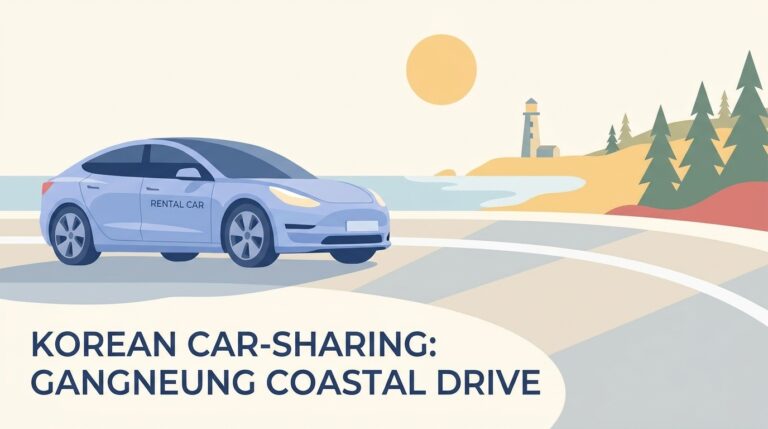
Master Legal & Insurance Nuances in Korean Car-Sharing Services
Phase 1: Empathy & Storytelling
안녕하세요! 매일한글 에디터입니다.
Imagine this: You’ve booked a sleek Hyundai Avante via SOCAR for a weekend getaway to Gangneung with friends. The playlist is pumping Korean indie hits, the coastal breeze is fresh, and your road trip feels like a scene straight out of a slice-of-life K-drama. But suddenly, while reversing into a tight spot near a beachside cafe, you hear an unsettling scraping sound. You step out to find a minor scuff on the rear bumper—along with a scraped guardrail. Panic sets in. How do you contact customer support in Korean? What does the app mean by myeon-chaek-geum (deductible)? Will your contract cover the hyu-cha-ryeo (loss-of-use fee)?
Navigating car-sharing accidents in Korea isn’t just about simple vocabulary; it requires C2-level mastery of complex legal terminology, dispute resolution, and insurance nuances. Based on real feedback from foreign residents and advanced learners, this guide breaks down the sophisticated language you need to resolve car-sharing incidents smoothly and protect your rights without stress.
Phase 2: Deep Dive into 3 Core Advanced Expressions
1. 과실 비율을 가리다 (Gwa-sil Bi-yul-eul Ga-ri-da)
- Pronunciation: [Gwa-sil bi-yul-eul ga-ri-da] (Sounds like “gwa-seal bee-yool-eul gah-ree-dah”)
- Meaning: Literal: “To filter/sift the fault ratio.” | Real Nuance: To determine or establish legal liability and negligence proportion between involved parties.
- K-Culture Moment: Seen frequently in K-drama legal disputes or news reports when dashcam (black box) footage is sent to insurance adjusters to prove who was at fault.
- Editor’s Insight: The verb 가리다 means to distinguish right from wrong or sift truth from error. At C2 level, using 과실 비율을 가리다 instead of simply 누구 잘못인지 정하다 immediately conveys legal precision and formal fluency.
- Situation Spectrum: Casual 🚫 | Semi-formal ⚠️ | Formal ✅
- 🤔 Think About It: In your home country, how are traffic fault ratios determined, and how does the culture view sharing dashcam evidence compared to Korea’s ubiquitous black box culture?
2. 자기부담금 단소조항을 확인하다 (Ja-gi-bu-dam-geum Dan-so-jo-hang-eul Hwag-in-ha-da)
- Pronunciation: [Ja-gi-bu-dam-geum dan-so-jo-hang-eul hwag-in-ha-da] (Sounds like “jah-gee-boo-dam-geum dahn-so-joh-hahng-eul hwahg-in-hah-dah”)
- Meaning: Literal: “To verify the self-burden amount proviso clause.” | Real Nuance: To review the exact terms regarding insurance deductibles and special exemption conditions.
- K-Culture Moment: Crucial when reading the fine print in Korean car-sharing apps like GreenCar or SOCAR before confirming a claim.
- Editor’s Insight: 단서조항 (proviso/qualifying clause) is an indispensable term in Korean contractual agreements. Misunderstanding this clause can lead to unexpected out-of-pocket expenses for damages not covered under standard indemnity policies.
- Situation Spectrum: Casual 🚫 | Semi-formal ⚠️ | Formal ✅
- 🤔 Think About It: Contract terms in Korean often embed fine nuances through Sino-Korean compounds (단서조항, 면책사유). How does legal contract terminology in your native language compare?
3. 면책 처리를 신청하다 (Myeon-chaek Cheo-ri-reul Sin-cheong-ha-da)
- Pronunciation: [Myeon-chaek cheo-ri-reul sin-cheong-ha-da] (Sounds like “myeon-chaek chuh-ree-reul seen-cheong-hah-dah”)
- Meaning: Literal: “To apply for exemption handling.” | Real Nuance: To request insurance coverage settlement under the platform’s deductible policy.
- K-Culture Moment: Used when submitting accident reports directly through app interfaces or customer hotline centers after an incident.
- Editor’s Insight: 면책 literally translates to “exemption from responsibility,” meaning the driver is relieved from paying full repair costs beyond their agreed deductible (자기부담금).
- Situation Spectrum: Casual 🚫 | Semi-formal ✅ | Formal ✅
- 🤔 Think About It: Why is formal and objective language essential when requesting insurance indemnity in Korean corporate settings?
Phase 3: Textbook Korean vs. Real Native Korean
Situation 1: Reporting a minor scratch on a shared vehicle
- 📖 Textbook Korean: 사고가 났습니다. 보험 처리를 하고 싶습니다. (An accident occurred. I want insurance processing.)
- 🗣️ Real Native Korean: 경미한 접촉 사고가 발생해서 고객센터를 통해 면책 접수를 진행하고자 합니다. (A minor fender bender occurred, so I would like to proceed with filing an indemnity claim through customer service.)
- 💡 Why is it different? C2 native speakers avoid vague words like 사고 or 보험 처리. Specifying 접촉 사고 (fender bender) and 면책 접수 (indemnity claim filing) communicates exact operational requests clearly.
Situation 2: Discussing liability and dashcam review
- 📖 Textbook Korean: 블랙박스 영상을 보면 누구 잘못인지 알 수 있습니다. (Looking at the dashcam video will show whose fault it is.)
- 🗣️ Real Native Korean: 블랙박스 영상 분석을 통해 정확한 과실 비율 산정이 필요해 보입니다. (It appears necessary to calculate the exact negligence ratio through dashcam footage analysis.)
- 💡 Why is it different? Professional settings require passive/objective noun endings (산정이 필요해 보입니다) to maintain polite, professional distance during dispute resolution.
Phase 4: K-Culture Deep Dive & Non-verbal Manners
4-1. Nunchi & Non-verbal Etiquette
When dealing with a vehicle accident in Korea:
1. Document immediately: Take clear photographs of vehicle alignment, tire direction, and surrounding road lines before moving the vehicle.
2. Maintain composure: Avoid emotional outbursts. Use a calm, measured voice (차분한 어조) when speaking to hotline agents, demonstrating Nunchi by respecting their protocol procedures.
3. Hazard lights (비상등): Turning on emergency flashers instantly signals courtesy and awareness to oncoming traffic.
4-2. Cultural Code Analysis: Korean Car-Sharing Ecosystem
Korea boasts one of the world’s most digitized car-sharing environments (SOCAR, GreenCar, Peoplecar). Everything—from keyless entry to reporting damages—is managed via smartphones. However, because these services rely heavily on automated algorithms and strict user reporting policies, failure to report an accident before ending a reservation can lead to permanent account suspension and heavy penalties. Understanding the legal terms guarantees you navigate this tech-forward ecosystem seamlessly.
Phase 5: Interactive Role-Play Scenario
Setting: Calling the SOCAR Accident Response Center hotline after scraping a parking pillar.
Characters: You (Advanced Learner) & Call Center Agent (김민준 대리)
- 상담원: 네, 쏘카 사고접수센터 김민준입니다. 운전자분 성함과 차량 번호 확인 부탁드립니다.
(Ne, ssoka sa-go-jeop-su-sen-teo gim-min-jun-im-ni-da. Un-jeon-ja-bun seong-ham-gwa cha-ryang beon-ho hwag-in bu-tag-deu-rim-ni-da.)
“Hello, this is Kim Min-jun from the SOCAR Accident Center. Please confirm your name and vehicle license plate number.”
🎭 Action: [Speaking calmly into the phone while checking app details] -
당신: 네, 홍길동이고 12가 3456 아반떼 차량입니다. 주차 중 기둥에 후면 범퍼를 긁는 경미한 사고가 발생했습니다.
(Ne, hong-gil-dong-i-go sip-i-ga sam-sa-o-ryuk a-ban-tte cha-ryang-im-ni-da. Ju-cha jung gi-dung-e hu-myeon beom-peo-reul geulg-neun gyeong-mi-han sa-go-ga bal-saeng-haess-sum-ni-da.)
“Yes, I’m Hong Gil-dong, license 12Ga 3456 Avante. I had a minor incident where I scraped the rear bumper against a pillar while parking.”
🎭 Action: [Maintaining a composed, objective tone] -
상담원: 다치신 곳은 없으신가요? 현장 사진 촬영은 진행하셨는지요?
(Da-chi-sin gos-eun eob-seu-sin-ga-yo? Hyeon-jang sa-jin chwal-yeong-eun jin-haeng-ha-seoss-neun-ji-yo?)
“Are you hurt anywhere? Have you taken photos of the scene?”
🎭 Action: [Expressing concern and checking compliance] -
당신: 네, 다친 사람은 없습니다. 파손 부위와 주차장 번호판이 보이도록 사진 촬영을 완료했습니다.
(Ne, da-chin sa-ram-eun eob-seum-ni-da. Pa-son bu-wi-wa ju-cha-jang beon-ho-pan-i bo-i-do-rok sa-jin chwal-yeong-eul wan-ryeo-haess-sum-ni-da.)
“Yes, no one is injured. I completed taking photos showing both the damaged area and the parking spot identification.”
🎭 Action: [Nodding reassuringly] -
상담원: 다행입니다. 가입하신 자기부담금 50만 원 플랜에 따라 면책 처리가 진행될 예정입니다.
(Da-haeng-im-ni-da. Ga-ib-ha-sin ja-gi-bu-dam-geum o-sip-man won pleul-raen-e tta-ra myeon-chaek cheo-ri-ga jin-haeng-doel ye-jeong-im-ni-da.)
“Glad to hear. Indemnity processing will proceed according to your selected 500,000 KRW deductible plan.”
🎭 Action: [Typing record into system] -
당신: 혹시 차량 수리 기간 동안 발생하는 휴차료 계산 방식을 설명해 주실 수 있나요?
(Hok-si cha-ryang su-ri gi-gan dong-an bal-saeng-ha-neun hyu-cha-ryeo gye-san bang-sig-eul seol-myeong-hae ju-sil su in-na-yo?)
“Could you please explain how the loss-of-use fee during the repair period will be calculated?”
🎭 Action: [Inquiring with precise contractual terms] -
상담원: 수리 입고 기간 동안의 표준 대여요금 50%가 휴차료로 부과됩니다. 앱 내 전송된 링크로 사진을 첨부해 주세요.
(Su-ri ip-go gi-gan dong-an-ui pyo-jun dae-yeo-yo-geum o-sip-pro-ga hyu-cha-ryeo-ro bu-gwa-doem-ni-da. Aeb nae jeon-song-doen ring-keu-ro sa-jin-eul cheom-bu-hae ju-se-yo.)
“50% of the standard daily rental rate during repair downtime will be charged as loss-of-use fees. Please upload photos via the app link.”
🎭 Action: [Sending automated text link] -
당신: 알겠습니다. 안내해 주신 링크를 통해 사진을 업로드하고 절차를 마무리하겠습니다. 감사합니다.
(Al-gaess-sum-ni-da. An-nae-hae ju-sin ring-keu-reul tong-hae sa-jin-eul eob-ro-deu-ha-go jeol-cha-reul ma-mu-ri-ha-gess-sum-ni-da. Gam-sa-ham-ni-da.)
“Understood. I will upload the photos through the provided link and finalize the procedure. Thank you.”
🎭 Action: [Ending call politely]
🔀 Interactive Choice Point
Scenario: The agent asks if you moved the vehicle before taking pictures.
* Choice A: “사진 안 찍고 바로 차 뺐는데요?” (I moved the car without taking photos.)
* 🚨 Feedback (Risk): Bad idea! Moving the vehicle without evidence makes determining exact liability difficult and may void contract exemptions.
* Choice B: “당황해서 일단 주차 구역으로 차를 이동시킨 상태입니다.” (Panicked, I moved the vehicle into a parking bay for now.)
* ⚠️ Feedback (Bad): Honest, but highlights procedural non-compliance. You may face extra inquiry.
* Choice C: “사고 직후 원형 보존을 위해 현장 정면 및 측면 사진을 촬영한 후 이동시켰습니다.” (Right after the incident, I photographed front and side angles to preserve evidence before moving it.)
* ✅ Feedback (Best): Excellent C2 formal articulation demonstrating complete compliance with insurance reporting protocols!
Phase 6: 10-Second Emotion Shadowing Drill
-
[😰 Anxious & Urgent]
경미한 접촉 사고가 발생했는데 / 혹시 면책 처리 접수를 / 지금 바로 진행할 수 있을까요?
(Gyeong-mi-han jeop-chok sa-go-ga bal-saeng-haess-neun-de / hok-si myeon-chaek cheo-ri jeop-su-reul / ji-geum ba-ro jin-haeng-hal su iss-eul-kka-yo?) -
[🏛️ Calm & Professional]
약관상 단서조항에 따라 / 휴차료 산정 기준을 / 상세히 검토해 주시길 바랍니다.
(Yak-gwan-sang dan-seo-jo-hang-e tta-ra / hyu-cha-ryeo san-jeong gi-jun-eul / sang-se-hi geom-to-hae ju-si-gil ba-ram-ni-da.)
Phase 7: K-Culture Mini Dictionary
- 면책금 (Myeon-chaek-geum) | Deductible | The maximum out-of-pocket amount a driver pays per accident under rental insurance coverage.
- 휴차료 (Hyu-cha-ryeo) | Loss-of-use fee | Daily compensation paid to car-sharing companies while a damaged vehicle undergoes repair in a garage.
- 대물/대인 보상 (Dae-mul / Dae-in Bo-sang) | Property damage / Bodily injury liability compensation | Coverage for damage caused to other vehicles/structures (대물) or bodily harm to people (대인).
- 과실 비율 (Gwa-sil Bi-yul) | Fault/Negligence ratio | Percentage distribution of legal negligence assessed by insurance adjusters between two colliding parties.
Phase 8: Traveler’s Survival Kit
TOP 3 Survival Expressions
- 사고 접수 부탁드립니다. (Sa-go jeop-su bu-tag-deu-rim-ni-da.) –
Frequently Asked Questions (FAQ)
Q: What does "과실 비율을 가리다 (Gwa-sil Bi-yul-eul Ga-ri-da)" mean in Korean and how do you pronounce it?
A: In Korean, "과실 비율을 가리다 (Gwa-sil Bi-yul-eul Ga-ri-da)" is pronounced [Gwa-sil bi-yul-eul ga-ri-da] and means: Literal: "To filter/sift the fault ratio." | Real Nuance: To determine or establish legal liability and negligence proportion between involved parties.
Q: What does "자기부담금 단소조항을 확인하다 (Ja-gi-bu-dam-geum Dan-so-jo-hang-eul Hwag-in-ha-da)" mean in Korean and how do you pronounce it?
A: In Korean, "자기부담금 단소조항을 확인하다 (Ja-gi-bu-dam-geum Dan-so-jo-hang-eul Hwag-in-ha-da)" is pronounced [Ja-gi-bu-dam-geum dan-so-jo-hang-eul hwag-in-ha-da] and means: Literal: "To verify the self-burden amount proviso clause." | Real Nuance: To review the exact terms regarding insurance deductibles and special exemption conditions.
Q: What does "면책 처리를 신청하다 (Myeon-chaek Cheo-ri-reul Sin-cheong-ha-da)" mean in Korean and how do you pronounce it?
A: In Korean, "면책 처리를 신청하다 (Myeon-chaek Cheo-ri-reul Sin-cheong-ha-da)" is pronounced [Myeon-chaek cheo-ri-reul sin-cheong-ha-da] and means: Literal: "To apply for exemption handling." | Real Nuance: To request insurance coverage settlement under the platform's deductible policy.







