

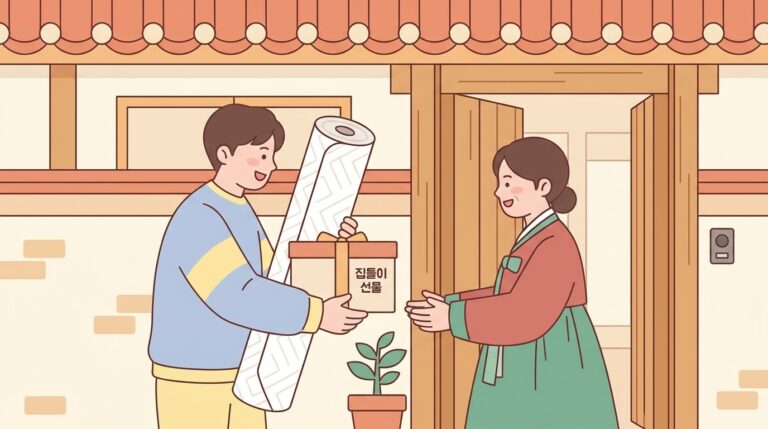
Phase 1: Welcome to Your First Korean Housewarming Party! 🎉
안녕하세요! (Annyeonghaseyo!) I’m your Daily Hangul editor and your 10-year Korean culture navigator! So, you’ve been invited to a Korean friend’s new apartment. Congratulations! That means you’re officially part of their inner circle. But as you step toward the front door, a wave of panic hits you: What do I say when I hand over my gift? Do I use two hands? Why is everyone carrying massive packs of toilet paper?!
Don’t worry! Navigating Korean social etiquette can feel intimidating at first, but giving a housewarming gift—known as 집들이 선물 (Jipdeuri Seonmul)—is actually one of the warmest, most heartwarming experiences in K-culture. Hundreds of our A1 beginner students have stood right where you are now. With just three simple expressions and a quick peek into Korean home etiquette, you will walk in with total confidence and leave a lasting impression as the sweetest guest ever. Let’s master this together step by step!
Phase 2: Top 3 Expressions for Housewarming Gifts 🎁
1. 집들이 선물이에요! (Jip-deu-ri seon-mul-i-e-yo!)
- Pronunciation: [Jeep-deh-ree seon-mool-ee-eh-yo] (Sounds like “Jeep” + “Daily” fast!)
- Meaning: “This is a housewarming gift!”
- K-Culture Moment: You hand a neatly wrapped box or a bag of toilet paper to your host at the front door while smiling brightly.
- Editor’s Insight: This phrase is super versatile and polite for A1 beginners. Adding -이에요 (-ieyo) makes it respectful to anyone, whether it’s a friend or a coworker!
- Situation Spectrum: Casual (⚠️) / Semi-formal (✅) / Formal (✅)
- 🤔 Think About It: In your home country, do you announce what your gift is when handing it over, or do you just say “Here you go”?
2. 초대해 주셔서 감사합니다! (Cho-dae-hae ju-seo-seo gam-sa-ham-ni-da!)
- Pronunciation: [Cho-dae-hae joo-suh-suh gahm-sah-ham-nee-da]
- Meaning: “Thank you for inviting me!”
- K-Culture Moment: Right after entering the hallway (현관 – hyeongwan) and taking off your shoes, you greet the host with a slight head bow.
- Editor’s Insight: Gratitude comes first in Korean culture! Saying this before sitting down makes you instantly stand out as a well-mannered guest.
- Situation Spectrum: Casual (⚠️) / Semi-formal (✅) / Formal (✅)
- 🤔 Think About It: How does thanking someone for the invitation change the atmosphere of a party in your culture?
3. 이거 받으세요! (I-geo ba-deu-se-yo!)
- Pronunciation: [Ee-geoh bah-deu-seh-yoh]
- Meaning: “Please take this!”
- K-Culture Moment: Handing over a box of tea or dessert with both hands at the living room table.
- Editor’s Insight: Short, sweet, and beginner-friendly! The ending -세요 (-seyeo) gently requests the host to accept your present with warm respect.
- Situation Spectrum: Casual (⚠️) / Semi-formal (✅) / Formal (✅)
- 🤔 Think About It: Why do you think using two hands is so important when giving something in Korea?
Phase 3: Textbook Korean vs. Real Korean 💬
Situation 1: Handing over the gift at the door
- 📖 Textbook Korean: 이것은 당신을 위한 선물입니다. (I-geos-eun dang-sin-eul wi-han seon-mul-im-ni-da. – “This is a gift for you.”)
- 🗣️ Real Korean: 이거 집들이 선물이에요! (I-geo jip-deu-ri seon-mul-i-e-yo! – “This is a housewarming gift!”)
- 💡 Why the difference? Textbook Korean uses 당신 (dangsin) for “you”, which sounds overly formal or unnatural in spoken conversation. Real Koreans use 이거 (igeo – this) directly and name the occasion!
Situation 2: Expressing small embarrassment about a simple gift
- 📖 Textbook Korean: 비싼 선물이 아니라서 죄송합니다. (Bis-san seon-mul-i a-ni-ra-seo joe-song-ham-ni-da. – “I am sorry it is not an expensive gift.”)
- 🗣️ Real Korean: 작지만 받으세요! (Jak-ji-man ba-deu-se-yo! – “It’s small, but please take it!”)
- 💡 Why the difference? Modern Koreans prefer humble positivity (“It’s small, but please accept it”) over dramatic apologies for gift sizes.
Phase 4: K-Culture Deep Dive & Non-Verbal Manners 🧼
4-1. Nunchi & Gestures: The Two-Hand Rule
- The Two-Hand Gift Hand-Off: Always hold the gift with both hands! If the gift is small, hold it with your right hand and place your left hand gently under your right wrist or elbow.
- Eye Contact & Bow: Make warm eye contact, give a slight 15-degree head bow, and say 이거 받으세요! (Igeo badeuseyo!).
- Shoe Etiquette at Hyeongwan: Point your shoes toward the front door (facing outwards) after taking them off as a courteous gesture.
4-2. Why Toilet Paper and Laundry Detergent?
Did you know that in Korea, bringing toilet paper (휴지 – hyuji) or laundry detergent (세제 – seje) to a housewarming party is the ultimate classic gift?
* Toilet Paper: Unrolling toilet paper symbolizes matters effortlessly unraveling smoothly (일이 술술 풀리다).
* Detergent: Bubbles represent wealth and prosperity popping up fast and multiplying!
Phase 5: Practical Roleplay Scenario 🎭
Setting: You arrive at your Korean friend Minjun’s new cozy apartment in Seoul. Minjun opens the front door with a warm smile.
- Turn 1 (Minjun): 어서 오세요! 와 주셔서 감사합니다! (Eo-seo o-se-yo! Wa ju-seo-seo gam-sa-ham-ni-da! / Welcome! Thank you for coming!)
🎭 [Smiling broadly, holding the door open] - Turn 2 (You): 초대해 주셔서 감사합니다! (Cho-dae-hae ju-seo-seo gam-sa-ham-ni-da! / Thank you for inviting me!)
🎭 [Taking off shoes and giving a slight bow] - Turn 3 (Minjun): 들어오세요. 집이 좀 좁지요? (Deu-reo-o-se-yo. Jib-i jom jop-ji-yo? / Come in. The house is a bit small, isn’t it?)
🎭 [Guiding you to the living room] - Turn 4 (You): 아니에요! 집이 정말 예뻐요! (A-ni-e-yo! Jib-i jeong-mal ye-ppeo-yo! / No way! The house is really pretty!)
🎭 [Looking around with admiring eyes] - Turn 5 (You): 이거 집들이 선물이에요! (I-geo jip-deu-ri seon-mul-i-e-yo! / This is a housewarming gift!)
🎭 [Holding out a gift package with both hands] - Turn 6 (Minjun): 어머, 뭘 이런 걸 가져왔어요! 고마워요! (Eeo-meo, mwol i-reon geol ga-jyeo-was-seo-yo! Go-ma-wo-yo! / Oh my, why did you bring such a thing! Thank you!)
🎭 [Surprised and receiving gift with two hands] - Turn 7 (You): 작지만 받으세요! (Jak-ji-man ba-deu-se-yo! / It’s small, but please take it!)
🎭 [Smiling warmly] - Turn 8 (Minjun): 잘 쓸게요! 여기 앉으세요. (Jal sseul-ge-yo! Yeo-gi an-jeu-se-yo. / I’ll use it well! Please sit here.)
🎭 [Pointing to the sofa]
🔀 Interactive Choice Point
Minjun says, “어머, 뭘 이런 걸 가져왔어요! (Oh, you shouldn’t have brought anything!)” How do you reply?
- Choice A: 작지만 받으세요! (Jak-ji-man ba-deu-se-yo!)
- Choice B: 아니에요, 비싸요! (A-ni-e-yo, bi-ssa-yo!)
- Choice C: 무조건 먹으세요! (Mu-jo-geon meog-eu-se-yo!)
[Feedback]
* Choice A (Best! ✅): Perfect! It humbly and warmly encourages your friend to accept the gift.
* Choice B (Bad! 🚫): Saying “No, it’s expensive!” sounds braggy and awkward.
* Choice C (Risk! ⚠️): “Eat it no matter what!” is overly aggressive and doesn’t fit if it’s not food!
Phase 6: 10-Second Emotion Shadowing Drill ⏱️
[😊 Bright & Excited]
초대해 / 주셔서 / 감사합니다!
(Cho-dae-hae / ju-seo-seo / gam-sa-ham-ni-da!)-
[🎁 Warm & Courteous]
이거 / 집들이 / 선물이에요!
(I-geo / jip-deu-ri / seon-mul-i-e-yo!) -
[🤗 Humble & Friendly]
작지만 / 받으세요!
(Jak-ji-man / ba-deu-se-yo!)
Phase 7: K-Culture Mini Dictionary 📚
- 집들이 (Jip-deu-ri) | Housewarming party | A traditional party hosted by someone who recently moved into a new home.
- 휴지 (Hyu-ji) | Toilet paper / Tissue | The most famous traditional housewarming gift representing smooth success.
- 세제 (Se-je) | Detergent | A classic housewarming gift symbolizing wealth bubbling up like soap suds.
- 초대 (Cho-dae) | Invitation | Used frequently in expressions like 초대해 주셔서 감사합니다 (Thank you for inviting me).
Phase 8: Traveler’s Survival Kit 🧰
TOP 3 Survival Phrases
- 집 어디예요? (Jip eo-di-ye-yo?) – Where is your house?
- 휴지 어디에 있어요? (Hyu-ji eo-di-e is-seo-yo?) – Where is the toilet paper? (Useful when buying at mart)
- 잘 먹겠습니다! (Jal meok-ges-sum-ni-da!) – I will eat well! (Before eating party snacks)
Editor’s Travel Note
When heading to a friend’s house in Korea, finding the right address or picking up a gift on the way is essential. Make sure you use the Naver Map Navigation App instead of Google Maps for precise residential directions in South Korea!
Phase 9: A Step Deeper (Reflection) 💭
In Korean culture, inviting someone into your home (집 – jip) is a big deal. Homes are seen as private safe spaces, so being invited to a 집들이 (Jipdeuri) signifies trust, warmth, and genuine friendship. Bringing a simple gift like toilet paper isn’t just about utility—it’s a wish for the family’s future peace and good fortune.
💬 Your Turn: Have you ever attended a housewarming party in another country? What is the standard gift in your culture? Tell us in the comments below!
Phase 10: FAQ & Common Mistakes 🚨
Q: Can I buy something other than toilet paper or detergent?
A: Yes! Modern Koreans also love scented candles, wine, coffee beans, or small indoor plants.
Q: Should I open the gift immediately in front of the guest?
A: In Korea, hosts often set the gift aside to open later unless invited to open it immediately. Don’t feel offended if they don’t unwrap it right away!
Q: Is it rude to come empty-handed?
A: Yes, coming completely empty-handed to a Korean housewarming party is considered bad etiquette. Even simple drinks or dessert will do!
🚨 Common Mistakes TOP 3
- Mistake: Handing a gift with only one hand.
- Correct Action: Always use two hands to hand over gifts!
- Mistake: Taking off shoes and stepping directly onto the clean floor with bare dirty feet.
- Correct Action: Wear clean socks when visiting someone’s home.
- Mistake: Saying 당신을 위한 선물입니다 (Dangsin-eul wihan seonmulimnida).
- Correct Action: Simply say 이거 집들이 선물이에요 (Igeo jipdeuri seonmulieyo).
Phase 11: Action Mission 🚀
- Bronze: Practice saying 이거 집들이 선물이에요! out loud 3 times in front of the mirror.
- Silver: Write down the phrase 초대해 주셔서 감사합니다 in your Korean study notebook.
- Gold: Use one of today’s expressions during your next live Korean tutoring session or with a Korean language exchange partner!
- 🎮 K-Culture Mission: Watch a Korean variety show or Vlog featuring a housewarming episode and spot someone bringing toilet paper!
Phase 12: Interactive Quiz Challenge 🧩
Q1. What is the symbolic meaning of giving toilet paper (휴지) at a Korean housewarming party?
1) To wash dishes fast
2) For matters to unravel smoothly like paper
3) To clean the windows
View Answer & Explanation
Answer: 2
Unrolling toilet paper symbolizes that all your plans and life matters will unravel smoothly and easily!
Q2. Fill in the blank: “이거 _______ 선물이에요!” (This is a housewarming gift!)
1) 학교 (hak-gyo)
2) 집들이 (jip-deu-ri)
3) 공원 (gong-won)
View Answer & Explanation
Answer: 2
집들이 (jip-deu-ri) means housewarming party!
Q3. True or False: In Korea, you should hand over gifts using only your right hand while keeping your left hand in your pocket.
View Answer & Explanation
Answer: False
In Korean culture, giving and receiving items with two hands shows respect and politeness!







