

Phase 1: Empathy (Welcome to Daily Hangul!)
안녕하세요! 매일한글 에디터입니다. (Hello! This is your editor from Daily Hangul.)
Have you ever arranged to meet a Korean friend at a cozy cafe in Hongdae or near a bustling subway exit in Gangnam at 3:00 PM, only to receive a text at 2:50 PM saying, “나 벌써 도착했어! 카페 자리 잡아둘게” (I’ve already arrived! I’ll grab a table)? Suddenly, your heart beats a little faster. You are technically on time, walking towards the exit, but you feel like you are late!
In modern Korean culture, punctuality is deeply tied to respect and consideration for the other person. While the old slang “Korean Time” used to imply being casually late, today’s urban Korea values being 10 minutes early as the gold standard of etiquette. Arriving 10 minutes early shows that you value the other person’s time and effort.
Mastering this single cultural habit—and the key expressions that go with it—will instantly transform you from a confused tourist into a considerate, native-like communicator. Based on real feedback from intermediate learners, this guide breaks down authentic phrases, non-verbal cues, and real-life scenarios so you can navigate Korean appointments with absolute confidence!
Phase 2: Deep Dive into 3 Core Expressions
1. 미리 와 있다 (Miri wa itda)
- Pronunciation: [Miri wa-it-da] (Sounds like: ‘MEE-ree wah-EET-dah’)
- Meaning: “To be already here in advance” (Literal: To have come ahead of time)
- K-Culture Moment: Frequently heard in K-dramas when a character arrives early at a restaurant to order appetizers or reserve a good seat before their date arrives.
- Editor’s Insight: While ‘일찍 오다’ simply means ‘to come early,’ ‘미리 와 있다’ highlights the state of already being present and waiting comfortably.
- Situation Spectrum: Casual ✅ | Semi-formal ✅ | Formal ⚠️
- 🤔 Think About It: Does your native language distinguish between the action of arriving early and the state of already being there waiting?
2. 10분 전 도착 (Sip-bun jeon dochak)
- Pronunciation: [Sip-bun jeon do-chak] (Sounds like: ‘SEEP-boon jun doh-CHAK’)
- Meaning: “Arriving 10 minutes before” / “10 minutes early arrival”
- K-Culture Moment: Used heavily in group text chats (KakaoTalk) when notifying friends or colleagues of your status.
- Editor’s Insight: Combining the number 10 (십), minutes (분), before (전), and arrival (도착) creates a concise phrase perfect for quick texting while walking from the subway station.
- Situation Spectrum: Casual ✅ | Semi-formal ✅ | Formal ✅
- 🤔 Think About It: Why do you think 10 minutes (and not 5 or 30 minutes) became the default polite buffer time in Korean daily life?
3. 천천히 와 (Cheoncheonhi wa)
- Pronunciation: [Cheon-cheon-hi wa] (Sounds like: ‘CHUN-chun-hee wah’)
- Meaning: “Take your time” (Literal: Come slowly)
- K-Culture Moment: When you tell a friend you’ve already arrived early, they might feel rushed. Saying “나 미리 왔어, 천천히 와!” reassures them not to panic or run.
- Editor’s Insight: This is a warm, caring phrase. Even if you arrived early, saying this relieves pressure from your meeting partner.
- Situation Spectrum: Casual ✅ | Semi-formal ⚠️ (Use ‘천천히 오세요’) | Formal 🚫
- 🤔 Think About It: How does reassuring the other person lower social tension during an outing?
Phase 3: Textbook Korean vs. Real Korean
Situation 1: Updating your status
- 📖 Textbook Korean: 저는 약속 장소에 10분 일찍 도착했습니다. (I arrived at the appointment location 10 minutes early.)
- 🗣️ Real Korean: 나 10분 전에 미리 나와 있어! (I’m already out here 10 minutes early!)
- 💡 Why is it different? Real Korean speakers prefer active, continuous expressions like ‘나와 있어’ (am out here waiting) over formal past-tense verbs when messaging friends in real time.
Situation 2: Reassuring a running friend
- 📖 Textbook Korean: 서두르지 마십시오. 기다리겠습니다. (Do not rush. I will wait.)
- 🗣️ Real Korean: 급하게 안 뛰어와도 돼, 천천히 와! (You don’t need to run hastily, take your time!)
- 💡 Why is it different? The textbook phrasing sounds like an automated subway announcement. Real Korean uses empathetic verbs like ‘급하게 안 뛰어와도 돼’ to show warmth.
Phase 4: K-Culture Deep Dive & Non-Verbal Etiquette
4-1. Nunchi & Gestures
When arriving 10 minutes early, good Nunchi (눈치 – social tact) plays a big role:
* The Reassuring Selfie or Location Shot: Korean friends often send a photo of the nearby landmark (e.g., Exit 3 or the cafe menu) with the text “나 도착!”. This helps the other person navigate without feeling pressured.
* Seat Reservation Manners: If meeting at a crowded cafe, arriving 10 minutes early allows you to secure seats. It is polite to text: “내가 자리 잡아놨어!” (I saved us seats!).
4-2. Cultural Code Analysis
In modern Korea, time is closely linked with 정성 (Jeongseong – sincere effort). Being 10 minutes early signifies that you prepared in advance, checked bus routes, and value the interaction. In fast-paced urban hubs like Seoul, public transportation is precise, so being late without notice suggests a lack of consideration. Showing up slightly early builds immediate social trust!
Phase 5: Real-Life Roleplay Scenario
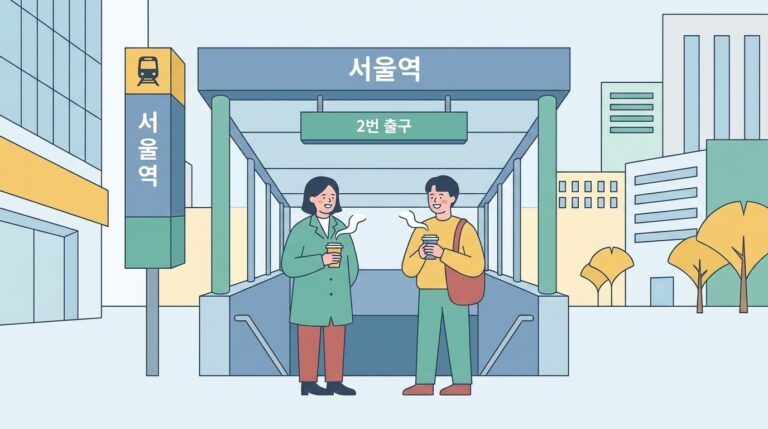
Setting: Outside Exit 9 of Gangnam Station. You (B1 learner) are meeting your Korean friend, Minji, for dinner.
- Turn 1 (Minji): (🎭 Texting on KakaoTalk while on the subway)
어디쯤이야? 나 지금 강남역 거의 다 왔어!
(Eodijjeumiya? Na jigeum Gangnam-yeok geoei da wasseo! / Where abouts are you? I’m almost at Gangnam Station!) -
Turn 2 (You): (🎭 Walking out of Exit 9, checking your watch at 5:50 PM for a 6:00 PM dinner)
나 10분 전에 미리 나와 있어! 9번 출구 앞이야.
(Na sip-bun jeon-e miri nawa isseo! Gu-beon chulgu apiya. / I’m already out here 10 minutes early! I’m in front of Exit 9.) -
Turn 3 (Minji): (🎭 Surprised and happy, rushing off the escalator)
우와, 진짜? 벌써 와 있었어? 나 3분 뒤에 도착해!
(Uwa, jinja? Beolssae wa isseosseo? Na sam-bun dwie dochakhae! / Wow, really? You’re already here? I’ll arrive in 3 minutes!) -
Turn 4 (You): (🎭 Smiling, looking at the weather outside)
날씨 조으니까 천천히 와. 서두르지 마!
(Nalssi joeunika cheoncheonhi wa. Seodureuji ma! / The weather is nice, so take your time. Don’t rush!) -
Turn 5 (Minji): (🎭 Exiting the glass door and waving warmly)
저기 있다! 기다리게 해서 미안해~
(Jeogi itda! Gidari-ge haeseo mianhae~ / There you are! Sorry for making you wait~) -
Turn 6 (You): (🎭 Lightly waving back with a welcoming posture)
아니야, 내가 일찍 온 건데 뭐! 늦은 거 아니야.
(Aniya, naega iljjik on geonde mweo! Neujeun geo aniya. / No way, I just came early! You’re not late.) -
Turn 7 (Minji): (🎭 Impressed by your consideration)
역시 센스 대박! 우리 배고픈데 바로 식당으로 갈까?
(Yeoksi sense daebak! Uri baegopeunde baro sikdang-euro galka? / As expected, your sense is amazing! Shall we head straight to the restaurant since we’re hungry?) -
Turn 8 (You): (🎭 Nodding enthusiastically)
응, 가자! 내가 예약 확인해볼게.
(Eung, gaja! Naega yeyak hwaginhaebolke. / Yeah, let’s go! I’ll check our reservation.)
🔀 Interactive Choice Point
What would you text if your friend texts: “나 차가 막혀서 5분 정도 늦을 것 같아!” (Traffic is blocked, I think I’ll be 5 minutes late!)?
- Option A: “왜 늦어? 약속 시간 지켜야지.” (Why are you late? You should keep appointment times.)
- Option B: “괜찮아! 나 미리 도착해서 카페에 있어. 천천히 조심히 와~” (It’s okay! I arrived early and I’m at a cafe. Take your time and come safely~)
- Option C: “그러면 나 그냥 집에 갈게.” (Then I’m just going home.)
Feedback:
* Option A (Risk): Very blunt and sounds confrontational for a small 5-minute delay due to traffic.
* Option B (Best ✅): Perfect B1 response! Shows empathy, indicates you are comfortable, and relieves their anxiety.
* Option C (Bad 🚫): Extremely passive-aggressive and ruins the relationship over 5 minutes.
Phase 6: 10-Second Emotion Shadowing Drill
Practice these lines out loud with exact rhythm and feeling!
[😊 Cheerful & Reassuring]
나 / 미리 와 있으니까 / 천천히 오세요!
(Na / miri wa isseunika / cheoncheonhi oseyeo!)-
[😎 Confident & Polished]
10분 전에 / 도착해서 / 자리 잡았어요.
(Sip-bun jeone / dochakhaeseo / jari jabasseoyo.) -
[🥺 Friendly & Soft]
급하게 안 뛰어와도 돼요! / 조심히 와요.
(Geubhage an ttiyeowado dwaeyo! / Joshimhi wayo.)
Phase 7: K-Culture Mini Dictionary
- 약속 (Yaksok) | Promise / Appointment / Plans | Refers to any social plan, formal meeting, or date. In Korea, breaking a ‘약속’ without notice impacts personal trust.
- 코리안 타임 (Korean Time) | Korean Time | A legacy term used decades ago for tardiness; today used mostly in self-deprecating jokes when someone is running late.
- 정시 (Jeongsi) | On Time / Exact Time | Being exact down to the minute. Arriving slightly before ‘정시’ shows professionalism.
- 매너 (Maeneor) | Manners / Etiquette | Borrowed from English, used to describe polite consideration (e.g., “10분 전 도착은 기본 매너야” = Arriving 10 minutes early is basic manners).
Phase 8: Traveler’s Survival Kit
Top 3 Emergency Expressions
- 나 도착했어! (Na dochak-haesseo!) – I’ve arrived!
- 천천히 오세요. (Cheoncheonhi oseyeo.) – Please take your time.
- 몇 번 출구로 갈까요? (Myeot beon chulgu-ro galkkayo?) – Which exit should I go to?
Editor’s Travel Note
Navigating Korean subway stations can take longer than expected due to large exits. Always check the Naver Map Navigation App or KakaoMap before leaving. Giving yourself a 10-minute buffer ensures you won’t be stressed searching for the right exit number!
Phase 9: One Step Deeper (Cultural Reflection)
In Korean society, time management is not merely about efficiency; it is an expression of social solidarity. When you arrive 10 minutes early, you signal: “My time is valuable, but your time and comfort are equally important to me.” This mutual respect creates a comfortable social space where both parties feel valued before the main event even begins.
💬 Your Turn: In your home country, is arriving 10 minutes early considered polite, expected, or overly eager? Share your experiences in the comments below!
Phase 10: FAQ & Common Mistakes
Q: Is arriving 30 minutes early better than 10 minutes early?
A: Not always! Arriving 10 minutes early is ideal. Arriving 30 minutes or an hour early might make the other person feel uncomfortable or guilty that they kept you waiting.
Q: What should I do if I am running 5 minutes late instead?
A: Text as soon as you realize it! A quick message like “미안해, 5분 정도 늦을 것 같아!” (Sorry, I think I’ll be about 5 minutes late!) resolves any anxiety immediately.
Q: Can I use “천천히 와” to my boss or teacher?
A: No! “천천히 와” is casual (반말). To a superior or teacher, say: “천천히 오십시오” or “천천히 오셔도 괜찮습니다.”
🚨 Common Mistakes Warning Board
- Mistake: Texting “I am almost there” when you haven’t even left your room.
- Correct Action: Be accurate with transit times. Koreans appreciate realistic updates.
- Mistake: Arriving early and waiting inside a wrong exit without sending a pin.
- Correct Action: Send a quick photo or mention the exit number (e.g., “강남역 9번 출구 앞이야”).
- Mistake: Apologizing too dramatically when arriving 2 minutes early.
- Correct Action: Just say cheerfully: “나 방금 막 도착했어!” (I just arrived right now!).
Phase 11: Action Mission
- 🥉 Bronze Mission: Practice saying “나 10분 전에 미리 나와 있어” 3 times out loud.
- 🥈 Silver Mission: Share this post on your language learning social media with your favourite phrase.
- 🥇 Gold Mission: Next time you meet a Korean friend, arrive 10 minutes early and text them: “천천히 오세요!”
🎮 K-Culture Mission: Watch a contemporary K-drama episode and spot a scene where characters meet up. Watch how many minutes early they arrive or what text messages they send while waiting!
Phase 12: Interactive Quiz Challenge
Test your knowledge!
- Situation Quiz: Your friend texts that they are 5 minutes late. What is the most polite, warm response?
- A) “왜 늦어?”
- B) “괜찮아, 천천히 와!”
- C) “다음에 보자.”
- Fill in the Blank: “나 약속 시간 ______ 전에 도착했어.” (I arrived __ minutes before the appointment time.)
- A) 10분
- B) 10시
- C) 10일
- True or False: In modern Korea, being 10 minutes early is generally considered polite etiquette.
- (T / F)
🔍 Click here to reveal Answers & Explanations!
- Answer: B – “괜찮아, 천천히 와!” puts your friend at ease.
- Answer: A – ’10분’ means 10 minutes. ’10시’ is 10 o’clock and ’10일’ is 10 days.
- Answer: True – Arriving 10 minutes early demonstrates consideration and respect for others!







