

Phase 1: Empathy & Storytelling
안녕하세요! Welcome back to Daily Hangul! I’m your lead editor and culture navigator. Have you ever watched a K-Drama where the main character anxiously opens a crisp white envelope from a general hospital? In Korea, annual or biennial health checkups (건강검진) are a huge part of everyday life. From corporate perks to national health checkups, everyone from young professionals to grandparents goes through this routine.
However, stepping into a high-tech Korean medical center with complex registration desks, fasting guidelines, and detailed result counseling can feel overwhelming if you’re not sure what to say. Many B2 learners know basic medical terms like ‘아파요’ (it hurts), but freeze when asked about complex procedures like endoscopic sedation options or fasting rules. Based on real feedback from international residents in Seoul, we’ve designed this step-by-step guide to help you confidently book, prepare for, and discuss your health checkup results in natural, natural Korean.
Phase 2: Top 3 Core Expressions
1. 종합 건강검진을 예약하고 싶은데요.
- Pronunciation: [Jong-hap geon-gang-geom-jin-eul ye-yak-ha-go sip-eun-deo-yo] (Sounds like: Jong-hap gun-gang gum-jean-ool yeh-yahk-hah-go ship-eun-dey-yo)
- Meaning: Literal: I want to reserve a comprehensive health checkup. / Real Nuance: “I’d like to make an appointment for a full medical checkup.”
- K-Culture Moment: Seen in corporate K-Dramas where employees schedule their company-sponsored yearly checkup before the year-end deadline.
- Editor’s Insight: Adding ‘종합’ (comprehensive) clarifies that you want the full package rather than a single specific test.
- Situation Spectrum: Casual 🚫 / Semi-formal ✅ / Formal ✅
- 🤔 Think About It: In your country, do you usually book checkups through a general clinic or dedicated health checkup centers like in Korea?
2. 검사 전 금식 유의사항이 따로 있나요?
- Pronunciation: [Geom-sa jeon geum-sik yu-ui-sa-hang-i tta-ro in-na-yo]
- Meaning: Literal: Are there separate fasting notice items before the test? / Real Nuance: “Are there any specific fasting instructions I should follow before the exam?”
- K-Culture Moment: Medical staff reminding patients not to drink even a single sip of water after 10 PM before an endoscopy.
- Editor’s Insight: ‘금식’ (fasting) is crucial. Asking this shows you are well-prepared and proactive about medical instructions.
- Situation Spectrum: Casual 🚫 / Semi-formal ✅ / Formal ✅
- 🤔 Think About It: Why do you think Korean health centers strictly emphasize ‘금식’ even for water?
3. 재검사가 필요한 항목이 있는지 궁금합니다.
- Pronunciation: [Jae-geom-sa-ga pil-yo-han hang-mok-i in-neun-ji gung-geum-ham-ni-da]
- Meaning: Literal: I am curious if there are items needing re-examination. / Real Nuance: “I’d like to know if any items require follow-up testing.”
- K-Culture Moment: The tense consultation scene where the doctor reviews the preliminary health report charts with the patient.
- Editor’s Insight: Using ‘궁금합니다’ (I am curious / I would like to know) softens your question politely during a professional medical consultation.
- Situation Spectrum: Casual 🚫 / Semi-formal ⚠️ / Formal ✅
- 🤔 Think About It: How does indirect phrasing in Korean medical settings help maintain politeness with healthcare professionals?
Phase 3: Textbook Korean vs. Real Native Korean
Situation 1: Asking about fasting guidelines
- 📖 교과서 한국어: 오늘 밤부터 아무것도 먹으면 안 됩니까? (Must I not eat anything from tonight?)
- 🗣️ 진짜 한국어: 오늘 몇 시부터 금식해야 하나요? 물도 마시면 안 되죠? (From what time should I fast tonight? No water either, right?)
- 💡 왜 다를까? Natives prefer specifying the exact starting time with ‘몇 시부터 금식’ and double-checking water intake, which is the most common mistake during prep.
Situation 2: Asking if sedation is included for endoscopy
- 📖 교과서 한국어: 내시경을 할 때 자면서 합니까? (Do I sleep when doing the endoscopy?)
- 🗣️ 진짜 한국어: 수면 내시경으로 진행할 수 있을까요? (Can we proceed with a sedated endoscopy?)
- 💡 왜 다를까? ‘수면 내시경’ is the standard Korean medical term for sedated endoscopy. Using proper medical terms gets you faster, clearer answers.
Phase 4: K-Culture Deep Dive & Non-Verbal Manners
4-1. Nunchi & Body Language
When consulting with a doctor or receptionist in Korea, hand over your ID or registration forms using both hands (or holding your forearm with the other hand). During result counseling, maintain steady eye contact while nodding slightly to show attentiveness to the doctor’s explanation.
4-2. Cultural Code Analysis: Korean Health Checkup Culture
In Korea, health checkups are exceptionally fast, efficient, and technologically advanced. Major checkup centers process hundreds of patients daily using RFID wristbands. Receiving annual checkups is considered a self-care responsibility, often incentivized by companies and national insurance programs.
Phase 5: Interactive Roleplay Scenario
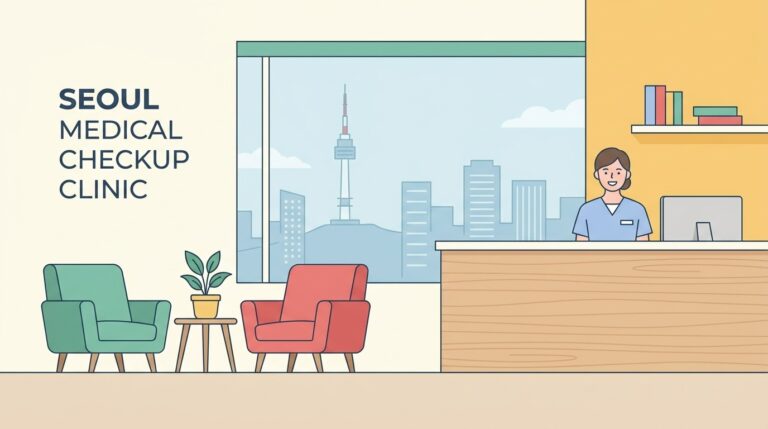
Setting: General Hospital Health Checkup Desk in Seoul. Patient (You) vs. Receptionist (NPC Kim).
- Kim (NPC): 안녕하세요, 매일병원 검진센터입니다. 어떤 진료를 도와드릴까요? (Hello, Daily Hospital Checkup Center. How can I help you today?)
- You: 안녕하세요, 종합 건강검진을 예약하고 싶어서 왔어요. (Hello, I came to book a comprehensive health checkup.)
- Kim (NPC): 네, 원하시는 검진 패키지나 특약 항목이 있으신가요? (Sure. Is there a specific checkup package or extra item you’d like?)
- You: Basic 패키지에 위 내시경을 추가하고 싶은데요. (I’d like to add a stomach endoscopy to the basic package.)
- Kim (NPC): 알겠습니다. 수면으로 진행하시겠어요, 비수면으로 하시겠어요? (Understood. Would you like to proceed with sedation or non-sedation?)
- You: 수면 내시경으로 진행해 주세요. (Please go with sedated endoscopy.)
- Kim (NPC): 네, 접수해 드렸습니다. 검사 전날 8시부터 금식하셔야 합니다. (Done! You must fast from 8 PM the night before the exam.)
- You: 네, 알겠습니다. 문진표는 모바일로 작성하면 되나요? (Got it. Can I fill out the questionnaire via mobile?)
🔀 Interactive Branching Point
The receptionist asks: “특이사항이나 드시는 약이 있으신가요?” (Do you have any pre-existing conditions or current medications?)
- Option A: “아니요, 아무것도 없어요.” (No, nothing at all. – Even though you take daily blood pressure meds)
- 🚫 Risk: Bad choice! Certain medications (like blood thinners) must be stopped before endoscopy.
- Option B: “혈압약을 먹고 있는데, 검사 당일 아침에도 먹어야 하나요?”
- ✅ Best: Excellent choice! Asking specifically about prescription medication timing prevents medical complications.
- Option C: “약은 나중에 의사 선생님한테만 말할게요.”
- ⚠️ Caution: Semi-risky. While doctors review medication, receptionists need this info early to schedule prep instructions.
Phase 6: 10-Second Emotion Shadowing Drill
- [😊 Polite & Clear] 안녕하세요, / 종합 건강검진 / 예약하러 왔는데요.
- [🤔 Inquiring & Careful] 검사 전날 / 물도 / 마시면 안 되나요?
- [🥺 Anxious & Calm] 수면 내시경 할 때 / 많이 깨거나 / 아프진 않겠죠?
- [😌 Relieved & Polite] 재검사 항목이 / 없다고 하시니 / 다행이네요.
Phase 7: K-Culture Mini Dictionary
- 검진 센터 (Geom-jin Sen-teo) | Health Checkup Center | Dedicated hospital wings specialized solely for comprehensive wellness exams.
- 금식 (Geum-sik) | Fasting | Complete restriction of food and liquid prior to medical tests.
- 수면 내시경 (Su-myeon Nae-si-gyeong) | Sedated Endoscopy | Conscious sedation procedure during gastrointestinal examinations.
- 문진표 (Mun-jin-pyo) | Medical History Questionnaire | Pre-exam questionnaire regarding lifestyle habits and family medical history.
Phase 8: Traveler’s Survival Kit
Survival Expressions TOP 3
- 약은 언제부터 복용을 중단해야 하나요? (When should I stop taking my medication?)
- 결과는 우편이나 모바일로 받을 수 있나요? (Can I receive results via mail or mobile?)
- 검사 당일에 운전해도 되나요? (Can I drive on the day of the test?)
Editor’s Travel Note
Make sure to check the National Health Insurance Service Portal to verify whether you are eligible for free bi-annual national checkups. Also, download the Naver Map App to search for nearby medical centers with English-speaking staff (‘외국어 가능 병원’).
Phase 9: A Step Deeper (Reflection Essay)
In Korea, health checkups reflect the society’s fast-paced, preventative mindset (‘빠르고 정확하게’). Korean healthcare focuses on early detection, which is why checkup centers operate with incredible efficiency. Communicating clearly with medical professionals in Korean ensures your health preferences are respected while experiencing world-class healthcare services.
💬 Your Turn: Have you ever taken a medical test in Korea? What surprised you the most about Korean medical efficiency? Share your story in the comments below!
Phase 10: FAQ & Common Mistakes
Q: Can I drink water during fasting hours before my checkup?
A: Usually, all liquids including water are strictly prohibited starting 8 to 10 hours prior to tests, especially for endoscopies or blood work.
Q: Is sedated endoscopy safe in Korea?
A: Yes, it is extremely common and performed under strict safety monitoring. However, you must refrain from driving afterward.
Q: How long does a full checkup usually take?
A: A standard comprehensive checkup takes about 2 to 3 hours thanks to streamlined clinic workflows.
🚨 Common Mistakes TOP 3
- Mistake: Driving yourself after a sedated endoscopy.
- Correct Action: Use public transit or ask a friend to accompany you.
- Mistake: Chewing gum during fasting hours.
- Correct Action: Avoid gum or hard candies as they stimulate gastric juice production.
- Mistake: Forgetting your physical ID card or ARC (Alien Registration Card).
- Correct Action: Always bring your physical ARC or passport to the clinic.
Phase 11: Action Missions
- 🥉 Bronze Mission: Practice saying ‘수면 내시경으로 예약해 주세요’ aloud 5 times.
- 🥈 Silver Mission: Share this post on Instagram/X and tag your Korean study buddy.
- 🥇 Gold Mission: Call or visit a Korean clinic website to draft a checkup inquiry message in Korean!
🎮 K-Culture Mission: Watch a medical Korean drama (like Doctor Cha or Hospital Playlist) and spot a health checkup scene!
Phase 12: Interactive Quiz Challenge
Question 1: What is the correct term for sedated endoscopy in Korean?
1) 자는 내시경
2) 수면 내시경
3) 기절 내시경
Click to view Answer & Explanation
Answer: 2) 수면 내시경
‘수면’ means sleep/sedation and is the accurate medical term used in Korean clinics.
Question 2 (True/False): You can freely drive home right after receiving a sedated endoscopy.
Click to view Answer & Explanation
Answer: False!
Driving after sedation is strictly prohibited due to lingering sedative effects.







