

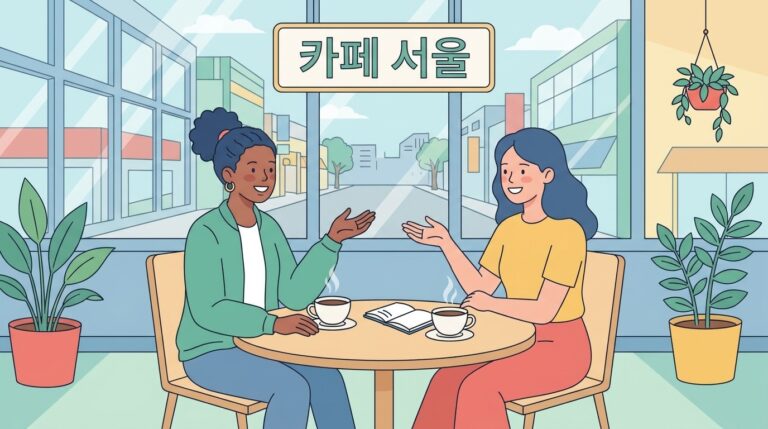
Phase 1: Welcome to Daily Hangul!
안녕하세요! This is your Daily Hangul editor, your 10-year local culture navigator!
Have you ever watched a K-Drama scene where two characters meet for coffee, exchange a few words, and suddenly ask, “몇 살이에요?” (How old are you?). In many Western cultures, asking someone’s age right after meeting can feel a bit intrusive. But in Korea, asking age is actually a warm gesture to figure out how to address each other respectfully—whether as an Oppa, Unnie, Hyung, Noona, or same-age friend (Dong-gap)!
Many beginner learners get stuck when trying to state their age because Korean uses Native Korean numbers (하나, 둘, 셋…) for age, which can feel tricky at first. Don’t worry! Based on real classroom experiences with hundreds of global learners, I’m going to teach you the exact phrases, practical shortcuts, and cultural manners you need so you can state your age with total confidence.
Phase 2: Core Expressions
1. 몇 살이에요?
- Pronunciation: [Myeot sal-i-e-yo?] (Sounds like Myot sa-ri-ye-yo)
- Meaning: Literal: “How many years old are you?” | Nuance: Polite and friendly way to ask someone’s age in casual-formal settings.
- K-Culture Moment: Seen in almost every youth drama when university students meet at a campus orientation or club gathering!
- Editor’s Insight: The word 살 (sal) is the age counter used strictly with Native Korean numbers.
- Situation Spectrum: Casual ⚠️ | Semi-formal ✅ | Formal 🚫
- 🤔 Think About It: How does asking age in Korea reflect the value of showing appropriate respect and care in relationships?
2. 저는 스물다섯 살이에요.
- Pronunciation: [Jeo-neun seu-mul-da-seot sal-i-e-yo.] (Sounds like Jeo-neun sseu-mool-da-sot sa-ri-ye-yo)
- Meaning: Literal: “I am 25 years old.” | Nuance: Natural, polite statement of your age.
- K-Culture Moment: K-Pop idols introducing themselves on variety shows like Running Man.
- Editor’s Insight: Always pair 살 with Native numbers (스물 = 20, 다섯 = 5). For 25, you say 스물다섯.
- Situation Spectrum: Casual ⚠️ | Semi-formal ✅ | Formal ✅
- 🤔 Think About It: Why do you think languages separate counting items from counting years of life?
3. 저 99년생이에요.
- Pronunciation: [Jeo gu-gu-nyeon-saeng-i-e-yo.] (Sounds like Jeo goo-goo-nyeon-saeng-i-e-yo)
- Meaning: Literal: “I was born in ’99.” | Nuance: The ultimate native lifehack! Koreans love using birth year to state age easily.
- K-Culture Moment: Friends making plans at a Hongdae street café, realizing they were born in the same year.
- Editor’s Insight: Using birth year (Sino-Korean numbers + 년생) saves you from memorizing complex Native numbers!
- Situation Spectrum: Casual ✅ | Semi-formal ✅ | Formal ⚠️
- 🤔 Think About It: Is birth year common for introductions in your hometown, or is exact age preferred?
Phase 3: Textbook Korean vs. Real Native Korean
Situation 1: Asking someone’s age during a casual chat
- 📖 Textbook Korean: 당신은 몇 살입니까? (Dang-sin-eun myeot sal-im-ni-ka?)
- 🗣️ Real Native Korean: 몇 년생이에요? (Myeot nyeon-saeng-i-e-yo?)
- 💡 Why the difference? “당신” sounds overly dramatic or stiff like a dubbing voice in a movie. Real Koreans ask for the birth year to calculate age quickly and naturally!
Situation 2: Stating your age to someone older or in polite settings
- 📖 Textbook Korean: 저는 스물네 살입니다. (Jeo-neun seu-mul-ne sal-im-ni-da.)
- 🗣️ Real Native Korean: 나이가 어떻게 되세요? / 저 스물네 살이에요! (Na-i-ga eot-teo-ke doe-se-yo? / Jeo seu-mul-ne sal-i-e-yo!)
- 💡 Why the difference? The formal suffix -입니다 can sound like a military report. Using -이에요/예요 strikes the perfect balance of friendliness and politeness.
Phase 4: K-Culture Deep Dive & Non-Verbal Manners
4-1. Nunchi (눈치) & Gestures
When discussing age, maintain eye contact and a gentle smile. If someone is older than you, slightly incline your head when stating your age. Avoid making aggressive hand gestures when asking age; keep hands relaxed or lightly folded.
4-2. Culture Code: The “Year of Birth” Shortcut
In Korea, even though the international age system is officially adopted by the government, people still naturally group social peer circles by birth year (년생). Knowing your two-digit birth year in Sino-Korean numbers (e.g., 98 = 구십팔 / 구팔) will make social connections instant and effortless!
Phase 5: Real Life Roleplay Scenario
Setting: A cozy coffee shop in Sinchon. You are meeting Minwoo (민우), a new university friend, for a language exchange.
- Turn 1 (Minwoo): 안녕하세요! 만나서 반가워요. / An-nyeong-ha-se-yo! Man-na-seo ban-ga-wo-yo. / (Hello! Nice to meet you.)
🎭 [bowing with a bright smile] - Turn 2 (You): 안녕하세요! 반갑습니다. / An-nyeong-ha-se-yo! Ban-gap-seum-ni-da. / (Hello! Nice to meet you too.)
🎭 [nodding politely] - Turn 3 (Minwoo): 혹시 몇 년생이에요? / Hok-si myeot nyeon-saeng-i-e-yo? / (By any chance, what year were you born?)
🎭 [asking curiouly with tilted head] - Turn 4 (You): 저 00년생이에요! / Jeo gong-gong-nyeon-saeng-i-e-yo! / (I was born in 2000!)
🎭 [smiling warmly] - Turn 5 (Minwoo): 정말요? 저도 00년생이에요! 우리 동갑이네요! / Jeong-mal-yo? Jeo-do gong-gong-nyeon-saeng-i-e-yo! U-ri dong-gap-i-ne-yo! / (Really? I’m born in 2000 too! We’re the same age!)
🎭 [clapping eyes wide open] - Turn 6 (You): 와, 대박! 우리 그럼 친구네요. / Wa, dae-bak! U-ri geu-reom chin-gu-ne-yo. / (Wow, awesome! Then we are friends.)
🎭 [laughing happily] - Turn 7 (Minwoo): 맞아요! 편하게 말 놓을까요? / Ma-ja-yo! Pyeon-ha-ge mal no-eul-kka-yo? / (Exactly! Shall we speak comfortably?)
🎭 [gesturing relaxedly] - Turn 8 (You): 좋아요! 반가워, 민우야! / Jo-a-yo! Ban-ga-wo, Min-u-ya! / (Sounds good! Nice to meet you, Minwoo!)
🎭 [giving a high five]
🔀 Interactive Choice Point
When Minwoo asks “몇 년생이에요?”, how do you respond?
* Option A: “저는 20살입니까?” (Risk: Mixes formal textbook grammar and confusing number format.)
* Option B: “저 99년생이에요!” (Best: Super natural, uses birth year, polite and clear!)
* Option C: “나이 왜 물어봐?” (Bad: Too blunt/rude for someone you just met!)
Phase 6: 10-Second Emotion Shadowing Drill
[😊 Happy & Energetic]
저 / 99년생이에요! / 반가워요!
(Jeo / gu-gu-nyeon-saeng-i-e-yo! / Ban-ga-wo-yo!)-
[🤔 Curious & Friendly]
혹시 / 나이가 / 어떻게 되세요?
(Hok-si / na-i-ga / eot-teo-ke doe-se-yo?) -
[🎉 Excited & Surprised]
와! / 우리 / 동갑이에요!
(Wa! / u-ri / dong-gap-i-e-yo!)
Phase 7: K-Culture Mini Dictionary
- 살 (Sal) | Age Counter | Native Korean age counting unit used with Native numbers (스물살 X -> 스물살 is wrong, 스물살 -> 스물 살 O).
- 년생 (Nyeon-saeng) | Year of Birth | Combined with Sino-Korean digits (e.g., 95년생 = born in 1995).
- 띠 (Tti) | Zodiac Sign | Korean animal zodiac year; often used playfully to figure out someone’s age.
- 동갑 (Dong-gap) | Same Age | People born in the same year; instant bond-builder in Korean culture!
Phase 8: Traveler’s Survival Kit
Survival Top 3 Expressions
- 몇 년생이에요? (Myeot nyeon-saeng-i-e-yo?) – Pro Tip: Best casual way to ask peer age.
- 저 [Birth Year]년생이에요. (Jeo [Year]-nyeon-saeng-i-e-yo.) – Pro Tip: Easiest way to state your age.
- 우리 동갑이에요! (U-ri dong-gap-i-e-yo!) – Pro Tip: Great phrase when meeting same-age friends.
Editor’s Travel Note
When navigating Korean cities or meeting local language partners, install navigation apps like Naver Map App Download to easily meet up at local hot spots in Hongdae or Seongsu-dong!
Phase 9: One Step Deeper
In Korea, age isn’t about setting up strict barriers—it’s about creating clear interpersonal harmony. Once age is established, Koreans know how to show appropriate politeness, support younger peers, or build instant comfortable friendships with same-age dong-gap peers. Embracing this concept helps you connect on a much deeper, warmer level.
💬 Your Turn: What birth year were you born in? Share in Korean in the comments below using “저 [Year]년생이에요!”
Phase 10: FAQ & Common Mistakes
Q: Should I use Native Korean numbers or Sino-Korean numbers for age?
A: Use Native numbers (스물, 서른…) when using 살, but use Sino numbers (구구, 공공…) when using 년생 (birth year).
Q: Can I just tell people my age using English numbers?
A: In young areas like Hongdae, people will understand, but saying your birth year in Korean will instantly impress locals!
Q: What if someone is just 1 year older than me?
A: You still use polite honorifics (-요 ending) at first until you both agree to speak comfortably (ban-mal)!
🚨 Common Mistakes TOP 3
- Mistake: Mixing Sino numbers with 살 (e.g., 이십다섯 살이에요 – X)
Correct Action: Use Native numbers with 살 (스물다섯 살이에요 – O). - Mistake: Calling a stranger “당신” when asking age.
Correct Action: Ask “혹시 몇 년생이에요?” or “나이가 어떻게 되세요?”. - Mistake: Forgetting polite endings with older acquaintances.
Correct Action: Stick with -요 until you build closer intimacy.
Phase 11: Action Mission
- Bronze Mission: Practice saying your birth year 3 times out loud using
저 [Year]년생이에요. - Silver Mission: Write a comment below introducing your birth year in Korean!
- Gold Mission: Use this line during your next language exchange or trip to Korea when introducing yourself!
🎮 K-Culture Mission: Watch a clip of your favorite K-Pop idol group and listen for them sharing their birth years! Can you hear the word 년생?
Phase 12: Interactive Quiz Challenge
Question 1: Fill in the blank
To say “I was born in ’98”, complete the sentence: “저 98_____이에요.”
🔍 Click to see Answer & Explanation
Answer: 년생 (nyeon-saeng)
Explanation: Year of birth is expressed using Sino numbers + 년생.
Question 2: Culture True/False
In Korea, people born in the same calendar year are called 동갑 (Dong-gap). (True / False)
🔍 Click to see Answer & Explanation
Answer: True
Explanation: Dong-gap means people of the same age/birth year, forming immediate peer friendship bonds!







