

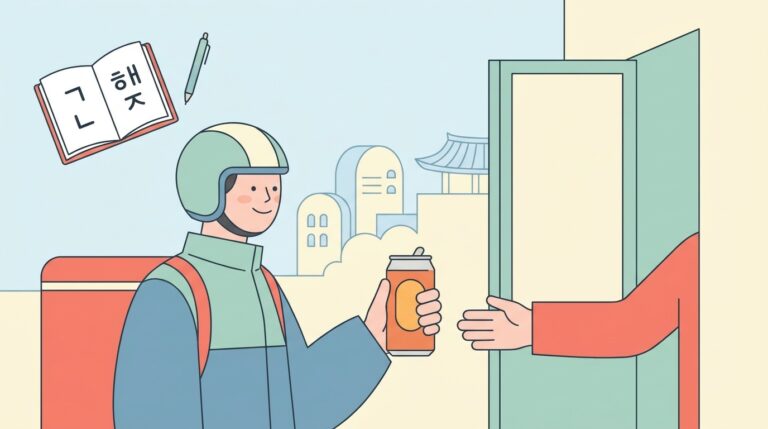
Beyond ‘Ppalli-Ppalli’: Understanding Delivery Rider Safety and Social Ethics in Korea
Phase 1: Empathy & Storytelling Opening
안녕하세요! 매일한글 에디터입니다. Have you ever ordered late-night chimaek (chicken and beer) in Seoul and watched the real-time delivery map on your phone? You see the icon moving smoothly across the map, arriving in under twenty minutes. It feels like magic! But behind Korea’s ultra-fast delivery ecosystem lies a complex social conversation about speed, safety, and labor rights. As advanced Korean learners (C1), navigating these nuanced societal topics allows you to engage in real, meaningful discussions with native speakers. Based on feedback from our C1 learners who wanted to discuss contemporary social issues naturally, this guide will help you express empathy, respect, and thoughtful opinions regarding rider working conditions in Korea.
Phase 2: Core Expressions Deep Dive
1. 천천히 오셔도 돼요
- Pronunciation: [Cheon-cheon-hi o-syeo-do dwae-yo] (Sounds like chuhn-chuhn-hee oh-syuh-doh dwae-yo)
- Meaning: Literally “It’s okay even if you come slowly.” Nuance: “Take your time, safety comes first!”
- K-Culture Moment: Commonly written in the ‘Delivery Request’ (배달 요청사항) box on apps like Baemin or Yogiyo during heavy snow or rain.
- Editor’s Insight: This phrase directly counters the stereotypical ppalli-ppalli (hurry-hurry) culture. Using it shows high empathy and modern social awareness.
- Situation Spectrum: Casual ✅ / Semi-formal ✅ / Formal ✅
- 🤔 Think About It: How does your culture balance customer convenience with gig-worker safety?
2. 안전에 유의해 주세요
- Pronunciation: [An-jeon-e yu-ui-hae ju-se-yo] (Sounds like ahn-juhn-eh yoo-ee-hae joo-seh-yoh)
- Meaning: “Please pay attention to safety.” Nuance: A respectful, polished way to remind someone to take care.
- K-Culture Moment: Heard in news broadcasts or corporate announcements addressing delivery platforms and rider safety regulations.
- Editor’s Insight: ‘유의하다’ (to pay attention/be careful) elevates your expression from simple ‘조심하세요’ to a C1-level sophisticated tone.
- Situation Spectrum: Casual 🚫 / Semi-formal ⚠️ / Formal ✅
- 🤔 Think About It: What formal vocabulary does your native language use for public safety reminders?
3. 처우 개선이 필요해요
- Pronunciation: [Cheo-u gae-seon-i pil-yo-hae-yo] (Sounds like chuh-oo gae-seuhn-ee peel-yoh-hae-yoh)
- Meaning: “Improvement in treatment/working conditions is necessary.”
- K-Culture Moment: Discussed frequently on Korean podcast debates and commentary channels regarding gig-economy workers.
- Editor’s Insight: ‘처우’ refers to how someone is treated in terms of compensation and working environment. It is essential vocabulary for discussing labor topics.
- Situation Spectrum: Casual 🚫 / Semi-formal ✅ / Formal ✅
- 🤔 Think About It: Is gig economy labor rights a major topic of debate in your home country?
Phase 3: Textbook Korean vs. Real Native Korean
Situation 1: Leaving a message for the delivery rider on a rainy day.
* 📖 Textbook Korean: 조심해서 천천히 운전하여 오십시오.
* 🗣️ Real Native Korean: 빗길인데 천천히 안전운전해서 오세요!
* 💡 Why is it different? Real Korean uses ‘빗길’ (rainy road) and the compound noun ‘안전운전’ (safe driving) to sound warm, natural, and friendly.
Situation 2: Discussing delivery fee increases and rider pay.
* 📖 Textbook Korean: 배달원들의 돈을 더 많이 주어야 합니다.
* 🗣️ Real Native Korean: 라이더분들의 처우 개선을 위해 배달비 인상이 논의되고 있어요.
* 💡 Why is it different? Using the honorific ‘-분’ (라이더분들) and formal terms like ‘처우 개선’ and ‘논의’ reflects mature, respectful conversation.
Phase 4: K-Culture Deep Dive & Non-verbal Manners
4-1. Nunchi & Gestures
When receiving food in person, receiving the package with both hands while slightly bowing your head (approx. 15 degrees) conveys deep respect for the rider’s effort, especially in harsh weather. If you leave cold drinks or snacks outside your door for riders with a warm note, that is considered top-tier nunchi and jeong (affection).
4-2. Cultural Code Analysis
In Korean K-Dramas and documentaries, delivery workers are no longer just background figures; they are framed as essential workers keeping urban life running. Shows highlighting the daily lives of delivery workers reflect a growing public awareness: speed should never compromise human dignity and physical safety.
Phase 5: Interactive Roleplay Scenario
Scenario: You are discussing delivery culture with a Korean friend, Minjun, at a cozy cafe in Hongdae.
Characters:
* Minjun (Korean Friend): Thoughtful, loves delivery apps but cares about social issues.
* You: C1 Korean learner engaging in a meaningful discussion.
Dialogue:
1. 민준: 한국은 배달이 정말 빠르지? 하지만 요즘 라이더 안전 문제가 많이 논의되고 있어. / (How fast Korean delivery is! But lately, rider safety is heavily discussed.)
2. You: 🎭 (Answering with empathy) / 맞아요. 비나 눈이 오는 날엔 특히 위험해 보여요. / (Right. On rainy or snowy days, it looks especially dangerous.)
3. 민준: 맞아. 그래서 요즘은 ‘천천히 오셔도 돼요’라고 메모를 남기는 사람들이 늘었어. / (True. So these days, more people leave notes saying ‘Take your time.’)
4. You: 🎭 (Sharing personal habit) / 저도 배달 주문할 때 항상 그 문구를 써요. / (I also always write that phrase when ordering delivery.)
5. 민준: 와, 정말 따뜻한 마음이네! 라이더분들 처우에 대해서는 어떻게 생각해? / (Wow, that’s so warm-hearted! What do you think about riders’ working conditions?)
6. You: 🎭 (Expressing C1 level opinion) / 적정한 배달비와 안전장구가 보장되는 처우 개선이 필요하다고 생각해요. / (I think treatment improvements securing fair delivery fees and safety equipment are necessary.)
7. 민준: 공감해. 속도보다 안전이 먼저라는 인식이 더 확산되어야 해. / (I agree. The awareness that safety comes before speed needs to spread more.)
8. You: 🎭 (Concluding gracefully) / 네, 서비스 이용자와 라이더 모두가 상생하는 문화가 되면 좋겠어요. / (Yes, I hope a culture where both users and riders coexist peacefully develops.)
🔀 Interactive Branching Point:
How would you respond if someone says delivery fees are getting too high?
* Option A: 배달비가 오르는 만큼 라이더의 안전과 처우도 개선되어야 한다고 생각해요. (Best Choice: Balanced and empathetic)
* Option B: 너무 비싸니까 그냥 제가 직접 가서 사 올래요. (Bad Choice: Avoids the social discussion entirely)
* Option C: 라이더들은 돈을 많이 버니까 괜찮지 않나요? (Risk Choice: Relies on stereotypes and lacks empathy)
Phase 6: 10-Second Emotion Shadowing Drill
- [🥺 Empathic & Caring] 빗길이라 위험하니 / 천천히 오셔도 돼요.
- [🤝 Resolute & Thoughtful] 속도보다는 / 라이더의 안전이 / 우선되어야 합니다.
- [😊 Warm & Friendly] 오늘도 안전운전해 주셔서 / 정말 감사합니다!
Phase 7: K-Culture Mini Dictionary
- 안전운전 (Anjeon-unjeon) | Safe driving | Used frequently in text messages or signs encouraging traffic safety.
- 처우 개선 (Cheo-u gaeseon) | Improvement of working conditions | Essential term for discussing labor rights and gig economy regulations.
- 상생 문화 (Sangsaeng munhwa) | Win-win / Coexistence culture | Describes mutual benefit between service providers and consumers.
- 배달팁/배달비 (Baedaltip/Baedalbi) | Delivery fee | The fee paid for delivery service, a central topic in discussions on rider earnings.
Phase 8: Traveler’s Survival Kit
Top 3 Survival Expressions:
1. 천천히 안전하게 오세요. (Cheoncheon-hi anjeon-hage o-se-yo.) – Please come slowly and safely.
2. 문 앞에 두고 가주세요. (Mun ap-e du-go ga-ju-se-yo.) – Please leave it in front of the door.
3. 감사합니다, 조심히 가세요! (Gam-sa-ham-ni-da, jo-shim-hi ga-se-yo!) – Thank you, drive safely!
Editor’s Travel Note:
When ordering food in Korea, use the Naver Map App Download or major delivery applications to set accurate delivery instructions. Always leave a warm note during severe weather conditions!
Phase 9: One Step Deeper
Korea’s rapid economic growth fostered the famous ppalli-ppalli culture, driving world-class efficiency. However, modern Korean society is actively re-evaluating this value. Today, young Koreans place higher value on ethical consumption, safety, and mutual respect (sangsaeng). Speaking about labor safety in fluent Korean shows you understand not just the language, but the heart of contemporary Korean society.
💬 Your Turn: What delivery etiquette or gig-worker safety initiatives exist in your country? Let us know in the comments below!
Phase 10: FAQ & Common Mistakes
Q: Is it polite to leave tips in cash for Korean delivery riders?
A: Tipping is generally not part of Korean culture, as delivery fees are calculated directly in the app. However, offering a canned coffee or bottled water during hot summer or freezing winter days is deeply appreciated!
Q: How can I write ‘Take your time’ in the app request box?
A: Simply write: “천천히 오셔도 되니 안전운전해 주세요!”
Q: Can I use informal speech (반말) when greeting delivery riders?
A: No, always use polite speech (존댓말) such as “감사합니다!” or “수고하셨습니다!”.
🚨 Common Mistakes:
* Mistake 1: Saying “빨리 오세요!” (Hurry up!) -> Correct Action: Avoid rushing riders; use “안전하게 오세요”.
* Mistake 2: Referring to workers without respect -> Correct Action: Use honorifics like ‘라이더분’ or ‘기사님’.
* Mistake 3: Using overly literal dictionary translations for labor conditions -> Correct Action: Use established terms like ‘처우 개선’.
Phase 11: Action Mission & K-Culture Mission
- Bronze Level: Practice saying “천천히 오셔도 돼요” out loud 3 times with warm intonation.
- Silver Level: Write a Korean delivery request note using today’s learned expressions on your social media.
- Gold Level: Have a 2-minute conversation with a Korean friend discussing rider safety and working conditions.
- 🎮 K-Culture Mission: Watch a Korean news segment or documentary short on ‘플랫폼 노동자’ (platform workers) and spot the key vocabulary words from Phase 7!
Phase 12: Interactive Quiz Challenge
-
What is the most appropriate way to ask a delivery rider to prioritize safety during rain?
Click to view answer
Answer: “빗길인데 천천히 안전운전해서 오세요!” – It expresses care and empathy for the weather condition.
-
True or False: Tipping cash is mandatory in Korean delivery culture.
Click to view answer
Answer: False. Tipping is not customary; offering warm words or small drinks is preferred.
-
Fill in the blank: 라이더들의 ( )을/를 위해 안전 가이드라인이 강화되고 있다. (Hint: Working conditions improvement)
Click to view answer
Answer: 처우 개선 (Cheo-u gaeseon)







