

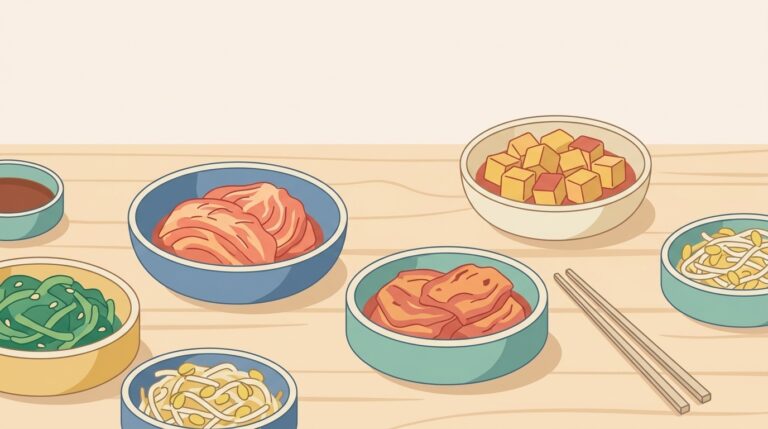
Phase 1: 공감 (Welcome to the World of Banchan!)
안녕하세요! 매일한글 에디터입니다. Have you ever sat down at a traditional Korean restaurant in Seoul, ordered your main dish, and suddenly watched the table fill up with six, eight, or even ten small dish bowls before your main meal even arrived? If you felt a wave of slight panic wondering, “Did I accidentally order all of these? Do I have to pay extra? Which kimchi is this?”—you are definitely not alone!
Navigating Korea’s famous side dish culture, known as Banchan (반찬), is one of the most delightful yet confusing experiences for learners. Many intermediate learners know what Baechu-kimchi (cabbage kimchi) is, but feel totally stuck when trying to ask for Kkakdugi (radish kimchi), complimenting the fresh Geotjeori (freshly made kimchi), or politely requesting a free side dish refill without breaking subtle dining etiquette. Based on feedback from hundreds of intermediate Korean learners at Daily Hangul, mastering these precise culinary descriptions will immediately elevate your social dining confidence from a confused tourist to a beloved local foodie!
Phase 2: 핵심 표현 3선 심층 분석
1. 깍두기 좀 더 주실 수 있나요? (Kkakdugi jom deo jusil su innayo?)
- Pronunciation: [Kkak-doo-gi jom deo joo-seel soo een-na-yo?] (Think of ‘Kkak’ like a crisp snapping sound, echoing the sound of biting into crunchy radish!)
- Meaning: Direct: “Can you give me more Kkakdugi?” | Nuance: A polite, natural request to refill cube radish kimchi.
- K-Culture Moment: In K-dramas, whenever characters eat hot beef bone soup (Seollongtang), you always see them dropping Kkakdugi broth into the bowl or asking the Imo (auntie/waitress) for a refill!
- Editor’s Insight: Adding ‘좀 (jom)’ softens requests in Korean. It turns a direct demand into a gentle, courteous ask.
- Situation Spectrum:
- Casual (Friends): 깍두기 더 줄 수 있어? (⚠️)
- Semi-formal (Restaurants): 깍두기 좀 더 주실 수 있나요? (✅)
- Formal (Fine Dining): 깍두기 좀 더 부탁드립니다. (✅)
- 🤔 Think About It: In your country, are side dishes usually free to refill, or is every item charged individually? How does this free refill culture reflect Korean hospitality (Jeong)?
2. 이 김치는 겉절이라서 아주 아삭아삭해요 (I gimchineun geotjeoriraseo aju asak-asakaeyo)
- Pronunciation: [I gim-chi-neun geot-jeo-ri-ra-seo ah-joo ah-sak-ah-sak-hae-yo]
- Meaning: Direct: “Because this kimchi is fresh unfermented kimchi, it’s very crunchy.”
- K-Culture Moment: Often seen in cooking shows where chefs highlight the fresh snap of unfermented cabbage kimchi served alongside handmade knife-cut noodles (Kalguksu).
- Editor’s Insight: Geotjeori is unfermented kimchi made to be eaten immediately, unlike deeply aged Mugeunji. ‘아삭아삭’ is an onomatopoeia for crisp crunchiness.
- Situation Spectrum:
- Casual: 이 김치 겉절이라 아삭아삭해! (✅)
- Semi-formal: 이 김치는 겉절이라서 아주 아삭아삭해요. (✅)
- Formal: 본 김치는 겉절이로 식감이 매우 아삭합니다. (✅)
- 🤔 Think About It: Why do you think Korean cuisine has such rich sensory sound words (Uiseong-eo) specifically tailored to food textures?
3. 혹시 백김치도 있나요? (Hoksi baekgimchido innayo?)
- Pronunciation: [Hok-si baek-gim-chi-do een-na-yo?]
- Meaning: Direct: “By any chance, do you also have white kimchi?”
- K-Culture Moment: Commonly used when dining with kids or friends who cannot eat spicy food, or when pairing with rich meats like pork belly (Samgyeopsal).
- Editor’s Insight: Baek-kimchi is made without chili pepper powder. Starting a inquiry with ‘혹시 (hok-si)’ makes you sound thoughtful and refined.
- Situation Spectrum:
- Casual: 혹시 백김치도 있어? (⚠️)
- Semi-formal: 혹시 백김치도 있나요? (✅)
- Formal: 혹시 백김치도 준비되어 있습니까? (✅)
- 🤔 Think About It: How does asking for milder food options politely demonstrate cultural awareness when dining in a country famous for spicy food?
Phase 3: 교과서 한국어 vs 진짜 한국어
Scenario 1: Requesting More Side Dishes
- 📖 교과서 한국어: “반찬을 더 가져다주십시오.” (Bring me more side dishes.)
- 🗣️ 진짜 한국어: “이모님, 깍두기 조금만 더 주실 수 있으세요?” (Auntie, could I get a little more Kkakdugi, please?)
- 💡 왜 다를까? Imperative textbook commands sound cold or blunt. Calling the staff Imo or Sajang-nim and asking with ~주실 수 있으세요? creates warm social intimacy (Jeong).
Scenario 2: Expressing Taste Preferences
- 📖 교과서 한국어: “이 김치는 신맛이 납니다.” (This kimchi tastes sour.)
- 🗣️ 진짜 한국어: “와, 이 묵은지 제대로 익었는데요!” (Wow, this aged kimchi is properly fermented!)
- 💡 왜 다를까? Simply saying food is “sour” can imply it’s spoiled to untrained ears. Using 제대로 익었다 (properly aged/fermented) praises the chef’s fermentation skill!
Phase 4: K-Culture 딥다이브 & 비언어적 매너
4-1. 눈치 (Nunchi) & Table Gestures
When asking for a Banchan refill in Korea, never wave both arms frantically or yell loudly across a quiet room. Catch the server’s eye, give a small polite nod, and gently lift the empty small dish slightly off the table with both hands when they approach. Using two hands when pointing to or receiving dish bowls shows deep respect!
4-2. Korean Food Code: Kimchi Diversity
In Korean culinary culture, Kimchi isn’t just one dish—it’s an entire universe categorized by season, vegetable type, and fermentation level:
1. 배추김치 (Baechu-kimchi): Standard cabbage kimchi, the backbone of Korean meals.
2. 깍두기 (Kkakdugi): Cubed radish kimchi, ideal companion for warm soups like Gukbap.
3. 파김치 (Pa-kimchi): Green onion kimchi, highly popular paired with instant ramen!
4. 백김치 (Baek-kimchi): Non-spicy white kimchi pickled in mild brine.
Phase 5: 실전 롤플레이 시나리오
Setting: A vibrant, bustling Gukbap (rice soup) restaurant in Seoul. You are sitting at a stainless steel table.
NPC: Restaurant Auntie (이모님 – Imo-nim), warm and super fast-moving.
- Turn 1 (Imo-nim): [😊 Smiling warmly while placing a tray] 뜨거운 국밥 나왔습니다! 맛있게 드세요!
- Turn 2 (Learner): [😋 Looking excited] 와, 감사해요! 국밥 냄새 진짜 좋네요.
- Turn 3 (Learner): [🥢 Taking a bite of radish kimchi] 깍두기가 진짜 아삭하고 맛있어요!
- Turn 4 (Imo-nim): [👍 Proudly wiping hands] 그렇지? 우리 집 깍두기는 매일 아침 직접 담그거든.
- Turn 5 (Learner): [🥣 Holding empty small dish with both hands] 이모님, 깍두기 너무 맛있어서 그러는데 조금만 더 주실 수 있나요?
- Turn 6 (Imo-nim): [😄 Laughing heartily] 당연하지! 우리 손님 잘 먹으니까 예쁘네. 듬뿍 가져다줄게!
- Turn 7 (Learner): [🙇 Bowing head slightly] 감사합니다! 혹시 저쪽 셀프바에서 직접 가져와도 되나요?
- Turn 8 (Imo-nim): [✨ Pointing with wooden spoon] 아유, 바쁠 땐 셀프바 이용해주면 우리야 고맙지! 편하게 더 가져다 먹어~
🔀 Interactive Choice Point
How will you respond when the server brings a huge full container of fresh kimchi?
- Option A: “우와, 진짜 감사합니다! 남기지 않고 다 먹을게요!”
- Option B: “너무 많이 주셨어요. 조금 도로 가져가세요.”
- Option C: “김치 말고 다른 반찬은 없나요?”
Feedback:
* Option A (Best): Perfect! Promising not to leave food waste (Namgiji anko) shows great appreciation for free refills and warm Korean culture.
* Option B (Bad): Asking them to take food back creates an awkward vibe. Just eat what you can comfortably!
* Option C (Risk): Sounds ungrateful right after receiving a generous refill. Better to ask separately about other dishes.
Phase 6: 10초 감정 섀도잉 드릴
Practice these lines out loud with exact rhythm and natural emotion!
- [😊 Expressing delight & crunchiness]
“이 / 깍두기 / 진짜 / 아삭아삭하고 / 맛있어요!”
(I / kkak-du-gi / jin-jja / a-sak-a-sak-ha-go / ma-sin-neo-yo!) -
[🥺 Polite & hopeful request]
“이모님, / 반찬 조금만 / 더 주실 수 있으세요?”
(I-mo-nim, / ban-chan jo-geum-man / deo ju-sil su i-seu-se-yo?) -
[😋 Savory appreciation]
“묵은지가 / 아주 / 제대로 / 익었네요!”
(Mu-geun-ji-ga / a-ju / je-dae-ro / i-geon-nae-yo!)
Phase 7: K-Culture 미니 사전
- 리필 (Ri-pil) | Refill | Used everywhere in restaurants for free side dish refills (e.g., “반찬 리필 돼요?”).
- 셀프바 (Sel-peu-ba) | Self-service side dish bar | Common buffet-style side dish station in modern Korean diners.
- 아삭아삭 (A-sak-a-sak) | Crunchy/Crisp | Onomatopoeia describing fresh bite textures of radishes, cucumbers, and fresh kimchi.
- 묵은지 (Mu-geun-ji) | Long-aged Kimchi | Well-fermented kimchi aged for over a year, essential for deep-flavored stews.
Phase 8: 여행자를 위한 생존 키트
Survival Expressions TOP 3
- “반찬 더 필요하시면 말씀하세요.” (Ban-chan deo pil-yo-ha-si-myeon mal-sseum-ha-se-yo.)
- Pro Tip: If you hear the staff say this, it means “Let us know if you need more side dishes!”
- “이거 안 매운 김치예요?” (I-geo an mae-un gim-chi-ye-yo?)
- Pro Tip: Use this to check spice levels before taking a big bite.
- “셀프바는 어디에 있나요?” (Sel-peu-ba-neun eo-di-e in-na-yo?)
- Pro Tip: Ask this to find the self-service side dish counter independently.
Editor’s Travel Note
When searching for authentic local culinary spots known for artisan homemade banchan, avoid relying solely on global tourist maps. Make sure to complete your Naver Map App Download before your trip to read real local visitor reviews (Naedonsaedan) and locate self-bar banchan restaurants nearby!
Phase 9: “한 발 더 깊이” (Culture & Mindset)
In many Western dining cultures, side dishes are à la carte items individually priced on the menu. In Korea, Banchan represents a collective sharing philosophy anchored in hospitality (Jeong). Preparing multiple colorful side dishes shows care and effort from the host. When you compliment a restaurant’s unique Kkakdugi or Geotjeori, you are acknowledging the kitchen’s craft, turning a simple meal into a warm human connection.
💬 Your Turn: What is your absolute favorite Korean side dish when you visit Korean restaurants? Have you ever tried Kkakdugi or Baek-kimchi? Share your dining stories in the comments below!
Phase 10: FAQ & 오해 방지
Q: Is every single banchan dish really free to refill in Korea?
A: Yes! Standard side dishes like cabbage kimchi, kkakdugi, bean sprouts, and pickled radish are almost universally free for refills. However, high-cost main side dishes like steamed pork slices (Bossam) or grilled fish may carry a extra charge if requested again.
Q: What should I do if there is a ‘셀프 (Self)’ sign near the banchan counter?
A: If you see signs saying “반찬은 셀프입니다” (Side dishes are self-service), bring your empty small dish to the counter and help yourself rather than calling the server!
Q: Is it rude if I don’t finish all the banchan served to me?
A: While it is polite to try dishes, you don’t have to force yourself to finish everything. However, taking moderate portions at self-bars to prevent food waste is highly appreciated!
🚨 Common Mistakes TOP 3
- Mistake: Waving directly at servers and shouting “Hey!” for refills.
- Correct Action: Catch eye contact gently or say “저기요~” (Excuse me) or use the table call button.
- Mistake: Assuming white non-spicy kimchi (Baek-kimchi) is sweet dessert.
- Correct Action: It is savory and tangy! Eat it alongside rich meats as a palate cleanser.
- Mistake: Sticking your chopsticks vertically into a side dish bowl.
- Correct Action: Rest chopsticks on the chopstick holder or table edge; vertical insertion resembles ancestral funeral rites.
Phase 11: 액션 미션 & 참여 유도
🎯 Action Mission 3 Steps
- Bronze Mission: Say “깍두기 좀 더 주실 수 있나요?” 3 times out loud focusing on soft tone.
- Silver Mission: Post a photo of your favorite Korean side dish on Instagram/X tagging
#DailyHangulBanchan. - Gold Mission: Visit a local Korean restaurant this week and successfully request a banchan refill in full Korean!
🎮 K-Culture Mission
Watch any K-drama dining scene this week (like Reply 1988 or Street Food Fighter) and spot at least 2 different types of Kimchi on the table!
Phase 12: 인터랙티브 퀴즈 챌린지
Q1. What is the main difference between Baechu-kimchi and Kkakdugi?
A) Baechu is radish, Kkakdugi is cabbage.
B) Baechu uses cabbage, Kkakdugi uses cubed radish.
C) Kkakdugi is never spicy.
🔍 Click to view Answer & Explanation
Answer: B
Baechu-kimchi (배추김치) is made with napa cabbage, while Kkakdugi (깍두기) is made with crunchy, cubed daikon radish!
Q2. True or False: In a restaurant with a sign saying “반찬은 셀프입니다”, you should ask the waitress to bring refills.
🔍 Click to view Answer & Explanation
Answer: False
“셀프입니다” means self-service! You should go to the self-bar station and refill your own side dish bowl.







