

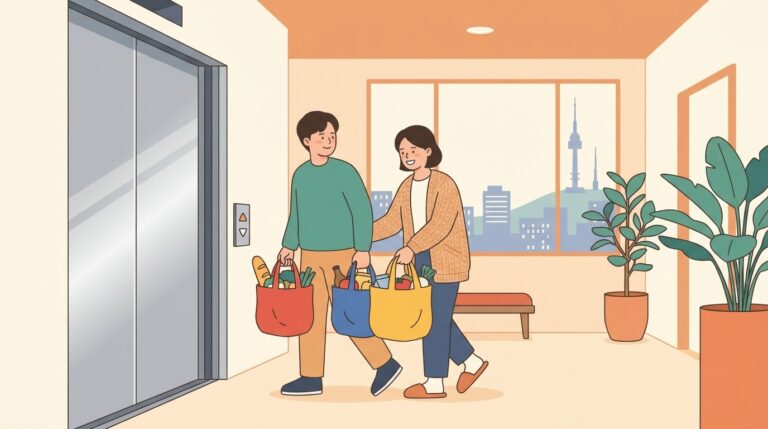
Phase 1: Empathy (스토리 몰입형 오프닝)
안녕하세요! 매일한글 에디터입니다. Have you ever stepped into a bustling Korean supermarket or a traditional market like Mangwon Market, filled with excitement to cook your favorite Korean dish, only to realize you bought way too much? You grab extra packs of Kimchi, heavy bottles of banana milk, fresh pears, and suddenly you are holding bags that weigh as much as a bowling ball. As you trudge back to your apartment or subway station, you realize carrying heavy grocery bags in Korea isn’t just physical exercise—it’s an entire social dynamic!
Many intermediate Korean learners know basic vocabulary for food, but when faced with heavy bags, offering or asking for help, or deciding whether to buy a plastic bag (봉투) or use a cardboard packaging station (자율포장대), panic sets in. Today, we are mastering how to navigate carrying heavy groceries in Korea with complete confidence and native-like grace. This guide is crafted directly from real student feedback and real-life Korean household experiences so you can handle your shopping trips like a local!
Phase 2: 핵심 표현 3선 심층 분석
1. 들어 드릴까요? (Deureo deureillkayo?)
- Pronunciation: Deureo deureillkayo? (Sounds like “doo-ruh doo-ray-ell-kah-yo?”)
- Meaning: “Shall I carry/hold that for you?”
- K-Culture Moment: You often hear this tender line in K-dramas when the main lead notices the other person carrying heavy shopping bags or luggage up a steep uphill alley in Seoul.
- Editor’s Insight: Combining ‘들다’ (to lift/carry) and ‘드리다’ (humble form of to give), this expression shows respect while proactively offering physical assistance.
- Situation Spectrum: Casual (🚫 들까?) / Semi-formal (✅ 들어 드릴까요?) / Formal (✅ 제가 들어 드리겠습니다)
- 🤔 Think About It: How does offering physical help immediately shift social distance in Korean culture compared to your home country?
2. 생각보다 엄청 무겁네요. (Saenggakboda eomcheong mugeomneyo.)
- Pronunciation: Saenggakboda eomcheong mugeomneyo. (Sounds like “seng-gahk-boh-dah um-chuhng moo-guhm-neh-yo”)
- Meaning: “It’s much heavier than I thought.”
- K-Culture Moment: Used casually when unpacking groceries at home with roommates or family after an unexpected mega-sale at Emart.
- Editor’s Insight: Using ‘-네요’ adds a spontaneous realization tone, expressing genuine surprise at the weight without sounding complaining.
- Situation Spectrum: Casual (✅ 생각보다 엄청 무거워) / Semi-formal (✅ 생각보다 엄청 무겁네요) / Formal (⚠️ 생각보다 매우 무겁습니다)
- 🤔 Think About It: Expressing honest physical reaction helps build emotional rapport in Korean conversation.
3. 봉투 하나만 더 주세요. (Bongtu hanaman deo juseyo.)
- Pronunciation: Bongtu hanaman deo juseyo. (Sounds like “bong-too ha-na-man duh joo-seh-yo”)
- Meaning: “Please give me one more bag.”
- K-Culture Moment: At the checkout counter when your paper or plastic bag starts ripping from heavy glass containers.
- Editor’s Insight: In Korea, eco-friendly policies require purchasing shopping bags separately. Asking politely with ‘하나만 더’ ensures your groceries arrive home safely without breaking.
- Situation Spectrum: Casual (⚠️ 봉투 더 줘) / Semi-formal (✅ 봉투 하나만 더 주세요) / Formal (✅ 봉투 한 개만 더 부탁드립니다)
- 🤔 Think About It: Korean eco-laws changed retail culture dramatically—how do local customs shape grocery shopping routines?
Phase 3: 교과서 한국어 vs 진짜 한국어
Situation 1: Offering help to carry heavy grocery bags
- 📖 교과서 한국어: 제가 당신의 짐을 들어주겠습니다. (Jega dangsin-ui jim-eul deureojugessseumnida.)
- 🗣️ 진짜 한국어: 제가 들어 드릴까요? 많이 무거워 보여요. (Jega deureo deureillkayo? Mani mugeowo boyeoyo.)
- 💡 왜 다를까?: Native speakers rarely use ‘당신’ (you). Instead, they drop the pronoun and use warm, supportive verbs like ‘들어 드릴까요?’.
Situation 2: Asking a friend to hold something momentarily
- 📖 교과서 한국어: 이것을 잠시 들고 있으십시오. (Igeoseul jamsi deulgo isseusipsio.)
- 🗣️ 진짜 한국어: 이거 잠깐만 들어 줄 수 있어? (Igeo jamkkanman deureo jul su isseo?)
- 💡 왜 다를까?: Bookish imperatives sound like a military command. Natural spoken Korean uses ‘잠깐만’ (just a sec) and ‘줄 수 있어?’ (can you?).
Phase 4: K-Culture 딥다이브 & 비언어적 매너
4-1. 눈치(Nunchi) & 제스처
When carrying heavy bags in Korea, subtle body language matters. If someone offers to carry your bag, it’s polite to initially wave your hand slightly down and say, “아니에요, 괜찮아요!” (No, it’s fine!) before accepting on the second offer. When receiving help, hold the bag with two hands momentarily before passing it over to show gratitude.
4-2. 문화 코드 분석: The Cart & Box Packing Culture
Korean hypermarkets like Homeplus and Lotte Mart have a unique culture: 자율포장대 (Self-Packing Stations). Due to plastic bag bans, shoppers carry heavy items by building custom cardboard boxes at designated packaging counters. Knowing how to pack efficiently and asking nearby shoppers for tape (“테이프 좀 써도 될까요?”) is a quintessential Korean life skill!
Phase 5: 실전 롤플레이 시나리오
Characters:
* You (Intermediate Learner): Grocery shopping after work.
* Min-woo (Korean Neighbor): Meets you at the apartment elevator entrance.
- Turn 1 (Min-woo): 🎭 (Notices you struggling with two full bags) 어? OO 씨! 장 보고 오는 길이에요?
- Turn 2 (You): 🎭 (Wiping sweat with a smile) 네, 민우 씨! 맛있는 거 만들려고 많이 샀어요.
- Turn 3 (Min-woo): 🎭 (Looks at the straining paper bags) 와, 봉투가 터질 것 같아요. 제가 들어 드릴까요?
- Turn 4 (You): 🎭 (Nodding gratefully) 진짜요? 괜찮으시면 이것 좀 들어 줄 수 있으세요?
- Turn 5 (Min-woo): 🎭 (Lifts one bag) 으아, 생각보다 엄청 무겁네요! 뭐 사셨어요?
- Turn 6 (You): 🎭 (Laughing nervously) 수박이랑 수제 잼을 샀더니 너무 무거워졌어요.
- Turn 7 (Min-woo): 🎭 (Walking toward the elevator) 엘리베이터 눌렀어요. 빠르게 올라가요!
- Turn 8 (You): 🎭 (Bowing slightly) 정말 고마워요, 민우 씨! 덕분에 살았어요.
🔀 인터랙티브 분기점 (Interactive Branching)
Min-woo offers: “제가 들어 드릴까요?” How do you respond?
- Option A: “네, 들어주세요.” (Yes, carry it.)
- Feedback (Bad): Too blunt! Sounds demanding like an order.
- Option B: “아니에요, 괜찮아요! 많이 무거운데 정말 감사해요.” (Oh no, it’s okay! It’s heavy, but thank you so much.)
- Feedback (Best): Perfect polite refusal-then-acceptance loop showing great Nunchi!
- Option C: “당신이 들으세요.” (You carry it.)
- Feedback (Risk): Grammatically unnatural and rude due to ‘당신’.
Phase 6: 10초 감정 섀도잉 드릴
[😊 감사와 안도감]정말 / 고마워요! / 덕분에 / 살았어요. (Jeongmal / gomawoyo! / Deokbune / sarasseoyo.)[😮 깜짝 놀라며]와, / 생각보다 / 엄청 / 무겁네요! (Wa, / saenggakboda / eomcheong / mugeomneyo!)[🥺 도움 요청]혹시 / 이것 좀 / 들어 주실 수 있으세요? (Hoksi / igeo jom / deureo jusil su isseuseyo?)
Phase 7: K-Culture 미니 사전 (핵심 키워드 4개)
- 장보기 (Jangbogi): Grocery shopping | Everyday routine of buying food ingredients at markets.
- 종량제 봉투 (Jongryangje Bongtu): Pay-as-you-throw trash bag | Grocery stores sell garbage bags as shopping bags so you reuse them at home.
- 자율포장대 (Jayul-pojangdae): Self-packaging station | Counter in stores with free boxes and tape for packing heavy items.
- 배달 서비스 (Baedal Service): Grocery delivery service | Many local marts deliver heavy bags right to your apartment door if you spend over a certain amount!
Phase 8: 여행자를 위한 생존 키트
Survival Expressions TOP 3
- 배달돼요? (Baedal-dwaeyo?) – Do you offer home delivery?
- Pro Tip: Use this at local neighborhood marts when buying heavy rice bags or water bottles!
- 종량제 봉투로 주세요. (Jongryangje bongturo juseyo.) – Please give me a waste-disposal bag.
- 너무 무거워서 그러는데, 좀 도와주세요. (Neomu mugeowoseo georeunende, jom dowajuseyo.) – It’s too heavy, please help me out.
Editor’s Travel Note
When navigating Korean residential streets with heavy loads, use the Naver Map App Download to find local marts with home delivery options or flat pedestrian paths.
Phase 9: “한 발 더 깊이” (생각 질문)
In Korea, helping someone with heavy bags goes beyond simple physical effort; it reflects ‘Jeong’ (정), a deep communal bond and warmth. Even between strangers, holding the elevator door or helping carry a stroller up subway stairs is second nature.
💬 Your Turn: Have you ever experienced or offered warm help while carrying heavy things in Korea? Share your story in the comments below!
Phase 10: FAQ & 오해 방지 (FAQ Schema)
Q: Is it okay to ask strangers for help with heavy grocery bags in Korea?
A: Yes! Elderly citizens or people carrying heavy items frequently receive help from younger passersby. Politeness with ‘저기요, 죄송하지만…’ goes a long way.
Q: Why do cashiers ask “봉투 필요하세요?” every single time?
A: Korean environmental laws ban free plastic bags. You must pay around 20–100 KRW per bag or request a trash bag (종량제 봉투).
Q: Can I leave heavy groceries in my cart while walking around the mall?
A: Korea is famous for high security, but it’s best to use supermarket coin lockers (보관함) for convenience.
🚨 Common Mistakes TOP 3
- Mistake: Calling supermarket workers “언니” or “오빠”.
- Correct Action: Use “저기요” or “사장님”.
- Mistake: Expecting plastic bags to be handed out automatically.
- Correct Action: Bring a reusable bag (장바구니) or buy a bag explicitly.
- Mistake: Using direct imperatives like “이거 들어요”.
- Correct Action: Soften with “-아/어 주시겠어요?”.
Phase 11: 액션 미션 & 참여 유도
- 🥉 Bronze: Practice saying “생각보다 엄청 무겁네요” out loud three times with natural emotion.
- 🥈 Silver: Leave a comment using the expression “들어 드릴까요?” in a context sentence.
- 🥇 Gold: Next time you shop in Korea, request a trash bag in Korean (“종량제 봉투 하나 주세요”).
🎮 K-Culture Mission: Watch a scene in a slice-of-life K-drama (like Reply 1988 or Crash Course in Romance) and spot characters carrying grocery baskets together!
Phase 12: 인터랙티브 퀴즈 챌린지
Quiz 1: Situation Judgment
What is the most natural way to offer help to a neighbor carrying heavy groceries?
* A) 이거 주세요.
* B) 제가 들어 드릴까요?
* C) 무거우니까 들으세요.
🔍 Show Answer & Explanation
Answer: B
‘제가 들어 드릴까요?’ is the gold standard polite offer in Korean.
Quiz 2: Fill in the Blank
“너무 _____(heavy) 들어 줄 수 있어요?”
🔍 Show Answer & Explanation
Answer: 무거워서 (mugeowoseo)
‘무겁다’ turns into ‘무거워서’ when giving a reason (It’s heavy, so…/Because it’s heavy…).
Quiz 3: True / False Culture Quiz
In Korea, grocery stores give out free plastic bags if your total purchase exceeds 50,000 KRW. (True / False)
🔍 Show Answer & Explanation
Answer: False
By law, disposable shopping bags must be purchased separately regardless of purchase total.







