

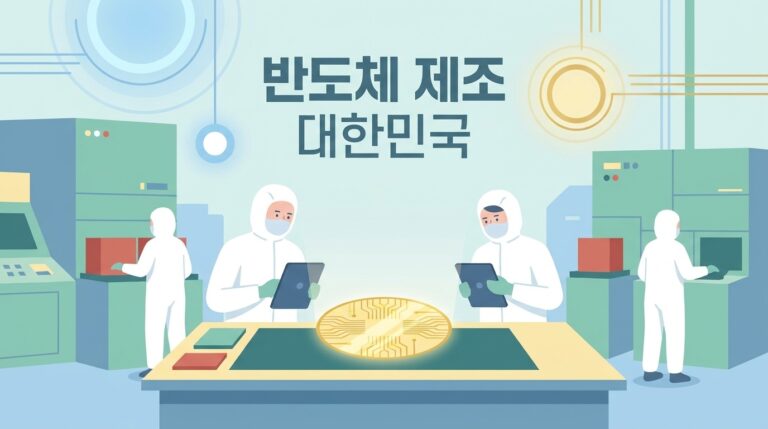
Master the Semiconductor War: Talking Foundry Yields and 3nm Tech in Korean
Phase 1: Navigating the 3nm Foundry Yield Battle
Hello! I’m your Daily Hangul editor (안녕하세요! 매일한글 에디터입니다). If you’ve been following global business tech news or watching K-dramas centered around high-stakes corporate drama like Reborn Rich, you know that the semiconductor industry is anything but quiet. Inside the pristine cleanrooms of Hwaseong and Pyeongtaek, Korean engineers and executives are locked in an intense zero-sum game: the foundry yield competition for next-generation 3-nanometer processes.
Imagine walking into a crucial strategy meeting in Pangyo Techno Valley. The board is staring at yield charts, worrying whether the 3nm GAA (Gate-All-Around) chip production will hit the commercially viable threshold before rival foundries secure major client contracts. When discussing ultra-advanced foundry nodes, standard textbook Korean simply falls short. You need advanced business Korean terms—sharp, concise, and nuanced—that convey technical precision, executive urgency, and strategic ambition.
By mastering these high-level C2 expressions, you won’t just understand corporate headlines; you will be able to articulate complex yield dynamics, lead technical debriefs, and understand the cultural drive behind Korea’s ‘Super-Gap’ (초격차) technology strategy.
Phase 2: Key Expressions Deep Dive
1. 수율을 잡다 (Suyu-reul japda)
- Pronunciation: [Suyu-reul japda] (Sounds like soo-yool-eul jahp-dah)
- Meaning: Literally “To catch/grab the yield rate,” meaning to stabilize or optimize production yield.
- K-Culture Moment: Seen in corporate tech thrillers when a chief technology officer demands immediate results from the R&D team before launching a new flagship smartphone.
- Editor’s Insight: While dictionary Korean uses ‘수율을 향상시키다’ (to improve yield), real tech professionals always say ‘수율을 잡다’. It carries a dynamic tone of taming a volatile manufacturing process.
- Situation Spectrum: Casual ⚠️ | Semi-formal ✅ | Formal ✅
- 🤔 Think About It: How does your native language describe stabilizing erratic manufacturing metrics? Notice how Korean treats manufacturing yield as something elusive that must be physically caught (‘잡다’).
2. 난항을 겪다 (Nanhang-eul gyeokda)
- Pronunciation: [Nanhang-eul gyeokda] (Sounds like nahn-hang-eul gyeok-dah)
- Meaning: Literally “To undergo stormy navigation,” meaning to suffer headwinds or hit major bottlenecks.
- K-Culture Moment: Frequently featured in economic news broadcasts summarizing quarter-end earnings and delay warnings in chip deliveries.
- Editor’s Insight: Excellent C2 alternative to simple terms like ‘어렵다’ (is difficult). It emphasizes structural, complex obstacles during groundbreaking research.
- Situation Spectrum: Casual 🚫 | Semi-formal ✅ | Formal ✅
- 🤔 Think About It: Compare this nautical metaphor for business turbulence with the metaphors used in your country’s tech sector.
3. 초격차를 유지하다 (Chogyeokcha-reul yujihada)
- Pronunciation: [Chogyeokcha-reul yujihada] (Sounds like cho-gyeok-cha-reul yoo-jee-hah-dah)
- Meaning: To maintain an overwhelming competitive gap / ‘Super-Gap’ ahead of rivals.
- K-Culture Moment: Iconic phrase coined by Korean semiconductor leadership describing the strategy of staying decades ahead in tech innovation so competitors cannot catch up.
- Editor’s Insight: This isn’t just business jargon; it’s a foundational mindset driving Korean tech conglomerates.
- Situation Spectrum: Casual 🚫 | Semi-formal ✅ | Formal ✅
- 🤔 Think About It: What single word in your language captures maintaining an insurmountable lead over market competitors?
Phase 3: Textbook Korean vs. Real Korean
Situation 1: Discussing Yield Optimization Success
- 📖 Textbook Korean: 수율이 안정적으로 상승하고 있습니다. (The yield is rising stably.)
- 🗣️ Real Korean: 드디어 3나노 수율이 잡혀 가고 있네요. (Looks like we’re finally getting a grip on the 3nm yield.)
- 💡 Why it differs: Native tech executives favor active, result-oriented expressions (‘수율이 잡히다’) over passive statistical descriptions.
Situation 2: Reporting Process Bottlenecks
- 📖 Textbook Korean: 공정 과정에 기술적 문제가 발생했습니다. (A technical problem occurred in the process.)
- 🗣️ Real Korean: 난공불락이었던 수율 벽에 좀 부딪혔습니다. (We’ve hit a bit of a wall with this tough yield bottleneck.)
- 💡 Why it differs: Advanced speakers use figurative language like ‘벽에 부딪히다’ (hit a wall) to express technical limits elegantly.
Phase 4: K-Culture Deep Dive & Business Manners
4-1. Executive Nunchi & Boardroom Body Language
When discussing yield crises in Korean foundries, non-verbal cues carry immense weight. High-level executives often lean forward slightly with interlocked hands when listening to engineering updates. A slow, heavy nod indicates deep shared problem-solving rather than outright agreement. Interrupting a chief engineer while they present defect rate graphs is considered unprofessional; instead, wait for them to pause, then ask with hands placed neatly on the table.
4-2. The Culture Code: ‘Chogyeokcha’ (초격차) and National Pride
In Korea, semiconductors are nicknamed the ‘Rice of Industry’ (산업의 쌀). Foundries represent national economic sovereignty. Understanding the term 초격차 (Super-Gap) reveals the psychological pressure on engineers working on 3nm/2nm GAA processes—it’s not just about corporate profit, but about maintaining technological leadership on the global stage.
Phase 5: Real-World Roleplay Scenario
Setting: Boardroom at a semiconductor headquarters in Hwaseong.
Characters: Executive Director Park (박 이사) & Lead GAA Process Engineer Choi (최 수석).
- 박 이사: 최 수석, 이번 달 3나노 웨이퍼 수율 보고는 어떻게 되고 있습니까?
(Choi Su-seok, ibeon dal sam-nano we-i-peo suyu-reul bogo-neun eotteohge doego isseumnika?)
“Chief Choi, how is this month’s 3nm wafer yield report looking?”
🎭 [Looking over spreadsheets with a grave, focused expression] -
최 수석: 초기 공정에서 약간의 난항을 겪었지만, 수율이 빠르게 잡혀 가고 있습니다.
(Chogi gongjeong-eseo yakgan-ui nanhang-eul gyeok-eotjiman, suyu-ri ppareuge japhyeo gago isseumnida.)
“We experienced some initial headwinds, but we are rapidly getting a grip on the yield.”
🎭 [Nodding confidently, standing by the projector slide] -
박 이사: 경쟁사에서도 3나노 양산을 서두르고 있는데, 고객사 납기를 맞출 수 있겠어요?
(Gyeongjaengsa-eseodo sam-nano yangsan-eul seodureugo inneunde, gogaeksa napgi-reul matchul su ikgennayo?)
“Competitors are rushing 3nm mass production too. Can we meet the client delivery deadline?”
🎭 [Tapping a pen lightly on the tabletop] -
최 수석: 네, 수율을 안정권으로 올렸기 때문에 초격차 유지에 문제없습니다.
(Ne, suyu-reul anjeonggwon-euro olryeotgi ttaemune chogyeokcha yuji-e munjeeopsseumnida.)
“Yes, because we raised the yield into the stable zone, maintaining our Super-Gap won’t be an issue.”
🎭 [Smiling slightly with a confident tone] -
박 이사: 다행이군요. 차세대 공정 안정화에도 만전을 기해 주세요.
(Dahaeng-igunyo. Chasedae gongjeong anjeonghwa-edo manjeon-eul gihae juseyo.)
“That is a relief. Please make sure every preparation is taken for next-gen process stabilization as well.”
🎭 [Relaxing shoulders and leaning back in chair] -
최 수석: 알겠습니다. 이번 주 내로 결함 분석 최종 보고서를 올리겠습니다.
(Algesseumnida. Ibeon ju naero gyeolham bunseok choejong bogoseo-reul olrigesseumnida.)
“Understood. I will submit the final defect analysis report within this week.”
🎭 [Bowing head slightly with hands lowered respectfully] -
박 이사: 좋아요. 수석님 팀원들 노고가 많았으니 이번 주 회식 비용은 지원하겠네.
(Joh-a-yo. Suseok-nim tim-won-deul nogo-ga man-asseuni ibeon ju hoesik biyong-eun jiwon-hagesseune.)
“Great. Your team worked hard, so I will sponsor this week’s team dinner expense.”
🎭 [Giving a warm smile] -
최 수석: 감사해라! 팀원 사기 진작에 큰 도움이 될 것 같습니다.
(Gamsahaera! Tim-won sagi jinjak-e keun do-um-i doel geot gatassemnida.)
“Thank you! That will be a huge boost to team morale.”
🎭 [Smiling brightly and making a brief bow]
🔀 Interactive Choice Point
Scenario: The executive asks if the yield rate will drop during the shift to 2nm nodes next quarter.
* Option A: “수율 하락은 불가피하므로 일정 연기가 필요합니다.” (Yield drop is inevitable, so schedule delay is necessary.)
* Option B: “초기 수율 변동성이 있겠지만, 최적화를 통해 리스크를 최소화하겠습니다.” (There may be initial yield volatility, but we will minimize risk through optimization.)
* Option C: “문제없습니다. 무조건 100% 수율을 보장합니다.” (No problem. We unconditionally guarantee 100% yield.)
Feedback:
* Best Choice (Option B): Excellent! Demonstrates high C2 business professionalism—acknowledging technical risks while asserting problem-solving capability.
* Bad Choice (Option A): Too passive. In Korean tech executive culture, presenting problems without immediate mitigation strategies harms confidence.
* Risk Choice (Option C): Overpromising. Claiming 100% yield in semiconductor foundries sounds unrealistic and untrustworthy.
Phase 6: 10-Second Emotion Shadowing Drill
[😤 단호하고 당당하게]초격차를 유지하려면 / 수율 확보가 / 최우선 과제입니다.
(Cho-gyeok-cha-reul yu-ji-ha-ryeo-myeon / su-yul hwak-bo-ga / choe-u-seon gwa-je-im-ni-da.)
“To maintain the Super-Gap, securing yield is our top priority.”-
[😮💨 안도하며]드디어 / 3나노 공정 수율이 / 안정권에 접어들었습니다.
(Deu-di-eo / sam-na-no gong-jeong su-yu-ri / an-jeong-gwon-e jeob-eo-deul-eoss-seum-ni-da.)
“Finally, the 3nm process yield has entered the safe zone.” -
[🔥 진지하게]양산 기일을 맞추지 못하면 / 시장 주도권을 / 빼앗길 수 있습니다.
(Yang-san gi-il-eul mat-chu-ji mot-ha-myeon / si-jang ju-do-gwon-eul / ppae-as-gil su isseumnida.)
“If we fail to meet the mass production deadline, we may lose market leadership.”
Phase 7: K-Culture Mini Dictionary
- 수율 (Suyu-reul – Yield Rate): The percentage of non-defective functional chips on a wafer. The ultimate indicator of foundry efficiency.
- 초격차 (Chogyeokcha – Super-Gap): A technological lead so advanced that competitors cannot easily bridge the gap.
- 파운드리 (Paundeuri – Semiconductor Foundry): Contract chip manufacturing companies (e.g., Samsung Foundry, TSMC).
- 수주 (Suju – Winning Orders): Securing commercial contracts from fabless tech companies like Apple, Nvidia, or Qualcomm.
Phase 8: Traveler & Business Kit
Survival Top 3 Expressions for High-Tech Business Visitors
- 판교 IT 밸리로 가주세요. (Pangyo IT bael-li-ro ga-juseyo.) – Please take me to Pangyo IT Valley.
- 회의록 정리해서 공유해 드리겠습니다. (Hoe-ui-rok jeong-ri-haeseo gong-yu-hae deu-rigesseumnida.) – I will organize and share the meeting minutes.
- 다음 명함으로 연락 주시면 감사하겠습니다. (Da-eum myeong-ham-euro yeon-rak ju-si-myeon gam-sa-ha-gesseumnida.) – I would appreciate it if you reached out via this business card.
Editor’s Travel Note
Visiting high-tech hubs like Pangyo Techno Valley or Suwon Samsung Digital City? Download Naver Map App Download for real-time bus and subway navigation, as Google Maps has limited walking directions in South Korea due to spatial data laws. Use Kakao T Taxi Calling for seamless transportation between tech campuses.
Phase 9: One Step Deeper
In Korean corporate discourse, technical vocabulary isn’t purely functional—it reflects a deeply ingrained spirit of collective survival and precision. Terms like Suyul (yield) and Chogyeokcha (Super-Gap) highlight a mindset where technological excellence safeguards national standing. When you speak fluent tech-business Korean, you earn immediate respect in corporate boardrooms.
💬 Your Turn: What business term in your industry carries a similar weight of national or corporate pride? Let us know in the comments below!
Phase 10: FAQ & Common Mistakes
Q: What is the exact difference between 수율 (Yield) and 생산성 (Productivity)?
A: 수율 refers specifically to the ratio of defect-free, usable chips out of total produced chips on a wafer. 생산성 is a broader term covering total throughput and output speed.
Q: Can I use ‘수율을 잡다’ in formal executive presentations?
A: Yes! While ‘수율을 향상하다’ is standard written Korean, ‘수율을 잡다’ is used extensively by engineers and executives in formal verbal briefings.
Q: Is ‘초격차’ used outside the semiconductor industry?
A: Yes! It was popularized by chip executives, but now applies to battery tech, display manufacturing, and AI software.
🚨 Common Mistakes
- ❌ Mistake: “수율을 만들었습니다.” (I made yield.)
- ✅ Correct Action: Use “수율을 확보했습니다” or “수율을 잡았습니다”.
- ❌ Mistake: Using casual verb endings (-어/아) with high-ranking directors.
- ✅ Correct Action: Stick to
-습니다 / -십니까endings during tech briefings.
- ✅ Correct Action: Stick to
- ❌ Mistake: Confusing 파운드리 (Foundry – manufacturing) with 팹리스 (Fabless – design only).
- ✅ Correct Action: Match terms accurately depending on company business models.
Phase 11: Action Missions
- 🥉 Bronze: Practice saying “3나노 수율을 안정적으로 잡았습니다” out loud 3 times with shadowing pauses.
- 🥈 Silver: Write a short sentence in the comments explaining a project bottleneck using ‘난항을 겪다’.
- 🥇 Gold: Read a real Korean tech news report on semiconductors and identify at least two target vocabulary words.
🎮 K-Culture Mission: Watch a clip of a Korean corporate news broadcast on YouTube and spot how many times the news anchor uses the word ‘수율’ or ‘초격차’!
Phase 12: Interactive Quiz Challenge
Question 1: Situation Judgment
Which expression is best when telling a Korean manager that your team successfully fixed wafer defects and stabilized yield?
1. 수율이 무너졌습니다.
2. 수율을 잡았습니다.
3. 수율을 포기했습니다.
Click here for Answer & Explanation
Answer: 2. 수율을 잡았습니다.
Explanation: ‘수율을 잡다’ means to successfully control, stabilize, or optimize process yields.
Question 2: Fill in the Blank
경쟁사와의 기술 격차를 더욱 벌려 __________를 유지해야 합니다. (We must widen the tech gap with rivals and maintain our _____.)
Click here for Answer & Explanation
Answer: 초격차 (Super-Gap)
Explanation: ‘초격차를 유지하다’ means maintaining an insurmountable technological competitive edge.
Question 3: True / False
In Korean business terminology, ‘난항을 겪다’ is a casual expression used only between close friends over beer.
Click here for Answer & Explanation
Answer: False
Explanation: ‘난항을 겪다’ is a highly formal, elevated C2 expression suitable for executive briefings and economic news reports.






