

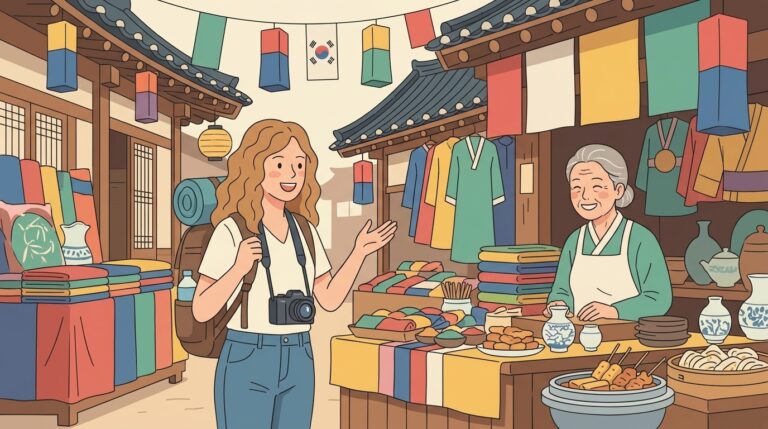
How Much Is This? Master Asking Prices in Korea Like a Local
Phase 1: Empathy (Welcome to Daily Hangul!)
안녕하세요! I’m your Daily Hangul editor and your personal Korean culture guide. Imagine this: You are walking through the vibrant alleys of Hongdae or the bustling stalls of Mangwon Market in Seoul. You spot an adorable handmade phone case or a sizzling hot plate of tteokbokki. Your heart leaps, but then hesitation strikes—How do I ask how much this costs without sounding like a robotic textbook? What if they reply with a super fast number in Korean?
If you’ve ever felt intimidated by asking prices or terrified of getting tangled up in Korean numbers, you are not alone! Countless Korean learners freeze at this exact moment. But don’t worry—asking prices in Korea is actually simple, fun, and a fantastic way to connect with local street vendors and shop owners. Based on real learner feedback, this guide will build your confidence so you can shop like a savvy Seoulite in no time!
Phase 2: Core Phrases Deep Dive
1. 이거 얼마예요? (Igeo eolmayeyo?)
- Pronunciation: [ee-geo eol-mah-yeh-yo] (Sounds like “Eegoo” + “All-my-yeah-yo”)
- Meaning: Literal: “How much is this?” | Nuance: Friendly, standard polite way to ask the price of any item near you.
- K-Culture Moment: You’ll hear this constantly in K-dramas whenever characters browse trendy boutiques in Myeongdong!
- Editor’s Insight: “이거” (igeo) means “this item.” You can simply point to an object and ask “이거 얼마예요?”
- Situation Spectrum: Casual ✅ | Semi-formal ✅ | Formal ⚠️
- 🤔 Think About It: In English, you might ask “How much for this one?” How does pointing while asking help break language barriers in your culture?
2. 모두 얼마예요? (Modu eolmayeyo?)
- Pronunciation: [moh-doo eol-mah-yeh-yo] (Sounds like “Mo-doo all-my-yeah-yo”)
- Meaning: Literal: “How much is it all together?” | Nuance: Perfect when buying multiple items at a market or snack bar.
- K-Culture Moment: Ordering a combination of tteokbokki, fried snacks (twigim), and sundae at a street food cart (pojangmacha).
- Editor’s Insight: “모두” (modu) means “all” or “altogether.” Use this when you have a basket full of items!
- Situation Spectrum: Casual ✅ | Semi-formal ✅ | Formal ⚠️
- 🤔 Think About It: Do you usually calculate the total in your head before paying, or do you prefer asking the cashier for the total?
3. 조금만 깎아 주세요 (Jogeumman ggakka juseyo)
- Pronunciation: [joh-geum-mahn ggah-kkah joo-seh-yo] (Sounds like “Cho-geum-man gga-kka joo-say-yo”)
- Meaning: Literal: “Please give a small discount.” | Nuance: A playful, cute way to negotiate prices in traditional markets.
- K-Culture Moment: Used by travelers at Dongdaemun night markets when buying clothes in bulk or cash!
- Editor’s Insight: Use this with a gentle smile! Note: Only use this in traditional markets or street stalls, never in department stores or convenience stores.
- Situation Spectrum: Casual ✅ | Semi-formal ⚠️ | Formal 🚫
- 🤔 Think About It: Is price haggling common in your country, or are fixed prices strict everywhere?
Phase 3: Textbook Korean vs. Real-Life Korean
Situation 1: Asking the price of a beverage at a cute cafe
- 📖 Textbook Korean: “이것은 얼마입니까?” (Igeoseun eolmainnika? – Extremely formal)
- 🗣️ Real-Life Korean: “이거 얼마예요?” (Igeo eolmayeyo? – Natural & polite)
- 💡 Why the difference?: “-입니까?” is reserved for news broadcasts, military, or formal business presentations. In real life, “-예요?” is the gold standard for polite daily conversation.
Situation 2: Hearing the total price from a street vendor
- 📖 Textbook Korean: “오천 원입니다.” (O-cheon won-imnida. – Textbook formal)
- 🗣️ Real-Life Korean: “오천 원이요!” (O-cheon won-iyo! – Casual polite default)
- 💡 Why the difference?: Adding “~요” to the end of noun phrases is the most natural way native speakers talk in everyday service interactions.
Phase 4: K-Culture Deep Dive & Non-Verbal Manners
4-1. Nunchi (눈치) & Gestures
- Two-Handed Delivery: When handing over your credit card or cash to pay, always hold it with both hands (or support your right forearm with your left hand). This shows immense respect!
- Pointing Etiquette: Instead of pointing aggressively with a single index finger at an item, gestural pointing with an open hand facing upward feels warmer and more polite in Korea.
4-2. Cultural Code Analysis: Shopping Styles
In modern Korea, fixed prices are standard in department stores, convenience stores, and brand chains. However, at traditional markets like Namdaemun or flea markets like Hwanghak-dong, friendly interactions can lead to small discounts or extra goodies known as 서비스 (Seobiseu / Free bonus service)! Building rapport with vendors using polite phrases like “이거 얼마예요?” opens the door to authentic local kindness.
Phase 5: Real-Life Roleplay Scenario
Setting: Alex is at a traditional street market stall trying to buy a souvenir cat mug.
Characters: Alex (Learner, A2) & Market Imo (Friendly Vendor Auntie)
- Alex: 안녕하세요! 이거 얼마예요?
(An-nyeong-ha-se-yo! I-geo eol-ma-ye-yo?)
🎭 Action: Points with an open hand to the cat mug with a bright smile.
“Hello! How much is this?” -
Market Imo: 아, 그거? 만 원이에요!
(A, geu-geo? Man won-i-ye-yo!)
🎭 Action: Holds up the mug proudly.
“Ah, that one? It’s 10,000 won!” -
Alex: 아, 만 원이요? 두 개 사면 조금만 깎아 주세요!
(A, man won-i-yo? Du gae sa-myeon jo-geum-man ggak-ka ju-se-yo!)
🎭 Action: Holds up two fingers and makes a playful, cute expression.
“Ah, 10,000 won? If I buy two, please give me a small discount!” -
Market Imo: 그래? 그럼 두 개에 만 팔천 원에 해 줄게!
(Geu-rae? Geu-rom du gae-e man pal-cheon won-e hae jul-ge!)
🎭 Action: Laughs warmly and nods.
“Really? Then I’ll give you two for 18,000 won!” -
Alex: 와, 감사합니다! 카드 돼요?
(Wa, gam-sa-ham-ni-da! Ka-deu dwae-yo?)
🎭 Action: Reaches into wallet.
“Wow, thank you! Do you take credit cards?” -
Market Imo: 현금이면 더 좋은데~ 카드로 해 줄게!
(Hyeon-geum-i-myeon deo jo-heun-de~ ka-deu-ro hae jul-ge!)
🎭 Action: Takes out card reader.
“Cash is better, but I’ll take card for you!” -
Alex: 여기 있습니다.
(Yeo-gi it-seum-ni-da.)
🎭 Action: Hands over card with both hands.
“Here you go.” -
Market Imo: 고마워요~ 또 와요!
(Go-ma-wo-yo~ tto wa-yo!)
🎭 Action: Hands over bag with two hands.
“Thank you~ Come again!”
🔀 Interactive Choice Point
What should Alex say after receiving the mug bag?
* Choice A: “안녕!” (An-nyeong! – Informal goodbye)
* Choice B: “감사합니다! 많이 파세요!” (Gam-sa-ham-ni-da! Ma-ni pa-se-yo!)
* Choice C: “이거 너무 비싸요!” (I-geo neo-mu bi-ssa-yo!)
Feedback on Choices:
* Choice A (Risk): Too informal! Speaking informal language to older vendors can sound rude.
* Choice B (Best!): Perfect! “많이 파세요!” literally means “Sell a lot!” and is the ultimate polite, warm phrase to say to shopkeepers in Korea.
* Choice C (Bad): Complaining about the price after completing the sale is improper etiquette.
Phase 6: 10-Second Emotion Shadowing Drill
Practice repeating these lines aloud with appropriate vocal emotion:
[😊 Bright & Polite]안녕하세요! / 이거 / 얼마예요?
(An-nyeong-ha-se-yo! / I-geo / eol-ma-ye-yo?)-
[🥺 Playful & Friendly]조금만 / 깎아 주세요~!
(Jo-geum-man / ggak-ka ju-se-yo~!) -
[🎉 Happy & Grateful]와! / 감사합니다! / 많이 파세요!
(Wa! / Gam-sa-ham-ni-da! / Ma-ni pa-se-yo!)
Phase 7: K-Culture Mini Dictionary
- 현금 (Hyeongeum) | Cash | Useful in traditional street food markets where cash or direct transfers are preferred.
- 카드 (Kadeu) | Card | Korea is virtually a cashless society; credit/debit cards are accepted almost everywhere.
- 영수증 (Yeongsujeung) | Receipt | Staff will often ask: “영수증 버려 드릴까요?” (Should I throw away the receipt for you?).
- 봉투 (Bongtu) | Shopping Bag | Bags usually cost 100~500 won extra in Korea due to environmental laws.
Phase 8: Traveler’s Survival Kit
TOP 3 Survival Phrases
- 이거 주세요. (I-geo ju-se-yo.) – “Please give me this one.”
- 카드 돼요? (Ka-deu dwae-yo?) – “Can I pay with card?”
- 봉투 필요 없어요. (Bong-tu pil-yo eop-seo-yo.) – “I don’t need a bag.”
Editor’s Travel Note
When navigating Korea’s markets or checking store reviews, Google Maps often lacks detail. Make sure to download the Naver Map App for Korean Travel Navigation before your trip to look up pricing menus and local retail shop hours easily!
Phase 9: One Step Deeper (Culture & Mindset)
In Korean culture, market transactions are not just monetary exchanges; they are opportunities for human connection, known as 정 (Jeong / warm emotional attachment). Saying a polite greeting and wishing a shopkeeper success (“많이 파세요!”) turns a routine purchase into a heartwarming local experience. Respect and warmth always bring back warmth in return.
💬 Your Turn: What is one thing you are most excited to buy when you visit Korea? Tell us in the comments below!
Phase 10: FAQ & Common Mistakes
Q: What is the difference between Sino-Korean and Native Korean numbers when reading prices?
A: Prices in Korea (like 1,000 won or 5,000 won) always use Sino-Korean numbers (일, 이, 삼, 사, 오… / 천 원, 만 원). You use Native Korean numbers (하나, 둘, 셋…) for counting individual items (e.g., 두 개 = 2 items).
Q: Can I haggle in Seoul department stores or convenience stores?
A: No! Fixed retail stores do not allow price negotiations. Keep haggling exclusively for traditional open-air markets like Namdaemun or Dongdaemun.
Q: How do I say “It’s too expensive” without sounding mean?
A: You can say “조금 비싸요~” (Jo-geum bi-ssa-yo~) with a gentle voice rather than complaining aggressively.
🚨 Common Mistakes TOP 3
- Mistake: Using Native Korean numbers for currency (e.g., saying 하나 원 instead of 일원).
- Correct Action: Always use Sino-Korean numbers for monetary amounts (1,000 won = 천 원 / cheon won).
- Mistake: Handing money or payment cards with only one hand.
- Correct Action: Use both hands to show politeness.
- Mistake: Asking for discounts at a chain retail shop like Olive Young or CU.
- Correct Action: Pay fixed prices at stores; only ask for small discounts at traditional street markets.
Phase 11: Action Missions
- Bronze Mission: Practice saying “이거 얼마예요?” out loud 5 times in front of your mirror.
- Silver Mission: Go to a local Asian market or record a video asking a practice price in Korean and share it on Instagram/TikTok tagging #DailyHangul.
- Gold Mission: Use “이거 얼마예요?” and “카드 돼요?” in real life during your next travel trip to Korea or at a local Korean grocery store!
🎮 K-Culture Mission: Watch a scene from your favorite K-drama set in a market or convenience store and spot how many times characters ask for prices or pay!
Phase 12: Interactive Quiz Challenge
Question 1: Fill in the blank
To ask “How much is this?”, you say: “이거 _______?”
Show Answer & Explanation
Answer: 얼마예요? (eol-ma-ye-yo?)
Explanation: “이거 얼마예요?” is the standard polite phrase for asking prices in everyday conversation.
Question 2: Culture True/False
True or False: It is recommended to bargain for lower prices at convenience stores like GS25 or CU in Korea.
Show Answer & Explanation
Answer: False
Explanation: Fixed-price retail outlets like convenience stores do not allow bargaining. Haggle only at traditional markets!







