

Phase 1: 공감 (Empathy)
안녕하세요! 매일한글 에디터입니다. Have you ever sat down at a cozy K-BBQ or Gimbap shop in Seoul, ordered your meal, and barely had time to check your phone before hot, steaming dishes arrived at your table? That magical 5-minute speed is powered by Korea’s legendary ‘Palli-Palli’ (빨리빨리 – hurry, hurry) service culture!
While this efficiency feels thrilling, it can also leave intermediate Korean learners flustered. What if the server asks you something fast? What if you need to politely check if your meal will arrive quickly because you have a KTX train to catch? Based on real feedback from hundreds of learners, this guide will equip you with authentic, natural expressions and cultural insights so you can navigate fast-paced dining in Korea like a seasoned local!
Phase 2: 핵심 표현 3선 심층 분석 (Core Expressions)
1. 빨리 나올 수 있는 메뉴가 뭐예요? (Palli na-ol su in-neun me-nyu-ga mwo-ye-yo?)
- Pronunciation: [Pahl-li nah-ol soo een-neun meh-nyoo-gah mwo-yeh-yo?] (Think of ‘pahl’ like ‘palm’ without the ‘m’)
- Meaning: Direct: “What menu items can come out quickly?” / Nuance: “What do you recommend if I’m in a hurry?”
- K-Culture Moment: In fast-paced lunch scenes in K-dramas, busy office workers rush into a restaurant during peak hours and ask this exact phrase to grab a quick meal.
- Editor’s Insight: Combining ‘빨리’ (fast) with ‘수 있는’ (able to) shows you respect the staff while expressing your time constraints naturally.
- Situation Spectrum: Casual ⚠️ | Semi-formal ✅ | Formal ✅
- 🤔 Think About It: How does your home country’s dining pace shape the way you interact with restaurant staff compared to Korea’s efficiency-driven dining culture?
2. 음식이 금방 나와요? (Eum-sig-i geum-bang na-wa-yo?)
- Pronunciation: [Eom-seeg-ee geum-bahng nah-wah-yo?] (‘Geum’ sounds like ‘gum’)
- Meaning: Direct: “Will the food come out soon?” / Nuance: “Does this dish take long to prepare?”
- K-Culture Moment: Commonly used at street food stalls or fast-casual eateries like Gimbap Heaven (김밥천국) when you need a quick bite before heading to a concert.
- Editor’s Insight: ‘금방’ (geum-bang) softens your request so you don’t sound demanding or impatient.
- Situation Spectrum: Casual ⚠️ | Semi-formal ✅ | Formal ✅
- 🤔 Think About It: Is asking about food preparation time considered polite or rude in your culture?
3. 이것 좀 더 주시겠어요? (I-geot jom deo ju-si-get-eo-yo?)
- Pronunciation: [Ee-geot jom deoh joo-see-get-eoh-yo?]
- Meaning: Direct: “Could you please give me a bit more of this?” / Nuance: “Can I get a side dish refill, please?”
- K-Culture Moment: Korean dining features free side dish (반찬) refills! Holding up your empty dish with this polite phrase gets instant service.
- Editor’s Insight: The word ‘좀’ (jom) acts as a politeness cushion, making your request sound friendly and courteous.
- Situation Spectrum: Casual 🚫 | Semi-formal ✅ | Formal ✅
- 🤔 Think About It: Why do you think Korean food culture offers unlimited free side dish refills?
Phase 3: 교과서 한국어 vs 진짜 한국어 (Textbook vs Real Korean)
Situation 1: Ordering quickly when you are in a rush
- 📖 교과서 한국어: 제 음식을 빠르게 준비해 주세요. (Je eum-sig-eul bpa-reu-ge jun-bi-hae ju-se-yo.)
- 🗣️ 진짜 한국어: 저희 조금 바쁜데, 금방 나올까요? (Jeo-hui jo-geum ba-ppeun-de, geum-bang na-ol-kka-yo?)
- 💡 왜 다를까?: The textbook sentence sounds like a command. Real Koreans state their own situation softly (“we are a bit busy”) to invite prompt service politely.
Situation 2: Asking for a fast recommendation
- 📖 교과서 한국어: 속도가 빠른 요리를 추천하십시오. (Sok-do-ga ppa-reun yo-ri-reul chu-cheon-ha-sip-si-o.)
- 🗣️ 진짜 한국어: 여기서 제일 금방 나오는 게 뭐예요? (Yeo-gi-seo je-il geum-bang na-o-neun ge mwo-ye-yo?)
- 💡 왜 다를까?: Formal imperative grammar feels unnaturally robotic in casual dining spots. Spoken Korean prefers natural conversational question endings.
Phase 4: K-Culture 딥다이브 & 비언어적 매너 (Deep Dive & Manners)
4-1. Nunchi & Gestures
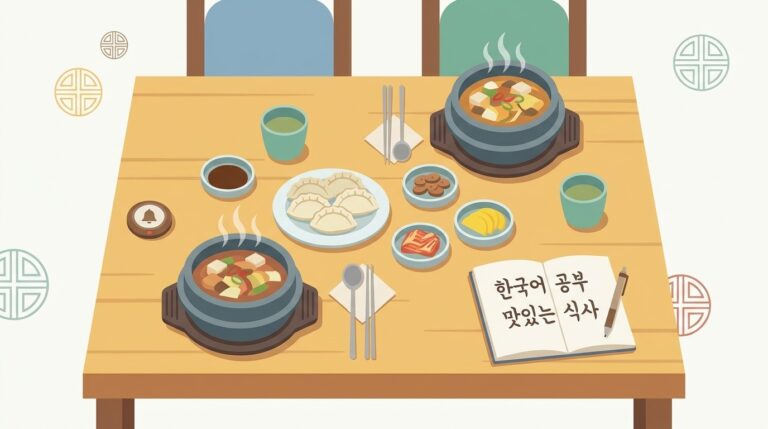
In fast Korean restaurants, look for the table call button (벨 – bel) on the side or corner of the table. Pressing it once makes a clear chime and alerts staff—no need to shout across the room! When asking for refills, holding up the empty dish gently with two hands shows great Nunchi (눈치 – situational tact) and respect.
4-2. Cultural Code Analysis
Fast service in K-Food stems from the post-war industrial era’s high-efficiency mindset, which has evolved into high-tech kitchen prep and hospitality pride. At places serving Seolleongtang (ox bone soup) or Gukbap (rice soup), broth simmers continuously in large kettles, allowing meals to be served in under two minutes!
Phase 5: 실전 롤플레이 시나리오 (Real Roleplay Scenario)
Setting: A bustling eatery near Gangnam Station during peak lunch hour.
NPC: Fast and friendly Ajumma (restaurant staff).
- Ajumma: 어서 오세요! 몇 분이세요? (Eo-seo o-se-yo! Myeot bun-i-se-yo? – Welcome! How many people?) 🎭 [Wiping table quickly with a warm smile]
- Learner: 한 명이요. 저, 혹시 금방 나오는 메뉴 있어요? (Han myeong-i-yo. Jeo, hok-si geum-bang na-o-neun me-nyu it-seo-yo? – Table for one. Excuse me, is there a menu item that comes out quickly?) 🎭 [Looking at watch timidly]
- Ajumma: 김찌나 제육은 3분이면 나와요! (Gim-jji-na je-yug-eun sam-bun-i-myeon na-wa-yo! – Kimchi stew or spicy pork comes out in 3 minutes!) 🎭 [Tapping notepad ready to write]
- Learner: 그럼 제육볶음 하나 주시겠어요? (Geu-reom je-yug-bbok-eum ha-na ju-si-get-eo-yo? – Then could you please give me one spicy pork stir-fry?) 🎭 [Nodding politely]
- Ajumma: 네, 제육 하나요! 물은 셀프입니다~ (Ne, je-yug ha-na-yo! Mul-eun sel-peu-im-ni-da~ – Yes, one spicy pork! Water is self-service~) 🎭 [Shouting order to kitchen]
- Learner: 네, 감사합니다! 혹시 공깃밥도 나오나요? (Ne, gam-sa-ham-ni-da! Hok-si gong-git-bpap-do na-o-na-yo? – Yes, thank you! Does it come with a bowl of rice?) 🎭 [Reaching for utensils in table drawer]
- Ajumma: 그럼요, 찌개랑 볶음은 밥 포함이에요! (Geu-reom-yo, jji-gae-rang bbok-eum-eun bpap po-ham-i-e-yo! – Of course, stews and stir-fries include rice!) 🎭 [Placing side dishes down within seconds]
- Learner: 와, 진짜 빠르네요! 잘 먹겠습니다. (Wa, jin-jja ppa-reu-ne-yo! Jal meok-get-seum-ni-da. – Wow, really fast! I will enjoy the meal.) 🎭 [Smiling brightly]
🔀 Interactive Branch
The food arrives in 3 minutes, but you need extra water and side dishes. What do you do?
* Option A: Press the table call button and say “여기 반찬 좀 더 주시겠어요?”
* Option B: Walk directly into the restaurant kitchen and ask for more side dishes.
* Option C: Sit quietly and finish your meal without asking.
Feedback:
* Option A (Best): Perfect! Using the table call button with a polite request is the standard local way.
* Option B (Risk): Entering commercial kitchens violates hygiene rules and startles the kitchen staff!
* Option C (Bad): You will miss out on free side dish refills and wait unnecessarily in a self-service dining culture.
Phase 6: 10초 감정 섀도잉 드릴 (Shadowing Drill)
- [😊 Friendly & Seeking Fast Recommendation]
여기서 / 제일 금방 나오는 게 / 뭐예요?
(Yeo-gi-seo / je-il geum-bang na-o-neun ge / mwo-ye-yo?) -
[🥺 Slightly Hurried & Polite Tone]
저희가 / 조금 바빠서 그러는데 / 금방 나올까요?
(Jeo-hui-ga / jo-geum ba-ppa-seo geu-reu-neun-de / geum-bang na-ol-kka-yo?) -
[😋 Enthusiastic & Grateful Tone]
와 / 진짜 빠르게 나오네요! / 잘 먹겠습니다!
(Wa / jin-jja ppa-reu-ge na-o-ne-yo! / jal meok-get-seum-ni-da!)
Phase 7: K-Culture 미니 사전 (Mini Dictionary)
- 빨리빨리 (Palli-palli) | Hurry-hurry | The cultural impulse for speed, efficiency, and prompt service across South Korea.
- 이모님 (I-mo-nim) | Auntie / Staff | Respectful and affectionate address used for female staff in casual eateries.
- 셀프 (Sel-peu) | Self-service | Sign indicating customers retrieve their own water, utensils, or extra side dishes.
- 공깃밥 (Gong-git-bpap) | Bowl of rice | Standard stainless steel bowl of warm white rice served with meals.
Phase 8: 여행자를 위한 생존 키트 (Traveler’s Kit)
Survival Expressions
- 금방 나와요? (Geum-bang na-wa-yo?) – Does it come out quickly? (Pro Tip: Use when ordering during busy hours)
- 이모님, 주문할게요! (I-mo-nim, ju-mun-hal-ge-yo!) – Auntie, I would like to order! (Pro Tip: Use when there is no call button)
- 포장해 주세요 (Po-jang-hae ju-se-yo) – Please wrap it to go. (Pro Tip: Useful if you need to leave quickly)
Editor’s Travel Note: Use the Naver Map App to check restaurant peak hours and reviews beforehand!
Phase 9: “한 발 더 깊이” (One Step Deeper)
Korean speed culture is not about impatience; it represents deep respect for another person’s time. Serving a hot meal within five minutes is a restaurant’s way of demonstrating hospitality and care. Recognizing this efficiency turns potential pressure into mutual appreciation.
💬 Your Turn: What was your fastest restaurant experience ever? Share your story in the comments below!
Phase 10: FAQ & 흔한 실수 (FAQ & Mistakes)
Q: Is it impolite to ask if the food will come out quickly?
A: Not at all! As long as you use polite language like “금방 나올까요?”, staff are happy to recommend quick dishes.
Q: What should I do if my food takes longer than expected?
A: Gently press the call button or ask “저기요, 저희 음식 언제쯤 나올까요?” (Excuse me, about when will our food come out?).
Q: Are all side dish refills free in traditional restaurants?
A: Yes! Standard side dishes (반찬) are free and refillable in almost all traditional Korean dining spots.
🚨 Common Mistakes TOP 3
- Mistake: Yelling “야!” (Ya!) to get attention. Correct Action: Say “저기요” (Jeo-gi-yo) or press the table call button.
- Mistake: Entering kitchen areas for extra water. Correct Action: Look for designated self-service stations (셀프 바) in the dining area.
- Mistake: Leaving payment cash on the dining table. Correct Action: Bring your bill slip to the front counter register near the exit.
Phase 11: 액션 미션 & 참여 유도 (Action Mission)
- Bronze Mission: Practice saying “금방 나오나요?” out loud 3 times with proper intonation.
- Silver Mission: Write a sentence using “이것 좀 더 주시겠어요?” in the comments.
- Gold Mission: Visit a Korean eatery or practice ordering in Korean using your fast recommendation phrases!
- 🎮 K-Culture Mission: Watch a Korean food vlog and spot the table call button or “셀프” sign in action!
Phase 12: 인터랙티브 퀴즈 챌린지 (Quiz Challenge)
- How do you politely ask which dish comes out fastest?
A) 이거 비싸요?
B) 여기서 제일 금방 나오는 게 뭐예요?
C) 물 주세요. -
True or False: Tipping is required if your food arrives under 5 minutes in Korea.
Click for Answers & Explanations
1. Answer: B! “여기서 제일 금방 나오는 게 뭐예요?” asks for the fastest meal option.
2. Answer: False! Tipping is non-existent in Korea; fast service is standard hospitality.







