

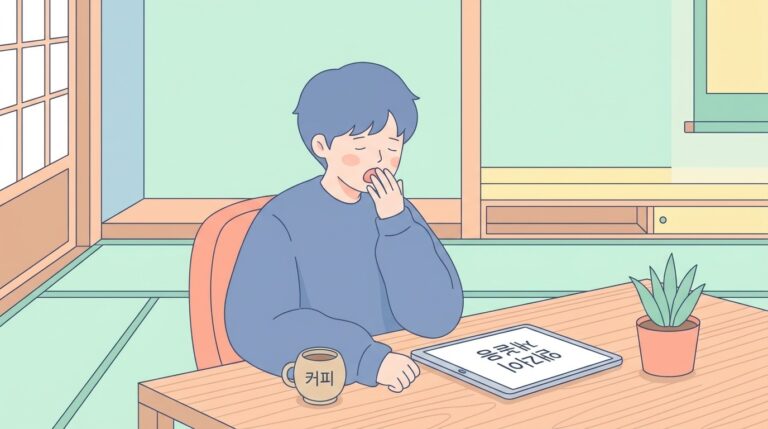
How to Express Boredom in Korean: Yawning Your Way Through Boring Moments Like a Native
Phase 1: Empathy – We’ve All Been There!
안녕하세요! Welcome back to Daily Hangul! It’s your favorite bestie and Korean culture navigator here. Have you ever sat through a two-hour lecture, a dragging office meeting, or a movie that felt like it would never end, feeling your eyelids get heavier by the second? Suddenly, your mouth stretches wide, and a giant yawn escapes before you can stop it!
Expressing boredom appropriately is an essential part of natural communication, but doing it in Korean requires a bit of finesse. You want to sound natural without being rude to your friends or elder colleagues. Many B1 learners know basic words like ‘지루하다’ (to be boring), but they struggle to express real emotional depth—like yawning from sheer boredom or feeling restless. In this guide, based on real feedback from hundreds of intermediate learners, you’ll master how to express boredom with authentic local flair while keeping your etiquette intact!
Phase 2: Core Expressions Deep Dive
1. 지루해서 하품이 나와요 (Jiruhaeseo hapumi nawayo)
- Pronunciation: [Ji-ru-hae-seo ha-pum-i na-wa-yo] (Sounds like ‘jee-roo-hae-seo hah-poom-ee nah-wah-yo’)
- Meaning: Literally: “I am yawning because it’s boring.” | Real Nuance: “It’s so dull I can’t keep from yawning.”
- K-Culture Moment: You often see this in K-dramas when the lead characters are stuck listening to a long, tedious speech by a school principal or company director.
- Editor’s Insight: ‘하품이 나오다’ means ‘a yawn comes out’. In Korean, emotions or bodily reactions are often described as happening to you naturally rather than something you actively force.
- Situation Spectrum: Casual ✅ | Semi-formal ✅ | Formal ⚠️ (Be careful using this around bosses!)
- 🤔 Think About It: Does your native language express boredom as a passive physical reaction like Korean does?
2. 따분해 죽겠어요 (Ttabunhae jukgesseoyo)
- Pronunciation: [Tta-bun-hae juk-ges-seo-yo] (Sounds like ‘ttah-boon-hae jook-get-seh-yo’)
- Meaning: Literally: “It’s so dull I could die.” | Real Nuance: “I’m dying of boredom.”
- K-Culture Moment: Used when hanging out at home on a rainy Sunday afternoon with nothing to watch or do.
- Editor’s Insight: Koreans love using ‘~죽겠다’ (dying of…) to exaggerate physical and emotional states. It adds immediate natural warmth and conversational flair.
- Situation Spectrum: Casual ✅ | Semi-formal ✅ | Formal 🚫
3. 심심해서 온몸이 쑤셔요 (Simsimhaeseo onmomi ssusyeoyo)
- Pronunciation: [Sim-sim-hae-seo on-mom-i ssu-syeo-yo] (Sounds like ‘seem-seem-hae-seo ohn-mom-ee ssoo-syeo-yo’)
- Meaning: Literally: “I’m so bored my whole body aches.” | Real Nuance: “I’m so bored I’m going crazy / getting restless.”
- K-Culture Moment: Often heard among friends during long weekend breaks when everyone is stuck indoors.
- Editor’s Insight: While ‘지루하다’ implies that an event itself is uninteresting, ‘심심하다’ refers to having nothing fun to do. Saying your body aches adds dramatic humor!
- Situation Spectrum: Casual ✅ | Semi-formal ⚠️ | Formal 🚫
Phase 3: Textbook Korean vs. Real Korean
Situation 1: Sitting in a slow, tedious presentation
- 📖 Textbook: 매우 지루해서 하품을 합니다. (Maeu jiruhaeseo hapumeul hamnida.)
- 🗣️ Real Korean: 아, 진짜 지루해서 하품만 나오네. (A, jinjja jiruhaeseo hapumman nawone.)
- 💡 Why is it different? Native speakers rarely use formal textbook markers like ‘매우’ in spoken banter. They use ‘진짜’ (really) and attach ‘~만 나오다’ (only keeps coming out) to highlight repetition.
Situation 2: Waiting for a friend who is 40 minutes late
- 📖 Textbook: 기다리는 동안 지루했습니다. (Gidarineun dongan jiruhaessseumnida.)
- 🗣️ Real Korean: 심심해서 죽는 줄 알았잖아! (Simsimhaeseo jungneun jul aratjana!)
- 💡 Why is it different? Saying ‘지루했습니다’ sounds like a official report! ‘~죽는 줄 알았다’ (I thought I was gonna die) dramatically expresses how long and boring the wait felt.
Phase 4: K-Culture Deep Dive & Non-verbal Manners
4-1. Nunchi (눈치) & Yawning Etiquette in Korea
In Korea, reading the room (Nunchi) is everything. If you yawn openly in front of a senior colleague, teacher, or elder, it can be viewed as disrespectful. If you feel a yawn coming during a long lecture or meeting:
1. Cover your mouth: Always use your hand or a notebook to cover your mouth completely.
2. Look Down Slightly: Avoid direct eye contact with the speaker while yawning.
3. The Subtle Stretch: Tilt your head slightly down and pretend to take a deep breath to mask it.
4-2. Cultural Code: The Drama Trope of Boredom
In Korean romantic comedies, when two characters are on an awkward blind date (맞선), one character will exaggeratedly yawn or check their watch to signal, “This date is going nowhere!” Expressing boredom indirectly through polite body language is an art form in Korean social dynamics.
Phase 5: Interactive Roleplay Scenario
Setting: You and your Korean friend Minjun (민준) have been stuck in an uninteresting university seminar for 90 minutes.
- Minjun: [🎭 Whispering while sighing] 아, 이 강의 언제 끝나는 거야?
(Ah, i gangui eonje kkeutnaneun geoya? / Ah, when is this lecture going to end?) - You: [🎭 Covering your mouth to hide a yawn] 진짜… 지루해서 하품이 끊이지 않아.
(Jinjja… jiruhaeseo hapumi kkeun-iji ana. / Seriously… it’s so boring my yawns won’t stop.) - Minjun: [🎭 Nodding quietly] 나도. 졸려 죽겠어. 나중에 커피 마시러 갈래?
(Nado. Jollyeo jukgesseo. Najunge keopi masireo gallae? / Me too. I’m dying of sleepiness. Want to grab coffee later?) - You: [🎭 Smiling subtly] 응, 빨리 나아가자. 심심해서 온몸이 쑤셔.
(Eung, ppalli naagaja. Simsimhaeseo onmomi ssusyeo. / Yeah, let me out soon. I’m so bored my whole body aches.)
🔀 Interactive Choice Point
Minjun’s professor suddenly stops and asks you a question! How do you respond?
* Choice A: “죄송합니다, 너무 지루해서 하품이 나왔습니다!” (Sorry, I was so bored I yawned!)
* Choice B: “죄송합니다, 잠시 집중력이 흐려졌습니다.” (Sorry, I lost my focus for a moment.)
* Choice C: “너무 심심해서 딴생각했어요.” (I was so bored I was daydreaming.)
Feedback:
* Choice A (Risk): Too honest! Saying the class is ‘지루하다’ directly to a professor is considered offensive.
* Choice B (BEST): Polite, accountable, and uses mature B1 level vocabulary without offending the teacher!
* Choice C (Bad): Blatantly rude in an academic or formal Korean context.
Phase 6: 10-Second Emotion Shadowing Drill
Practice reading these out loud with full emotion! Pay attention to the / pause marks.
- [🥱 Exhausted & Yawning]
아... / 진짜 지루해서 / 하품이 계속 나오네.
(A… / jinjja jiruhaeseo / hapumi gyesok nawone.) - [😫 Whiny & Playful]
아, 심심해! / 오늘 따분해 죽겠어!
(A, simsimhae! / oneul ttabunhae jukgesseo!) - [😴 Drowsy & Quiet]
졸려서 / 눈이 자꾸 감겨요...
(Jollyeoseo / nuni jakku gamgyeoyo…)
Phase 7: K-Culture Mini Dictionary
- 하품 (Hapum) | Noun | Yawn. (e.g., 하품을 참다 – to hold back a yawn)
- 따분하다 (Ttabunhada) | Adjective | Dull, tedious, monotonous.
- 눈치채다 (Nunchichaeda) | Verb | To notice or catch on to social cues.
- 멍때리다 (Meongttaerida) | Slang Verb | To zone out / stare blankly into space.
Phase 8: Traveler’s Survival Kit
TOP 3 Boredom & Fatigue Expressions
- 좀 피곤해서 하품이 나와요. (I’m a bit tired so I’m yawning – polite excuse for yawning!)
- 너무 졸려요. (I am very sleepy.)
- 잠깐 바람 좀 쐬고 올게요. (I’ll go get a breath of fresh air – great way to step out during a boring moment.)
- Editor’s Travel Note: Struggling to find a fun spot to beat boredom in Seoul? Use the Naver Map Navigation App to search for local board game cafes (보드게임카페) or coin karaoke rooms (코인노래방) nearby!
Phase 9: One Step Deeper
In Western cultures, honesty about one’s state of mind (“I’m bored”) is often seen as transparent. However, in Korean culture, which values group harmony and consideration (배려), expressing boredom directly can imply that the speaker or host is entertaining you poorly. Learning to disguise boredom—or expressing it jokingly only with close peers—is a key step toward true cultural fluency.
💬 Your Turn: How do you politely signal that you’re bored in your own culture without being rude? Let us know in the comments below!
Phase 10: FAQ & Common Mistakes
Q: What is the difference between 지루하다 and 심심하다?
A: 지루하다 describes an activity or situation that is boring (e.g., a long movie). 심심하다 describes a personal state of having nothing to do (e.g., sitting alone at home).
Q: Is it okay to say ‘하품 나와요’ to my boss?
A: No, it’s better to say “피곤해서 잠시 바람 좀 쐬고 오겠습니다” (I’m a bit tired so I’ll step out for air).
Q: Can I use ‘죽겠다’ with older people?
A: Avoid using ‘~죽겠다’ with superiors or elders, as it sounds very casual and informal.
🚨 Common Mistakes Alert
- ❌ Mistake: Saying “저는 지루해요” to mean “I am bored”.
- ⭕ Correct Action: Say “심심해요” (I have nothing to do) or “지루한 시간을 보내고 있어요”.
Phase 11: Action Missions
- 🥉 Bronze Mission: Record yourself practicing the Phase 6 shadowing sentences 3 times.
- 🥈 Silver Mission: Share your favorite expression from today on your Instagram story and tag @DailyHangul!
- 🥇 Gold Mission: Try using “하품이 나와요” in your next Korean tutoring session when discussing daily routines.
- 🎮 K-Culture Mission: Watch an episode of a Korean variety show (like Running Man) and spot a celebrity saying “아, 심심해!”.
Phase 12: Interactive Quiz Challenge
Q1. Fill in the blank: “너무 지루해서 ______이/가 나와요.” (It’s so boring I’m ____ing.)
Click to view answer & explanation
Answer: 하품 (Hapum / Yawn). Complete sentence: “너무 지루해서 하품이 나와요.”
Q2. True or False: Saying “심심해서 죽겠어” is appropriate to say to your university professor.
Click to view answer & explanation
Answer: False. It contains casual slang (~죽겠어) suitable only for close friends.







