

Phase 1: Welcome! Your Heart Fluttering Valentine’s Mission Starts Here
안녕하세요! This is your Daily Hangul editor and favorite culture navigator. If you’ve been watching K-dramas lately, you might have noticed a very specific, butterflies-in-the-stomach trope: the heroine nervously holding a cute, beautifully wrapped box of chocolates behind her back before handing it over to her crush. In Korea, Valentine’s Day (February 14th) holds a unique cultural twist—traditionally, it is the day women give chocolates to men to express their romantic interest or appreciation! (Don’t worry, guys get their turn to reciprocate on White Day on March 14th!)
Preparing handmade or specially chosen chocolates is a major milestone when you’re in the ‘Ssome’ (썸 – the sweet pre-dating stage) with someone you like in Korea. But as an international learner, you might wonder: What do I say when I hand over the box? Is it too cheesy to say ‘I love you’? How do I sound cute and sincere without making things super awkward?
Don’t worry! After guiding thousands of Korean learners through their real-life romantic endeavors, I’ve crafted this foolproof guide tailored to intermediate (B1) learners. By the end of this lesson, you will master natural, flattering expressions and subtle cultural etiquette that will leave an unforgettable impression on your special someone!
Phase 2: Deep Dive into 3 Essential Phrases
1. 이거 직접 만들었어요
- Pronunciation: [I-geo jik-jeob man-deul-eo-sseo-yo] (Feels like: Ee-geo jeek-job mahn-deul-uh-ssuh-yo)
- Meaning: Literally “I made this directly,” used naturally as “I made this myself.”
- K-Culture Moment: Seen in almost every high school or university K-drama where the female lead stays up late tempering chocolate and putting cute decorations on cake pops.
- Editor’s Insight: Mentioning that you made it yourself instantly conveys deep effort and warm sincerity. If you bought high-end artisanal chocolates instead, you can swap this with “이거 맛있다고 해서 사왔어요” (I heard these are delicious, so I bought them for you).
- Situation Spectrum: Casual ✅ | Semi-formal ✅ | Formal ⚠️
- 🤔 Think About It: In your culture, is handmade gifting seen as romantic or overly intense early in a relationship?
2. 부담 가지지 말고 받으세요
- Pronunciation: [Bu-dam ga-ji-ji mal-go bat-deu-se-yo] (Feels like: Boo-dam gah-jee-jee mahl-go baht-deu-seh-yo)
- Meaning: Literally “Don’t have a burden and accept it,” meaning “Please take this without feeling pressured.”
- K-Culture Moment: Used when giving gifts to someone you respect or suspect might feel indebted by receiving a thoughtful gift.
- Editor’s Insight: Korean social harmony values Jung (정) and mutual obligation. Telling someone not to feel burdened (부담) relaxes the atmosphere and prevents social pressure.
- Situation Spectrum: Casual ⚠️ | Semi-formal ✅ | Formal ✅
- 🤔 Think About It: Why does Korean culture place such high emotional weight on preventing the recipient from feeling burdened?
3. 제 마음이에요
- Pronunciation: [Je ma-eum-i-e-yo] (Feels like: Jeh mah-eum-ee-eh-yo)
- Meaning: Literally “It’s my heart/mind,” translated as “This is a small token of my affection.”
- K-Culture Moment: The classic line said with a shy smile while extending a gift bag with both hands.
- Editor’s Insight: 마음 (Heart/Sincerity) is a powerful Korean emotional word. Saying 제 마음이에요 communicates fond sentiment without forcing an immediate formal confession (고백).
- Situation Spectrum: Casual ✅ | Semi-formal ✅ | Formal ✅
- 🤔 Think About It: How does saying “It’s my heart” differ from directly saying “I like you” in your native language?
Phase 3: Textbook Korean vs. Real Korean
Situation 1: Handing over the chocolates
- 📖 Textbook Korean: “이 초콜릿을 당신에게 드립니다.” (I give this chocolate to you.)
- 🗣️ Real Korean: “이거 별건 아닌데, 드시라고 가져왔어요!” (It’s nothing crazy, but I brought it for you to try!)
- 💡 Why is it different? Koreans prefer modest, humble phrasing (별건 아닌데 – It’s not much) to avoid sounding overly grand or boastful.
Situation 2: Expressing your hope that they enjoy it
- 📖 Textbook Korean: “나의 마음을 받아주십시오.” (Please accept my heart.)
- 🗣️ Real Korean: “입에 맞았으면 좋겠어요!” (I hope it suits your taste!)
- 💡 Why is it different? Focus on the recipient’s personal enjoyment (입에 맞다 – suits one’s palate) feels far more natural and sweet than dramatic declarations.
Phase 4: K-Culture Deep Dive & Non-Verbal Etiquette
4-1. Nunchi (눈치) & Gestures
- The Two-Handed Hold (두 손): Always hold the gift box with both hands when handing it over. It conveys deep politeness and respect.
- Eye Contact & Smile: Eye contact in Korean culture shouldn’t be an intense stare. Hold eye contact for 2 seconds with a soft smile, then look down slightly at the gift as you offer it.
- Modest Demeanor: Don’t boast about how expensive or hard it was to make. Modesty makes the gesture twice as charming.
4-2. Cultural Code Analysis: Valentine’s Day vs. White Day
In Western countries, Valentine’s Day is usually mutual. In Korea, February 14th is the female-to-male giving day. March 14th (White Day) is when males return the favor, often with candies or gifts. April 14th is ‘Black Day’, where single friends who received nothing eat Jajangmyeon (black bean noodles) together! Knowing this cycle helps you navigate local romantic expectations seamlessly.
Phase 5: Real Roleplay Scenario
Setting: A cozy cafe in Hongdae on February 14th afternoon. You are sitting across from Minwoo (민우), your close Korean friend with whom you have mutual romantic interest.
- Turn 1 (You): 민우 씨, 오늘 발렌타인데이인 거 알아요? (Minwoo, do you know today is Valentine’s Day?)
- Turn 2 (Minwoo): 아, 맞다! 오늘 14일이죠? 시간 진짜 빠르네요. (Ah, right! Today is the 14th? Time really flies.)
- Turn 3 (You): 🎭 Pulling out a nicely wrapped pink box with both hands
이거 별건 아닌데, 민우 씨 드시라고 가져왔어요. (It’s nothing much, but I brought this for you to eat.) - Turn 4 (Minwoo): 어? 진짜요? 와, 감사합니다! 이거 직접 만든 거예요? (Huh? Really? Wow, thank you! Did you make this yourself?)
- Turn 5 (You): 🎭 Smiling blushingly
네, 주말에 직접 만들었어요. 부담 가지지 말고 드세요! (Yes, I made it myself over the weekend. Please enjoy it without feeling burdened!) - Turn 6 (Minwoo): 와… 정성이 대단해요. 모양도 진짜 예뻐요! (Wow… your effort is amazing. The shape is really pretty too!)
- Turn 7 (You): 제 마음이니까 맛있게 먹어줘요. (It’s my small token of affection, so please enjoy eating it.)
- Turn 8 (Minwoo): 너무 고마워요. 화이트데이 때 기대하세요! (Thank you so much. Look forward to White Day!)
🔀 Interactive Choice Point
Minwoo asks: “Did you make this yourself?” How do you answer?
* Option A: “네, 밤새워서 만들었어요. 꼭 다 드셔야 해요!” (Yes, I stayed up all night making it. You MUST eat all of it!)
* Option B: “네! 부족하지만 열심히 만들었어요. 입에 맞았으면 좋겠어요.” (Yes! It’s not perfect, but I worked hard making it. I hope you like the taste.)
* Option C: “아니요, 사왔어요. 돈 많이 들었어요.” (No, I bought it. It cost a lot of money.)
Feedback:
* Option A (Risk): Demanding they eat all of it after mentioning staying up all night creates emotional pressure (부담).
* Option B (BEST): Perfect balance of charm, modesty, and sincere consideration!
* Option C (Bad): Talking about money destroys the romantic mood completely.
Phase 6: 10-Second Emotion Shadowing Drill
[😊 Shy but playful]
이거 / 별건 아닌데 / 드시라고 / 가져왔어요!
(I-geo / byeol-geon a-nin-de / deu-si-ra-go / ga-jyeo-wa-sseo-yo!)-
[🥺 Warm and tender]
부담 가지지 말고 / 편하게 / 받으세요.
(Bu-dam ga-ji-ji mal-go / pyeon-ha-ge / bat-deu-se-yo.) -
[❤️ Soft and sincere]
작지만 / 제 마음이에요 / 맛있게 먹어요!
(Jak-ji-man / je ma-eum-i-e-yo / ma-sit-ge meok-eo-yo!)
Phase 7: K-Culture Mini Dictionary
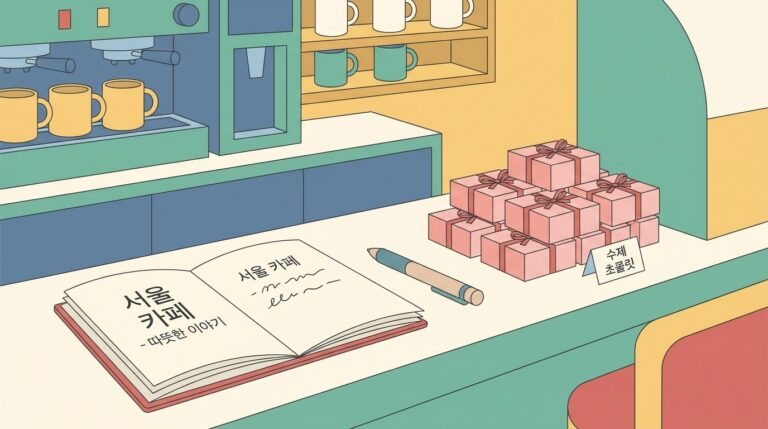
- 수제 초콜릿 (Suje Chokkollit): Handmade chocolate. Adding ‘수제’ (handmade) to foods implies high effort, taste, and quality.
- 고백 (Gobaek): Romantic confession. In Korea, official dating usually starts after an explicit confession (“Will you date me?”).
- 썸 (Ssome): The ambiguous ‘something’ stage between two people who like each other before officially dating.
- 화이트데이 (White Day): March 14th, when men return chocolates/candies to women who gave them gifts on Valentine’s Day.
Phase 8: Survival Kit for Travelers & Romantics
Survival Expressions TOP 3
- 이거 포장해 주세요. (I-geo po-jang-hae ju-se-yo) – Please gift wrap this.
- 추천해 주실 수 있나요? (Chu-cheon-hae ju-sil su in-na-yo?) – Can you recommend a popular chocolate box?
- 메시지 카드도 있나요? (Me-si-ji ka-deu-do in-na-yo?) – Do you also have a gift message card?
Editor’s Travel Note
Looking for the best romantic chocolate shops in Seoul? Check trendy neighborhoods like Seongsu-dong or Yeonnam-dong. Make sure you use the Naver Map App Download to find local boutique chocolatiers rated highly by Korean locals, as KakaoMap and Naver Map provide far more accurate shop hours than international apps.
Phase 9: One Step Deeper (Thinking Question)
In Korean culture, romantic expressions often balance direct warmth with gentle modesty. Rather than grand, dramatic speeches, true affection is shown through thoughtful actions, soft wording, and reducing emotional burdens on your partner. This reflects Korea’s collectivist value of harmony and considerate care (배려).
💬 Your Turn: How are Valentine’s Day gifts usually given in your country? Do you prefer direct declarations or subtle, sweet gestures? Let me know in the comments below!
Phase 10: FAQ & Common Mistakes
Q: Can I give Valentine’s chocolates to male coworkers or male friends in Korea?
A: Yes! This is called ‘Uiri Chocolate’ (의리 초콜릿 – friendship/courtesy chocolate). Just keep the packaging casual and say “오다 가다 샀어요, 드세요!” (I picked this up on the way, enjoy!) to keep it strictly friendly.
Q: Should I include a hand-written note?
A: Absolutely! A short 1-2 sentence hand-written card inside the bag adds massive romantic charm in Korea.
Q: What if I am a guy? Can I give chocolates on February 14th in Korea?
A: Yes, it’s completely fine! While traditionally women give gifts on Feb 14th, modern young Koreans frequently exchange gifts on both days.
🚨 Common Mistakes TOP 3
- Mistake: Using excessive honorifics like “이것을 당신에게 바칩니다” (I dedicate this to you).
- Correct Action: Use natural B1 level phrasing: “이거 드시라고 가져왔어요.”
- Mistake: Giving the gift with only one hand.
- Correct Action: Always present the gift bag with both hands.
- Mistake: Demanding an instant answer or confession on the spot.
- Correct Action: Give them space and time to enjoy the chocolate and respond comfortably.
Phase 11: Action Mission & Engagement
Action Mission 3 Steps
- 🥇 Bronze: Practice Phase 6 emotion shadowing out loud 3 times in front of a mirror!
- 🥈 Silver: Write a cute 1-sentence note in Korean: “맛있게 먹고 행복한 하루 보내요!”
- 🥇 Gold: Use “이거 별건 아닌데, 드세요!” when giving a treat or coffee to a friend or colleague this week.
🎮 K-Culture Mission
Watch a romantic K-drama clip featuring Valentine’s Day or gift-giving. See if you can spot the character presenting the gift with both hands!
Phase 12: Interactive Quiz Challenge
Question 1: What is the most appropriate gesture when handing a gift in Korea?
A) Toss it playfully with one hand
B) Hold it with both hands with a gentle smile
C) Place it on the floor in front of them
Click to reveal answer
Correct Answer: B
Handing gifts with both hands demonstrates respect, warmth, and sincerity in Korean etiquette.
Question 2: Complete the sentence for a humble, sweet gift delivery:
“이거 ______ 아닌데, 드시라고 가져왔어요.”
A) 사랑
B) 별건
C) 가격
Click to reveal answer
Correct Answer: B (별건)
별건 아닌데 means “It’s nothing special/much,” which is the classic modest Korean expression.







