

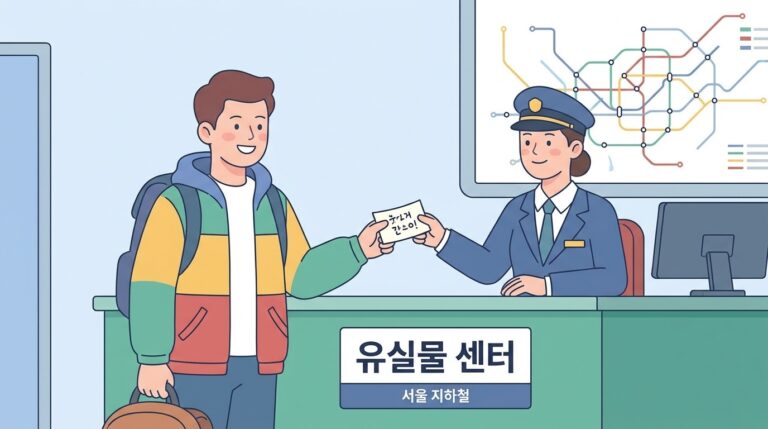
Lost Something in Korea? How to Ask Someone to Call You If Found
Phase 1: Empathy (Story-Driven Opening)
안녕하세요! 매일한글 에디터입니다. (Hello! This is your Daily Hangul editor!)
Picture this: You just stepped off a bustling subway train at Hongdae Station after a wonderful day of shopping, K-beauty hauls, and street food. You reach into your pocket for your phone to check the map… but it’s empty! Your heart drops. Your photos, hotel details, and mobile pay cards are all on that phone.
Panicked, you hurry to the station lost and found office or return to the cafe where you last sat. You know the staff wants to help, but how do you tell them in polite Korean: “Please call me if you find it” or “I’ll leave my contact number”?
Losing an item in a foreign country can feel overwhelming. But here is the comforting truth: South Korea is legendary for its high rate of returned lost items! People frequently turn in lost wallets, bags, and smartphones to station offices or police boxes. Today, based on real feedback from international learners, we will master three simple, natural A2-level Korean expressions so you can confidently ask staff to contact you when your lost item turns up!
Phase 2: Core 3 Expressions Deep Dive
1. 찾으시면 연락 주세요 (Chajeusimyeon yeollak juseyo)
- Pronunciation: [Chah-jeu-si-myeon yeol-lak joo-seh-yo] (Sounds like “yeol-lak” with a smooth flowing L sound)
- Meaning: Literal: “If you find it, please contact me.” | Real Nuance: A polite, natural request asking staff or employees to reach out if your item turns up.
- K-Culture Moment: In K-dramas, whenever a protagonist drops a sentimental key ring or notebook at a neighborhood convenience store, they leave a sticky note saying, “찾으시면 연락 주세요!”
- Editor’s Insight: Combining “찾다” (to find/look for) with honorific “-으시면” shows respectful manners to service staff.
- Situation Spectrum: Casual: ⚠️ | Semi-formal: ✅ | Formal: ✅
- 🤔 Think About It: How does adding honorific suffixes in Korean reflect the cultural value of mutual respect in public interactions?
2. 연락처 남겨드릴게요 (Yeollakcheo namgyeodeureilgeyo)
- Pronunciation: [Yeol-lak-cheo nam-gyeo-deu-ril-geh-yo] (Think of “namgyeod” sliding into “reil-geyo”)
- Meaning: Literal: “I will leave my contact info for you.” | Real Nuance: Proactively offering your phone number or email so they can log it in their records.
- K-Culture Moment: Commonly heard at hotel front desks or subway customer service centers when reporting lost luggage.
- Editor’s Insight: Using “-드릴게요” (I will humbly give to you) makes your offer sound very polite and cooperative.
- Situation Spectrum: Casual: 🚫 | Semi-formal: ✅ | Formal: ✅
- 🤔 Think About It: In your home country, do lost and found counters usually take down contact numbers on physical paper or digital logs?
3. 혹시 들어오면 알려주세요 (Hoksi deureoomyeon allyeojuseyo)
- Pronunciation: [Hok-si deu-reo-oh-myeon al-ryeo-joo-seh-yo]
- Meaning: Literal: “If it happens to come in, please let me know.” | Real Nuance: Softly asking staff to notify you if someone brings your item in later.
- K-Culture Moment: Used in cozy cafes or restaurants when you think you left an umbrella or scarf behind earlier that day.
- Editor’s Insight: “혹시” (by any chance) acts as a gentle conversational buffer in Korean, softening your request.
- Situation Spectrum: Casual: ⚠️ | Semi-formal: ✅ | Formal: ✅
- 🤔 Think About It: Why does starting a request with “by any chance” make conversations feel warmer in Korean society?
Phase 3: Textbook Korean vs. Real Korean
Scenario 1: Asking staff to contact you
* 📖 Textbook Korean: 제 물건을 찾으면 전화하십시오. (Je mulgeoneul chajeumyeon jeonhwahasipsio. – Too rigid/military-style)
* 🗣️ Real Korean: 찾으시면 연락해 주세요! (Chajeusimyeon yeollakhae juseyo!)
* 💡 Why the difference? “전화하십시오” sounds like a strict command from an old manual. “연락해 주세요” is warm, natural, and friendly for A2 speakers.
Scenario 2: Offering to write down your phone number
* 📖 Textbook Korean: 제 전화번호를 여기에 적겠습니다. (Je jeonhwabeonhoreul yeogie jeokgesseumnida.)
* 🗣️ Real Korean: 제 연락처 남겨드릴게요! (Je yeollakcheo namgyeodeureilgeyo!)
* 💡 Why the difference? “연락처” (contact details) encompasses phone numbers, messenger IDs, or emails, making it far more versatile for travelers.
Phase 4: K-Culture Deep Dive & Non-Verbal Manners
4-1. Nunchi & Gestures
When asking staff to take your contact info, bow your head slightly (about 15 degrees) while handing over your written phone number using both hands. Holding paper or your phone with both hands shows sincerity and gratitude, signaling that you deeply appreciate their effort to help.
4-2. Culture Code: Lost and Found Magic in Korea
Korea has one of the safest lost-and-found ecosystems in the world! Subway stations operate centralized Lost & Found Centers (유실물센터), and police run an integrated online lost-and-found database called LOST112. It is customary for citizens who find lost wallets or electronics to hand them directly to a station master, bus driver, or nearby police officer.
Phase 5: Real-Life Roleplay Scenario
Setting: Hongdae Station Lost & Found Office (홍대입구역 유실물센터)
Character: Friendly Station Staff Officer (직원)
- 🗣️ Learner: 저기요… 제가 가방을 잃어버렸어요.
(Jeogiyo… jega gabangeul ireobeoryeosseoyo.)
Excuse me… I lost my bag.
🎭 [Looking anxious, hands resting lightly together] -
👮 Staff: 아, 그래요? 어떤 가방이에요?
(A, geuraeyo? Eotteon gabang-ieyo?)
Oh, really? What kind of bag is it? -
🗣️ Learner: 까만색 배낭이에요. 지질철 안에 두고 내렸어요.
(Kkamansaek baenang-ieyo. Jihacheol ane dugo naeryeosseoyo.)
It’s a black backpack. I left it inside the subway train. -
👮 Staff: 지하철 몇 호선이었어요? 시간은요?
(Jihacheol myeot hoseonieosseoyo? Siganeunyo?)
Which subway line was it? What time? -
🗣️ Learner: 2호선이고 10분 전이에요!
(I-hoseon-igo sip-bun jeonieyo!)
Line 2, about 10 minutes ago! -
👮 Staff: 알겠습니다. 확인해 볼게요. 연락처 있으세요?
(Algesseumnida. Hwaginhae beolgeyo. Yeollakcheo isseuseyo?)
Understood. I will check. Do you have a contact number? -
🗣️ Learner: 네! 제 연락처 남겨드릴게요. 찾으시면 연락해 주세요!
(Ne! Je yeollakcheo namgyeodeureilgeyo. Chajeusimyeon yeollakhae juseyo!)
Yes! I’ll leave my contact details. Please call me if you find it!
🎭 [Handing a paper with contact info using both hands with a quick polite bow] -
👮 Staff: 네, 연락 올 테니 조금만 기다려 보세요!
(Ne, yeollak ol teni jogeumman gidaryeo boseyo!)
Okay, we will get back to you, so please wait a short while!
🔀 Interactive Choice Point
The staff asks: “전화번호 적어주시겠어요?” (Would you write down your phone number?)
What do you reply?
- Option A: 네, 제 연락처 남겨드릴게요. 찾으시면 연락해 주세요! (Yes, I’ll leave my contact info. Please call me if found!)
- Option B: 야, 전화해! (Hey, call me!)
- Option C: 몰라요. (I don’t know.)
Feedback:
* Option A (Best): PERFECT! Respectful, clear, and very natural A2 Korean. The staff will happily assist you.
* Option B (Bad): Yikes! Using impolite low-form (반말) commands like “야” will sound rude.
* Option C (Risk): Saying “I don’t know” leaves the staff with no way to contact you even if your bag is found!
Phase 6: 10-Second Emotion Shadowing Drill
Practice saying these lines with natural pauses (/) and emotional tone:
[🥺 Hoping dearly]혹시 / 가방 들어오면 / 알려주세요!
(Hoksi / gabang deureoomyeon / allyeojuseyo!)[😊 Polite & Reassuring]제 연락처 / 여기에 / 남겨드릴게요.
(Je yeollakcheo / yeogie / namgyeodeureilgeyo.)[🙏 Heartfelt request]찾으시면 / 꼭 / 연락해 주세요!
(Chajeusimyeon / kkok / yeollakhae juseyo!)
Phase 7: K-Culture Mini Dictionary
- 유실물센터 (Yusilmul-senteo) | Lost & Found Center | Official facility located in major train/subway stations in Korea.
- 연락처 (Yeollakcheo) | Contact Information | Includes phone numbers, KakaoTalk IDs, or hotel room numbers.
- 보관소 (Bogwanso) | Storage / Holding Area | The safe desk where returned lost items are temporarily stored.
- 습득물 (Seubdeukmul) | Found Items | The official term used by staff for items handed in by good citizens.
Phase 8: Traveler’s Survival Kit
Survival Phrases Top 3
- 제 전화번호예요. (Je jeonhwabeonhoyeyo. – This is my phone number.)
- 찾으면 이 번호로 연락해 주세요. (Chajeumyeon i beonhoro yeollakhae juseyo. – If found, please call this number.)
- 감사합니다! (Gamsahamnida! – Thank you!)
Editor’s Travel Note
If you drop something while traveling, check the official police database online or use your phone browser to visit the Naver Map app download page to locate the nearest station Lost & Found desk (유실물센터). Most items are turned in within 24 hours!
Phase 9: One Step Deeper (Reflection)
In Korean culture, helping someone retrieve lost belongings is seen as a community duty. When you say “찾으시면 연락 주세요,” you are connecting with a system built on high trust and honesty. Koreans take pride in returning dropped items intact.
💬 Your Turn: Have you ever lost an item while traveling abroad? How did you ask for help? Share your stories in the comments below!
Phase 10: FAQ & Common Mistakes
Q: What if I don’t have a local Korean phone number?
A: No problem! You can say: “카카오톡 ID나 이메일 남겨드릴게요” (I’ll leave my KakaoTalk ID or email address instead).
Q: Is “연락해” okay to say to subway staff?
A: No! “연락해” is informal (반말). Always use the polite form “연락해 주세요” or “연락 주세요” with staff.
Q: Where do items turned into subway counters go after a few days?
A: They are kept at the station lost-and-found center for about 7 days before being transferred to the official police database (LOST112).
🚨 Common Mistakes TOP 3
- Mistake: Saying “전화해요” (Call me – sounds like a casual hangout request to a friend).
- Correct Action: Say “연락 주세요” (Please contact me).
- Mistake: Handing paper with one hand.
- Correct Action: Use both hands to offer your phone number paper.
- Mistake: Forgetting to specify the subway line or time lost.
- Correct Action: Tell them the line number (예: 2호선) and approximate time (예: 10분 전).
Phase 11: Action Mission & Engagement
- 🥉 Bronze: Say “제 연락처 남겨드릴게요” 3 times out loud with clear pronunciation.
- 🥈 Silver: Practice writing down your phone number and saying “찾으시면 연락 주세요!” in front of a mirror.
- 🥇 Gold: Leave a comment below using today’s sentence to tell us what lost item you hope to retrieve!
🎮 K-Culture Mission: Watch a K-drama train scene and spot if someone leaves their phone number behind when losing an item!
Phase 12: Interactive Quiz Challenge
1. Situation Quiz: What is the polite way to ask staff to call you if your lost wallet is found?
* A) 야! 전화해!
* B) 찾으시면 연락 주세요.
* C) 몰라요.
2. Fill-in-the-Blank: 제 _________ 남겨드릴게요. (I’ll leave my contact info.)
* A) 연락처
* B) 가방
* C) 지하철
3. Culture T/F: In Korea, it is polite to hand your written contact details to staff using only one hand. (T/F)
🔍 Click here to reveal Answers & Explanations!
- Answer: B (“찾으시면 연락 주세요” is polite and natural for A2 level.)
- Answer: A (“연락처” means contact information.)
- Answer: F (False! Always use both hands to show respect in Korea.)







