

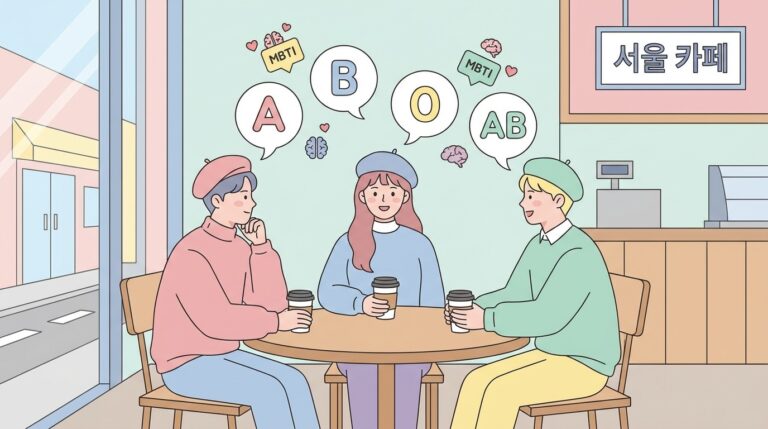
안녕하세요! 매일한글 에디터입니다. Have you ever been hanging out with Korean friends at a cozy cafe in Hongdae, enjoying your iced Americano, when someone suddenly asks, “What’s your blood type?” If you answered “Type A” and watched everyone nod in unison saying “Ah, that’s why you’re so careful!”, you’ve experienced one of Korea’s most famous social icebreakers: blood type personality theories (혈액형별 성격 속설). Even in the modern era of MBTI obsession, blood type stereotypes remain a deeply rooted cultural topic in dramas, TV shows, and everyday banter. As a intermediate B2 Korean learner, understanding these nuanced personality descriptors will instantly elevate your conversations from basic textbook sentences to rich, authentic Korean communication!
Phase 2: Core Expressions Deep Dive
1. 소심하다 (So-sim-hada)
- Pronunciation: [So-sim-ha-da] (Sounds like “so seam ha-dah”, soft and gentle)
- Meaning: Literally “small-minded,” but actually means overly cautious, timid, or sensitive to others’ reactions (traditionally tied to Type A).
- K-Culture Moment: In Korean dramas, a character who hesitates for ten episodes before confessing their feelings is often teased as Type A and “소심하다”.
- Editor’s Insight: It isn’t necessarily an insult. Saying “나 좀 소심해서…” (Because I’m a bit timid…) is a polite, humble way to excuse your hesitation.
- Situation Spectrum: Casual ✅ / Semi-formal ✅ / Formal ⚠️
- 🤔 Think About It: In your culture, is being cautious seen as a flaw or a virtue? How does Korean culture value considering others’ feelings?
2. 직설적이다 (Jik-seol-jeog-ida)
- Pronunciation: [Jik-seol-jeog-i-da] (Crisp ‘Jik’ sound, like “straightforward”)
- Meaning: Direct, outspoken, or blunt (frequently attributed to Type B).
- K-Culture Moment: When a K-Pop idol answers tough interview questions without hesitation, fans compliment their “직설적인 매력” (direct charm).
- Editor’s Insight: Korean culture deeply values indirect communication (Nunchi), so labeling someone as “직설적이다” can be either a compliment for honesty or a gentle warning about being too sharp.
- Situation Spectrum: Casual ✅ / Semi-formal ✅ / Formal ✅
- 🤔 Think About It: How do you balance honesty with politeness when speaking in Korean?
3. 엉뚱하다 (Eong-ttung-hada)
- Pronunciation: [Eong-ttung-ha-da] (Emphasize the double ‘tt’ like “eong-ttong-ha-dah”)
- Meaning: Quirky, unpredictable, or humorously offbeat (classic Type AB stereotype).
- K-Culture Moment: Variety show legends who give absurd, hilarious answers out of nowhere are constantly dubbed “엉뚱한 매력” (quirky charm).
- Editor’s Insight: This is almost always an affectionate term used among friends to describe someone charmingly eccentric.
- Situation Spectrum: Casual ✅ / Semi-formal ✅ / Formal 🚫
- 🤔 Think About It: Do you have a friend whose unexpected humor makes everyone smile?
Phase 3: Textbook Korean vs. Real Korean
Situation 1: Explaining that you get hurt easily by small remarks
- 📖 Textbook Korean: 저는 성격이 다소 민감한 편입니다. (I have a somewhat sensitive personality.)
- 🗣️ Real Korean: 나 소심해서 작은 말에도 상처 잘 받아. (I’m cautious/sensitive, so small words hurt me easily.)
- 💡 Why the difference? Real native Korean conversations favor relatable emotional honesty over formal, psychological jargon.
Situation 2: Describing someone who says what’s on their mind
- 📖 Textbook Korean: 그 사람은 솔직하게 의사를 표현합니다. (That person expresses their opinion honestly.)
- 🗣️ Real Korean: 그 사람 완전 돌직구 스타일이야. (That person is totally a straight-talker.)
- 💡 Why the difference? “돌직구” (fastball) is a popular baseball slang used daily to describe unapologetic directness.
Phase 4: K-Culture Deep Dive & Non-verbal Manners
4-1. Nunchi & Body Language
When discussing personality myths in Korea, body language is key! When someone playfully calls you “소심하다”, lighthearted hand waving or a quiet laugh shows you don’t take it personally. If someone is being overly direct, a subtle tilt of the head accompanied by “아, 그래요?” (Ah, is that so?) gently signals that you need a moment to process their words.
4-2. Cultural Shift: Blood Types to MBTI
In the 2000s, Korean dating culture revolved around blood types—Type O was seen as natural leaders, Type A as caring, Type B as passionate bad boys, and Type AB as geniuses or eccentrics. Today, MBTI has taken over, yet blood type references remain deeply embedded in everyday Korean slang. Combining both shows true cultural fluency!
Phase 5: Real-life Roleplay Scenario
Setting: A lively cafe in Seongsu-dong. Ji-won (Korean friend) and Alex (Intermediate learner) are comparing personality traits.
- Ji-won: 알렉스, 혹시 혈액형이 어떻게 돼? (Alex, what’s your blood type?)
- Alex: 🎭 [웃으며] 나 A형이야. 왜, 소심해 보여? (I’m Type A. Why, do I look timid?)
- Ji-won: 🎭 [손사래 치며] 아니 전혀! 너 되게 직설적이고 활발하잖아. (No, not at all! You’re super direct and lively.)
- Alex: 🎭 [어깨를 으쓱하며] 맞아, 사실 혈액형 속설은 그냥 재미로 보는 거지. (Right, honestly blood type myths are just for fun.)
- Ji-won: 그건 그래! 요새는 혈액형보다 MBTI를 더 많이 물어보긴 해. (That’s true! These days people ask about MBTI more than blood types.)
- Alex: 🎭 [고개를 끄덕이며] 너 MBTI는 뭐야? 나 완전 T 스타일이야? (What’s your MBTI? Am I totally a ‘T’ style?)
- Ji-won: 약간? 하지만 생각보다 남들 배려도 잘 해주잖아. (A little bit? But you care for others more than expected.)
- Alex: 🎭 [미소 지으며] 고마워! 나름대로 눈치껏 맞춰가려고 노력 중이야. (Thanks! I’m trying my best to read the room thoughtfully.)
🔀 Interactive Choice Point
Ji-won asks: “혈액형 성격설 진짜 믿어?” (Do you really believe in blood type personalities?)
* Option A: “전혀 안 믿어. 말도 안 돼.” (I don’t believe it at all. It makes no sense.) -> Risk: Too blunt, might kill the fun vibe.
* Option B: “재미로만 봐! 한국 문화 이해하는데 도움도 되고.” (Just for fun! It helps me understand Korean culture.) -> Best: Friendly, balanced, culturally engaged.
* Option C: “혈액형은 과학입니다.” (Blood type is science.) -> Bad: Incorrect factual statement in casual conversation.
Phase 6: 10-Second Emotion Shadowing Drill
- [😊 억울하다는 듯이 playful defensive]
나 소심한 거 아니야! / 그냥 신중한 거라고! / (Na so-sim-han geo a-ni-ya! / Geu-nyang sin-jung-han geo-ra-go!) -
[🥺 수줍고 다정하게 gentle and polite]
제가 약간 소심해서 / 먼저 말을 잘 못 걸어요. / (Je-ga yak-gan so-sim-hae-seo / meon-jeo mal-eul jal mot geol-eo-yo.) -
[🤣 흥미진진하게 excited curiosity]
혈액형으로 성격 맞히는 거 / 진짜 신기하지 않아? / (Hyeol-aek-hyeong-eu-ro seong-gyeok mat-hi-neun geo / jin-jja sin-gi-ha-ji a-na?)
Phase 7: K-Culture Mini Dictionary
- 혈액형 (Hyeol-aek-hyeong) | Blood type | Standard noun used in medical or casual personality contexts.
- 과몰입 (Gwa-mol-ip) | Over-immersion / Overthinking | Refers to taking personality tests like MBTI or blood types way too seriously.
- 속설 (Sok-seol) | Popular belief / Myth | Unproven common beliefs passed down socially.
- 공감하다 (Gong-gam-hada) | To empathize | Deeply connecting with someone’s feelings or personality description.
Phase 8: Travel & Survival Kit
- Top 1: “혈액형이 어떻게 되세요?” (Hyeol-aek-hyeong-i eo-tteoh-ge doe-se-yo?) – Pro Tip: Great conversation starter with young locals!
- Top 2: “재미로 보는 거예요.” (Jae-mi-ro bo-neun geo-ye-yo.) – Pro Tip: Smoothly lightens the mood if discussions get serious.
- Top 3: “MBTI가 어떻게 되세요?” (MBTI-ga eo-tteoh-ge doe-se-yo?) – Pro Tip: The ultimate modern icebreaker in Korea today.
Editor’s Travel Note: When meeting Korean friends at local hotspots, navigating smoothly is essential. Make sure you use the Naver Map Application Download before arriving in Seoul for seamless walking and transit directions.
Phase 9: A Step Deeper
In Korean society, asking about blood types or MBTI isn’t about putting people into rigid boxes. Rather, it acts as a gentle social cushion—a lighthearted bridge to break the ice and build rapport (Jeong) without intruding into deep personal matters. It shows an interest in understanding how the other person navigates relationships.
💬 Your Turn: What is your favorite personality icebreaker in your home culture? Leave a comment below!
Phase 10: FAQ & Common Mistakes
Q: Is calling someone ‘소심하다’ considered an insult in Korea?
A: Not always! While it means timid, friends often use it affectionately or as self-deprecating humor. Context and tone matter.
Q: Do older Koreans care more about blood types than MBTI?
A: Yes! Older generations are more familiar with blood type myths, while younger generations favor MBTI.
Q: What should I reply if I don’t know my blood type?
A: You can simply say “제 혈액형을 잘 모르겠어요” (I’m not sure of my blood type). It’s totally fine!
🚨 Common Mistakes TOP 3
- Mistake: Using “소심하다” to mean “humble”.
Correct Action: Use “겸손하다” (Gyeom-son-hada) for humble traits. - Mistake: Translating “direct” directly as “직접적” in personality contexts.
Correct Action: Use “직설적” (Jik-seol-jeog) for personal speech style. - Mistake: Taking blood type critiques personally.
Correct Action: Smile and respond with “재미로 보는 거죠!” (It’s just for fun!).
Phase 11: Action Mission
- Bronze Level: Practice saying your blood type and MBTI out loud in Korean three times.
- Silver Level: Share a post or comment on social media describing your personality in Korean.
- Gold Level: Use the expression “재미로 보는 거죠” during your next conversation with a Korean speaker.
- 🎮 K-Culture Mission: Watch a clip of your favorite K-Pop group discussing their blood types or MBTI and spot the word “과몰입”!
Phase 12: Interactive Quiz Challenge
- Fill in the blank: “그 사람은 성격이 너무 ( )해서 말을 돌려서 하지 않아요.”
A) 소심
B) 직설적
C) 엉뚱
Click to view Answer & Explanation
Answer: B) 직설적. ‘직설적’ means direct/outspoken, matching the sentence context of speaking straightforwardly.
- True or False: In Korea, asking about someone’s blood type is considered rude and overly personal.
Click to view Answer & Explanation
Answer: False! It is a common, friendly icebreaker used in casual settings.







