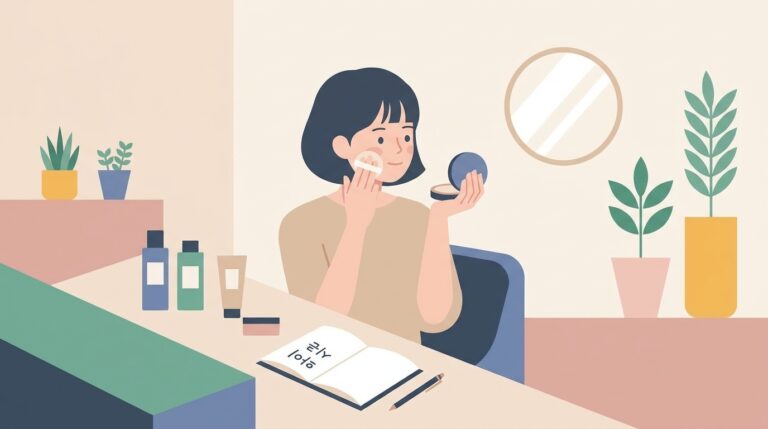
Master Korean Daily Makeup Talk Like a Beauty Creator
Phase 1: Empathy (Storytelling Opening)
안녕하세요! 매일한글 에디터입니다.
Have you ever tuned into a popular Korean YouTube vlog or K-beauty tutorial, expecting a simple step-by-step cosmetic guide, only to get completely lost in a sea of descriptive verbs and nuanced slang? You might hear creators talk about how a base product “eats the skin well” (피부가 화장을 잘 먹다) or how a blush color is “sticking like rice cake” (찰떡이다). If you are aiming for C1-level fluency, simply knowing the Korean names for lipsticks and concealers won’t cut it. You need to master the art of describing textures, undertones, application techniques, and subtle aesthetic moods effortlessly.
In Korea, daily makeup (데일리 메이크업) isn’t just about applying products; it’s a sophisticated visual narrative centered on achieving that coveted kku-an-kku (꾸안꾸 – effortless, natural beauty) look. Understanding these expressions will not only boost your conversational fluency in Korean cosmetic shops like Olive Young or Seongsu beauty flagships, but it will also give you an authentic insider perspective on K-beauty culture. Today’s guide is crafted from real user feedback and native creator speech patterns to help you articulate your beauty routine with exact precision.
Phase 2: Deep Dive into 3 Core Expressions
1. 피부 표현을 잡다
- Pronunciation: [Pibu pyo-hyeon-eul jap-da] (Think of pibu sounding like “pee-boo”, and jap-da pronounced like “jahp-dah” with a sharp snap at the end)
- Meaning: Literal: To catch/hold skin expression | Nuance: To establish the desired base finish (e.g., matte, glowing, or semi-matte).
- K-Culture Moment: Used by professional makeup artists on K-drama sets when discussing whether an actor’s skin should look dewy (chok-chok) or velvety (bo-song) for night scenes.
- Editor’s Insight: The verb 잡다 (to catch/set) implies mastering control over a specific texture or vibe. C1 speakers use 잡다 for abstract goals like tone, mood, or skin base finish.
- Situation Spectrum: Casual ✅ | Semi-formal ✅ | Formal ✅
- 🤔 Think About It: How does your native language describe the texture finish of skin? Is it treated as a canvas texture or an expressive mood?
2. 음영을 주다
- Pronunciation: [Eum-yeong-eul ju-da] (Eum-yeong sounds like “oom-young”, ju-da sounds like “joo-dah”)
- Meaning: Literal: To give shade/shadow | Nuance: To contour or build dimensional shading naturally on eyes, nose, or cheekbones.
- K-Culture Moment: Frequently used in idol makeup tutorials when building soft eye-depth without looking heavily painted.
- Editor’s Insight: Instead of using the English loanword “contouring” (컨투어링), high-level Korean speakers prefer 음영 (shade/shadow) to describe subtle depth building.
- Situation Spectrum: Casual ✅ | Semi-formal ✅ | Formal ✅
- 🤔 Think About It: Why do you think Korean beauty terminology emphasizes “shadowing” over hard “contouring”?
3. 찰떡같이 붙다 / 찰떡이다
- Pronunciation: [Chal-tteok-ga-chi beut-da] (Chal-tteok rhymes with “chal-tuck”, beut-da sounds like “beot-dah”)
- Meaning: Literal: To stick like glutinous rice cake | Nuance: To perfectly complement one’s skin tone/features, or for makeup to adhere seamlessly without caking.
- K-Culture Moment: A staple compliment used in K-Pop beauty vlogs when a lip shade aligns seamlessly with someone’s personal color palette.
- Editor’s Insight: 찰떡 represents ultimate adhesion and harmony. When applied to makeup, it means zero floating skin cast and absolute personal color alignment.
- Situation Spectrum: Casual ✅ | Semi-formal ⚠️ | Formal 🚫
- 🤔 Think About It: Culinary metaphors are abundant in Korean descriptive phrases. What food metaphors exist in your language for aesthetic perfection?
Phase 3: Textbook Korean vs. Real Korean
Scenario 1: Describing seamless base makeup
- 📖 Textbook Korean: “화장이 피부에 아주 잘 붙었습니다.” (The makeup attached very well to the skin.)
- 🗣️ Real Korean: “오늘 베이스 메이크업 피부에 완전 찰떡으로 얇게 얹혀졌어요.” (Today’s base makeup sat super seamlessly and thinly on the skin.)
- 💡 Why Different? Advanced native speakers rarely say 붙다 in isolation. They use sensory verbs like 얹히다 (to sit softly on top) combined with 찰떡 for natural nuance.
Scenario 2: Asking for a natural daily eyeshadow
- 📖 Textbook Korean: “자연스러운 섀도를 보여주세요.” (Please show me a natural shadow.)
- 🗣️ Real Korean: “데일리로 부담 없이 음영 넣기 좋은 섀도 팔레트 추천해 주세요.” (Please recommend an eyeshadow palette good for adding effortless daily depth without looking heavy.)
- 💡 Why Different? C1 speakers specify usage conditions (부담 없이, 음영 넣기 좋은) rather than generic adjectives like 자연스러운.
Phase 4: K-Culture Deep Dive & Non-Verbal Manners
4-1. Nunchi & Gestures
When interacting at a Korean cosmetic counter or presenting a tutorial, subtle actions matter. When testing cushion compacts, tap gently with two fingers inside the ribbon rather than pressing down hard. Maintaining a light, rhythmic tapping motion shows you understand proper product dispersion. When discussing skin undertones with an advisor, hold product swatches near your jawline under neutral light while maintaining polite eye contact.
4-2. Cultural Code: The ‘꾸안꾸’ (Kku-An-Kku) Aesthetic
The term 꾸안꾸 (꾸민 듯 안 꾸민 듯 – looking dressed up without trying) dominates Korean daily makeup philosophy. Rather than bold cut-creases, Korean daily tutorials prioritize clear skin texturing (피부결 살리기), subtle eye shadows (음영 메이크업), and soft gradient lips (그라데이션 립). Demonstrating fluency in these aesthetic concepts elevates your language skills from functional to culturally integrated.
Phase 5: Interactive Roleplay Scenario
Setting: You are visiting a flagship beauty lab in Seongsu to build a personalized daily makeup palette with a professional consultant (Minji).
- Minji (Consultant): 안녕하세요! 오늘 어떤 느낌의 데일리 메이크업을 원하시나요?
- You: 안녕하세요! 저는 매일 부담 없이 쓸 수 있는 맑은 음영 메이크업을 원해요.
- Minji (Consultant): 🎭 (피부 톤을 유심히 살피며) 고객님 피부 톤이 맑아서 쿨 뮤트 톤 컬러가 찰떡일 것 같아요.
- You: 🎭 (거울을 보며 고개를 끄덕인다) 아, 정말요? 너무 딥하지 않게 피부 표현이랑 자연스럽게 어우러졌으면 좋겠어요.
- Minji (Consultant): 그럼 베이스는 얇게 얹고, 섀도로 눈가에 은은하게 음영만 줘볼게요.
- You: 좋아요! 립은 착색이 너무 과하지 않고 들뜸 없는 걸로 보여주세요.
- Minji (Consultant): 이 틴트 어떠세요? 입술에 얇게 밀착돼서 원래 내 입술처럼 표현돼요.
- You: 와, 색감이 진짜 자연스럽네요. 딱 제가 찾던 데일리 조합이에요!
🔀 Interactive Branching Choice
How would you ask the consultant to ensure your makeup base doesn’t cake during long office hours?
- Option A: “밀림이나 들뜸 없이 지속력 있게 피부 표현 잡는 팁이 있나요?” (Best)
- Option B: “화장이 안 지워지게 두껍게 바르는 법 알려주세요.” (Bad – Suggests heavy application)
- Option C: “이거 바르면 절대로 안 지워지죠?” (Risk – Overly blunt, challenging tone)
Feedback: Option A uses advanced collocations (밀림, 들뜸, 피부 표현을 잡다) demonstrating high-level communicative competence.
Phase 6: 10-Second Emotion Shadowing Drill
[😊 Excitement]오늘 피부 표현 / 완전 찰떡으로 / 먹은 거 있지! (One-line pause structure)[🤔 Thoughtful]과한 컨투어링보다는 / 은은하게 음영만 주는 게 / 훨씬 깔끔해 보여요.[💡 Confidence]들뜸 없이 얇게 밀착시켜서 / 하루 종일 맑은 피부 톤 유지할게요.
Phase 7: K-Culture Mini Dictionary
- 속건조 (Sok-geon-jo) | Inner Skin Dryness | Refers to skin that feels tight/dry internally while appearing oily on the surface. Essential term for skin base consultations.
- 밀착력 (Mil-chak-ryeok) | Adherence/Sticking Power | The degree to which cosmetics bind smoothly to skin texture without slipping.
- 톤파괴자 (Ton-pa-goe-ja) | Tone Destroyer | Slang describing a product shade so versatile that it suits all undertones perfectly.
- 유유자적 (Yoo-yoo-ja-jeok) | Effortless Serenity | Used metaphorically in high-end beauty reviews to describe a look that seems calm, polished, and unbothered.
Phase 8: Traveler’s Survival Kit
Top 3 Survival Phrases
- “피부 톤에 떠보이지 않게 추천해 주세요.” (Pibu ton-e tteo-bo-i-ji an-ge chu-cheon-hae ju-se-yo.) — Please recommend something that doesn’t look washed out on my skin tone.
- “요철 커버가 잘되는 베이스 있나요?” (Yo-cheol keo-beo-ga jal-doe-neun be-i-seu it-na-yo?) — Do you have a base product that covers skin surface unevenness well?
- “가루 날림 없이 밀착되나요?” (Ga-ru nal-lim eop-si mil-chak-doe-na-yo?) — Does it adhere well without fallout?
Editor’s Travel Note
Before visiting flagship beauty spots in Seoul, download the Glowpick Ranking App to check real-time consumer rankings for daily makeup essentials. Pair it with the Naver Map Navigation App to locate specialized personal color analysis labs across Seongsu and Hongdae.
Phase 9: One Step Deeper (Reflective Essay)
Korean beauty language reflects a broader societal value placed on subtle harmony and continuous refineability rather than striking transformation. Terms like 음영 (shading) and 결 (texture) highlight how beauty is viewed as enhancing existing natural structures. By mastering these expressions, you gain insight into how precision and meticulous care permeate daily Korean communication.
💬 Your Turn: What is your go-to phrase when describing your daily makeup style? Share your favorite K-beauty terms in the comments below!
Phase 10: FAQ & Common Mistakes
Q: Is it incorrect to use “화장을 하다” instead of
Frequently Asked Questions (FAQ)
Q: What does "피부 표현을 잡다" mean in Korean and how do you pronounce it?
A: In Korean, "피부 표현을 잡다" is pronounced [Pibu pyo-hyeon-eul jap-da] and means: Literal: To catch/hold skin expression | Nuance: To establish the desired base finish (e.g., matte, glowing, or semi-matte).
Q: What does "음영을 주다" mean in Korean and how do you pronounce it?
A: In Korean, "음영을 주다" is pronounced [Eum-yeong-eul ju-da] and means: Literal: To give shade/shadow | Nuance: To contour or build dimensional shading naturally on eyes, nose, or cheekbones.
Q: What does "찰떡같이 붙다 / 찰떡이다" mean in Korean and how do you pronounce it?
A: In Korean, "찰떡같이 붙다 / 찰떡이다" is pronounced [Chal-tteok-ga-chi beut-da] and means: Literal: To stick like glutinous rice cake | Nuance: To perfectly complement one's skin tone/features, or for makeup to adhere seamlessly without caking.