

안녕하세요! 매일한글 에디터입니다.
Imagine this: You step into a bustling Seoul subway station during evening rush hour. The train arrives with a gentle chime, and the platform screen doors open. You are eager to step on, but suddenly you notice neat lines formed on both sides of the door markings on the ground. People are waiting patiently, leaving the center clear for exiting passengers. You wonder: Should I step up? Am I in the right line? How do I politely check if someone is waiting in line or just standing around?
If you’ve ever felt a moment of panic at a busy Korean bus stop or subway platform, you are definitely not alone! Lining up to board public transit in Korea—known as 줄 서기 (jul seo-gi)—is an effortless art form practiced daily by millions. Mastering this subtle etiquette and the key phrases that go with it will instantly boost your confidence and make you feel like a savvy local. Today, based on feedback from hundreds of intermediate learners, we are breaking down the unspoken rules and essential Korean phrases for lining up effortlessly!
Phase 2: Core Expressions Deep Dive
1. 줄 서 계신가요? (Jul seo gyesin-gayo?)
- Pronunciation: [Jul seo gye-shin-ga-yo?] (Sounds like: “Jool suh gyeh-shin-gah-yo?”)
- Meaning: “Are you standing in line?” (Literal vs. Polite local check to see if someone is queueing)
- K-Culture Moment: Seen in K-dramas when main characters meet accidentally in long lines at famous dessert cafes or bus stops in Gangnam.
- Editor’s Insight: Use this when a crowd looks ambiguous near a bus stop sign or subway door. It shows immediate respect for order.
- Situation Spectrum: Casual 🚫 | Semi-formal ✅ | Formal ✅
- 🤔 Think About It: How does asking directly prevent awkward misunderstandings compared to silently standing behind someone in your country?
2. 먼저 타세요. (Meonjeo taseyo.)
- Pronunciation: [Meon-jeo ta-se-yo] (Sounds like: “Muhn-juh tah-seh-yo”)
- Meaning: “Please go ahead and board first.”
- K-Culture Moment: Often heard when elderly commuters or parents with children are offered priority at busy bus doors.
- Editor’s Insight: This phrase radiates warmth and high social intelligence (눈치). It is perfect when you want to show consideration.
- Situation Spectrum: Casual ⚠️ | Semi-formal ✅ | Formal ✅
- 🤔 Think About It: In what situations in your daily life would offering someone priority make the commute pleasant?
3. 줄 서서 기다려 주세요. (Jul seoseo gidaryeo juseyo.)
- Pronunciation: [Jul seo-seo gi-da-ryeo ju-se-yo] (Sounds like: “Jool suh-suh ghee-dah-ryuh joo-seh-yo”)
- Meaning: “Please line up and wait.”
- K-Culture Moment: Announcements on platforms or gentle reminders by station attendants during peak festival seasons.
- Editor’s Insight: While direct, using the polite ending ~주세요 keeps the request firm yet courteous.
- Situation Spectrum: Casual 🚫 | Semi-formal ✅ | Formal ✅
- 🤔 Think About It: How does clear group signaling help maintain order in crowded urban centers?
Phase 3: Textbook Korean vs. Real Native Korean
Situation 1: Checking if someone is in line
- 📖 Textbook Korean: 여간 줄입니까? (Is this line here? – Stiff/Outdated)
- 🗣️ Real Native Korean: 혹시 줄 서신 거예요? (Hoksi jul seosin geoyeyo? – Polite & Natural)
- 💡 Why the difference? Modern Koreans prefer softening questions with 혹시 (by any chance) to sound approachable and respectful.
Situation 2: Asking someone to move aside for exiting passengers
- 📖 Textbook Korean: 내리는 사람이 있으니 물러서십시오. (Step back as people exit – Command style)
- 🗣️ Real Native Korean: 먼저 내리고 타실게요~ (Meonjeo naerigo tasil-geyo~ – Friendly tone)
- 💡 Why the difference? Service staff and polite commuters use the softer ~하실게요 structure to maintain harmony in public spaces.
Phase 4: K-Culture Deep Dive & Non-Verbal Manners
4-1. Nunchi (눈치) & Line Etiquette
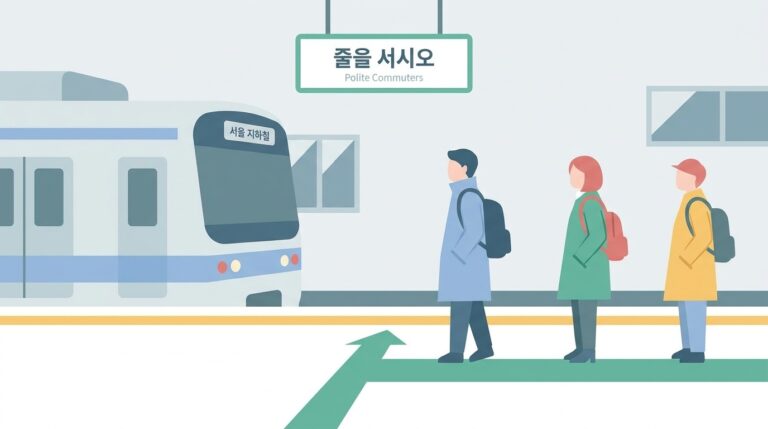
When waiting for the subway, notice the triangular or rectangular line markings on the floor in front of the platform screen doors. Native Koreans stand in two neat single files along the side lines, leaving the central aisle completely clear for arriving passengers to step off. Exercising Nunchi (눈치) means observing whether people around you are forming two distinct lines and aligning yourself naturally without blocking walkways.
4-2. Cultural Code: The Rhythm of Korean Transit
Korea’s public transit culture revolves around efficiency and mutual spatial respect (빠르기 & 배려). On buses, queuing happens near the front door, while exiting occurs through the middle door. Standing near the rear door while waiting to board can confuse incoming traffic!
Phase 5: Real Life Roleplay Scenario
Setting: A crowded subway platform at Express Bus Terminal Station during peak hours. You want to board Line 3, but the crowd is thick.
Character (NPC): Min-jun (A helpful commuter with a backpack).
- Min-jun: 앗, 지하철 들어오네요! (Oh, the train is coming in!)
- You: 🎭 (Looking hesitant near the door markings) 혹시 줄 서 계신가요? (Hoksi jul seo gyesin-gayo?)
- Min-jun: 아, 네! 여기 줄이에요. 제 뒤로 서시면 돼요. (Ah, yes! This is the line. You can stand behind me.)
- You: 🎭 (Nodding politely) 감사합니다. 혹시 이 문 다 열리나요? (Gamsahamnida. Hoksi i mun da yeollinayo?)
- Min-jun: 네, 스크린도어 열리면 내리는 분들 먼저 내리고 타요. (Yes, once screen doors open, people exit first before we board.)
- You: 🎭 (Noticing someone pushing slightly) 아, 먼저 내리고 타실게요~ (Ah, let’s let people off first~)
- Min-jun: 맞아요, 내리는 분 먼저! (That’s right, exiting passengers first!)
- You: 🎭 (Stepping onto train) 먼저 타세요! (Meonjeo taseyo!)
🔀 Interactive Choice Point
A person behind you tries to board before passengers finished getting off the train. What do you do?
* Option A: Say loudly “줄 서세요!” (Bad – Too confrontational for public setting)
* Option B: Gently say “먼저 내리고 타실게요~” while waiting stepping aside (BEST – Polite, indirect, effective)
* Option C: Say nothing and push inside immediately (Risk – Creates unnecessary physical crowding)
Phase 6: 10-Second Emotion Shadowing Drill
Practice these with natural pause points (/) and feeling!
- [😊 Friendly & Inquiring] 혹시 / 줄 서 계신가요? (Hoksi / jul seo gyesin-gayo?)
- [🤝 Considerate & Courteous] 먼저 / 내리고 / 타실게요~ (Meonjeo / naerigo / tasil-geyo~)
- [Warm & Generous] 바쁘시면 / 먼저 / 타세요! (Bappeusimyeon / meonjeo / taseyo!)
Phase 7: K-Culture Mini Dictionary
- 줄서기 (Jul-seo-gi) | Line queuing | The practice of forming orderly lines in public venues.
- 스크린도어 (Seukeurin-doe-eo) | Platform Screen Door | Automated safety glass doors installed on Korean subway platforms.
- 하차문 (Hacha-mun) | Exit Door | The designated door (usually middle of bus) for exiting transit.
- 환승 (Hwan-seung) | Transfer | Changing between transit lines using T-money or credit card discounts.
Phase 8: Traveler’s Survival Kit
Survival Phrases TOP 3
- 여기 줄인가요? (Yeogi julingayo?) – Is this the line?
- 지나가겠습니다. (Jinageasseumnida.) – Excuse me, passing through.
- 먼저 타세요. (Meonjeo taseyo.) – Please go ahead and board first.
Editor’s Travel Note
Before heading out to explore Seoul’s transit network, ensure you get your navigation tools ready! Check out our guide on how to download KakaoMap and Naver Map apps to navigate subway platforms like a local. Always keep your T-Money card ready in your right hand before reaching the turnstiles!
Phase 9: One Step Deeper
Korean queuing etiquette reflects the underlying cultural concept of 더불어 살기 (living in harmony) in high-density urban environments. While speed is valued, consideration for communal efficiency ensures millions commute daily without chaos. Observing these small courtesies transforms routine transportation into an act of shared respect.
💬 Your Turn: Have you ever experienced transit queuing in Korea or your home country? Share your stories in the comments below!
Phase 10: FAQ & Common Mistakes
Q: What should I do if the bus stop has no clear floor markings for a line?
A: Stand near the bus stop sign in the order you arrived. When the bus approaches, people usually form an informal queue walking toward the front door.
Q: Is it okay to eat or drink while queuing or riding the bus in Seoul?
A: Takeout cups with open liquids are prohibited on Seoul city buses. Keep drinks sealed inside bags before lining up!
Q: Can I board through the back door of a bus if the front door line is long?
A: No, boarding is strictly through the front door unless directed otherwise by the driver during special crowding.
🚨 Common Mistakes
- Mistake 1: Standing directly in the center of the subway door markings.
- Correct Action: Stand along the side lines so exiting passengers have a clear middle lane.
- Mistake 2: Boarding while passengers are still exiting.
- Correct Action: Wait until all exiting commuters have cleared the threshold.
- Mistake 3: Loudly scolding someone who accidentally cuts in line.
- Correct Action: Politely check using “혹시 줄 서신 거예요?” to avoid misunderstandings.
Phase 11: Action Mission
- 🥉 Bronze Mission: Practice saying “혹시 줄 서 계신가요?” out loud 3 times with natural pauses.
- 🥈 Silver Mission: Write down a short sentence in Korean offering someone priority in line on social media.
- 🥇 Gold Mission: Use “먼저 타세요” or “먼저 내리고 타실게요” during your next real-life trip or roleplay practice!
🎮 K-Culture Mission: Watch a scene in a K-drama set in a subway station and count how many floor queue markings you spot!
Phase 12: Interactive Quiz Challenge
Quiz 1: Situation Judgment
Where should you stand when waiting for the subway train at a screen door?
– A) Directly in the middle of the screen door.
– B) Along the side line markings printed on the floor.
– C) Behind the elevator.
Click to reveal Answer & Explanation
Answer: B
Standing along the side line markings allows exiting passengers to exit smoothly through the middle first!
Quiz 2: Fill in the Blank
Complete the polite phrase to offer someone to board first: “_____ 타세요.”
Click to reveal Answer & Explanation
Answer: 먼저 (Meonjeo)
“먼저 타세요” means “Please board first.”
Quiz 3: True or False
Open takeaway drinks like boba tea are allowed on Seoul city buses as long as you queue politely.
Click to reveal Answer & Explanation
Answer: False
Open food and drink cups are strictly prohibited on Seoul city buses to prevent spills.







