

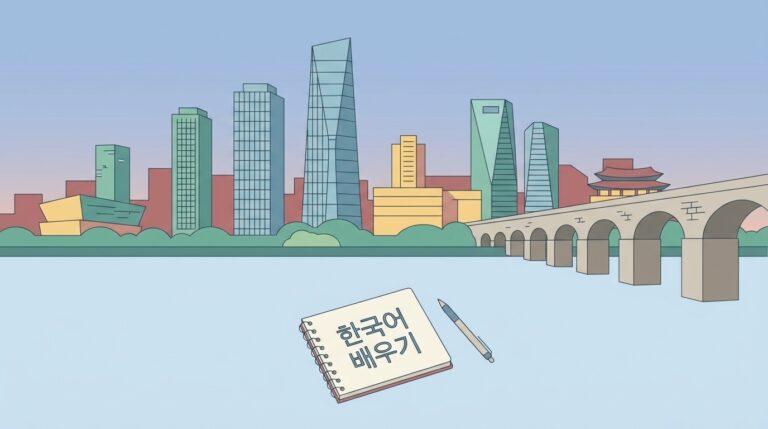
From War to Modern Wonders: How Korea’s Han River Miracle Shaped Today’s Express Culture
Phase 1: Empathy (Story-Driven Opening)
안녕하세요! 매일한글 에디터입니다. Have you ever watched a nostalgic K-Drama like Reply 1988 and wondered how South Korea transformed from a war-torn country in the 1950s to a global powerhouse of tech, fashion, and K-Pop today? When you walk through the bustling streets of Gangnam or take the hyper-fast KTX bullet train, it feels almost surreal. Older Koreans often refer to this legendary transformation as ‘한강의 기적’ (Miracle on the Han River).
Many intermediate Korean learners face a subtle wall when conversing with native speakers: you know daily vocabulary, but you miss the deep historical resilience embedded in expressions used by older colleagues, grandfathers, or high-level business partners. When your Korean boss says, “아무것도 없는 상태에서 맨땅에 헤딩하며 만들었지,” understanding that phrase requires knowing the grit behind Korea’s economic sprint. By mastering these mid-to-advanced (B2) expressions, you will move beyond standard textbook speak and connect genuinely with native Koreans on a cultural and emotional level.
Phase 2: Core Expressions Deep Dive
1. 한강의 기적 (Han-gang-ui Gi-jeok)
- Pronunciation: [Han-gang-ui Gi-jeok] (Sounds like ‘Han-gahng-wee Gee-juhk’)
- Meaning: Literal: Miracle on the Han River | Nuance: South Korea’s rapid economic growth after the Korean War.
- K-Culture Moment: Featured frequently in historical documentaries and news broadcasts reflecting on Korea’s rapid modern development.
- Editor’s Insight: Beyond economic jargon, this phrase carries immense national pride. Use it when expressing genuine awe at Korea’s fast development.
- Situation Spectrum: Casual ⚠️ | Semi-formal ✅ | Formal ✅
- 🤔 Think About It: Does your home country have a specific idiom or historical term for a period of rapid national growth?
2. 격세지감 (Gyeok-se-ji-gam)
- Pronunciation: [Gyeok-se-ji-gam] (Sounds like ‘Gyuhk-seh-jee-gahm’)
- Meaning: Literal: Feeling as if a full generation has passed | Nuance: Astonishment at how drastically things have changed over time.
- K-Culture Moment: An elder in a drama seeing smartphone payment systems in Euljiro retro markets and sighing with a smile.
- Editor’s Insight: This four-character idiom (사자성어) instantly elevates your B2 Korean fluency in formal and semi-formal discussions.
- Situation Spectrum: Casual ⚠️ | Semi-formal ✅ | Formal ✅
- 🤔 Think About It: How do you express the feeling of “How time flies and changes everything” in your native language?
3. 맨땅에 헤딩하다 (Maen-ttang-e He-ding-ha-da)
- Pronunciation: [Maen-ttang-e He-ding-ha-da] (Sounds like ‘Maen-ttang-eh Heh-ding-hah-dah’)
- Meaning: Literal: To headbutt the bare ground | Nuance: To start from complete scratch with zero capital or support through sheer grit.
- K-Culture Moment: K-Drama startup founders describing how they built their tech companies without investor funding.
- Editor’s Insight: Highly vivid and colloquial! Perfectly captures the spirit of early Korean entrepreneurs during the economic growth era.
- Situation Spectrum: Casual ✅ | Semi-formal ✅ | Formal 🚫
- 🤔 Think About It: Is taking high risks without resources viewed as brave or reckless in your local culture?
Phase 3: Textbook Korean vs. Real Native Korean
Situation 1: Describing Korea’s fast development
- 📖 Textbook Korean: 한국은 지난 몇 십 년 동안 엄청난 경제 성장을 달성하였습니다.
(Korea has achieved massive economic growth over the past few decades.) - 🗣️ Real Native Korean: 한국은 단기간에 진짜 한강의 기적을 이뤄냈잖아요.
(Korea literally pulled off the Miracle on the Han River in such a short time.) - 💡 Why is it different? Native speakers prefer historical metaphors like ‘한강의 기적’ over dry statistical terms like ‘경제 성장’ during natural conversations.
Situation 2: Expressing building something from nothing
- 📖 Textbook Korean: 자본이 없는 상태에서 사업을 시작했습니다.
(I started a business without capital.) - 🗣️ Real Native Korean: 완전히 맨땅에 헤딩하는 기분으로 시작했어요.
(I started with a mindset of totally headbutting the bare ground.) - 💡 Why is it different? ‘맨땅에 헤딩하다’ adds vivid emotion and grit, making the narrative engaging and relatable.
Phase 4: K-Culture Deep Dive & Non-Verbal Manners
4-1. Nunchi & Gestures: Respecting the Pioneer Generation
When discussing Korean history with seniors (어르신) who personally lived through the economic boom of the 1970s and 80s, keep your posture relaxed yet respectful. When drinking tea or coffee during such conversations, turn your torso slightly away if taking a sip in front of an elder. Nodding slowly with both hands gently placed on your lap or desk shows active listening (경청).
4-2. Culture Code: The Roots of ‘Pali-Pali’ (빨리빨리)
Why is delivery speed and modern fiber-optic internet so fast in Korea? The ‘Pali-Pali’ (hurry-hurry) mindset was born during the rapid post-war industrialization drive. Efficiency was a matter of national survival. Today, this mindset lives on in modern services like early-morning grocery deliveries (새벽배송) and fast subway transfers.
Phase 5: Real-Life Roleplay Scenario
Setting: A cozy coffee shop in Euljiro, Seoul. You are talking with your senior Korean colleague, Ah-jung (아정), while looking at old photos of Seoul.
- Turn 1 (Ah-jung): 🎭 (Points at a black-and-white picture of the Han River in 1960) 여길 보세요. 예전 한강 모습이에요.
(Yeo-gil bo-se-yo. Ye-jeon Han-gang mo-seub-i-e-yo. / Look here. This was the Han River in the past.) - Turn 2 (You): 🎭 (Leaning in with wide eyes) 와, 지금하고 너무 달라서 격세지감이 느껴지네요!
(Wa, ji-geum-ha-go neo-mu dal-ra-seo gyeok-se-ji-gam-i nyeo-kkeo-ji-ne-yo! / Wow, it feels so different from today that I feel a real sense of transformation!) - Turn 3 (Ah-jung): 🎭 (Nodding proudly) 맞아요. 선배들이 진짜 맨땅에 헤딩하면서 일했죠.
(Ma-ja-yo. Seon-bae-deul-i jin-jja maen-ttang-e he-ding-ha-myeon-seo il-haess-jyo. / Exactly. Our predecessors worked by literally headbutting the bare ground.) - Turn 4 (You): 🎭 (Gently) 그 덕분에 ‘한강의 기적’을 만들 수 있었던 거군요.
(Geu deok-bun-e ‘Han-gang-ui Gi-jeok’-eul man-deul su iss-eos-deon geo-gun-yo. / Thanks to that, they were able to create the ‘Miracle on the Han River’.) - Turn 5 (Ah-jung): 🎭 (Smiles broadly) 한국 역사에 대해 정말 잘 아시네요! 놀라워요.
(Han-guk yeok-sa-e dae-hae jeong-mal jal a-si-ne-yo! Nol-ra-wo-yo. / You really know Korean history well! I’m impressed.) - Turn 6 (You): 🎭 (Smiling modestly) 아니에요. 한국 문화에 관심이 많아서 공부했어요.
(A-ni-e-yo. Han-guk mun-hwa-e gwan-sim-i ma-na-seo gong-bu-haess-eo-yo. / No problem. I studied because I have a lot of interest in Korean culture.) - Turn 7 (Ah-jung): 🎭 (Offers a cookie) 다음에는 대한민국 역사박물관에 같이 가요.
(Da-eum-e-neun Dae-han-min-guk Yeok-sa-bak-mul-gwan-e ga-chi ga-yo. / Next time, let’s go to the National Museum of Korean Contemporary History together.) - Turn 8 (You): 🎭 (Clapping hands softly) 좋아요! 꼭 같이 가요.
(Jo-a-yo! Kkok ga-chi ga-yo. / Sounds great! Let’s definitely go.)
🔀 Interactive Branching Point
**If Ah-jung asks:
Frequently Asked Questions (FAQ)
Q: What does "한강의 기적 (Han-gang-ui Gi-jeok)" mean in Korean and how do you pronounce it?
A: In Korean, "한강의 기적 (Han-gang-ui Gi-jeok)" is pronounced [Han-gang-ui Gi-jeok] and means: Literal: Miracle on the Han River | Nuance: South Korea's rapid economic growth after the Korean War.
Q: What does "격세지감 (Gyeok-se-ji-gam)" mean in Korean and how do you pronounce it?
A: In Korean, "격세지감 (Gyeok-se-ji-gam)" is pronounced [Gyeok-se-ji-gam] and means: Literal: Feeling as if a full generation has passed | Nuance: Astonishment at how drastically things have changed over time.
Q: What does "맨땅에 헤딩하다 (Maen-ttang-e He-ding-ha-da)" mean in Korean and how do you pronounce it?
A: In Korean, "맨땅에 헤딩하다 (Maen-ttang-e He-ding-ha-da)" is pronounced [Maen-ttang-e He-ding-ha-da] and means: Literal: To headbutt the bare ground | Nuance: To start from complete scratch with zero capital or support through sheer grit.







