

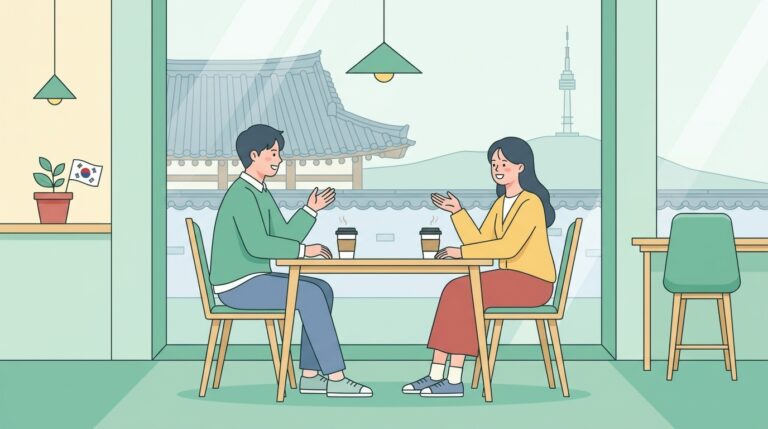
Phase 1: Empathy & Story Opening
안녕하세요! 매일한글 에디터입니다. Have you ever been watching a hit K-drama like Crash Landing on You or tuning into the evening news in Seoul, only to feel a sudden wall of complex terminology when the topic shifts to South-North relations (남북 관계) and reunification (통일)? Many intermediate learners reach out to us at Daily Hangul sharing a common frustration: “I want to share my thoughts on inter-Korean topics with my Korean friends, but I don’t know how to frame my opinion without sounding too stiff, political, or overly simplistic!” You are not alone. Navigating socio-political conversations requires more than dictionary definitions—it demands cultural empathy, age-appropriate nuance, and the right degree of politeness. Based on real feedback from B2-level learners, this guide is crafted to help you express balanced, respectful perspectives effortlessly during social gatherings or academic discussions in Korea.
Phase 2: Deep Dive into 3 Key Expressions
1. 세대별로 시각 차이가 있어요 (Hangul)
- Pronunciation: [Sede-byeol-lo sigak cha-i-ga isseoyo] (Sounds like seh-dae-byeol-roh she-gak chah-ee-gah ee-ssuh-yo)
- Meaning: Direct translation: “There is a difference in perspective by generation.” / Real nuance: “People’s views vary significantly depending on how old they are.”
- K-Culture Moment: Commonly heard in news panel discussions or university seminars when debating social policy and inter-Korean affairs.
- Editor’s Insight: In Korea, older generations who lived closer to the war era often view unification as a moral necessity, whereas younger generations often look at it through economic or practical lenses. Using ‘세대별로’ shows you understand Korean societal dynamics.
- Situation Spectrum: Casual ⚠️ / Semi-formal ✅ / Formal ✅
- 🤔 Think About It: How do generational gaps affect political topics in your home country compared to Korea?
2. 평화로운 관계가 우선이지 않을까요? (Hangul)
- Pronunciation: [Pyeong-hwa-ro-un gwan-gye-ga u-seon-i-ji an-eul-kka-yo?]
- Meaning: Direct translation: “Wouldn’t a peaceful relationship be the priority?” / Real nuance: “I think maintaining peace should come first before anything else.”
- K-Culture Moment: Used frequently in calm current-affairs talk shows when shifting focus from heated debates to practical peaceful coexistence.
- Editor’s Insight: Ending your opinion with ‘~지 않을까요?’ softens your statement, turning an assertion into a polite suggestion. It prevents you from sounding confrontational.
- Situation Spectrum: Casual ⚠️ / Semi-formal ✅ / Formal ✅
- 🤔 Think About It: In your native language, how do you politely express an alternative opinion without sounding aggressive?
3. 현실적인 길을 찾아야 해요 (Hangul)
- Pronunciation: [Hyeon-sil-jeok-in gil-eul cha-ja-ya hae-yo]
- Meaning: Direct translation: “We must find a realistic road.” / Real nuance: “We need to take a practical approach to this issue.”
- K-Culture Moment: Often said during dinner gatherings or podcasts when bringing a lofty or emotional debate back down to practical reality.
- Editor’s Insight: ‘현실적’ (realistic/practical) is a favorite buzzword among modern Koreans when discussing complex political or social dilemmas.
- Situation Spectrum: Casual ✅ / Semi-formal ✅ / Formal ✅
- 🤔 Think About It: What counts as a ‘practical’ solution in political conversations in your culture?
Phase 3: Textbook Korean vs Real Korean
Situation 1: Giving your opinion on inter-Korean relations
- 📖 Textbook Korean: 저는 남북한의 통일을 간절히 원합니다. (I earnestly desire the unification of North and South Korea.)
- 🗣️ Real Korean: 통일도 중요하지만, 일단 평화로운 관계 유지가 먼저인 것 같아요. (Unification is important, but maintaining a peaceful relationship seems like the priority for now.)
- 💡 Why?: Modern Korean speakers rarely use heavy dictionary phrasing like ‘간절히 원합니다’ in casual conversation. Expressing a moderate, stepped perspective using ‘~인 것 같아요’ sounds much more natural.
Situation 2: Discussing generational views
- 📖 Textbook Korean: 젊은 사람들과 늙은 사람들의 생각이 다릅니다. (Young people and old people have different thoughts.)
- 🗣️ Real Korean: 아무래도 세대마다 통일에 대한 생각이 조금씩 다른 것 같아요. (It seems that every generation has slightly different views on unification.)
- 💡 Why?: Referring to older adults as ‘늙은 사람’ is disrespectful in Korean culture. Using ‘세대마다’ (by generation) is polite and politically appropriate.
Phase 4: K-Culture Deep Dive & Non-verbal Manners
4-1. Nunchi & Gestures
- Softening Tone with Gestures: When voicing a mild counter-opinion on sensitive political topics, slightly tilt your head and hold your hands softly together near your chest or lap. Avoid pointing fingers or raising your voice.
- Eye Contact: Maintain gentle, open eye contact, but nod frequently while the other person speaks to signal that you are listening respectfully, even if you hold a different view.
4-2. Culture Code Analysis
In media like Crash Landing on You or documentary films covering the Demilitarized Zone (DMZ), inter-Korean issues are depicted not just as foreign politics, but as deeply personal family stories (이산가족 – separated families). Recognizing this balance between emotional history and modern practical economics is key to connecting with locals.
Phase 5: Interactive Roleplay Scenario
- Location: A cozy café near a university campus in Sinchon, Seoul.
- Character: Min-ho (민호), a 20-something Korean graduate student in Political Science who loves discussing current affairs over coffee.
Dialogue
- Min-ho: [☕ 컵을 만지작거리며] 혹시 한국의 남북 관계나 통일에 대해 어떻게 생각하세요?
(What do you think about South-North relations or unification in Korea?) - Learner: [😊 미소를 지으며] 관심은 많은데, 조금 어렵게 느껴져요.
(I’m very interested, but it feels a bit difficult.) - Min-ho: [💡 고개를 끄덕이며] 맞아요. 사실 한국 사람들 사이에서도 의견이 진짜 다양하거든요.
(That’s true. Actually, opinions vary a lot even among Koreans.) - Learner: [🤔 생각하듯] 세대별로도 시각 차이가 좀 있죠?
(There are differences in perspective across generations too, right?) - Min-ho: [정확하다는 듯] 네, 맞아요! 젊은 세대는 현실적인 경제나 평화를 더 중요하게 보는 것 같아요.
(Yes, exactly! The younger generation seems to place more weight on practical economics and peace.) - Learner: [🤝 차분하게] 맞아요. 통일도 좋지만 평화로운 관계 유지가 우선이지 않을까요?
(I agree. Unification is good, but wouldn’t maintaining a peaceful relationship be the priority?) - Min-ho: [👍 감탄하며] 와, 아주 깊이 있게 이해하고 계시네요! 저도 그렇게 생각해요.
(Wow, you understand this deeply! I think so too.) - Learner: [😄 가볍게 웃으며] 네, 서로 현실적인 길을 찾아가는 게 중요한 것 같아요.
(Yes, I think finding a realistic path together is what matters.)
🔀 Branching Choices
If Min-ho asks: “통일이 꼭 이루어져야 한다고 보세요?” (Do you think unification must happen?)
* Option A: “당연히 무조건 바로 해야죠!” (Best 🚫 / Bad ⚠️ / Risk: Sounds overly dogmatic and ignores complex economic realities.)
* Option B: “글쎄요, 세대마다 생각이 달라서 현실적인 평화 정착이 먼저인 것 같아요.” (Best ✅ / Feedback: Highly thoughtful, nuanced, and culturally sensitive.)
* Option C: “저는 정치에 관심 없어서 잘 몰라요.” (Best 🚫 / Risk: Ends the conversation abruptly.)
Phase 6: 10-Second Emotion Shadowing Drill
- [🤔 신중하고 차분하게]
세대별로 / 시각 차이가 / 조금씩 있는 것 같아요.
(Sede-byeol-lo / sigak cha-i-ga / jogeum-ssik inneun geot gata-yo.) -
[😊 부드럽고 공감하며]
무엇보다 / 평화로운 관계 유지가 / 우선이지 않을까요?
(Mueos-boda / pyeong-hwa-ro-un gwan-gye yu-ji-ga / u-seon-i-ji an-eul-kka-yo?) -
[💡 확신에 찬 목소리로]
서로에게 도움이 되는 / 현실적인 길을 / 찾아야 해요.
(Seo-ro-e-ge do-um-i doe-neun / hyeon-sil-jeok-in gil-eul / cha-ja-ya hae-yo.)
Phase 7: K-Culture Mini Dictionary
- 이산가족 (Isan-gajok) | Separated Families | Refers to family members separated by the division of Korea. Essential vocabulary when watching news or documentaries about Red Cross reunions.
- 평화 정착 (Pyeong-hwa jeong-chak) | Peace Settlement/Stabilization | Frequently used in political and diplomatic news to describe establishing durable peace on the peninsula.
- 실향민 (Sil-hyang-min) | Displaced Persons | People whose hometowns are in North Korea who moved South before or during the Korean War.
- 교류와 협력 (Gyo-ryu-wa hyeop-ryeok) | Exchange and Cooperation | Used when discussing economic, cultural, or sports partnerships between North and South.
Phase 8: Traveler’s Survival Kit
TOP 3 DMZ & Historical Site Expressions
- DMZ 투어 예약하고 싶어요. (I’d like to book a DMZ tour.)
- 평화누리공원이 어디에 있나요? (Where is Pyeonghwa Nuri Park located?)
- 역사적인 장소를 방문하게 되어 뜻깊네요. (It is meaningful to visit such a historical place.)
Editor’s Travel Note
When planning a trip near the border (like Paju or Ganghwa Island), use the 네이버 지도 앱 다운로드 to search for DMZ tour hubs and peace parks. Always remember to bring your original passport when visiting security-controlled areas near the border!
Phase 9: One Step Deeper
In Korean culture, political discussions are often approached with high regard for harmony (화합) and emotional empathy for human suffering (정 and 이산가족의 아픔). Rather than treating inter-Korean issues strictly as cold geopolitical strategy, Koreans frequently reflect on shared history and future stability. Understanding this balance helps you connect with native speakers on a deeper, more human level.
💬 Your Turn: What is your perspective on peace and practical exchange? Share your thoughts in Korean in the comments below!
Phase 10: FAQ & Mistake Avoidance
Q: Can I discuss North Korea freely with my Korean friends?
A: Yes! Modern Koreans speak openly about current news, but it is best to express your opinions politely and avoid overly extreme or aggressive statements.
Q: Is it better to say ‘북한’ or ‘조선’?
A: In South Korea, you should always say 북한 (Buk-han). The term ‘조선’ is used in North Korea or by Korean diaspora in China, so using it in South Korea can cause confusion.
Q: How do I express my opinion without sounding rude?
A: Use soft sentence endings like ~인 것 같아요 (It seems that…) or ~지 않을까요? (Wouldn’t it be…?) rather than absolute declarative statements.
🚨 Common Mistakes TOP 3
- Mistake: Using ‘늙은 사람’ when talking about older generations.
- Correct Action: Use 어르신 or 기성세대 / 이전 세대.
- Mistake: Calling reunification ‘무조건 해야 하는 것’ (Something that must be done unconditionally).
- Correct Action: Use 현실적인 과정을 거쳐야 하는 것 (Something requiring a realistic process).
- Mistake: Mixing up ‘한국’ and ‘남한’ in confusing ways.
- Correct Action: Use 한국 or 남한 naturally depending on context (남북 관계 uses 남한/북한).
Phase 11: Action Mission & Engagement
- 🥉 Bronze Mission: Read the 3 key expressions aloud 3 times focusing on soft intonation.
- 🥈 Silver Mission: Write a 2-sentence comment using ‘~인 것 같아요’ to express your opinion on a current news topic.
- 🥇 Gold Mission: Watch a short clip of a Korean news talk show on YouTube and identify the phrase ‘세대별’.
🎮 K-Culture Mission: Watch an episode of a documentary or K-drama involving inter-Korean themes and spot at least one usage of ‘평화’ or ‘통일’!
Phase 12: Interactive Quiz Challenge
Question 1: Fill in the blank
“통일도 중요하지만, 우선 ________ 관계를 유지하는 것이 필요해요.”
1) 시끄러운
2) 평화로운
3) 복잡한
🔍 Click to view Answer & Explanation
Answer: 2) 평화로운 (Peaceful)
Explanation: ‘평화로운 관계’ means ‘peaceful relationship’, which fits the practical context of modern inter-Korean discourse.
Question 2: True or False
In South Korea, it is polite to refer to older citizens in political debates as ‘늙은 사람’.
🔍 Click to view Answer & Explanation
Answer: False!
Explanation: You should use polite terms like ‘기성세대’ (older generation) or ‘어르신’ (elders).







