안녕하세요! 매일한글 에디터입니다.
Have you ever walked past a cozy Korean ‘pocha’ (street pub) or a stylish izakaya after a busy day in Seoul, wishing you could sit down for a cold drink and tasty snacks, but felt hesitant? You might wonder: “Is it weird to drink alone in Korea? Will the server feel uncomfortable if I ask for a table for one?”
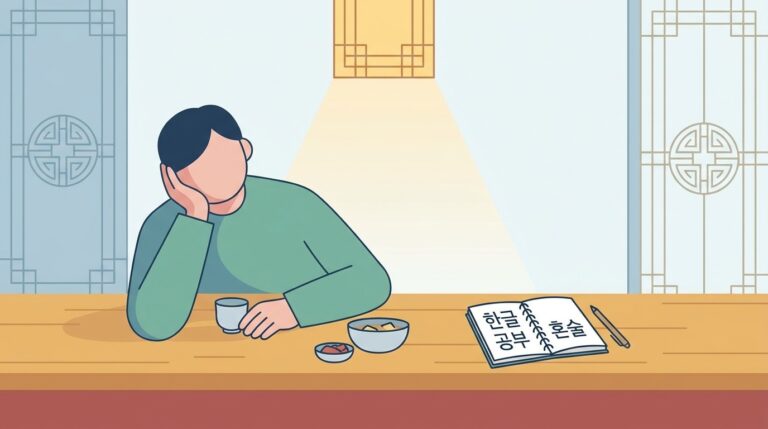
In the past, Korean dining culture revolved heavily around group gatherings. However, with the rapid rise of single-person households (1인 가구), a popular lifestyle trend called Honsool (혼술 – drinking alone) has transformed the country! From trendy solo bars in Hongdae to quiet neighborhood pubs in Seongsu, drinking alone is now seen as a sophisticated, relaxing form of self-care.
Based on real feedback from intermediate Korean learners living in Korea, this guide will give you the practical B1-level phrases, social etiquette (Nunchi), and confidence you need to enjoy a perfect solo night out.
Phase 2: Core Expressions Deep Dive
1. 혼술하다 (Hon-sul-ha-da)
- Pronunciation: [hon-sul-ha-da] (Sounds like ‘horn’ + ‘soul’ + ‘ha-da’)
- Meaning: Literal: To drink alcohol alone / Nuance: Enjoying a peaceful drink by oneself without social pressure.
- K-Culture Moment: In the K-Drama Drinking Solo (혼술남녀), the main character unwinds after a stressful workday with an ice-cold beer and delicious side dishes, celebrating personal peace.
- Editor’s Insight: This is a trendy compound word made from 혼자 (alone) and 술 (alcohol). Using it shows you understand modern Korean lifestyle culture!
- Situation Spectrum: Casual ✅ / Semi-formal ✅ / Formal 🚫
- 🤔 Think About It: In your country, is drinking alone viewed as a social activity or a private moment? How does your native language express solo relaxing time?
2. 혼자 왔는데 자리 있나요? (Hon-ja wan-neun-de ja-ri in-na-yo?)
- Pronunciation: [hon-ja wan-neun-de ja-ri in-na-yo] (hn-ja wan-neun-deh jah-ree een-nah-yo)
- Meaning: Literal: I came alone, is there a seat? / Nuance: A polite, natural way to ask for a single table without feeling self-conscious.
- K-Culture Moment: Walking into a bustling pub and catching the server’s eye right at the entrance.
- Editor’s Insight: The connector ~ㄴ데 (-nde) softens your sentence, making it sound polite and natural rather than direct or demanding.
- Situation Spectrum: Casual ⚠️ / Semi-formal ✅ / Formal ✅
- 🤔 Think About It: Why do you think Korean speakers use softening endings like ‘~ㄴ데’ when entering public establishments?
3. 안주 추천해 주실 수 있나요? (An-ju chu-cheon-hae ju-sil su in-na-yo?)
- Pronunciation: [an-ju chu-cheon-hae ju-sil su in-na-yo] (ahn-joo choo-chuhn-hae joo-seel soo een-nah-yo)
- Meaning: Literal: Can you recommend a side dish? / Nuance: Asking the host for the best food pairing for your solo drink.
- K-Culture Moment: Sitting at the bar counter, looking at a menu full of options, and asking the chef for their top pick.
- Editor’s Insight: In Korea, drinking alcohol almost always involves Anju (food paired with alcohol). Ordering good food is central to the drinking experience.
- Situation Spectrum: Casual ⚠️ / Semi-formal ✅ / Formal ✅
- 🤔 Think About It: How important is food pairing when drinking in your culture compared to Korea?
Phase 3: Textbook Korean vs. Real Korean
Situation 1: Expressing your intention to drink alone
* 📖 교과서 한국어: 혼자 술을 마시고 싶습니다. (Hon-ja sul-eul ma-si-go sip-seub-ni-da.)
* 🗣️ 진짜 한국어: 오늘 혼술 한잔하려고요. (O-neul hon-sul han-jan-ha-ryeo-go-yo.)
* 💡 왜 다를까?: Textbook sentences sound like a written essay. Locals use ‘혼술’ and ‘한잔하다’ (to have a drink) to sound warm and natural.
Situation 2: Asking for generous side dishes
* 📖 교과서 한국어: 안주를 많이 주세요. (An-ju-reul ma-ni ju-se-yo.)
* 🗣️ 진짜 한국어: 안주 푸짐하게 주세요! (An-ju pu-jim-ha-ge ju-se-yo!)
* 💡 왜 다를까?: ‘푸짐하다’ expresses abundant, heartwarming generosity rather than just a plain physical quantity (‘많이’).
Phase 4: K-Culture Deep Dive & Non-verbal Manners
4-1. Nunchi (눈치) & Gestures
When entering a pub alone, catch the staff’s eye, raise your index finger slightly to signal ‘one person’, and ask politely. If you sit at a bar counter (바 테이블), keep your personal belongings neat so you don’t occupy extra space.
4-2. Cultural Code Analysis
The rise of 1인 가구 (single households) in Korea has reshaped local dining. Many pubs now offer single bar seating equipped with phone chargers and subtle dividers. K-Dramas like Work Later, Drink Now show how solo drinking has become a therapeutic ritual for modern Korean adults.
Phase 5: Real Roleplay Scenario
Setting: A cozy pub in Yeonnam-dong. Server (NPC) greets Min-woo (Learner).
- Turn 1 (Server): 어서 오세요! 몇 분이세요? (Welcome! How many people?)
- Turn 2 (Min-woo): [😊 수줍게 미소 지으며] 안녕하세요, 혼자 왔는데 자리 있나요? (Hello, I came alone, do you have a seat?)
- Turn 3 (Server): 네, 바 테이블 쪽에 앉으시면 됩니다. 메뉴판 드릴게요! (Yes, you can sit at the bar counter. Here is the menu!)
- Turn 4 (Min-woo): [📜 메뉴를 살피며] 혹시 혼술할 때 먹기 좋은 안주 추천해 주실 수 있나요? (By the way, can you recommend a good side dish for solo drinking?)
- Turn 5 (Server): 혼자 드시기에는 모듬 꼬치나 감바스가 인기 많아요! (For solo guests, assorted skewers or gambas are very popular!)
- Turn 6 (Min-woo): [👍 고개를 끄덕이며] 그럼 모듬 꼬치 하나랑 맥주 한 잔 주세요. (Then please give me one order of skewers and a beer.)
- Turn 7 (Server): 네, 금방 준비해 드리겠습니다! (Sure, I will prepare it right away!)
- Turn 8 (Min-woo): [😄 기분 좋게] 감사합니다! 천천히 주세요. (Thank you! Please take your time.)
🔀 Interactive Branching Choice
If the server mentions the pub is currently full with group reservations, how should you respond?
- Option A: “아, 그렇군요! 그럼 다음에 올게요.” (Ah, I see! Then I’ll come next time.)
- Option B: “혼자니까 그냥 구석에 끼워 주시면 안 돼요?” (Can’t you just squeeze me into a corner since I’m alone?)
- Option C: “왜 혼자는 안 돼요?” (Why can’t solo guests sit?)
Feedback:
* Option A (Best Choice): Highly polite and natural. Preserves good rapport with the staff for your next visit!
* Option B (Risk Choice): Might put the staff in an awkward position if tables are fully booked.
* Option C (Bad Choice): Sounds defensive and unnecessarily argumentative.
Phase 6: 10-Second Emotion Shadowing Drill
- [😊 기쁘고 설레게] 오늘 밤에 / 혼술 한잔하려고요! (O-neul bam-e / hon-sul han-jan-ha-ryeo-go-yo!)
- [🥺 아쉽지만 다정하게] 저 / 혼자 왔는데 / 자리 있을까요? (Jeo / hon-ja wan-neun-de / ja-ri it-seul-kka-yo?)
- [😋 기대감을 담아] 안주 / 추천해 주실 수 있나요? (An-ju / chu-cheon-hae ju-sil su in-na-yo?)
Phase 7: K-Culture Mini Dictionary
- 혼술족 (Hon-sul-jok) | Solo Drinkers Club | Refers to people who regularly enjoy drinking alone as a lifestyle.
- 안주 (An-ju) | Alcohol Food Pairings | Dishes specifically served to accompany alcoholic drinks.
- 안주빨 (An-ju-ppal) | Eating more snacks than drinking | Playful slang for someone who eats all the pub food instead of drinking.
- 2차 (I-cha) | Second Round | Moving to a second venue pub/café after the first round of dining.
Phase 8: Traveler’s Survival Kit
Survival Expressions TOP 3
- 바 테이블 있어요? (Ba te-i-beul it-seo-yo?) – Do you have counter seating?
- 1인분도 주문 돼요? (I-rin-bun-do ju-mun dwae-yo?) – Can I order a single portion?
- 계산서 따로 주세요. (Gye-san-seo tta-ro ju-se-yo.) – Please give me separate bills.
Editor’s Travel Note
To quickly discover solo-friendly places near you, open the Naver Map App Download and search keywords like ‘혼술집’ or ‘바 테이블’ in your destination neighborhood!
Phase 9: A Step Deeper (Thinking Essay)
In fast-paced modern Korea, honsool is not about loneliness; it represents personal freedom and setting healthy boundaries in a highly social society. By choosing to drink alone, individuals take back control of their own time and mental space.
💬 Your Turn: What is your favorite way to enjoy quiet solo time in your country? Tell us in the comments below!
Phase 10: FAQ & Common Mistakes
Q: Is it considered rude to sit at a 4-person table when I am drinking alone?
A: It is not rude, but during peak hours, it is polite to prefer bar seating (바 테이블) or 2-person tables so the venue can host larger groups.
Q: Can I order alcohol without ordering food (Anju) in Korea?
A: In most Korean pubs (포차/술집), ordering at least one food dish (안주) alongside your drinks is standard customer etiquette.
Q: What should I do if a pub menu dish is only for 2 or more people?
A: You can ask politely: “1인분만 혹시 가능할까요?” (Is a 1-person portion possible by any chance?). If not, asking to pack leftovers (“남은 거 포장 돼요?”) is completely natural!
🚨 Common Mistakes
- Entering without checking seating -> Correct Action: Always ask “혼자 왔는데 자리 있나요?” at the entrance.
- Ordering drinks only -> Correct Action: Always pair your beverage with a small Anju item.
- Talking loudly on the phone -> Correct Action: Keep phone conversations low to preserve the cozy solo-friendly atmosphere.
Phase 11: Action Missions
- Bronze: Practice saying “혼자 왔는데 자리 있나요?” 3 times out loud.
- Silver: Share your favorite honsool snack photo on Instagram with #DailyHangul #Honsool.
- Gold: Visit a local Korean pub alone and successfully order in Korean!
- 🎮 K-Culture Mission: Watch an episode of K-Drama Drinking Solo and spot 3 side dishes featured in the show!
Phase 12: Interactive Quiz Challenge
- What does 혼술 stand for?
- Fill in the blank: 혼자 왔는데 _____ 있나요? (meaning ‘seat’)
- True / False: Ordering side dishes (Anju) is a standard part of Korean pub culture.
Click to reveal answers
1. Drinking alone (혼자 술 마시기)
2. 자리 (ja-ri)
3. True! Anju is a essential part of Korean drinking culture.