

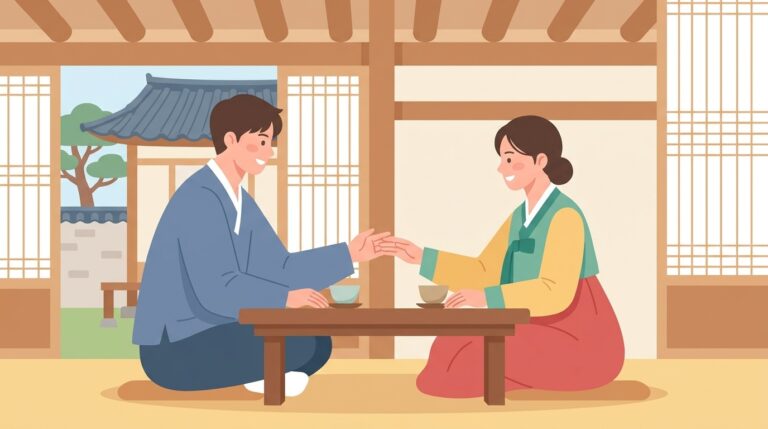
안녕하세요! 매일한글 에디터입니다. Have you ever found yourself in a tricky spot in Seoul—maybe negotiating a late check-out at a boutique stay, splitting a bulky taxi fare with travel buddies, or agreeing on a meetup spot during rush hour? You want to be polite, but you also want a fair outcome where everyone feels respected. Negotiation in Korea isn’t about winning at all costs; it’s about preserving harmony (Jeong) while finding a sweet spot where both sides step back just a little. In this guide, based on real learner feedback and cultural insights, you will master essential B1-level compromise expressions that will instantly make you sound like a thoughtful, savvy insider!
Phase 2: Core Expressions Deep Dive
1. 한발씩 양보해요 (Han-bal-ssik yang-bo-hae-yo)
- Pronunciation: [Han-bal-ssik yang-bo-hae-yo] (Sounds like han-ball-sseek yahng-boh-hae-yo)
- Meaning: Literal: “Let’s yield one step each.” / Actual: “Let’s both compromise a little bit.”
- K-Culture Moment: In workplace K-Dramas like Misaeng, team members use this when balancing project responsibilities between departments.
- Editor’s Insight: Using “한발” (one step) visualizes physical movement backwards, softening the request so it feels friendly rather than demanding.
- Situation Spectrum: Casual ⚠️ / Semi-formal ✅ / Formal ✅
- 🤔 Think About It: Why does visual language like “taking a step back” make negotiation feel less aggressive in Korean culture compared to direct demands?
2. 중간에서 만나요 (Jung-gan-e-seo man-na-yo)
- Pronunciation: [Jung-gan-e-seo man-na-yo] (Sounds like joong-gahn-eh-suh mahn-nah-yo)
- Meaning: Literal: “Let’s meet in the middle.” / Actual: “Let me split the difference or find a fair middle ground.”
- K-Culture Moment: When choosing a location between Hongdae and Gangnam, friends often suggest Yongsan or Itaewon with this exact phrase.
- Editor’s Insight: It works for both literal geographical locations and abstract bargaining amounts!
- Situation Spectrum: Casual ✅ / Semi-formal ✅ / Formal ⚠️
- 🤔 Think About It: How does proposing a middle ground reflect the Korean value of fairness and social balance?
3. 이 정도면 서로 좋지 않을까요? (I jeong-do-myeon seo-ro jo-chi an-eul-kka-yo?)
- Pronunciation: [I jeong-do-myeon seo-ro jo-chi an-eul-kka-yo?] (Sounds like ee juhng-doh-myuhn suh-roh joh-chee ahn-eul-kkah-yoh?)
- Meaning: Literal: “If it’s this much, wouldn’t it be good for both?” / Actual: “Isn’t this a win-win solution?”
- K-Culture Moment: Used frequently in boutique markets or contract talks when proposing a final, mutually beneficial offer.
- Editor’s Insight: Formulating your idea as a gentle question invites the listener to agree without feeling pushed.
- Situation Spectrum: Casual ⚠️ / Semi-formal ✅ / Formal ✅
- 🤔 Think About It: Notice how framed questions in Korean help save “face” (Che-myeon) for both parties.
Phase 3: Textbook Korean vs Real Korean
Situation 1: Splitting expenses or duties
- 📖 Textbook: 우리 서로 타협합시다. (Uri seo-ro ta-hyeop-hap-si-da.) – “Let us compromise.”
- 🗣️ Real Korean: 우리 한발씩만 양보해요. (Uri han-bal-ssik-man yang-bo-hae-yo.) – “Let’s each step back a tiny bit.”
- 💡 Why different? “타협” sounds like a formal political treaty or legal contract! In real conversation, Koreans prefer “양보하다” (to yield/step back) which sounds much warmer.
Situation 2: Deciding on a price or middle value
- 📖 Textbook: 중간 가격으로 합의합시다. (Jung-gan ga-gyeok-eu-ro hab-ui-hab-si-da.) – “Let us agree on the middle price.”
- 🗣️ Real Korean: 그냥 중간에서 만나기로 해요! (Geu-nyang jung-gan-e-seo man-na-gi-ro hae-yo!) – “Let’s just meet in the middle!”
- 💡 Why different? Koreans value colloquial, conversational flow over stiff business terminology during casual negotiations.
Phase 4: K-Culture Deep Dive & Non-verbal Manners
4-1. Nunchi & Gestures
- Soft Hand Sweep: Lowering your hands slightly with palms facing down signals you want to calm the tension and negotiate gently.
- Slight Head Tilt & Smile: Tilting your head slightly while asking “이 정도면 어떨까요?” shows humility and openness.
- Nunchi Tip: Pay attention to tone! A flat tone can sound demanding, so keep your pitch light and friendly.
4-2. Cultural Code Analysis
In Korea, bargaining isn’t just about money or resources; it’s a social dance. The concept of Mildang (밀당 – push and pull) applies to personal relationships and negotiations alike. Showing flexibility demonstrates that you value the relationship higher than a rigid rule.
Phase 5: Real Roleplay Scenario
Setting: Negotiating a late check-out time at a boutique Hanok stay in Bukchon.
Characters: You (Guest) & Min-su (Hanok Host).
- Turn 1:
- Guest: 호스트님, 혹시 체크아웃 시간을 1시간만 연장할 수 있을까요?
- Romanization: Ho-seu-teu-nim, hok-si che-keu-a-ut si-gan-eul han-si-gan-man yeon-jang-hal su iss-eul-kka-yo?
- English: Host, could I possibly extend my check-out time by 1 hour?
- 🎭 [약간 쑥스러운 듯 미소를 지으며] (Smiling slightly shyly)
- Turn 2:
- Min-su: 아, 다음 손님 청소 때문에 12시는 좀 힘들 것 같은데요…
- Romanization: A, da-eum son-nim cheong-so ttae-mu-ne 12-si-neun jom him-deul geot gat-eun-deo…
- English: Ah, because of cleaning for the next guest, 12 o’clock might be a bit difficult…
- 🎭 [곤란한 표정을 지으며 머리를 긁적인다] (Looking embarrassed and scratching head)
- Turn 3:
- Guest: 그렇군요! 그럼 우리 한발씩만 양보해서 11시 30분은 어떨까요?
- Romanization: Geu-reot-gun-yo! Geu-reom u-ri han-bal-ssik-man yang-bo-hae-seo 11-si 30-bun-eun eot-teol-kka-yo?
- English: I see! Then how about we each yield a bit and aim for 11:30?
- 🎭 [손가락으로 30분을 표시하며 밝게 제안한다] (Brightly suggesting while gesturing 30 minutes)
- Turn 4:
- Min-su: 11시 30분이요? 음… 청소 팀에 확인해 볼게요.
- Romanization: 11-si 30-bun-i-yo? Eum… cheong-so tim-e hwa-gin-hae bool-ge-yo.
- English: 11:30? Hmm… let me check with the cleaning team.
- 🎭 [휴대폰을 들여다보며 신중하게 고려한다] (Looking at phone while carefully considering)
- Turn 5:
- Guest: 짐만 방에 두고 11시 반에 나가도 괜찮아요! 중간에서 만나요.
- Romanization: Jim-man bang-e du-go 11-si ban-e na-ga-do gwaen-chan-a-yo! Jung-gan-e-seo man-na-yo.
- English: I can just leave my bags in the room and leave at 11:30! Let’s meet in the middle.
- 🎭 [부담을 줄여주려는 듯 두 손을 들어 보이며] (Raising hands slightly to ease pressure)
- Turn 6:
- Min-su: 좋아요! 짐 정리만 도와주시면 11시 30분까지 가능해요.
- Romanization: Jo-a-yo! Jim jeong-ri-man do-wa-ju-si-myeon 11-si 30-bun-kka-ji ga-neung-hae-yo.
- English: Great! If you help consolidate your luggage, 11:30 is possible.
- 🎭 [안도하며 미소를 짓는다] (Smiling with relief)
- Turn 7:
- Guest: 정말 감사합니다! 이 정도면 서로 완벽한 해결책이네요.
- Romanization: Jeong-mal gam-sa-ham-ni-da! I jeong-do-myeon seo-ro wan-byeok-han hae-gyeol-chaek-i-ne-yo.
- English: Thank you so much! This seems like a perfect solution for both of us.
- 🎭 [고개를 숙이며 정중하게 인사한다] (Bowing politely)
- Turn 8:
- Min-su: 편안하게 준비하시고 천천히 퇴실하세요!
- Romanization: Pyeon-an-ha-ge jun-bi-ha-si-go cheon-cheon-hi toe-sil-ha-se-yo!
- English: Prepare comfortably and take your time checking out!
- 🎭 [손을 흔들며 친절하게 응대한다] (Waving hands kindly)
🔀 Interactive Choice Point:
What would you say if the host hesitated further?
* Choice A: “그럼 제안하신 대로 11시 15분으로 해요! 한발씩 양보합시다.”
* Feedback: BEST – Shows great flexibility while using key target vocabulary!
* Choice B: “안 되나요? 그냥 12시까지 있게 해주세요.”
* Feedback: BAD – Pushing your original demand ignores their situation and breaks harmony.
* Choice C: “그럼 그냥 지금 나갈게요.”
* Feedback: RISK – Too abrupt; might make the host feel guilty unnecessarily.
Phase 6: 10-Second Emotion Shadowing Drill
- [😊 온화하고 제안하듯] 우리 / 한발씩만 / 양보해요!
(u-ri / han-bal-ssik-man / yang-bo-hae-yo!) - [🤝 쾌활하고 타협하듯] 중간에서 / 만나면 / 서로 좋잖아요!
(jung-gan-e-seo / man-na-myeon / seo-ro jo-chan-a-yo!) - [🥺 곤란하면서도 예의 바르게] 조금만 / 맞춰 주실 수 / 있을까요?
(jo-geum-man / mat-chwo ju-sil su / iss-eul-kka-yo?)
Phase 7: K-Culture Mini Dictionary
- 양보 (Yang-bo) | Yielding / Compromising | Giving up a bit of your position for another person.
- 타협점 (Ta-hyeop-jeom) | Agreement Point / Middle Ground | The point where both sides reach a smooth agreement.
- 절충 (Jeol-chung) | Blending / Compromise | Combining different views to create a practical solution.
- 조율 (Jo-yul) | Tuning / Adjusting | Fine-tuning schedules or opinions smoothly.
Phase 8: Traveler’s Survival Kit
Survival Top 3 Expressions
- 서로 조금씩 양보해요. (Seo-ro jo-geum-ssik yang-bo-hae-yo.) – Pro Tip: Ideal when negotiating meeting times or daily chores.
- 중간으로 맞춰요. (Jung-gan-eu-ro mat-chwo-yo.) – Pro Tip: Quick way to split prices or deadlines.
- 그럼 이 정도로 할까요? (Geu-reom i jeong-do-ro hal-kka-yo?) – Pro Tip: Great wrap-up sentence once an agreement is reached.
Editor’s Travel Note
When navigating Korea, clear communication saves time! Download the Naver Map App Download to search for mid-point meeting spots easily. If you are negotiating subway routes or meetups, having real-time transit data helps you propose practical options!
Phase 9: One Step Deeper
In Korean society, negotiation isn’t about victory; it’s about maintaining Inhwa (인화 – social harmony). Yielding a small point shows respect and maturity. When you use expressions like “한발씩 양보해요”, you signal that you respect the other person’s position as much as your own.
💬 Your Turn: What is the most common way to negotiate or reach a compromise in your home country? Share your story in the comments below!
Phase 10: FAQ & Common Mistakes
Q: Is bargaining acceptable in traditional markets in Korea?
A: Yes! However, instead of demanding a discount, friendly negotiation phrases like “조금만 깎아주시면 안 될까요?” or “중간에서 만나요!” with a warm smile work best.
Q: Can I use “한발씩 양보해요” with my boss?
A: It is better to use formal honorifics with your boss, such as “한 발씩 양보하여 조율하는 것은 어떨까요?” to maintain workplace etiquette.
Q: Does “중간에서 만나요” only apply to physical locations?
A: No! You can use it for time, budget, task allocation, or any negotiated situation.
🚨 Common Mistakes TOP 3:
1. Mistake: Using “타협합시다” in casual settings.
* Correct Action: Use “우리 한발씩 양보해요” instead.
2. Mistake: Speaking in a flat, blunt tone when asking for compromise.
* Correct Action: Soften the sentence ender with “~요?” or “~을까요?”.
3. Mistake: Forgetting to acknowledge the other person’s concession.
* Correct Action: Always follow up with “양보해 주셔서 감사합니다!”.
Phase 11: Action Mission & Participation
Action Mission 3 Steps
- Bronze: Practice saying “중간에서 만나요” in front of the mirror three times.
- Silver: Write a short sentence in the comment section proposing a compromise time to a friend.
- Gold: Use one compromise expression during your next interaction with a Korean speaker or tutor!
🎮 K-Culture Mission:
Watch a Korean reality show (like Running Man) and spot the exact moment cast members negotiate task divisions using compromise phrases!
Phase 12: Interactive Quiz Challenge
-
Situation Judgment: You want to split a time difference (10:00 vs 11:00) with a Korean friend. Which sentence is best?
Click to reveal Answer & Explanation
Answer: “중간에서 만나서 10시 30분에 만나요!”
Explanation: Proposing 10:30 clearly demonstrates meeting in the middle smoothly.
-
Fill in the Blank: 우리 한_____씩 양보해서 결정해요.
Click to reveal Answer & Explanation
Answer: 발 (bal)
Explanation: “한발씩 양보하다” means “to yield step by step”.
-
True/False: “타협합시다” is the most natural, friendly phrase to use with close Korean friends.
Click to reveal Answer & Explanation
Answer: False
Explanation: “타협합시다” sounds overly formal and rigid. “한발씩 양보해요” or “중간에서 만나요” is much more natural!







