

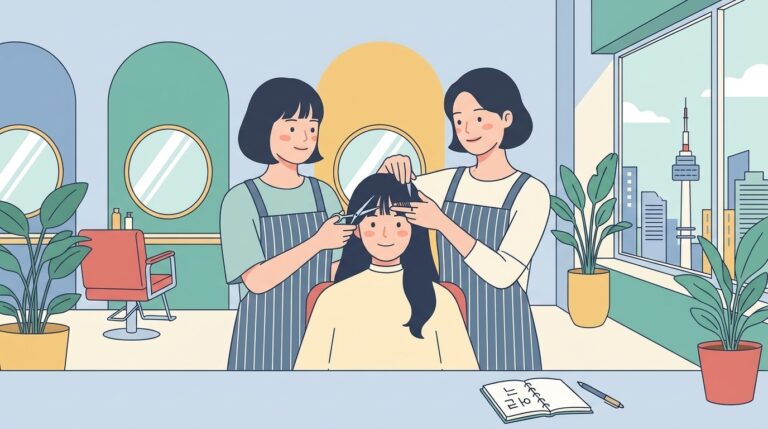
Don’t Panic at the Korean Hair Salon! How to Get the Perfect Bang Trim in 1 Minute
Phase 1: 공감 (Story-Driven Opening)
안녕하세요! I’m your Daily Hangul editor and your 10-year native culture navigator! 💇♀️✨
Picture this: You are standing in front of a chic, aesthetic salon in Hongdae or Seongsu. You walked in hoping to get a quick, cute bang trim—just like your favorite K-pop idol or K-drama star. But suddenly, sweat builds up on your palms. The hair designer smiles and asks, “어떻게 해드릴까요?” (Eotteoke hae-deuril-kka-yo? / How would you like your hair done?).
You panic! What if they cut too much? What if you end up with micro-bangs when you just wanted a light refresh? Many of our A2 learners share this exact fear: hair salons feel intimidating because hair doesn’t grow back overnight! But don’t worry. Today, based on real feedback from hundreds of K-beauty enthusiasts, I’m giving you the ultimate survival script to get your bangs trimmed exactly the way you want. Master these 3 simple phrases, and you’ll step out of any Seoul salon feeling like a main character! 🌸
Phase 2: 핵심 표현 3선 심층 분석 (Top 3 Core Phrases)
1. 앞머리만 좀 다듬어 주세요.
- Pronunciation: Apmori-man jom dadumeo juseyo. (Sounds like: Up-mori-man jom dah-doo-meo joo-seh-yo) – Tip: ‘다듬어’ (dadumeo) glides smoothly like trimming garden leaves gently!
- Meaning: “Please just trim my bangs.” (Literal: Bangs-only a bit trim please.)
- K-Culture Moment: The magic phrase used by K-drama protagonists whenever they make a quick pop-in visit to a local salon before a romantic date.
- Editor’s Insight: The word ‘다듬다’ (dadumda) means to tidy up or trim without changing the main length. Using ‘만’ (man = only) reassures the stylist not to touch the rest of your hair.
- Situation Spectrum:
- Casual: 앞머리만 좀 다듬어 줘. ⚠️ (Only with close friends)
- Semi-formal: 앞머리만 좀 다듬어 주세요. ✅ (Perfect for salons!)
- Formal: 앞머리만 다듬어 주시겠습니까? 🚫 (Too rigid for hair salons)
- 🤔 Think About It: In your culture, do you usually get bangs trimmed separately from a full haircut service, or is it always bundled together?
2. 눈썹 선에 맞춰 주세요.
- Pronunciation: Nunsseop seon-e matchwo juseyo. (Sounds like: Noon-sseop sun-eh maht-chwo joo-seh-yo) – ‘눈썹’ (nunsseop) feels soft like your eyebrows!
- Meaning: “Please align it with my eyebrow line.”
- K-Culture Moment: Essential when aiming for the iconic Korean ‘See-through Bangs’ (시스루 뱅), where length sitting right at the eyebrow line is crucial.
- Editor’s Insight: ‘선’ (seon) means ‘line’ and ‘맞춰 주세요’ (matchwo juseyo) means ‘please match/align’. Pointing at your eyebrows while saying this guarantees zero miscommunication!
- Situation Spectrum:
- Casual: 눈썹 선에 맞춰 줘. ⚠️
- Semi-formal: 눈썹 선에 맞춰 주세요. ✅
- Formal: 눈썹 선에 맞춰 주시길 바랍니다. 🚫 (Sounds like a corporate speech)
- 🤔 Think About It: Korean hair terminology often uses facial landmarks (eyebrows, cheekbones, jawline) as baseline reference points. How do you describe lengths in your language?
3. 너무 짧지 않게 해주세요.
- Pronunciation: Neomu jjalpji anke hae-juseyo. (Sounds like: No-moo jjalp-jee ahn-keh hae-joo-seh-yo) – ‘짧’ (jjalp) has a sharp tensing sound, emphasizing ‘short’.
- Meaning: “Please don’t make it too short.”
- K-Culture Moment: Used by everyone in Korea who fears the dreaded ‘Choppy Bangs’ accident!
- Editor’s Insight: ‘너무’ (neomu) means ‘too/overly’, and ‘-지 않게 해주세요’ (-ji anke hae-juseyo) means ‘please make it so that it isn’t’. It’s your safety guard phrase.
- Situation Spectrum:
- Casual: 너무 짧지 않게 해줘. ⚠️
- Semi-formal: 너무 짧지 않게 해주세요. ✅
- Formal: 너무 짧지 않도록 부탁드립니다. 🚫 (Overly formal for salon chat)
- 🤔 Think About It: Why is politely expressing caution before a haircut considered polite rather than distrustful in Korean culture?
Phase 3: 교과서 한국어 vs 진짜 한국어
Situation 1: Telling the stylist what you want today
- 📖 교과서 한국어: 저는 앞머리를 자르고 싶습니다. (Jeoneun apmorireul jareugo sipseumnida. – I want to cut my bangs.)
- 🗣️ 진짜 한국어: 앞머리 다듬으려고요. (Apmori dadumeuryeogoyo. – Just looking to trim my bangs.)
- 💡 왜 다를까? Textbook Korean uses rigid sentence endings (-sipseumnida). Real Koreans use -려고요 (-ryeogoyo) to express gentle intentions smoothly during casual business interactions.
Situation 2: Asking for just a tiny bit cut off
- 📖 교과서 한국어: 조금만 잘라주십시오. (Jogeum-man jallajusipsio. – Please cut a little bit.)
- 🗣️ 진짜 한국어: 살짝만 쳐주세요. (Saljjak-man chyeojuseyo. – Just thin/trim it out lightly.)
- 💡 왜 다를까? Stylists often use the verb ‘치다’ (chida – light thinning/feathering) and the adverb ‘살짝’ (saljjak – lightly/slightly) instead of basic cutting words.
Phase 4: K-Culture 딥다이브 & 비언어적 매너
4-1. 눈치 (Nunchi) & Gestures
When asking for a bang trim, non-verbal cues work magic! Use your index finger horizontally across your forehead right above your eyebrows while saying “눈썹 선에 맞춰 주세요”. Also, gently tilt your head slightly forward when sitting down so the hair designer can assess your hairline. Avoid moving your head once the scissors are out!
4-2. Culture Code: The Art of
Frequently Asked Questions (FAQ)
Q: What does "앞머리만 좀 다듬어 주세요." mean in Korean and how do you pronounce it?
A: In Korean, "앞머리만 좀 다듬어 주세요." is pronounced [Apmori-man jom dadumeo juseyo. (Sounds like: Up-mori-man jom dah-doo-meo joo-seh-yo] and means: "Please just trim my bangs." (Literal: Bangs-only a bit trim please.)
Q: What does "눈썹 선에 맞춰 주세요." mean in Korean and how do you pronounce it?
A: In Korean, "눈썹 선에 맞춰 주세요." is pronounced [Nunsseop seon-e matchwo juseyo. (Sounds like: Noon-sseop sun-eh maht-chwo joo-seh-yo] and means: "Please align it with my eyebrow line."
Q: What does "너무 짧지 않게 해주세요." mean in Korean and how do you pronounce it?
A: In Korean, "너무 짧지 않게 해주세요." is pronounced [Neomu jjalpji anke hae-juseyo. (Sounds like: No-moo jjalp-jee ahn-keh hae-joo-seh-yo] and means: "Please don't make it too short."







