

Don’t Get Lost in Korea! How to Ask “Where is the Elevator?” Like a Local
Phase 1: Empathy & K-Culture Story
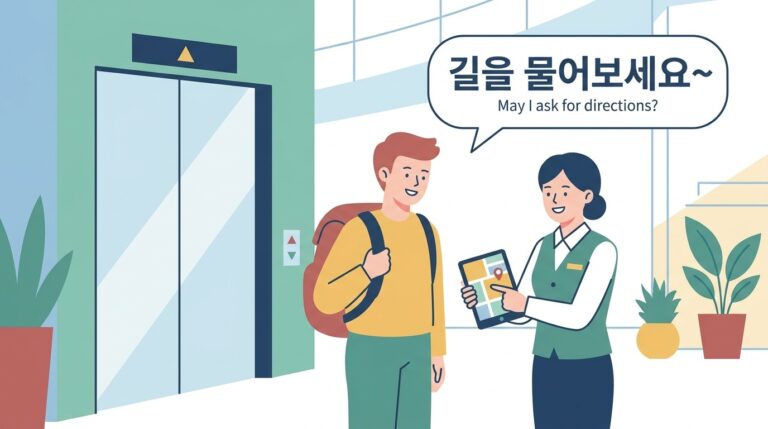
안녕하세요! 매일한글 에디터입니다. (Hello! This is your Daily Hangul Editor.) Imagine this: You just finished an amazing shopping spree at the famous Yeouido Hyundai Department Store in Seoul. Your arms are heavy with bags full of K-beauty products and merch, and your legs are exhausted from walking. You need to head to the subway station, but you are carrying heavy luggage and stairs are out of the question. You look around, but all the signage seems like a maze of Korean text! Panic sets in—how do you ask someone where the elevator is without freezing up?
Don’t worry! This is one of the most common pain points for foreign travelers in Korea. Navigating giant multi-story malls, subway hubs, and airport terminals becomes effortless once you master a single simple phrase. Today, based on feedback from hundreds of beginner learners, we will break down the essential facility-finding phrase so you can travel comfortably and confidently across Korea!
Phase 2: Key Expressions Deep Dive
1. 엘리베이터 어디예요?
- Pronunciation: [el-li-be-i-teo eo-di-ye-yo?] (Sounds like: ‘El-lee-bay-i-tor’ + ‘oh-dee-yeah-yo?’)
- Meaning: Literal: “Elevator where is it?” | Nuance: “Excuse me, where is the elevator?”
- K-Culture Moment: You will hear this phrase constantly in K-Dramas when characters carry heavy suit cases at airports or search for VIP lounges in grand corporate buildings.
- Editor’s Insight: Combining the object (엘리베이터) with ‘어디예요?’ (Where is…?) is the ultimate beginner shortcut! You can replace ‘엘리베이터’ with ‘화장실’ (toilet) or ‘출구’ (exit) using the exact same structure.
- Situation Spectrum: Casual ⚠️ | Semi-formal ✅ | Formal ✅
- 🤔 Think About It: In English, we usually add “Excuse me” at the beginning. In Korean, adding the polite ending ‘-예요 (ye-yo)’ naturally conveys politeness even without a long preamble!
2. 저기예요
- Pronunciation: [jeo-gi-ye-yo]
- Meaning: Literal: “It is over there.” | Nuance: “It’s right over that way.”
- K-Culture Moment: Helpful Koreans at subway stations pointing toward an elevator while giving a warm smile.
- Editor’s Insight: Koreans often combine this phrase with a gentle hand gesture toward the direction.
- Situation Spectrum: Casual ⚠️ | Semi-formal ✅ | Formal ✅
- 🤔 Think About It: Notice how Korean direction words are short and punchy so people can point and explain quickly!
3. 감사합니다!
- Pronunciation: [gam-sa-ham-ni-da]
- Meaning: Literal: “I give thanks!” | Nuance: “Thank you so much!”
- K-Culture Moment: The polite finish to every single polite interaction in daily Korean life.
- Editor’s Insight: A slight bow of the head (15 degrees) makes this sound 200% more genuine!
- Situation Spectrum: Casual 🚫 | Semi-formal ✅ | Formal ✅
- 🤔 Think About It: Saying thank you immediately builds a friendly bridge with locals wherever you go.
Phase 3: Textbook Korean vs. Real Korean
Situation 1: Asking an information desk clerk
- 📖 Textbook Korean: 엘리베이터가 어디에 있습니까? (el-li-be-i-teo-ga eo-di-e it-seum-ni-ka?)
- 🗣️ Real Korean: 저기요, 엘리베이터 어디예요? (jeo-gi-yo, el-li-be-i-teo eo-di-ye-yo?)
- 💡 Why different? While the textbook version is grammatically correct and very formal, real native speakers prefer shorter, friendly sentences like ‘어디예요?’ in daily interactions.
Situation 2: Asking someone on the street in a hurry
- 📖 Textbook Korean: 엘리베이터 위치를 가르쳐 주세요. (el-li-be-i-teo wi-chi-reul ga-reu-chyeo ju-se-yo.)
- 🗣️ Real Korean: 엘리베이터 어디쪽이에요? (el-li-be-i-teo eo-di-jjok-i-e-yo?)
- 💡 Why different? Asking ‘어디쪽이에요?’ (Which direction is it?) sounds more intuitive when you need immediate direction pointing.
Phase 4: K-Culture Deep Dive & Non-Verbal Manners
4-1. Nunchi & Body Language Gestures
When asking for directions in Korea, never point with a single index finger directly at a person or close location, as it can seem aggressive. Instead, use an open palm facing slightly upward to point toward the elevator or direction. Make gentle eye contact, give a soft smile, and slightly tilt your head forward when saying “저기요” (Excuse me) to show politeness.
4-2. Culture Code: Modern Korean Malls & Accessibility
Korea’s modern infrastructure prioritizes convenience and accessibility. In large places like COEX Mall or Incheon Airport, elevators are designated for luggage, strollers, and accessibility needs. Knowing how to locate them quickly saves your time and energy during your travels!
Phase 5: Real-Life Roleplay Scenario
Setting: Inside a large shopping mall in Seoul. You (Alex) are carrying two heavy shopping bags and looking for the elevator.
Character: Helpful Mall Staff (스태프)
- Turn 1 (Alex): 저기요! (jeo-gi-yo!) (🎭 Waving hand slightly with a polite bow) – Excuse me!
- Turn 2 (Staff): 네, 무엇을 도와드릴까요? (ne, mu-eot-eul do-wa-deu-ril-kka-yo?) (🎭 Smiling kindly) – Yes, how can I help you?
- Turn 3 (Alex): 엘리베이터 어디예요? (el-li-be-i-teo eo-di-ye-yo?) (🎭 Pointing gently to heavy bags) – Where is the elevator?
- Turn 4 (Staff): 아, 엘리베이터요? 저쪽에 있어요. (a, el-li-be-i-teo-yo? jeo-jjok-e it-seo-yo.) (🎭 Pointing open hand to the right) – Ah, the elevator? It’s over that way.
- Turn 5 (Alex): 오른쪽이요? (o-reun-jjok-i-yo?) (🎭 Looking right to confirm) – To the right?
- Turn 6 (Staff): 네, 직진하시면 바로 보여요. (ne, jik-jin-ha-si-myeon ba-ro bo-yeo-yo.) (🎭 Nodding head) – Yes, if you go straight, you’ll see it right away.
- Turn 7 (Alex): 아! 감사합니다! (a! gam-sa-ham-ni-da!) (🎭 Bowing slightly with a relieved smile) – Ah! Thank you!
- Turn 8 (Staff): 좋은 하루 되세요! (jo-eun ha-ru doe-se-yo!) (🎭 Waving softly) – Have a nice day!
🔀 Interactive Branching Choice
What will you say after the staff member points to the right?
* Choice A: “감사합니다!” (gam-sa-ham-ni-da!) and bow slightly.
* Choice B: Walk away silently without saying anything.
* Choice C: “야! 고마워!” (ya! go-ma-wo!) loudly.
Feedback:
* Best (Choice A): Perfect! Saying thank you with a bow leaves a wonderful impression.
* Bad (Choice B): Risky! Walking away without acknowledgment can seem impolite in Korean culture.
* Risk (Choice C): Oh no! “야! 고마워!” is overly casual slang used only with close childhood friends. Using it with staff is rude!
Phase 6: 10-Second Emotion Shadowing Drill
[🥺 Seeking help anxiously]
저기요… / 엘리베이터 / 어디예요?
(jeo-gi-yo / el-li-be-i-teo / eo-di-ye-yo?)-
[😊 Expressing bright gratitude]
아! / 정말 / 감사합니다!
(a! / jeong-mal / gam-sa-ham-ni-da!)
Phase 7: K-Culture Mini Dictionary
- 엘리베이터 (el-li-be-i-teo) | Elevator | Essential facility keyword used in all public buildings.
- 에스컬레이터 (e-seu-keol-re-i-teo) | Escalator | Moving stairs found in subways and shopping malls.
- 화장실 (hwa-jang-sil) | Restroom / Bathroom | The most requested facility phrase: “화장실 어디예요?”.
- 출구 (chul-gu) | Exit | Crucial for finding your way out of Korean subway stations.
Phase 8: Traveler’s Survival Kit
Survival Expressions TOP 3
- 어디예요? (eo-di-ye-yo?) – Where is it?
- 저기요 (jeo-gi-yo) – Excuse me (to get attention).
- 감사합니다 (gam-sa-ham-ni-da) – Thank you.
Editor’s Travel Note
When navigating Korea, floor levels can sometimes be confusing (e.g., B1, B2 for underground food courts). Make sure to download the Naver Map App Download before your trip! It provides indoor maps for major Korean subway stations and shopping malls so you never lose your way.
Phase 9: One Step Deeper
In Korean society, asking for help is considered a natural part of community living. Korean culture values mutual consideration, so locals are usually very willing to help tourists find facilities. When you use polite phrasing like ‘어디예요?’ and bow slightly, you are partaking in the core Korean social harmony value of respect.
💬 Your Turn: Have you ever lost your way in a foreign city or shopping mall? Tell us in the comments below!
Phase 10: FAQ & Common Mistakes
Q: Can I just say “Elevator?” with a rising tone?
A: Yes, locals will understand you! However, adding “어디예요?” (eo-di-ye-yo?) makes you sound much more respectful and natural.
Q: What is the difference between ‘어디예요’ and ‘어디 있어요’?
A: ‘어디예요?’ means “Where is it?” while ‘어디 있어요?’ means “Where does it exist/stay?”. Both are completely fine for beginners, but ‘어디예요?’ is simpler to pronounce!
Q: Is ‘저기요’ rude?
A: Not at all! ‘저기요’ literally means “Over there” and is the standard polite way to call out to staff in restaurants, shops, or public places.
🚨 Common Mistakes TOP 3
- Mistake: Using casual words like “어디야?” to strangers. | Correct Action: Always use polite ending “어디예요?”.
- Mistake: Pointing directly with one finger at someone. | Correct Action: Use an open palm toward the direction.
- Mistake: Saying “안녕” (casual hello) to mall staff. | Correct Action: Say “안녕하세요” or simply “저기요”.
Phase 11: Action Mission & Engagement
- Bronze Mission: Speak “엘리베이터 어디예요?” out loud 3 times in front of your mirror.
- Silver Mission: Write a comment below inserting a different facility word: “[Facility] 어디예요?”.
- Gold Mission: Spot an elevator scene while watching your favorite K-Drama today and listen for the word ‘엘리베이터’!
🎮 K-Culture Mission: Watch a video tour of Hyundai Seoul Mall on YouTube and spot where the elevator signs are located!
Phase 12: Interactive Quiz Challenge
Q1. How do you politely ask “Where is the elevator?” in Korean?
1) 엘리베이터 고마워
2) 엘리베이터 어디예요?
3) 엘리베이터 안녕
Click to view Answer & Explanation
Answer: 2) 엘리베이터 어디예요?
Explanation: ‘어디예요?’ means “Where is it?” in polite conversational Korean.
Q2. True or False: Pointing with one finger directly at a person’s face is polite in Korea.
Click to view Answer & Explanation
Answer: False
Explanation: Use an open hand or palm when indicating directions politely.







