

Understanding the Sacred Harmony of Jongmyo Jeryeak and Ye-Ak Philosophy
Phase 1: Empathy & Storytelling Opening
안녕하세요! 매일한글 에디터입니다. Welcome back to another deep dive into the rich tapestry of Korean culture and language.
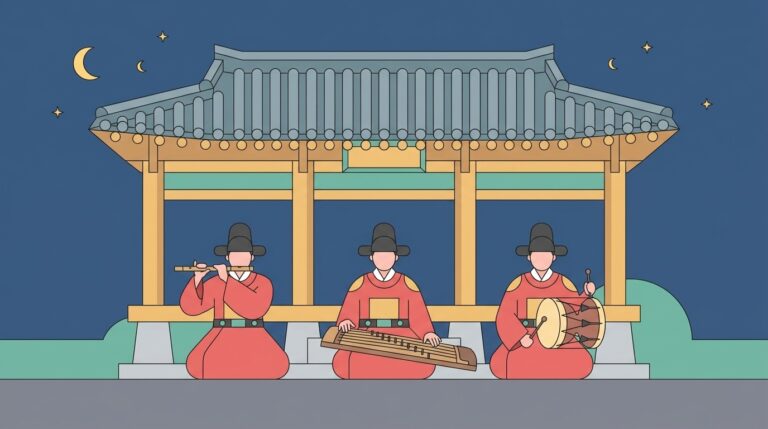
Imagine standing in the courtyard of Jongmyo Shrine on a crisp spring day. The air is heavy with the subtle scent of incense. Ancient wooden pillars frame a grand procession of court musicians dressed in striking crimson robes. As the first strike of the Bakh (wooden clapper) pierces the air, time seems to freeze. The resonant bronze chimes (Pyeonjong) and stone slabs (Pyeongyeong) harmonize into a soundscape that feels both hauntingly ancient and profound. You aren’t just listening to music—you are witnessing five hundred years of royal Joseon tradition brought to life.
For advanced learners, stepping into the realm of Korean traditional arts (전통 예술) often brings a distinct challenge: how do you express the complex philosophical gravity of rituals like Jongmyo Jeryeak (종묘 제례악) without sounding like a dry academic textbook? Many students tell us they struggle to articulate the reverence and cosmic philosophy embedded in these experiences.
This guide is crafted from real classroom feedback and native linguistic insights. By mastering C2-level vocabulary and understanding the underlying philosophy of Ye-Ak (예악 사상 – the interplay of Ritual Propriety and Music), you will elevate your Korean from merely fluent to intellectually sophisticated.
Phase 2: Deep Dive into 3 Key Expressions
1. 깃들다 (Gis-deul-da)
- Pronunciation: [gis-deul-da] (Sounds like gees-deul-dah, gliding smoothly on the vowels)
- Meaning: Literally “to nest” or “to settle in”; idiomatically used when an abstract spirit, emotion, history, or philosophy is deeply embedded inside an object or music.
- K-Culture Moment: Documentaries describing the craftsman’s spirit in traditional instruments like the Geomung-o or describing ancient architecture where royal ancestral spirits reside.
- Editor’s Insight: Unlike standard verbs for “contain” (담기다), 깃들다 carries a poetic, solemn weight. It implies that the emotion or spirit chose this place to dwell permanently.
- Situation Spectrum:
- Casual: 🚫
- Semi-formal: ⚠️
- Formal / Artistic analysis: ✅
- 🤔 Think About It: Does your native language have a verb that combines the concept of “dwelling comfortably” with “inherent spiritual presence”?
2. 엄숙하다 (Eom-suk-ha-da)
- Pronunciation: [eom-su-ka-da] (A soft ‘eom’ transitioning into an aspirated ‘kah’ sound)
- Meaning: Literal translation is “to be solemn/majestic.” It describes an atmosphere of deep respect, quiet dignity, and sacred gravity.
- K-Culture Moment: Used when describing national remembrance ceremonies, royal rituals at Jongmyo, or quiet moments inside sacred Buddhist temples.
- Editor’s Insight: Don’t confuse 엄숙하다 with 진지하다 (to be serious). 진지하다 refers to personal attitude, whereas 엄숙하다 characterizes an entire ambient atmosphere or collective reverence.
- Situation Spectrum:
- Casual: 🚫
- Semi-formal: ⚠️
- Formal: ✅
- 🤔 Think About It: How does collective silence in a ceremony convey respect differently across Western and Asian cultural traditions?
3. 조화를 이루다 (Jo-hwa-reul I-ru-da)
- Pronunciation: [jo-hwa-reul i-ru-da] (Rhythmic and flowing, no sharp breaks)
- Meaning: Literally “to accomplish harmony.” In the context of Ye-Ak, it signifies cosmic equilibrium between social order (Ye) and emotional unity (Ak).
- K-Culture Moment: Art critics explaining how court dance (Ilmu) moves seamlessly alongside instrumental arrangements to symbolize cosmic balance between Heaven and Earth.
- Editor’s Insight: At the C2 level, pairing 조화 with 이루다 shows active synthesis. It moves beyond passive coexistence (조화롭다) to an intentional act of creating balance.
- Situation Spectrum:
- Casual: ⚠️
- Semi-formal: ✅
- Formal: ✅
- 🤔 Think About It: In your culture, is harmony viewed as a natural given state, or as something achieved through strict social and artistic structure?
Phase 3: Textbook Korean vs. Real Native Korean
Situation 1: Describing the atmosphere of a traditional ritual performance
- 📖 Textbook Korean: 이 음악은 아주 조용하고 정숙한 분위기에서 연주됩니다. (This music is played in a very quiet and reserved atmosphere.)
- 🗣️ Real Native Korean: 종묘 제례악 특유의 엄숙함과 정중동의 미학이 좌중을 완전히 압도하네요. (The unique solemnity of Jongmyo Jeryeak and its aesthetic of ‘stillness within motion’ completely overwhelms the audience.)
- 💡 Why the Difference?: Native critics and cultured speakers use conceptual cultural terms like 정중동 (靜中動 – dynamic energy within stillness) to capture nuanced spiritual depth beyond simple adjectives like “quiet.”
Situation 2: Discussing the philosophical meaning of traditional art
- 📖 Textbook Korean: 예악 사상은 예의와 음악을 같이 강조하는 사상입니다. (Ye-Ak philosophy is a philosophy that emphasizes both politeness and music.)
- 🗣️ Real Native Korean: 예악 사상은 절제된 ‘예’로 질서를 잡고, 융합의 ‘악’으로 마음을 하나로 묶어 국태민안을 도모했던 통치 철학이었죠. (Ye-Ak philosophy was a governance framework designed to establish order through restrained ‘Ye’ and unite hearts through harmonious ‘Ak’ to promote national prosperity.)
- 💡 Why the Difference?: High-level discussions connect historical art forms directly to political philosophy and collective social mindset, employing advanced four-character idioms and refined connectors.
Phase 4: K-Culture Deep Dive & Non-Verbal Etiquette
4-1. Nunchi & Etiquette at Sacred Ceremonies
When attending royal heritage rituals such as the annual Jongmyo Daeje (종묘 대제):
* Body Posture & Silence: Maintain low, calm posture. Avoid loud exclamations or overly expressive hand movements. Deep respect is communicated through stillness.
* Gaze Control: Keep your gaze soft and directed slightly downward when standing near ritual officiants, reflecting the traditional Korean value of humble reverence (겸손).
* Attire: Wear muted tones. Flashy colors or overly relaxed beachwear are considered insensitive to the ancestral rites.
4-2. Cultural Code: The Ye-Ak Philosophy (예악 사상)
In Neo-Confucian Joseon, music was never mere entertainment. It was an instrument of statecraft. Ye (禮 – Propriety) sets clear ethical boundaries and maintains social distinction, preventing chaos. Ak (樂 – Music) harmonizes human emotions so that people accept their societal roles with joy. Jongmyo Jeryeak perfectly crystallizes this: the structured, solemn choreography (Ilmu) represents Ye, while the resonant blend of wind, string, and percussion reflects Ak.
Phase 5: Interactive Roleplay Scenario
Setting: The courtyard of Jongmyo Shrine during an afternoon lecture on traditional arts.
Characters:
* Min-woo (민우): A senior docent specializing in Joseon royal heritage.
* You (학습자): An advanced learner researching Joseon royal court music.
Dialogue
- Min-woo: 종묘 제례악이 시작될 때 나는 박(拍) 소리를 들어보셨나요? 🎭 [손짓으로 공중을 가리키며]
(Did you catch the sound of the Bakh wooden clapper as Jongmyo Jeryeak began?) - You: 네, 순간적으로 모든 장내가 정적에 휩싸이는 것을 느꼈습니다. 🎭 [진지한 목소리로 고개를 끄덕이며]
(Yes, I felt the entire venue instantly enveloped in absolute silence.) - You: 그 둔탁하면서도 명확한 소리 속에 신성한 엄숙함이 깃들어 있더군요.
(Inside that heavy yet clear sound, a sacred solemnity seems embedded.) - Min-woo: 정확히 보셨네요! 바로 그것이 예악 사상에서 말하는 ‘절제’의 순간입니다. 🎭 [미소를 지으며 칭찬하듯]
(You observed accurately! That is precisely the moment of ‘restraint’ emphasized in Ye-Ak philosophy.) - You: 음악과 춤이 단순히 화려함에 그치지 않고 질서를 체화하고 있는 듯합니다.
(It seems the music and dance do not stop at mere visual splendor, but embody social order itself.) - Min-woo: 맞습니다. 무용수들의 ‘일무(佾舞)’ 동작 하나하나도 천지인의 조화를 상징하지요. 🎭 [장엄한 어조로 바깥을 바라보며]
(Correct. Every single movement of the Ilmu dance symbolizes the harmony of Heaven, Earth, and Humanity.) - You: 웅장하면서도 과시적이지 않은 그 절제미가 현대인에게도 큰 울림을 주네요.
(That understated aesthetic—grand yet unpretentious—resonates deeply even with modern audiences.) - Min-woo: 이렇게 깊이 있게 이해해 주시니 수석 도슨트로서 큰 보람을 느낍니다! 🎭 [감격스러운 표정으로 감사를 표하며]
(Understanding it so deeply brings me tremendous satisfaction as a chief docent!)
🔀 Interactive Branching Choice
How would you respond to Min-woo’s comment on how court music achieves civic unity?
- Option A: 전통 음악이 modern society에서도 똑같이 적용될 수 있다고 봅니다. (Casual phrasing mix)
- Option B: 예와 악이 빚어내는 궁극의 조화야말로 현대 사회의 갈등을 치유하는 온고지신의 정수라 생각합니다. (C2 Advanced & Philosophical)
- Option C: 음악이 너무 길고 지루해서 현대인에게는 맞지 않네요. (Overly direct negative feedback)
Feedback:
- Best Choice (Option B): Excellent! Using high-level phrasing like 온고지신의 정수 (the essence of learning from the past to understand the present) demonstrates profound cultural empathy and C2 command.
- Bad Choice (Option A): Mixing English words casually breaks the elevated aesthetic tone required in formal cultural commentary.
- Risk Choice (Option C): Dismissing traditional ritual music as boring shows a lack of cultural awareness (Nunchi) during an intellectual exchange.
Phase 6: 10-Second Emotion Shadowing Drill
Practice pronouncing these sentences with accurate cadence and emotional depth. Use the / marks for natural breathing pauses.
- [ 🥺 Awe-struck and Reverent ]
제례악의 / 첫 울림 속에 / 조선 500년의 역사와 / 엄숙함이 / 그대로 깃들어 있습니다.
(Je-rye-ak-ui / cheot ul-lim so-ge / Jo-seon o-baek-nyeon-ui yeok-sa-wa / eom-suk-ham-i / geu-dae-ro gis-deul-eo it-seumb-ni-da.) -
[ 😊 Insightful and Confident ]
절제된 예와 / 아우르는 악이 / 조화를 이룰 때 / 비로소 거대한 울림이 완성됩니다.
(Jeol-je-doen ye-wa / a-u-reu-neun ag-i / jo-hwa-reul i-rul ttae / bi-ro-so geo-dae-han ul-lim-i wan-seong-doeb-ni-da.)
Phase 7: K-Culture Mini Dictionary
- 예악사상 (Ye-ak Sasang) | Ritual-Music Philosophy | The Neo-Confucian ideology holding that propriety (order) and music (harmony) are essential pillars for a stable society.
- 보태평 (Botaepyeong) | Preserving Great Peace | One of the two primary suites in Jongmyo Jeryeak, composed by King Sejong to honor civil achievements of past kings.
- 정대업 (Jeongdaeup) | Establishing Great Heritage | The martial suite in Jongmyo Jeryeak that celebrates the military accomplishments of royal ancestors.
- 일무 (Ilmu) | Line Dance Ritual | The ceremonial dance performed by dancers lined up in a grid formation, representing cosmic order during royal rites.
Phase 8: Traveler’s Survival Kit
Survival Expressions TOP 3
- 해설 투어를 신청할 수 있을까요? (Hae-seol tu-eo-reul sin-cheong-hal su is-seul-kka-yo?)
- Pro Tip: Use this at heritage sites to join guided commentary tours.
- 전통 공연 예매는 어디서 하나요? (Jeon-tong gong-yeon ye-mae-neun eo-di-seo ha-na-yo?)
- Pro Tip: Ask staff at major cultural venues for physical or online ticket booths.
- 사진 촬영이 허용되는 구역인가요? (Sa-jin chwal-yeong-i heo-yong-doe-neun gu-yeok-in-ga-yo?)
- Pro Tip: Essential when entering sacred areas like Jongmyo Shrine main halls.
Editor’s Travel Note
Planning a visit to Jongmyo Shrine? Be sure to check event schedules in advance! You can check official navigation routes and real-time transit by downloading the Naver Map App for iOS and Android. Note that Jongmyo Jeryeak is fully showcased in its grandest form during the annual ceremony on the first Sunday of May.
Phase 9:
Frequently Asked Questions (FAQ)
Q: What does "깃들다 (Gis-deul-da)" mean in Korean and how do you pronounce it?
A: In Korean, "깃들다 (Gis-deul-da)" is pronounced [gis-deul-da] and means: Literally "to nest" or "to settle in"; idiomatically used when an abstract spirit, emotion, history, or philosophy is deeply embedded inside an object or music.
Q: What does "엄숙하다 (Eom-suk-ha-da)" mean in Korean and how do you pronounce it?
A: In Korean, "엄숙하다 (Eom-suk-ha-da)" is pronounced [eom-su-ka-da] and means: Literal translation is "to be solemn/majestic." It describes an atmosphere of deep respect, quiet dignity, and sacred gravity.
Q: What does "조화를 이루다 (Jo-hwa-reul I-ru-da)" mean in Korean and how do you pronounce it?
A: In Korean, "조화를 이루다 (Jo-hwa-reul I-ru-da)" is pronounced [jo-hwa-reul i-ru-da] and means: Literally "to accomplish harmony." In the context of Ye-Ak, it signifies cosmic equilibrium between social order (Ye) and emotional unity (Ak).






