

Phase 1: Empathy & Storytelling
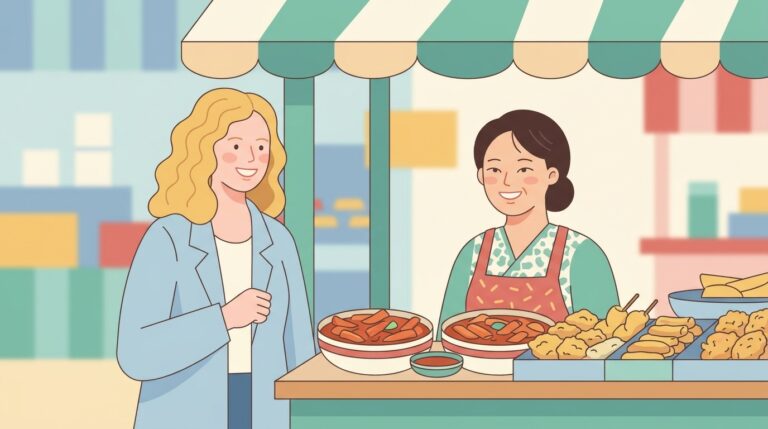
안녕하세요! I’m your Daily Hangul editor and favorite Korean friend! Have you ever visited a vibrant Korean traditional market like Gwangjang Market or Mangwon Market? Imagine walking through bustling stalls packed with sizzling tteokbokki, fresh fruits, and colorful snacks. You buy a bag of juicy strawberries, and the sweet stall owner smiles, slipping two extra apples into your bag for free while saying, “Here’s ‘Deom’!”
That magical free gift is called 덤 (Deom)! It is a beautiful part of Korean traditional culture that turns simple shopping into a warm, human connection. Asking for ‘Deom’ isn’t just about getting free stuff; it’s a fun, friendly way to show your affection and bond with local vendors. Based on real feedback from beginner learners, asking for extras in a foreign language can feel intimidating. But don’t worry! Today, I’ll teach you the easiest, most polite A1-level phrases so you can confidently ask for extra treats like a local!
Phase 2: Key Expressions
1. 덤 주세요 (Deom ju-se-yo)
- Pronunciation: [Deom joo-seh-yo] (Sounds like “Dumb” + “Juicy” without ‘cy’ + “Yo-yo”)
- Meaning: “Please give me a little extra!” (Literal: Give me ‘Deom’)
- K-Culture Moment: You’ll often see travelers in Korean variety shows like Two Days One Night playfully begging warm-hearted market grandmothers (halmoni) for an extra dumplings or fried treat!
- Editor’s Insight: ‘Deom’ represents 정을 나누다 (sharing Jeong)—the special Korean sense of warmth and affection. Use this with a big, bright smile!
- Situation Spectrum: Casual ✅ | Semi-formal ✅ | Formal 🚫
- 🤔 Think About It: Does your hometown market have a custom of giving free bonus items when you shop? How do you feel when vendors show small acts of kindness?
2. 조금만 더 주세요 (Jo-geum-man deo ju-se-yo)
- Pronunciation: [Joh-geum-mahn duh joo-seh-yo]
- Meaning: “Please give me just a little bit more!”
- K-Culture Moment: In K-Dramas, when characters eat street food like Odeng (fish cake broth) on a chilly night, they politely ask the vendor for just a little more delicious warm soup!
- Editor’s Insight: 조금만 (Jo-geum-man) means “just a little.” Adding this softens your request, making you sound extremely polite and cute rather than greedy.
- Situation Spectrum: Casual ✅ | Semi-formal ✅ | Formal ⚠️
- 🤔 Think About It: In English, we say “Could I get a bit more?” Notice how both languages use words like “a bit” to sound polite and modest!
3. 이모, 서비스 주세요! (I-mo, seo-bi-seu ju-se-yo!)
- Pronunciation: [Ee-mo, suh-bee-seu joo-seh-yo!]
- Meaning: “Auntie, please give me a free service/bonus!”
- K-Culture Moment: Group dining scene in K-Dramas! Friends ordering grilled belly pork (Samgyeopsal) cheerily shout this to get a free soft drink or steamed egg (Gyeran-jjim).
- Editor’s Insight: In Korea, 서비스 (Service) actually means “on the house” or “free treat”! And 이모 (Imo) literally means maternal aunt, but it is a friendly, endearing title for female restaurant and market stall owners.
- Situation Spectrum: Casual ✅ | Semi-formal ✅ | Formal 🚫
- 🤔 Think About It: Why do you think Koreans call female restaurant staff “Auntie”? It highlights Korea’s warm, family-oriented community culture!
Phase 3: Textbook vs. Real Korean
Situation 1: Asking for extra snacks at a market stall
* 📖 Textbook Korean: 덤을 추가해 주시겠습니까? (Deom-eul chu-ga-hae ju-si-geess-neung-ni-kka?) – “Would you add a bonus item for me?”
* 🗣️ Real Korean: 덤 조금만 주세요! (Deom jo-geum-man ju-se-yo!) – “Can I get a little ‘deom’ please?”
* 💡 Why is it different? Textbook Korean sounds like a commercial business contract! At an open-air market, short, warm, and friendly phrases build instant connection.
Situation 2: Calling the female vendor friendly
* 📖 Textbook Korean: 판매원님, 저기요. (Pan-mae-won-nim, jeo-gi-yo.) – “Salesperson, excuse me.”
* 🗣️ Real Korean: 이모님! (I-mo-nim!) – “Auntie!”
* 💡 Why is it different? Calling stall owners “Salesperson” creates distance. Calling them 이모 (Auntie) or 사장님 (Boss/Owner) creates instant intimacy!
Phase 4: K-Culture Deep Dive & Non-Verbal Etiquette
4-1. Nunchi (Tact) & Gestures
- Eye Contact & Smile: Make friendly eye contact and deliver your line with a cute, hopeful smile!
- Two Hands Rule: When receiving your bag (and the extra deom), always accept it with both hands while nodding your head gently. This shows high respect and gratitude.
- Timing (Nunchi): Don’t ask for deom right when you buy just one tiny 1,000 KRW snack! Ask when you buy a reasonable amount or multiple items.
4-2. Cultural Code: Market “Jeong” (정)
In Korea, traditional markets are not just places to trade money for goods; they are places where 정 (Jeong – deep social affection) is exchanged. Giving deom is a vendor’s way of saying, “Thank you for visiting my stall! Have a blessed day!”
Phase 5: Real-Life Roleplay Scenario
Setting: A bustling, warm Tteokbokki stall at Mangwon Market.
NPC Character: Friendly Market Auntie (이모 – Imo) wearing a bright apron.
- Turn 1 (You): 안녕하세요! 떡볶이 일 인분 주세요.
(An-nyeong-ha-se-yo! Tteok-bok-ki il-in-bun ju-se-yo.)
“Hello! One portion of tteokbokki, please.”
🎭 Action: Smiling bright and pointing at the simmering tteokbokki. - Turn 2 (Imo): 네~ 떡볶이 일 인분! 3,000원이에요.
(Ne~ tteok-bok-ki il-in-bun! Sam-cheon-won-i-e-yo.)
“Sure~ One tteokbokki! That’s 3,000 won.” - Turn 3 (You): 저… 이모! 덤 조금만 주세요!
(Jeo… i-mo! Deom jo-geum-man ju-se-yo!)
“Um… Auntie! Can I get a little extra ‘deom’ please?”
🎭 Action: Putting hands together politely with a cute, hopeful expression. - Turn 4 (Imo): 어머나, 한국어 잘하네! 서비스로 튀김 하나 줄게!
(Eom-eo-na, han-gug-eo jal-ha-ne! Seo-bi-seu-ro twi-gim ha-na jul-ge!)
“Oh my, your Korean is so good! I’ll give you a fried snack as a service!” - Turn 5 (You): 와! 진짜요? 감사합니다!
(Wa! Jin-jja-yo? Gam-sa-ham-ni-da!)
“Wow! Really? Thank you so much!”
🎭 Action: Clapping softly with joy. - Turn 6 (Imo): 여기 떡볶이랑 튀김 나왔어요~
(Yeo-gi tteok-bok-ki-rang twi-gim na-wat-eo-yo~)
“Here is your tteokbokki and free fried snack~” - Turn 7 (You): 잘 먹겠습니다, 이모!
(Jal meok-geess-seum-ni-da, i-mo!)
“I will eat well, Auntie!”
🎭 Action: Bowing slightly and receiving the bag with both hands. - Turn 8 (Imo): 또 봐요, 학생!
(Tto bwa-yo, hak-saeng!)
“See you again!”
🔀 Interactive Choice Point!
When you ask for extra, what do you do?
* Choice A: (Smiling politely) “이모, 덤 조금만 주세요!” (Imo, deom jo-geum-man ju-se-yo!)
* Choice B: (Demanding loudly) “덤 더 많이 줘요!” (Deom deo man-i jwo-yo! – Give me way more deom!)
* Choice C: (Silent, snatching the bag with one hand)
Feedback:
* Choice A (BEST 🌟): Perfect! You used polite language, called her ‘Imo’, and asked charmingly. Expect extra yummy treats!
* Choice B (RISK ⚠️): Uh oh! Demand style sounds rude in Korean culture. The vendor might feel offended.
* Choice C (BAD ❌): Oh no! Taking items with one hand without saying anything misses the whole spirit of market warmth!
Frequently Asked Questions (FAQ)
Q: What does "덤 주세요 (Deom ju-se-yo)" mean in Korean and how do you pronounce it?
A: In Korean, "덤 주세요 (Deom ju-se-yo)" is pronounced [Deom joo-seh-yo] and means: "Please give me a little extra!" (Literal: Give me 'Deom')
Q: What does "조금만 더 주세요 (Jo-geum-man deo ju-se-yo)" mean in Korean and how do you pronounce it?
A: In Korean, "조금만 더 주세요 (Jo-geum-man deo ju-se-yo)" is pronounced [Joh-geum-mahn duh joo-seh-yo] and means: "Please give me just a little bit more!"
Q: What does "이모, 서비스 주세요! (I-mo, seo-bi-seu ju-se-yo!)" mean in Korean and how do you pronounce it?
A: In Korean, "이모, 서비스 주세요! (I-mo, seo-bi-seu ju-se-yo!)" is pronounced [Ee-mo, suh-bee-seu joo-seh-yo!] and means: "Auntie, please give me a free service/bonus!"







