

Freeze No More! How to Fix Hot Water & Boiler Issues in Korea
Phase 1: Empathy (Story-Driven Opening)
안녕하세요! 매일한글 에디터입니다. Imagine this: It is a crisp winter morning in Seoul. You wake up inside your cozy rental apartment, eager to start your day. You step into the shower, turn on the tap, expecting soothing hot water—and suddenly, boom! Ice-cold water blasts your face. You quickly check the wall panel, but the red lights are blinking ominously. You turn the dial back and forth, but nothing changes. Only freezing water flows out.
If you have lived or traveled in Korea during late autumn or winter, this scenario might feel terrifyingly real. Dealing with a broken floor heating system (보일러) and missing hot water is one of the most common pain points foreigners face in Korea. You want to contact your landlord or building management, but you freeze up—not just from the cold, but because you do not know the right Korean words to explain the problem clearly without sounding rude.
Don’t worry! Today, we are going to master practical Korean expressions specifically tailored to solve housing and heating emergencies. Based on real learner experiences and feedback from hundreds of expats, this guide will give you the confidence to negotiate with landlords and request repair technicians like a natural Korean resident. Let’s dive in!
Phase 2: Core Expressions Deep-Dive
1. 보일러가 고장 났어요 (Bo-il-leo-ga go-jang na-sseo-yo)
- Pronunciation: [Bo-il-leo-ga go-jang na-sseo-yo] (Sounds like “boy-ler-gah go-jang nah-ssuh-yo”)
- Meaning: Literal: The boiler has broken down. / Nuance: “My heating system isn’t working at all.”
- K-Culture Moment: You often hear this panicked line in K-dramas when a main character moves into a cheap rooftop room (옥탑방) during winter.
- Editor’s Insight: In Korea, “보일러” controls both ambient room heating (온돌) and hot water (온수). So when you say it’s broken, it implies you have neither heat nor hot tap water.
- Situation Spectrum: Casual (⚠️ 보일러 고장 났어) / Semi-formal (✅ 보일러가 고장 났어요) / Formal (✅ 보일러가 고장 났습니다)
- 🤔 Think About It: Does your country use a central floor-heating system like Korea’s Ondol, or do you rely on radiators or air vents?
2. 찬물만 나와요 (Chan-mul-man na-wa-yo)
- Pronunciation: [Chan-mul-man na-wa-yo] (Think of “chan” like ‘chant’ without ‘t’, “mul” like ‘mool’)
- Meaning: Literal: Only cold water comes out. / Nuance: “I have no hot water running.”
- K-Culture Moment: Used at a guesthouse or Airbnb when complaining to the host after a shivering shower attempt.
- Editor’s Insight: Combining “찬물” (cold water) + “만” (only) clearly specifies that water IS flowing, but the temperature control is dead.
- Situation Spectrum: Casual (⚠️ 찬물만 나와) / Semi-formal (✅ 찬물만 나와요) / Formal (✅ 찬물만 나옵니다)
- 🤔 Think About It: Notice how Korean combines words cleanly: 찬 (cold) + 물 (water) + 만 (only).
3. 기사님을 불러 주실 수 있나요? (Gi-sa-nim-eul bul-leo ju-sil su it-na-yo?)
- Pronunciation: [Gi-sa-nim-eul bul-leo ju-sil su it-na-yo?]
- Meaning: Literal: Can you call a technician for me? / Nuance: “Could you please schedule a repair service person?”
- K-Culture Moment: A essential phrase when dealing with property management (부동산 / 집주인).
- Editor’s Insight: “기사님” is a respectful honorific term used for technicians, drivers, and service professionals. Using this shows high cultural fluency.
- Situation Spectrum: Casual (🚫) / Semi-formal (✅ 기사님 좀 불러 줄 수 있어요?) / Formal (✅ 기사님을 불러 주실 수 있나요?)
- 🤔 Think About It: Why does Korean use respectful titles like “-님” even for service specialists?
Phase 3: Textbook Korean vs. Real Korean
Situation 1: Reporting the broken heater
- 📖 Textbook: 난방 장치가 작동하지 않습니다. (The heating apparatus is not functioning.)
- 🗣️ Real Korean: 집주인님, 보일러가 안 돌아가요. (Landlord, the boiler isn’t running.)
- 💡 Why the difference? Real Koreans rarely use formal words like “난방 장치”. Instead, they use “보일러” and active verbs like “돌아가다” (to turn/run).
Situation 2: Asking for urgent help
- 📖 Textbook: 빠른 시일 내에 수리해 주십시오. (Please repair it in a fast timeframe.)
- 🗣️ Real Korean: 너무 추워서 그런데 오늘 바로 봐 주실 수 있나요? (It’s so cold, could you take a look at it today?)
- 💡 Why the difference? Adding your emotional/physical context (“너무 추워서 그런데” – It’s so cold so…) softens the request and increases urgency politely.
Phase 4: K-Culture Deep Dive & Non-verbal Manners
4-1. Nunchi & Gestures
When explaining a housing issue to your landlord (집주인):
1. Slight Bow & Soft Tone: Start with an apologetic smile or a slight bow. In Korea, asking for repairs is normal, but starting with a polite tone lowers resistance.
2. Shivering Gesture / Pointing: If you are showing the boiler unit, point gently with an open palm rather than a single index finger. Shivering lightly while saying “너무 추워요” (It’s so cold) conveys genuine distress without sound demanding.
4-2. Culture Code: Ondol & Landlord Dynamics
Korea’s traditional heating system, Ondol (온돌), heats the room through pipes under the floor. Modern boilers heat both floor water and tap water. In Korean rental agreements (especially One-room / 원룸 living), structural repairs like boiler breakdown are almost always the landlord’s financial responsibility. However, communication is key—promptly informing them prevents pipe freezing (동파) during harsh winter cold snaps.
Phase 5: Real-Life Roleplay Scenario
Setting: Texting/Calling your landlord (집주인 아주머니) on a freezing January morning.
- Landlord (집주인): 여보세요? OO 씨, 무슨 일이에요?
(Yeo-bo-se-yo? OO ssi, mu-seun il-i-e-yo? / Hello? OO, what’s up?) - You: 🎭 (Hesitant tone) 안녕하세요, 이모님! 다름이 아니라 보일러 때문에 연락드렸어요.
(An-nyeong-ha-se-yo, i-mo-nim! Da-reum-i a-ni-ra bo-il-leo ttae-mu-ne yeol-lak-deu-ryeot-seo-yo. / Hello! I’m calling because of the boiler.) - Landlord: 보일러요? 왜요? 안 켜져요?
(Bo-il-leo-yo? Wae-yo? An kyeo-jyeo-yo? / The boiler? Why? Won’t it turn on?) - You: 🎭 (Pointing at the tap) 네, 전원은 들어오는데 찬물만 나와요.
(Ne, jeon-won-eun deu-reo-o-neun-de chan-mul-man na-wa-yo. / Yes, power is on, but only cold water comes out.) - Landlord: 아 그래요? 따뜻한 물 쪽으로 수도꼭지 돌렸어요?
(A geu-rae-yo? Tta-tteut-han mul jjok-eu-ro su-do-kkok-ji dol-ryeot-seo-yo? / Oh really? Did you turn the faucet toward hot water?) - You: 🎭 (Shaking head) 네, 돌려도 온수가 전혀 안 나와요. 너무 추워요.
(Ne, dol-ryeo-do on-su-ga jeon-hyeo an na-wa-yo. Neo-mu chu-wo-yo. / Yes, even if I turn it, no hot water comes out at all. It’s so cold.) - Landlord: 아이구, 날씨가 추워서 그런가 보네. 내가 수리 기사님 알아볼게요.
(A-i-gu, nal-ssi-ga chu-wo-seo geu-reon-ga bo-ne. Nae-ga su-ri gi-sa-nim a-ra-bol-ge-yo. / Oh dear, must be because of the cold weather. I’ll check for a repair technician.) - You: 🎭 (Relieved, bowing over phone) 감사합니다! 오늘 오실 수 있는지 확인 부탁드릴게요!
(Gam-sa-ham-ni-da! O-neul o-sil su in-neun-ji hwak-in bu-tak-deu-ril-ge-yo! / Thank you! Please check if they can come today!)
🔀 Interactive Choice Point
What should you say if the landlord says they can only send someone next week?
- Option A: “네, 알겠습니다. 그때까지 기다릴게요.” (Okay, I’ll wait until then.)
- Option B: “저기… 날씨가 너무 추워서 찬물로 씻을 수가 없어요. 혹시 오늘이나 내일은 안 될까요?” (Um… it’s so cold that I can’t shower with cold water. Could it be today or tomorrow?)
- Option C: “안 돼요! 당장 오늘 바꿔 주세요!” (No way! Change it right today!)
Feedback:
* Option A (Risk): You will freeze for a week! Landlords often push back unless you express politeness combined with actual necessity.
* Option B (BEST): Polite, explains the difficulty, and pushes gently for a faster solution.
* Option C (Bad): Too aggressive in Korean culture; may harm your relationship with the landlord.
Phase 6: 10-Second Emotion Shadowing Drill
Practice these lines out loud with the indicated rhythm and emotion!
[🥶 덜덜 떨면서]저기… / 보일러가 고장 나서 / 찬물만 나와요.
(Jeo-gi… / bo-il-leo-ga go-jang na-seo / chan-mul-man na-wa-yo.)[🥺 아쉽고 급하게]오늘 날씨가 너무 추운데 / 바로 봐 주실 수 있나요?
(O-neul nal-ssi-ga neo-mu chu-un-de / ba-ro bwa ju-sil su it-na-yo?)[🙏 감사하며]바쁘실 텐데 / 빨리 처리해 주셔서 / 정말 감사합니다!
(Ba-ppeu-sil ten-de / ppal-li cheo-ri-hae ju-syeo-seo / jeong-mal gam-sa-ham-ni-da!)
Phase 7: K-Culture Mini Dictionary
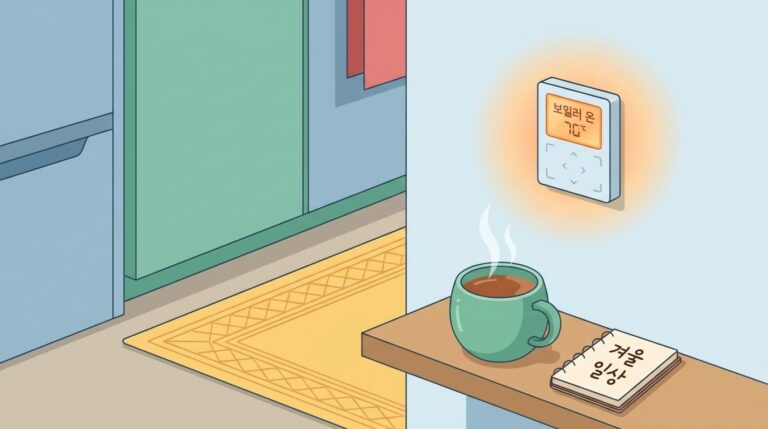
- 보일러 조절기 (Bo-il-leo jo-jeol-gi) | Boiler Control Panel | The wall-mounted digital controller in Korean houses used to toggle between heating (난방) and hot water (온수).
- 온수 (On-su) | Hot Water | The dedicated word for hot tap water. (Opposite: 냉수 / 찬물).
- 수리 기사님 (Su-ri gi-sa-nim) | Repair Technician | Service professional called to inspect heating, plumbing, or electrical issues.
- 동파 (Dong-pa) | Freezing and Bursting | Winter crisis when pipes freeze and burst due to sub-zero temperatures. Prevention is heavily stressed in Korea!
Phase 8: Traveler’s Survival Kit
Top 3 Survival Phrases
- 온수가 안 나와요. (On-su-ga an na-wa-yo.) – Hot water isn’t coming out.
- 보일러 어떻게 켜요? (Bo-il-leo eot-teo-ke kyeo-yo?) – How do I turn on the boiler?
- 방이 너무 차가워요. (Bang-i neo-mu cha-ga-wo-yo.) – The room is too cold.
Editor’s Travel Note
When traveling or living in Korea during winter, keep your boiler setting on “외출” (Away mode) instead of turning it off completely when leaving the house. This prevents pipe freezing (동파). If you ever need to find local repair shops or contact management, use the 네이버 지도 앱 다운로드 to search for nearby maintenance service branches (보일러 AS 센터).
Phase 9: One Step Deeper
In Korean culture, housing management involves a delicate balance between personal responsibility and community courtesy. The concept of Jeonse and Wolse rentals places maintenance duty largely on landlords, but tenants are expected to act with Nunchi—notifying issues early before winter damages worsen. Expressing hardships politely (“추워서 힘들어요”) evokes warmth and compassion (Jeong / 정) from older Korean landlords, who will often hurry over with extra heaters or blankets!
💬 Your Turn: Have you ever experienced a hot water emergency while traveling abroad? How did you communicate with your host? Share your story in the comments below!
Phase 10: FAQ & Common Mistakes
Q: What is the difference between 온수 and 난방 on the boiler controller?
A: 난방 warms up the floor of your apartment. 온수 heats the water coming out of your shower and sink faucets. Make sure your boiler is set to either “난방+온수” or “온수 전용” (Hot Water Only) mode!
Q: Who pays for the boiler repair in a Korean rental house?
A: Under standard Korean housing law, major equipment repairs like boilers are paid for by the landlord, unless the tenant damaged it through extreme negligence.
Q: Can I turn off the boiler completely when going on a 3-day trip in winter?
A: No! In sub-zero Korean winters, turning off the boiler completely can cause the pipes to freeze (동파). Always set it to 외출 (Away Mode).
🚨 Common Mistakes TOP 3
- Mistake: Telling the landlord “보일러를 사 주세요” (Please buy me a boiler).
- Correct Action: Say “보일러 수리해 주세요” (Please repair the boiler).
- Mistake: Confusing “차가운 물” (Cold drinking water) with missing hot water in shower context.
- Correct Action: Say “온수가 안 나와요” (Hot water is not coming out).
- Mistake: Demanding instant fixes aggressively.
- Correct Action: Use soft softeners like “~는데 혹시…” (It’s cold, so by any chance…).
Phase 11: Action Mission & Engagement
- 🥉 Bronze: Read the 3 core expressions out loud 3 times using the Shadowing Drill.
- 🥈 Silver: Check your current accommodation’s boiler panel and identify the buttons:
전원,난방,온수,외출. - 🥇 Gold: Practice acting out Phase 5 roleplay with a study partner or post a voice memo on your social media!
🎮 K-Culture Mission: Watch a winter scene in a Korean vlog or drama (like Reply 1988 or Fight for My Way) and spot scenes where characters complain about cold water or boiler panels!
Phase 12: Interactive Quiz Challenge
Q1. What is the most polite and natural way to say “Only cold water comes out” to your host?
a) 찬물 나와라
b) 찬물만 나와요
c) 차가운 물 좋아해요
Click to reveal Answer & Explanation
Answer: b) 찬물만 나와요
Explanation: “찬물” (cold water) + “만” (only) + “나와요” (comes out) is the standard polite formulation.
Q2. Fill in the blank: “보일러가 ______ 났어요.” (The boiler is broken.)
a) 고장
b) 고기
c) 감기
Click to reveal Answer & Explanation
Answer: a) 고장
Explanation: “고장(이) 나다” means to break down or malfunction for devices/machines.
Q3. True or False: You should turn off the Korean boiler completely during freezing winter vacations.
Click to reveal Answer & Explanation
Answer: False!
Explanation: You must set it to “외출” (Away mode) to prevent pipe freezing (동파).







