

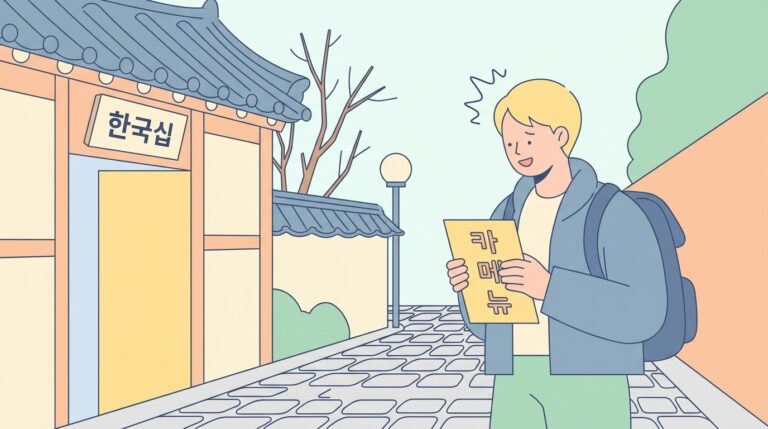
Say Goodbye to Butterflies: How to Express Nervousness in Korean Like a Native!
Phase 1: Empathy & Storytelling
안녕하세요! 매일한글 에디터입니다. (Annyeonghaseyo! I’m your Daily Hangul editor.)
Picture this: You are standing in line at a bustling K-pop concert in Seoul, holding your fan light, waiting for your turn at the high-touch event. Or maybe you are about to give a quick self-introduction in Korean during your first meeting with Korean friends. Your palms get sweaty, your heart beats fast, and you want to tell the person next to you, “I’m so nervous!” But suddenly, your mind goes blank. You remember dictionary words, but do they sound natural?
Feeling nervous is a universal human emotion, but expressing it naturally in Korean will instantly bring you closer to locals. When you share your raw emotions in real-time, Koreans respond with warmth, cheering you on with a warm “화이팅!” (Hwaiting!). In this lesson, built on real learner experiences and local cultural insights, you’ll master 3 practical A2-level expressions to say “I’m nervous” with total confidence.
Phase 2: Key Expressions Deep Dive
1. 떨려요 (Eotteollyeoyo)
- Pronunciation: [Tteol-lyeo-yo] (Sounds like “tseol” with a short vibrate sound on your tongue, like a phone buzzing bzz)
- Meaning: Literal: “I am trembling/shaking” | Nuance: Butteries in stomach, excited nervousness before a big moment.
- K-Culture Moment: Seen in almost every audition show when an idol trainee steps onto the stage and says, “너무 떨려요!” (Neomu tteollyeoyo!)
- Editor’s Insight: Use this when your body literally feels jittery from excitement or anxiety.
- Situation Spectrum: Casual (떨려 / tteollyeo) ✅ | Semi-formal (떨려요 / tteollyeoyo) ✅ | Formal (떨립니다 / tteollimnida) ✅
- 🤔 Think About It: In English, you say “I have butterflies.” In Korean, you describe the physical shaking (떨림). How does your native language describe nervousness?
2. 긴장돼요 (Ginjangdwaeyo)
- Pronunciation: [Gin-jang-dwae-yo] (Sounds like “Ginn-Jahng-Dway-Yo”)
- Meaning: Literal: “Tension is being made” | Nuance: Mental tension or pressure (exams, job interviews, meeting in-laws).
- K-Culture Moment: K-drama characters right before entering an important job interview or meeting senior bosses.
- Editor’s Insight: While ‘떨려요’ leans towards excited jitters, ‘긴장돼요’ is more about formal or psychological stress.
- Situation Spectrum: Casual (긴장돼 / ginjangdwae) ✅ | Semi-formal (긴장돼요 / ginjangdwaeyo) ✅ | Formal (긴장됩니다 / ginjangdoemnida) ✅
- 🤔 Think About It: Why do you think Korean uses a passive form (“tension happens to me”) rather than “I tense up”?
3. 가슴이 쿵쾅거려요 (Gaseumi kungkwanggeoryeoyo)
- Pronunciation: [Ga-seum-i kung-kwang-geo-ryeo-yo] (“Kung-kwang” sounds like heavy footsteps or thumping bass!)
- Meaning: Literal: “My chest is going thud-thud” | Nuance: My heart is pounding fast due to nervousness or romantic excitement.
- K-Culture Moment: Romance dramas when the lead character gets close to their crush!
- Editor’s Insight: Onomatopoeia makes your Korean sound 10x more vivid and friendly.
- Situation Spectrum: Casual (가슴이 쿵쾅거려) ✅ | Semi-formal (가슴이 쿵쾅거려요) ✅ | Formal (가슴이 쿵쾅거립니다) ⚠️ (Sounds too poetic for formal settings)
- 🤔 Think About It: What sound words does your language use for heartbeats?
Phase 3: Textbook Korean vs Real Korean
Situation 1: Ordering at a trendy local cafe in Seongsu-dong
* 📖 교과서 한국어: 저는 지금 매우 불안합니다. (Jeoneun jigeum maeu bulanhambnida. – I am very anxious right now.)
* 🗣️ 진짜 한국어: 아, 너무 떨려요! (A, neomu tteollyeoyo! – Ah, I’m so nervous!)
* 💡 왜 다를까? ‘불안합니다’ sounds like a medical diagnosis or severe anxiety. Locals use ‘떨려요’ for lighthearted, everyday nerves.
Situation 2: Right before giving a presentation or speech
* 📖 교과서 한국어: 긴장감을 느끼고 있습니다. (Ginjanggameul neukkigo isseumnida. – I am feeling tension.)
* 🗣️ 진짜 한국어: 솔직히 너무 긴장돼요. (Soljiki neomu ginjangdwaeyo. – Honestly, I’m super nervous.)
* 💡 왜 다를까? Adding ‘솔직히’ (Honestly) bridges the emotional gap and makes you sound much more human and natural.
Phase 4: K-Culture Deep Dive & Non-verbal Manners
4-1. Nunchi (눈치) & Gestures
When saying you are nervous in Korea, pair your words with realistic gestures:
* Hand Fan Gesture: Lightly wave your hand near your face like a fan while saying “아, 떨려!” (Ah, tteollyeo!).
* Chest Touch: Place one hand lightly over your heart when saying “가슴이 쿵쾅거려요.”
* Eye Contact: Avoid staring blankly; a slightly wide-eyed, smiling look signals that you are excited-nervous, not angry or miserable.
4-2. Cultural Code: Expressing Vulnerability in Korea
In Korean culture, admitting you are nervous (“제가 좀 긴장해서요…” – Because I’m a bit nervous…) is not seen as weakness! It is a polite way to ask for empathy. Koreans will instantly smile, comfort you, and speak more slowly to help you out.
Phase 5: Real-life Roleplay Scenario
Setting: You are waiting behind the stage at a local Korean singing contest in Seoul.
NPC: Min-ho (Friendly Korean backstage staff)
- Min-ho: 안녕하세요! 다음 순서인데, 준비되셨나요?
(Annyeonghaseyo! Daeum sunseoinde, junbidoesyeonnayo?)
“Hello! You are next, are you ready?” - You: 🎭 (Holding your hands together tightly) 네… 그런데 너무 떨려요!
(Ne… georonde neomu tteollyeoyo!)
“Yes… but I’m so nervous!” - Min-ho: 하하, 괜찮아요! 많이 긴장되세요?
(Haha, gwaenchanayo! Mani ginjangdwaeseoyo?)
“Haha, it’s okay! Are you feeling really tense?” - You: 🎭 (Touching your chest) 네, 가슴이 쿵쾅거려요.
(Ne, gaseumi kungkwanggeoryeoyo.)
“Yes, my heart is thumping!” - Min-ho: 잘할 수 있어요! 무대 올라가기 전에 심호흡 해보세요.
(Jalhal su isseoyo! Mudae ollagagi jeone simhoheup haeboseoyo.)
“You can do great! Take a deep breath before going up.” - You: 🎭 (Taking a deep breath) 후… 감사합니다. 힘낼게요!
(Hu… gamsahambnida. Himnaelgeyo!)
“Phew… Thank you. I’ll do my best!” - Min-ho: 화이팅! 즐기고 오세요!
(Hwaiting! Jeulgigo oseyeo!)
“Fighting! Go enjoy it!” - You: 네, 화이팅!
(Ne, hwaiting!)
“Yes, fighting!”
🔀 Interactive Branching Choice:
Min-ho asks: “많이 긴장되세요?” How do you answer?
* Choice A: “아니요, 전혀 안 긴장됩니다.” (No, I am not tense at all. – Cold/stiff)
* Choice B: “네, 조금 긴장돼요. 하지만 열심히 할게요!” (Yes, a bit nervous. But I’ll do my best!)
* Choice C: “몰라요. 무서워요.” (I don’t know. I’m scared. – Overly dramatic)
Feedback:
* Best Choice (B): Perfect! It admits your feeling politely while showing a positive attitude.
* Bad Choice (A): Risk of appearing robotic or overly defensive.
* Risk Choice (C): Might make the staff worried about your safety!
Phase 6: 10-Second Emotion Shadowing Drill
Practice saying these with natural pauses (/) and real emotions!
[🥺 Nervous & Seeking Comfort]
아… / 너무 떨려서 / 어떡하죠?
(A… / neomu tteollyeoseo / eotteokhajo?)
“Ah… / I’m so nervous / what should I do?”-
[😊 Excited & Hopeful]
긴장되지만 / 정말 재미있을 것 같아요!
(Ginjangdoejiman / jeongmal jaemiisseul geot gat-ayo!)
“I’m nervous / but I think it will be super fun!” -
[💓 Vivid & Playful]
손에 땀이 나고 / 가슴이 쿵쾅거려요!
(Sone ttami nago / gaseumi kungkwanggeoryeoyo!)
“My hands are sweaty / and my heart is going thump-thump!”
Phase 7: K-Culture Mini Dictionary
- 심쿵 (Sim-kung) | Translation: Heart-stopping crush / Heart flutter | Usage: Used when seeing your favorite idol or romantic drama scene.
- 심호흡 (Sim-ho-heup) | Translation: Deep breath | Usage: “심호흡 하세요” (Take a deep breath to relax).
- 멘붕 (Men-bung) | Translation: Mental breakdown | Usage: Used casually when you panic because you’re too nervous.
- 청심환 (Cheong-sim-hwan) | Translation: Traditional Korean herbal calmative pill | Usage: Koreans often take this before big tests or driving exams!
Phase 8: Traveler’s Survival Kit
TOP 3 Emergency Expressions
- 천천히 말씀해 주세요. (Cheoncheonhi malssamhae juseyo.) – Please speak slowly.
- 제가 한국어를 잘 못해서 긴장돼요. (Jega hangugeoreul jal mothaeseo ginjangdwaeyo.) – I’m nervous because my Korean isn’t great.
- 괜찮아요, 천천히 하세요. (Gwaenchanayo, cheoncheonhi haseyo.) – It’s okay, take your time. (What kind Koreans will say back!)
Editor’s Travel Note
When traveling around Seoul, finding your way or ordering food might trigger nerves. Download the Naver Map App for Korean Navigation before your trip. Having accurate subway routes in hand reduces nervousness by 90%!
Phase 9: A Step Deeper (Culture Insight)
In Korean society, showing modest vulnerability builds interpersonal affection known as Jeong (정). Expressing nervousness is not seen as an error; it’s an invitation for connection. When you tell a Korean, “너무 떨려요,” you transform a stranger into a supportive ally who wants to help you succeed.
💬 Your Turn: When was the last time you felt super nervous in Korea or while learning Korean? Share your story in the comments below!
Phase 10: FAQ & Common Mistakes
Q: Is there a difference between ‘떨려요’ and ‘긴장돼요’?
A: Yes! ‘떨려요’ is physical trembling and can be positive (excited nerves). ‘긴장돼요’ is mental tension and usually relates to pressure or formal situations.
Q: Can I say ‘두려워요’ when I am nervous?
A: ‘두려워요’ means “I am terrified/fearful” (like seeing a ghost or danger). For everyday nerves, stick to ‘떨려요’ or ‘긴장돼요’.
Q: What should I say if my Korean friend is nervous?
A: Say “걱정 마세요! 잘할 수 있어요!” (Don’t worry! You can do great!).
🚨 Common Mistakes TOP 3
- Mistake: Saying “저는 긴장해요” 🚫 -> Correct Action: Say “저는 긴장돼요” ✅ (Use passive voice).
- Mistake: Using formal ‘합니다’ with friends 🚫 -> Correct Action: Use ‘긴장돼’ or ‘떨려’ with close friends.
- Mistake: Calling excitement ‘무서워요’ (scared) 🚫 -> Correct Action: Use ‘떨려요’ for excited jitters.
Phase 11: Action Missions
- Bronze Mission: Record yourself saying “아, 너무 떨려요!” 3 times with realistic facial expressions.
- Silver Mission: Post a picture of your favorite K-pop artist on social media with the caption: “심쿵! 너무 떨려요!”
- Gold Mission: Use “긴장돼요” in a conversation with a native Korean speaker or tutor this week!
- 🎮 K-Culture Mission: Watch a K-drama interview on YouTube and spot when the actor says “떨려요”.
Phase 12: Interactive Quiz Challenge
Q1. You are about to take the TOPIK exam. Which expression fits best?
1) 너무 심쿵해요!
2) 정말 긴장돼요.
3) 너무 두려워요.
Click to reveal Answer & Explanation
Option 2 (정말 긴장돼요) is correct because exam pressure causes mental tension!
**Q2. Fill in the blank:






