

Phase 1: Empathy & Storytelling Opening
안녕하세요! 매일한글 에디터입니다. (Hello! I’m your Daily Hangul Editor.)
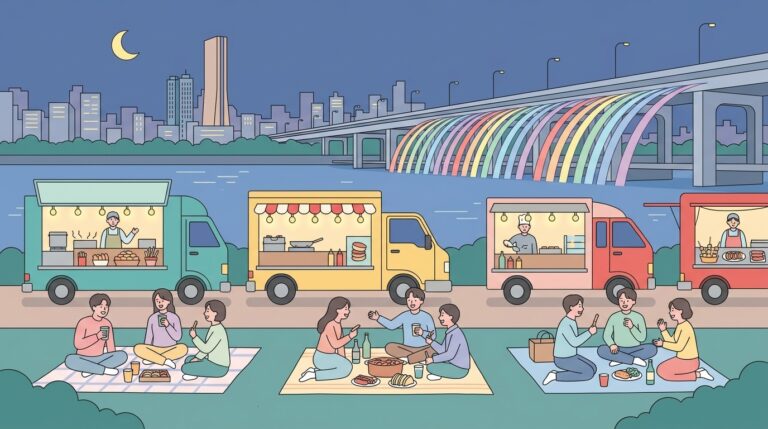
Imagine this: The cool breeze from the Han River touches your face as evening falls over Seoul. Colorful food trucks light up the riverbank at the Bamdokkaebi Night Market. Mouth-watering aromas of grilled meat, spicy tteokbokki, and sweet street snacks fill the air. You walk up to a vibrant food stall, ready to order, but suddenly your mind goes blank. You see the delicious food, but you freeze up—what do you say? How do you ask for the price or order nicely without resorting to silent pointing?
Don’t worry, you are not alone! Almost every traveler and Korean learner faces this exact moment of anxiety. That’s why we created this guide based on real feedback from hundreds of beginner learners just like you. By learning a few ultra-simple A1-level Korean phrases today, you’ll easily transform your nervous hesitation into a confident, fun ordering experience at any Korean night market. Let’s make your Han River evening unforgettable!
Phase 2: Top 3 Essential Expressions Deep Dive
1. 이거 얼마예요? (I-geo eol-ma-ye-yo?)
- Pronunciation: [ee-geo eol-mah-yeh-yo] (Sounds like “E-go all-my-hey-yo?”)
- Meaning: Direct: “How much is this?” / Nuance: A natural, polite way to ask the price of any item or food.
- K-Culture Moment: Seen in almost every K-Drama when characters visit street markets or local vendors!
- Editor’s Insight: 이거 (I-geo) means “this”. You can point directly to any street food and ask this phrase with a soft smile.
- Situation Spectrum: Casual (⚠️) / Semi-formal (✅) / Formal (✅)
- Thinking Question: In your home country, do prices stay fixed at night markets, or is asking prices expected?
2. 이거 하나 주세요 (I-geo ha-na ju-se-yo)
- Pronunciation: [ee-geo ha-nah joo-seh-yo] (Sounds like “E-go ha-na Jew-say-yo”)
- Meaning: Direct: “Please give me one of this.” / Nuance: Simple, respectful ordering magic phrase.
- K-Culture Moment: Used everywhere from K-Pop idol vlogs at night markets to busy Seoul cafes.
- Editor’s Insight: 하나 (ha-na) means “one”. If you want two, you can say 두 개 (du-gae), but pointing while saying 하나 주세요 works like magic!
- Situation Spectrum: Casual (⚠️) / Semi-formal (✅) / Formal (✅)
- Thinking Question: How does saying “please give me” in Korean differ from how you order food in English?
3. 맛있게 해주세요! (Ma-sit-ge hae-ju-se-yo!)
- Pronunciation: [mah-sit-geh hae-joo-seh-yo] (Sounds like “Mah-sit-geh hey-joo-say-yo”)
- Meaning: Direct: “Please make it delicious!” / Nuance: A warm, cute icebreaker showing excitement for their food.
- K-Culture Moment: Foodie YouTubers and variety show hosts say this to food truck owners to share warm vibes.
- Editor’s Insight: Saying this brings an instant smile to the vendor’s face and might even net you extra portions!
- Situation Spectrum: Casual (✅) / Semi-formal (✅) / Formal (🚫)
- Thinking Question: Why do you think Korean culinary culture values sharing cheerful remarks before cooking?
Phase 3: Textbook Korean vs. Real Korean
Situation 1: Asking if a food is spicy
* 📖 Textbook Korean: 이것은 매우 매운 음식입니까? (I-geot-eun mae-u mae-un eum-sik-im-ni-ka? – Is this very spicy food?)
* 🗣️ Real Korean: 이거 많이 매워요? (I-geo ma-ni mae-wo-yo? – Is this really spicy?)
* 💡 Why is it different? Real Koreans drop formal textbook endings (-입니까) in casual market settings and use simple conversational forms.
Situation 2: Asking for napkins or wet wipes
* 📖 Textbook Korean: 휴지를 저에게 주시겠습니까? (Hyu-ji-reul jeo-e-ge ju-si-get-seum-ni-ka? – Would you give me tissues?)
* 🗣️ Real Korean: 휴지 좀 주세요! (Hyu-ji jom ju-se-yo! – Tissues, please!)
* 💡 Why is it different? Adding 좀 (jom – please/a bit) makes requests instantly soft, natural, and polite.
Phase 4: K-Culture Deep Dive & Non-Verbal Manners
4-1. Nunchi (눈치) & Gestures
When ordering at a Han River night market, use two hands when handing over your money or payment card. This basic Korean manner shows deep respect. Also, make slight eye contact and nod gently (목인사 – mok-in-sa) when receiving your food truck order.
4-2. K-Culture Code: Bamdokkaebi (밤도깨비)
Korean night markets at Han River are named after Dokkaebi (Korean mythical goblins) because they appear magically at night and vanish by morning! Enjoying street foods like steak cups, churros, and spicy skewers while looking at the river lights is a core K-lifestyle experience.
Phase 5: Real-Life Roleplay Scenario
Background: You are standing in front of a popular food truck at Yeouido Han River Night Market. The cheerful vendor smiles at you.
- Vendor (사장님): 안녕하세요! 뭐 드릴까요? (An-nyeong-ha-se-yo! Mwo deu-ril-kka-yo?) – Hello! What can I get for you?
- Learner (나): 🎭 (Pointing at a delicious steak cup with a smile) 안녕하세요! 이거 얼마예요? (An-nyeong-ha-se-yo! I-geo eol-ma-ye-yo?) – Hello! How much is this?
- Vendor (사장님): 이거 만 원이에요! (I-geo man-won-i-e-yo!) – This is 10,000 won!
- Learner (나): 🎭 (Nodding cheerfully) 이거 하나 주세요! (I-geo ha-na ju-se-yo!) – Please give me one of this!
- Vendor (사장님): 매운 소스 괜찮으세요? (Mae-un so-seu gwaen-chan-eu-se-yo?) – Is spicy sauce okay?
- Learner (나): 🎭 (Making a gentle gesture) 많이 매워요? (Ma-ni mae-wo-yo?) – Is it very spicy?
- Vendor (사장님): 조금 매워요~ (Jo-geum mae-wo-yo~) – Just a little spicy~
- Learner (나): 🎭 (Handing over card with both hands) 네, 주세요! 맛있게 해주세요! (Ne, ju-se-yo! Ma-sit-ge hae-ju-se-yo!) – Yes, please! Please make it delicious!
🔀 Interactive Branching Point
What would you do if the vendor asks if you need a bag? (봉투 필요하세요?)
- Option A: Say “네, 주세요” (Ne, ju-se-yo) while holding out your hands.
- Option B: Shake your head silently and walk away.
- Option C: Say “아니요, 괜찮아요” (A-ni-yo, gwaen-chan-a-yo) with a polite wave.
-
Feedback:
- Best (Option C & A): Option C politely declines (“No, it’s okay”). Option A accepts politely. Both show great Korean manners!
- Bad/Risk (Option B): Walking away silently without answering can seem rude to friendly market vendors.
Phase 6: 10-Second Emotion Shadowing Drill
Practice saying these lines out loud with the right emotion!
[😊 Exciting & Polite]이거 / 얼마예요? (I-geo / eol-ma-ye-yo?)[😋 Hungry & Happy]이거 하나 / 주세요! (I-geo ha-na / ju-se-yo!)[💖 Cheerful & Cute]맛있게 / 해주세요! (Ma-sit-ge / hae-ju-se-yo!)
Phase 7: K-Culture Mini Dictionary
- 야시장 (Ya-si-jang) | Night Market | Vibrant evening markets serving delicious street food and artisanal goods.
- 푸드트럭 (Poo-deu-teu-reok) | Food Truck | Trendy mobile kitchens set up along Han River parks.
- 서비스 (Seo-bi-seu) | Free Treat / Service | Complimentary food or drinks given by generous Korean vendors.
- 포장 (Po-jang) | Takeout / To Go | Asking to pack your food so you can sit on the river grass.
Phase 8: Traveler’s Survival Kit
Top 3 Survival Phrases
- 카드 돼요? (Ka-deu dwae-yo?) – Can I pay by card?
- 휴지 주세요 (Hyu-ji ju-se-yo) – Please give me napkins.
- 감사합니다! (Gam-sa-ham-ni-da!) – Thank you!
Editor’s Travel Note
Before heading to the night market, make sure to check operating hours on the Seoul Public Transit Naver Map App Guide. Carrying a picnic mat and a little cash is a huge plus!
Phase 9: A Step Deeper (Reflection)
In Korea, ordering street food isn’t just a transaction; it’s a small emotional exchange (정 – Jeong). Saying simple warm phrases like 맛있게 해주세요! bridges cultural gaps instantly and brings genuine joy to local shop owners.
💬 Your Turn: Have you ever ordered food in another language? What phrase helped you feel most confident? Share your story in the comments below!
Phase 10: FAQ & Common Mistakes
Q: Can I use cash at Han River night markets?
A: Yes! Most food trucks accept cards, but cash is great to have as a backup.
Q: Is street food at Han River clean and safe?
A: Absolutely. Han River night markets are strictly managed by the Seoul government.
Q: How do I say I am allergic to something?
A: You can say “[Ingredient] 알레르기 있어요” ([Ingredient] al-le-reu-gi it-seo-yo).
🚨 Common Mistakes TOP 3
- Mistake: Using one hand to give your credit card.
- Correct Action: Hold your card with both hands to show politeness.
- Mistake: Calling young vendors “아줌마” (Ajumma).
- Correct Action: Simply say “사장님” (Sa-jang-nim – Boss/Owner) to everyone!
- Mistake: Saying “Yo!” at the start of sentences.
- Correct Action: Keep “요” (yo) strictly at the end of sentences for politeness!
Phase 11: Action Missions
- Bronze Mission: Practice saying 이거 하나 주세요 3 times in front of a mirror!
- Silver Mission: Post a picture of your favorite street food on SNS with the caption “이거 맛있어요!”.
- Gold Mission: Visit a night market and successfully order using only Korean!
- 🎮 K-Culture Mission: Watch a Han River vlog on YouTube and spot 2 street food names in Korean!
Phase 12: Interactive Quiz Challenge
Q1. How do you ask “How much is this?” at a Korean night market?
Click to view Answer & Explanation
Answer: 이거 얼마예요? (I-geo eol-ma-ye-yo?)
Explanation: This is the most natural A1 expression for asking prices politely.
Q2. True or False: You should call food truck owners “사장님” (Sa-jang-nim).
Click to view Answer & Explanation
Answer: True!
Explanation: Calling street vendors “사장님” is polite, friendly, and universally appreciated.






