

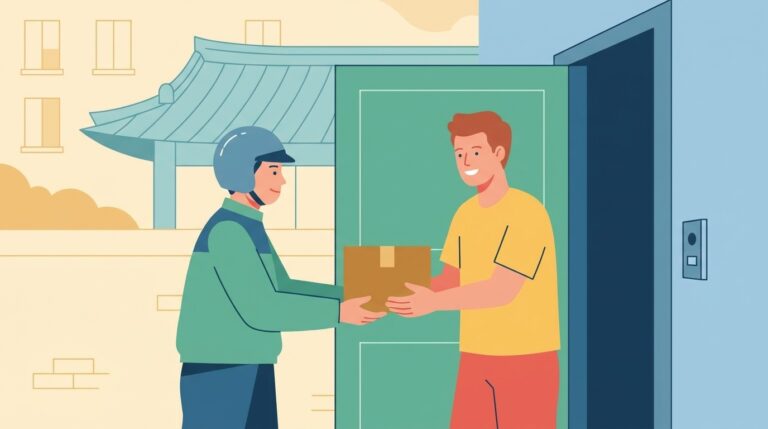
안녕하세요! 매일한글 에디터입니다. 👋 Have you ever waited eagerly for a exciting K-Beauty haul or K-Pop merch to arrive at your door in Korea, only to be stopped by a delivery driver saying something you didn’t quite understand? Imagine hearing the phrase “착불입니다” (Chakbul-imnida) and freezing up. Does it mean a gift? A sign to sign something? Don’t worry! This is one of the most common surprises foreign residents and travelers face in Korea. Today, based on real feedback from hundreds of beginner learners, we’re going to master this exact situation so you can receive your packages smoothly every single time!
Phase 2: Key Expressions Analysis
1. 착불입니다 (Chakbul-imnida)
- Pronunciation: [Chak-bool-im-ni-da] (Sounds like Chalk + Bull + im-nee-da)
- Meaning: “This is cash on delivery” (Pay on delivery).
- K-Culture Moment: You order a vintage item on a secondhand app or receive a package sent from a friend, and the delivery driver delivers it asking for payment at the door.
- Editor’s Insight: ‘착’ (Chak) means arrival, and ‘불’ (Bul) comes from payment (지불). It simply means you pay upon arrival!
- Situation Spectrum: Casual 🚫 / Semi-formal ⚠️ / Formal ✅
- 🤔 Think About It: In your home country, do you usually pay shipping fees before or after delivery?
2. 얼마예요? (Eolmayeyo?)
- Pronunciation: [Eol-ma-ye-yo?] (Sounds like All-mah-ye-yo)
- Meaning: “How much is it?”
- K-Culture Moment: Asking the delivery driver or a shop clerk the cost instantly and clearly.
- Editor’s Insight: This is the ultimate survival phrase in Korea for any payment situation!
- Situation Spectrum: Casual ⚠️ / Semi-formal ✅ / Formal ✅
- 🤔 Think About It: How does asking prices politely change your shopping experience?
3. 카드 돼요? (Kadeu dwaeyo?)
- Pronunciation: [Kah-deu dwae-yo?]
- Meaning: “Can I use a credit card?”
- K-Culture Moment: Korea is virtually a cashless society. Even delivery drivers carry portable card terminals!
- Editor’s Insight: You don’t need complex grammar; just say ‘Card’ + ‘dwaeyo?’ with a rising intonation.
- Situation Spectrum: Casual ⚠️ / Semi-formal ✅ / Formal ✅
- 🤔 Think About It: Is cash or card more common for home deliveries in your country?
Phase 3: Textbook vs. Real Korean
Situation 1: Asking if payment on delivery is required
* 📖 Textbook Korean: 이 택배는 배송비를 도착해서 지불해야 합니까? (Is it required to pay the delivery fee upon arrival for this parcel?)
* 🗣️ Real Korean: 이거 착불이에요? (Is this cash on delivery?)
* 💡 Why the difference? Real Koreans prefer ultra-short, efficient phrases in daily interactions.
Situation 2: Asking where to leave the package
* 📖 Textbook Korean: 문 앞에 물건을 놓아주시겠습니까? (Would you please place the item in front of the door?)
* 🗣️ Real Korean: 문 앞에 두고 가주세요! (Please leave it in front of the door!)
* 💡 Why the difference? Short imperative forms with polite endings (-주세요) are standard and friendly.
Phase 4: K-Culture Deep Dive & Manner
4-1. Nunchi & Gestures
When a delivery driver arrives, a slight head nod (about 15 degrees) while saying “감사합니다” (Gamsahamnida) goes a long way. If paying by card, hand over your card using both hands to show respect.
4-2. Culture Code: Delivery Kingdom (택배 공화국)
Korea is famous for its fast delivery service! From ‘Rocket Delivery’ to doorstep drops, drivers often call or message before arrival. Knowing how to handle payment at the door makes you look like a true local.
Phase 5: Roleplay Scenario
Characters: You (A1 Korean Learner) & Delivery Driver (Friendly Korean NPC)
- Driver: 안녕하세요! 택배왔습니다. (Hello! Parcel delivery.)
- You: 🎭 [Nodding warmly] 네, 감사합니다! (Yes, thank you!)
- Driver: 이거 착불입니다. (This is pay on delivery.)
- You: 🎭 [Surprised look] 아, 얼마예요? (Oh, how much is it?)
- Driver: 3,000원입니다. (It’s 3,000 won.)
- You: 🎭 [Holding out card with both hands] 카드 돼요? (Can I pay by card?)
- Driver: 네, 됩니다. 결제되었습니다! (Yes, you can. Payment complete!)
- You: 🎭 [Taking card back politely] 감사합니다. 안녕히 가세요! (Thank you. Goodbye!)
🔀 Interactive Choice Point:
If you don’t have cash or card ready right away, what do you say?
* Option A: 잠깐만요! (Wait a moment!) -> Best! Perfect and natural.
* Option B: 안 돼요! (No way / Cannot!) -> Bad! Sounds aggressive and rude.
* Option C: 돈 없어요! (I have no money!) -> Risk! Might cause misunderstandings.
Phase 6: 10-Sec Emotion Shadowing Drill
[😊 Welcoming & Happy]네 / 감사합니다! (Ne / Gamsahamnida!)[😮 Surprised & Curious]아, / 얼마예요? (A, / eolmayeyo?)[🙏 Polite Request]카드 / 돼요? (Kadeu / dwaeyo?)
Phase 7: K-Culture Mini Dictionary
- 택배 (Taekbae) | Delivery / Parcel | Used daily for online shopping packages.
- 선불 (Seonbul) | Prepaid | Shipping paid in advance.
- 착불 (Chakbul) | Cash on Delivery | Shipping paid upon receiving.
- 문 앞 (Mun ap) | In front of the door | The standard drop-off spot in Korea.
Phase 8: Traveler’s Survival Kit
- Top 1: 착불이에요? (Is it pay on delivery?)
- Top 2: 문 앞에 주세요. (Please leave it at the door.)
- Top 3: 카드 돼요? (Can I use a card?)
- Pro Tip: Download Naver Map to easily track local delivery points and convenience store pickup locations nearby!
Phase 9: A Step Deeper
In Korea, trust in public safety allows packages to be left right at your door without getting stolen. Paying for ‘Chakbul’ using a mobile card terminal right at your doorstep highlights both modern convenience and mutual trust in Korean culture.
💬 Your Turn: Have you ever received a package in Korea? Share your story in the comments below!
Phase 10: FAQ & Common Mistakes
Q: What if I am not at home when a ‘Chakbul’ package arrives?
A: The driver will usually send a text with a bank account number so you can transfer the shipping fee digitally!
Q: Can I pay ‘Chakbul’ with cash?
A: Yes, exact cash is appreciated, but card is generally preferred.
Q: Is ‘Chakbul’ more expensive than ‘Seonbul’?
A: Usually it costs the same, but it depends on the sender’s contract with the courier.
🚨 Common Mistake: Saying “돈 없어요” (I don’t have money) when you just mean you need to grab your card! Always use “잠깐만요!” (Just a moment!) instead.
Phase 11: Action Mission
- 🥉 Bronze: Say “카드 돼요?” out loud 3 times in front of a mirror.
- 🥈 Silver: Practice the Phase 5 roleplay with a study buddy or AI speaker.
- 🥇 Gold: Use “감사합니다” and hand over a card with both hands during your next real purchase!
- 🎮 K-Culture Mission: Spot the word ‘택배’ on a delivery truck in a Korean drama or street photo!
Phase 12: Quiz Challenge
- What does 착불 (Chakbul) mean?
- A) Free shipping
- B) Pay on delivery
- C) Return package
Click to see Answer & Explanation
Answer: B) Pay on delivery! ‘착’ means arrival and ‘불’ means payment.
- True or False: You can pay delivery drivers in Korea using a credit card.
Click to see Answer & Explanation
Answer: True! Most Korean delivery drivers carry portable card readers.







