

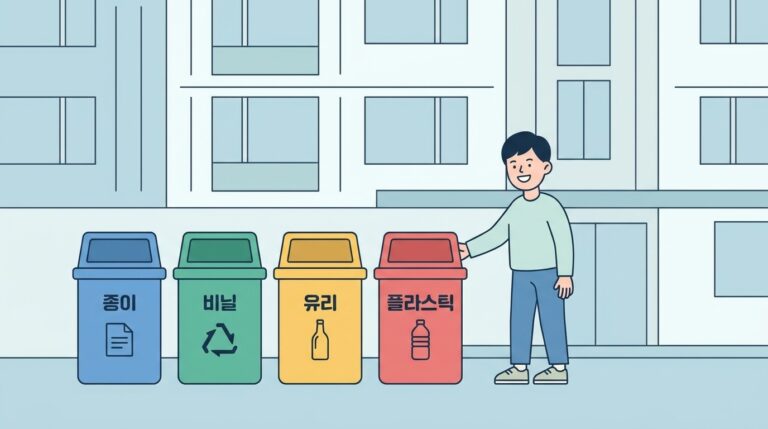
안녕하세요! 매일한글 에디터입니다. Have you ever stood in front of a Korean recycling station holding a sticky milk carton or an oily pizza box, feeling completely overwhelmed by the daunting array of bins? You are definitely not alone! Korea is world-renowned for its hyper-strict waste management system—known as Bunri-Sugeo (분리수거). Even native Koreans occasionally pause to debate whether an eggshell belongs in food waste or general trash. For advanced learners living in or visiting Korea, navigating these subtle distinctions is more than just about keeping your apartment clean; it’s a masterclass in understanding societal norms, civic duty, and subtle cultural nuances. Today, we are going to master the art of deciphering confusing waste items with ultimate linguistic precision and cultural confidence!
Phase 2: Core Expressions Deep Dive
1. 일반 쓰레기로 배출하다 (Ilban sseuregiro baechulhada)
- Pronunciation: [Il-ban sseu-re-gi-ro bae-chul-ha-da] (Think of ‘baechul’ sounding like ‘bae’ [ship] leaving port with ‘chul’ [departure]—literally releasing waste into the stream).
- Meaning: To dispose of as general/non-recyclable waste.
- K-Culture Moment: In reality TV shows like I Live Alone (나 혼자 산다), you often see celebrities agonizing over greasy takeout containers, debating whether to scrub them clean or just ‘일반 쓰레기로 배출하다’.
- Editor’s Insight: While ‘버리다’ (to throw away) is common in daily chatter, ‘배출하다’ (to discharge/dispose according to regulation) is used when discussing compliance, instructions, or administrative accuracy. Using ‘배출하다’ elevates your Korean fluency to C2 institutional precision.
- Situation Spectrum: Casual ⚠️ | Semi-formal ✅ | Formal ✅
- 🤔 Think About It: Why does Korean distinguish so sharply between throwing something out (버리다) and officially discharging it (배출하다)?
2. 잔여물을 세척하다 (Janyeomureul secheokhada)
- Pronunciation: [Jan-yeo-mul-eul se-cheok-ha-da] (‘Secheok’ sounds like ‘say-choke’, crisp and clean scrubbing).
- Meaning: To wash off residue/remaining contents.
- K-Culture Moment: apartment complexes feature warning signs by municipal officers: “플라스틱 용기, 잔여물을 세척한 후 배출해 주세요!” (Please wash off residue from plastic containers before disposal!).
- Editor’s Insight: ‘잔여물’ refers to any leftover food, liquid, or substance. If you don’t clean it off, the item loses its recyclable status and degrades the quality of the batch.
- Situation Spectrum: Casual ⚠️ | Semi-formal ✅ | Formal ✅
- 🤔 Think About It: How does the responsibility of pre-cleaning recyclables reflect Korea’s collective civic values?
3. 부자재를 분리하다 (Bujajaereul bunrihada)
- Pronunciation: [Bu-ja-jae-reul bun-ri-ha-da]
- Meaning: To separate auxiliary materials/components (e.g., removing plastic caps or vinyl labels from glass bottles).
- K-Culture Moment: Watching K-drama characters meticulously peel off clear plastic wraps from water bottles before crushing them.
- Editor’s Insight: ‘부자재’ encompasses labels, caps, metal rings, and tape. True mastery of Korean waste sorting requires identifying all mixed components.
- Situation Spectrum: Casual ⚠️ | Semi-formal ✅ | Formal ✅
- 🤔 Think About It: Is auxiliary material sorting enforced strictly by law in your home country?
Phase 3: Textbook Korean vs. Real Korean
Situation 1: Asking if a dirty delivery container can be recycled.
* 📖 Textbook: 이 오염된 용기는 재활용이 가능합니까? (Is this contaminated container recyclable?)
* 🗣️ Real Korean: 이거 양념 안 씻기는데 그냥 종량제에 버려야 되죠? (This sauce stain won’t wash off, so I should just toss it in the pay-per-bag trash, right?)
* 💡 Why the difference? Locals refer to general waste bags directly by their legal/functional name: Jongryangje bongtu (종량제 봉투).
Situation 2: Telling someone to take off the label from a bottle.
* 📖 Textbook: 병에 붙어 있는 비닐 라벨을 제거해 주십시오. (Please remove the plastic label attached to the bottle.)
* 🗣️ Real Korean: 페트병 비닐 라벨 떼서 따로 버리셔야 돼요. (You have to peel off the PET bottle wrap and throw it away separately.)
* 💡 Why the difference? Spoken Korean favors action-oriented verbs like ‘떼다’ (to peel off) over administrative terms like ‘제거하다’.
Phase 4: K-Culture Deep Dive & Non-verbal Manners
4-1. Nunchi & Gestures: When approaching an apartment recycling station (bunri-sugeo-jang), observe the recycling caretaker (Gyeongbi-ajeossi). A polite head tilt (15-30 degrees) accompanied by a quick double-check gesture (holding up the item with a questioning look) shows immense respect and Nunchi. Never toss unwashed or mixed items carelessly when the caretaker is watching!
4-2. Cultural Code: Korea’s landmass is limited, making landfill capacity a critical national concern. This gave rise to the strict Volume-Based Waste Fee System (쓰레기 수수료 종량제) introduced in 1995. Thus, sorting waste properly is seen as a benchmark of an educated, conscientious citizen.
Phase 5: Real-World Roleplay Scenario
Setting: Apartment Recycling Station on a Sunday evening. Resident Min-jun meets Neighbor Sarah.
- 민준: 🎭 (지켜보며) 아, 사라는 분리수거 중이셨군요! 혹시 그 컵라면 용기, 그대로 버리시려는 건가요?
(Ah, Sarah! You’re sorting your recyclables! Are you perhaps planning to throw that instant ramen container away as is?) - 사라: 🎭 (당황하며) 네! 스티로폼이라 당연히 재활용함에 넣는 줄 알았는데요…
(Yes! It’s styrofoam, so I thought it naturally belongs in the recycling bin…) - 민준: 🎭 (친절하게 웃으며) 국물이 들은 스티로폼은 국물이 배어 있어서 재활용이 불가능해요. 잔여물이 안 씻기면 일반 쓰레기로 배출해야 하거든요.
(Styrofoam stained with broth retains the oil, making it unrecyclable. If the residue won’t wash out, it must go into general trash.) - 사라: 🎭 (아하 하는 표정으로) 아, 그렇군요! 그럼 이 테이프가 붙은 택배 박스는 어떻게 하나요?
(Ah, I see! Then what about this delivery cardboard box with tape attached?) - 민준: 🎭 (박스를 가리키며) 상자의 운송장 스티커랑 비닐 테이프 같은 부자재를 전부 제거한 뒤에 펴서 배출하셔야 해요.
(You need to peel off all auxiliary materials like the shipping label sticker and plastic tape, then flatten it before disposal.) - 사라: 🎭 (고개를 끄덕이며) 생각보다 훨씬 까다롭네요! 계란 껍데기나 과일 씨앗도 음식물이 아니죠?
(It’s much more intricate than I thought! Eggshells and fruit pits aren’t food waste either, right?) - 민준: 🎭 (손가락을 세우며) 정확해요! 동물이 먹을 수 없는 딱딱한 건 전부 종량제 봉투에 넣으셔야 합니다.
(Spot on! Anything hard that animals cannot eat must go into the volume-based general trash bag.) - 사라: 🎭 (감사해하며) 민준 씨 덕분에 과태료 물 수도 있었던 위기를 넘겼네요! 정말 감사합니다.
(Thanks to you Min-jun, I avoided a potential fine! Thank you so much.)
🔀 Interactive Branch:
What should Sarah do with a clean glass bottle that has a metal cap?
– Option A: Throw it directly into the glass bin with the cap attached.
– Option B: Remove the metal cap, toss the cap in ‘Metal’ and the bottle in ‘Glass’.
– Option C: Put it in the food waste bin.
Feedback:
– Best (Option B): Perfect! Separating multi-material components (부자재 분리) is the gold standard of Korean recycling.
– Bad (Option A): Mixing metal with glass contaminates the recycling process.
– Risk (Option C): Glass in food waste risks breaking machinery and severely harming livestock feed processing!
Phase 6: 10-Second Emotional Shadowing Drill
- [😊 Friendly & Informative]
양념이 배어버린 / 스티로폼 용기는 / 재활용이 / 안 됩니다!
(Yangnyeomi bae-eobeorin / seutiropom yonggineun / jaehwalyongi / an doembnida!) -
[🥺 Realization & Regret]
아, 테이프 같은 / 부자재를 / 전부 떼어냈어야 / 했군요…
(A, teipeu gateun / bujajaereul / jeonbu tte-eo-naesseoya / haetgunyo…)
Phase 7: K-Culture Mini Dictionary
- 종량제 봉투 (Jongryangje Bongtu) | Official Pay-Per-Bag Trash Bag | Government-issued bags required for general waste disposal; color and price vary by district (Gu).
- 음식물 쓰레기 (Eomsikmul Sseuregi) | Food Waste | Organic waste processed into animal feed or fertilizer; hard bones, shells, and pits are excluded.
- 분리배출 표시 (Bunribaechul Pyosi) | Recycling Codes Symbol | The printed triangular arrow symbol on packaging indicating material type (PET, PP, PS, Can, etc.).
- 과태료 (Gwataeryo) | Administrative Fine | Fines imposed for non-compliant waste disposal (often up to 100,000 KRW or more).
Phase 8: Traveler’s Survival Kit
Survival Phrases:
1. 이거 음식물 쓰레기에 버려도 돼요? (Can I throw this into food waste?)
2. 페트병 라벨 떼는 곳이 어디예요? (Where is the place to peel off PET bottle labels?)
3. 일반 쓰레기봉투 어디서 사요? (Where can I buy general waste bags?)
Pro Tip: General waste bags (종량제 봉투) can be purchased at convenience stores or local marts by asking the cashier at the counter.
Editor’s Travel Note:
Unsure about district-specific waste rules? You can use local mapping tools like 네이버 지도 앱 다운로드 to search for nearby recycling centers or municipal guidelines.
Phase 9: A Step Deeper (Reflection)
In Korea, waste separation is a vivid reflection of Jeong (정) and collective responsibility. By meticulously washing out a beverage container or detaching a plastic wrap, you express consideration for the community workers and your neighbors. It reveals how Korean society balances high-density modern living with communal harmony.
💬 Your Turn: What was the most surprising waste sorting rule you encountered in Korea? Share your story in the comments below!
Phase 10: FAQ & Common Mistakes
Q: Are greasy pizza boxes recyclable as paper?
A: No! If paper is contaminated with oil or food residue, it cannot be recycled and must be thrown into the general trash bag (종량제 봉투).
Q: Are chicken bones considered food waste?
A: No. A good rule of thumb: If an animal cannot swallow or digest it (bones, hard shells, fruit stones), it goes into general trash.
Q: What should I do with clear PET bottles?
A: Rinse them, remove the vinyl label completely, crush the bottle flat, and put the cap back on (or sort per district guidelines).
🚨 Common Mistakes:
1. Leaving plastic wrap attached to delivery boxes → Correct Action: Strip off tape and stickers completely.
2. Throwing dirty plastic cups into recycling → Correct Action: Wash thoroughly; if stained, throw in general waste.
3. Putting broken glass in general bags safely without wrapping → Correct Action: Wrap tightly in newspaper or place in special paid bags (종량제 마대) to protect workers.
Phase 11: Action Missions
- Bronze Mission: Check 3 plastic items in your home right now for the 분리배출 symbol.
- Silver Mission: Take a photo of a properly prepared PET bottle (washed, label peeled) and post it on social media with #DailyHangulRecycling.
- Gold Mission: Explain to a friend in Korean why oily ramen cups belong in general waste!
🎮 K-Culture Mission: Spot a recycling scene in a slice-of-life K-drama and write down the sorting vocabulary used by the actors!
Phase 12: Interactive Quiz Challenge
- Question: Which item belongs in the Food Waste (음식물 쓰레기) bin?
A) Pork ribs bones
B) Soft banana peels
C) Walnut shells -
True or False: Styrofoam stained red with spicy broth can be recycled if left under the sun.
Click to see Answers & Explanations
1. Answer: B (Soft banana peels)
Explanation: Hard items like bones and walnut shells cannot be processed into animal feed.
2. Answer: False
Explanation: Sun bleaching does not eliminate chemical/oil contamination inside styrofoam; it must go to general trash!







