

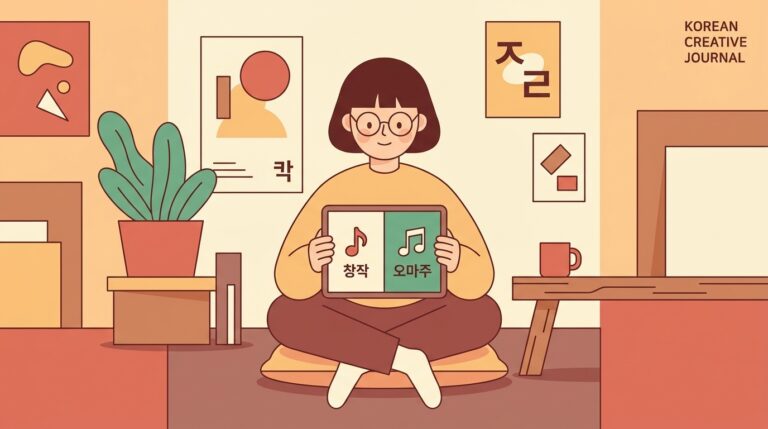
Phase 1: Empathy & K-Culture Scene
안녕하세요! 매일한글 에디터입니다.
Imagine you are watching the latest K-drama or listening to a newly released K-pop track. The beat drops, and suddenly you think, “Wait, isn’t this melody from that famous 90s hit? Is it plagiarism, or a clever tribute?” As K-content dominates the global stage, discussions around creative ethics have exploded in Korea. Foreign learners often find it tricky to express nuanced opinions on sensitive topics like Plagiarism (표절) versus Homage (오마주) or Parody (패러디) in Korean.
Expressing your thoughts clearly without sounding overly blunt or academically dry is a high-level skill. You don’t want to accidentally accuse an artist of stealing when they were actually paying respect! This guide is built on real feedback from C1-level learners who wanted to discuss art, copyright, and entertainment naturally with Korean friends. By the end of this lesson, you will confidently navigate creative ethics debates in fluent, nuanced Korean!
Phase 2: Core Expressions Deep Dive
1. 표절이라기보다는 오마주에 가까워요 (Pyo-jeol-i-ra-gi-bo-da-neun o-ma-ju-e gga-gga-wo-yo)
- Pronunciation: [Pyo-jeol-i-ra-gi-bo-da-neun o-ma-ju-e gga-gga-wo-yo] (Sounds like “Pyo-joel” + soft “O-mah-joo” with a gentle cadence)
- Meaning: It’s closer to an homage than plagiarism.
- K-Culture Moment: Discussing a K-pop music video that visually references a classic Hollywood film scene.
- Editor’s Insight: The phrase ‘~이라기보다는’ (rather than~) softens your opinion, making you sound analytical yet respectful rather than accusatory.
- Situation Spectrum: Casual ⚠️ | Semi-formal ✅ | Formal ✅
- 🤔 Think About It: How does softening your opinion with ‘~에 가까워요’ reflect the Korean cultural value of avoiding direct confrontation in public discussions?
2. 창작의 경계를 넘어서다 (Chang-jak-ui gyeong-gye-reul neo-meo-seo-da)
- Pronunciation: [Chang-ja-gui gyeong-gye-reul neo-meo-seo-da] (Flows smoothly like “Chang-jak” -> “Gyeong-gye”)
- Meaning: To cross the line of creative boundaries.
- K-Culture Moment: Debating whether a webtoon’s plot points are too similar to an existing novel.
- Editor’s Insight: Used when discussing whether an artist has stepped beyond inspiration into unethical copying. It’s an elegant, high-level metaphor frequently seen in Korean arts criticism.
- Situation Spectrum: Casual ⚠️ | Semi-formal ✅ | Formal ✅
- 🤔 Think About It: In your culture, is crossing creative boundaries viewed as bold innovation or an immediate moral violation?
3. 풍자와 해학을 담아내다 (Pung-ja-wa hae-hag-eul dam-a-nae-da)
- Pronunciation: [Pung-ja-wa hae-ha-geul dam-a-nae-da] (Rhythmic tone emphasizing “Pung-ja” and “Hae-hak”)
- Meaning: To embody satire and humor/wit.
- K-Culture Moment: Explaining why a comedy show parodying a famous politician or K-drama scene is legally and artistically acceptable.
- Editor’s Insight: ‘해학’ (Hae-hak) is a unique traditional Korean concept of warmhearted, witty humor distinct from sharp satire (‘풍자’). Using both terms shows deep cultural literacy.
- Situation Spectrum: Casual 🚫 | Semi-formal ✅ | Formal ✅
- 🤔 Think About It: How does the traditional Korean idea of ‘해학’ shape modern parody in K-entertainment?
Phase 3: Textbook Korean vs. Real Korean
Situation 1: Calling out a suspicious song similarity
- 📖 Textbook: 이 노래는 타인의 저작권을 침해했습니다. (This song infringed on another’s copyright.)
- 🗣️ Real Korean: 이거 완전 표절 느낌 아니야? 대놓고 베낀 것 같은데. (Doesn’t this totally feel like plagiarism? It looks like they copied it blatantly.)
- 💡 Why the difference? Native speakers use punchy, emotive verbs like ‘베끼다’ (to copy/cheat) and conversational hedge words like ‘느낌 아니야?’ in casual debates.
Situation 2: Defending a parody video
- 📖 Textbook: 이것은 합법적인 패러디 작품입니다. (This is a legal parody work.)
- 🗣️ Real Korean: 이건 원작을 유쾌하게 꼬집은 패러디지! (This is a parody that pleasantly pokes fun at the original!)
- 💡 Why the difference? ‘꼬집다’ (to pinch/poke fun at) captures the satirical essence of parody far better than dry legal terms.
Phase 4: K-Culture Deep Dive & Mannerisms
4-1. Nunchi & Gestures
When discussing sensitive topics like plagiarism in Korea, maintain a thoughtful, non-confrontational posture. Slightly tilt your head and raise one hand slightly when saying “표절이라기보다는…” to show you are contemplating, not attacking.
4-2. Cultural Code: K-Pop & Webtoon Ethics
In Korea’s fast-paced entertainment industry, fans act as vigilant guardians of intellectual property. However, K-pop frequently utilizes homage to pay respect to retro eras (e.g., 90s K-pop or Y2K aesthetics). Distinguishing homage from plagiarism relies on whether credit and artistic reinterpretations are transparently presented.
Phase 5: Interactive Roleplay Scenario
Setting: A cozy cafe in Hongdae. You are discussing a trending indie song with your Korean friend, Min-jun (a music producer).
- Turn 1 (Min-jun): 너 이번에 나온 신곡 들어봤어? 완전 예전 POP 곡이랑 똑같은데?
(Neo i-beon-e na-on sin-gog deu-reo-bwas-seo? Wan-jeon ye-jeon POP gog-i-rang ggok-ga-teun-de?)
(Did you listen to the new release? It sounds identical to an old POP song!)
🎭 Shaking his head while playing the track on his phone -
Turn 2 (You): 아, 그 곡요? 저도 들어봤는데, 표절이라기보다는 오마주에 가까운 것 같아요.
(A, geu gog-yo? Jeo-do deu-reo-bwas-neun-de, pyo-jeol-i-ra-gi-bo-da-neun o-ma-ju-e gga-gga-un geot ga-ta-yo.)
(Ah, that song? I heard it too, but I think it’s closer to an homage than plagiarism.)
🎭 Tilting your head thoughtfully and speaking softly -
Turn 3 (Min-jun): 그래? 하지만 코드 진행이랑 분위기가 너무 흡사하잖아.
(Geu-rae? Ha-ji-man ko-deu jin-haeng-i-rang bun-wi-gi-ga neo-mu heub-sa-ha-jan-ah.)
(Really? But the chord progression and vibe are way too similar.)
🎭 Pointing at the audio waveform -
Turn 4 (You): 원작자의 허락을 받고 뮤직비디오에 오마주 요소를 넣었다고 하더라고요.
(Won-jak-ja-ui heo-rag-eul bat-go myu-jik-bi-di-o-e o-ma-ju yo-so-reul neo-at-da-go ha-der-a-go-yo.)
(I heard they got permission from the original artist and included homage elements in the MV.)
🎭 Showing a news article on your phone -
Turn 5 (Min-jun): 아, 정말? 공식적으로 밝힌 거라면 인정해야겠네.
(A, jeong-mal? Gong-sig-jeog-eu-ro bal-khin geor-a-myeon in-jeong-hae-ya-get-ne.)
(Oh, really? If they officially stated it, then I guess I should acknowledge it.)
🎭 Nodding with an impressed smile -
Turn 6 (You): 맞아요. 창작의 경계를 지키면서 원작에 대한 존중을 표한 거죠.
(Maj-a-yo. Chang-jak-ui gyeong-gye-reul ji-khi-myeon-seo won-jak-e dae-han jon-jung-eul pyo-han geo-jyo.)
(Exactly. They respected the original while maintaining creative boundaries.)
🎭 Smiling and taking a sip of coffee -
Turn 7 (Min-jun): 듣고 보니 그러네! 그냥 패러디물인 줄만 알았어.
(Deut-go bo-ni geu-reo-ne! Geu-nyang pae-reo-di-mul-in jul-man al-as-seo.)
(Now that you mention it, that’s true! I thought it was just a cheap parody.)
🎭 Laughing comfortably -
Turn 8 (You): 풍자와 해학이 넘치는 패러디도 재미있지만, 이런 진정성 있는 오마주도 멋지죠.
(Pung-ja-wa hae-hag-i neom-chi-neun pae-reo-di-do jae-mi-it-ji-man, i-reon jin-jeong-seong in-neun o-ma-ju-do meot-ji-jyo.)
(Parodies filled with satire and wit are fun too, but sincere homages like this are truly cool.)
🎭 Gesturing appreciatively with your hands
🔀 Interactive Branch
What would you say if Min-jun still insists it’s plagiarism?
* Option A: 무조건 표절이에요! 님 음악 잘 못 들으시네요. (It’s definitely plagiarism! You don’t know music well.)
* Option B: 관점에 따라 다르게 볼 수도 있으니, 원작자의 공식 입장을 기다려봐요. (We might see it differently depending on perspective, so let’s wait for the original artist’s statement.)
* Option C: 표절이든 아니든 노래만 좋으면 상관없어요. (Whether it’s plagiarism or not, who cares as long as the song is good?)
Feedback:
* Option A (Bad): Extremely rude and aggressive. Ruins the conversation instantly.
* Option B (Best): Diplomatic, mature, and sophisticated C1-level response!
* Option C (Risk): Dismisses the ethics of creation, which can turn off artists or music lovers.
Phase 6: 10-Second Emotion Shadowing Drill
[🤔 고민하며 신중하게]표절이라기보다는… / 오마주에 가까워요.[💡 깨달음을 얻으며]아, 원작을 풍자하고 해학적으로 표현한 거였군요![😮 감탄하며]창작의 경계를 넘지 않고 / 멋지게 재해석했네요.
Phase 7: K-Culture Mini Dictionary
- 표절 (Pyo-jeol) | Plagiarism | Stealing someone’s creative work without credit or transformation.
- 오마주 (O-ma-ju) | Homage | Respectful artistic tribute to an original work or creator.
- 패러디 (Pae-reo-di) | Parody | Reimagining a work humorously with satire (‘풍자’) and wit (‘해학’).
- 원작자 (Won-jak-ja) | Original Creator | The legal and creative copyright holder of the foundational work.
Phase 8: Traveler’s Survival Kit
Top 3 Survival Phrases
- 이거 혹시 패러디인가요? (Is this by any chance a parody?) — Pro Tip: Use at cultural exhibitions or comedy shows.
- 원작이 따로 있어요. (There is an original work separately.) — Pro Tip: Great when explaining movie references.
- 저작권 등록이 되어 있나요? (Is it registered for copyright?) — Pro Tip: Useful for business or indie artists.
Editor’s Travel Note
When exploring creative districts like Seongsu or Hongdae, use Naver Map App Download to find indie art galleries and popup stores celebrating local Korean creators.
Phase 9: A Step Deeper (Reflection)
In Korean culture, artistic creation is increasingly seen through the lens of ‘예의’ (courtesy and respect). An homage is celebrated because it shows explicit respect toward seniors or predecessors in the industry. Understanding the distinction between copying and honoring another’s work reflects your deep comprehension of Korean social ethics.
💬 Your Turn: Have you ever seen a K-pop MV or drama scene that felt like an homage? Share your favorite examples in the comments below!
Phase 10: FAQ & Common Mistakes
Q: What is the main difference between ‘오마주’ and ‘패러디’ in Korean discussions?
A: ‘오마주’ (homage) emphasizes respect and admiration for the original work, whereas ‘패러디’ (parody) focuses on satirical critique, humor (‘해학’), and entertainment.
Q: Can I use the word ‘표절’ directly when talking to a Korean artist?
A: It is very direct and sensitive. Instead of saying “표절했어요” (You plagiarized), it is safer to say “유사성 논란이 있어요” (There is a controversy over similarity).
Q: Is ‘베끼다’ formal enough for a presentation?
A: No. ‘베끼다’ is casual slang. In formal contexts, use ‘표절하다’ or ‘무단 도용하다’ (unauthorized usage).
🚨 Common Mistakes
- ❌ Mistake: “이 노래는 오마주를 침해했어요.” (Wrong combination)
- ⭕ Correct Action: Say “저작권을 침해했어요” (Infringed copyright) or “오마주를 표했어요” (Expressed homage).
Phase 11: Action Mission
- 🥉 Bronze: Record yourself saying “표절이라기보다는 오마주에 가까워요” with gentle emotion.
- 🥈 Silver: Post a comment on a K-pop MV in Korean analyzing whether a scene is an homage.
- 🥇 Gold: Have a 3-minute discussion with a native speaker about creative ethics in webtoons.
🎮 K-Culture Mission: Watch a recent K-pop MV and spot one scene that references a famous film. Comment below!
Phase 12: Interactive Quiz Challenge
Q1. Situation Judgment: Which expression is best when respectfully defending an artist’s inspired work?
1) 대놓고 베꼈어요.
2) 원작에 대한 오마주로 볼 수 있어요.
3) 저작권 침해로 고소해야 해요.
Click for Answer & Explanation
Answer: 2
Explanation: Option 2 sophisticatedly frame the work as a respectful homage rather than an illegal copy or accusation.
Q2. Fill in the blank: 패러디는 괄호 안에 들어갈 (_______)와 해학을 담아내는 경우가 많다.
1) 풍자 (Satire)
2) 표절 (Plagiarism)
3) 도용 (Misappropriation)
Click for Answer & Explanation
Answer: 1 (풍자)
Explanation: Parody relies on satire (풍자) and humor/wit (해학).







