

Phase 1: Empathy – Story-Driven Opening
안녕하세요! I’m your Daily Hangul editor and cultural navigator! Have you ever found yourself sitting at a lively Korean Hoesik (company dinner), watching your Korean colleagues meticulously turn away when drinking, or pour drinks with both hands, leaving you frozen with your glass midway? You want to explain these fascinating cultural nuances to your non-Korean business partners or team members in natural Korean, but you get stuck translating word-for-word.
Navigating Korean business hospitality—especially drinking etiquette—can feel like walking through a minefield of unwritten social rules. Based on real feedback from mid-level learners working in international environments, knowing how to explain Korean drinking culture in Korean elevates your business relationships instantly. By mastering this guide, you won’t just explain etiquette; you will build deeper trust and turn formal dinners into successful business wins! Let’s dive in!
Phase 2: Deep Dive into 3 Essential Expressions
1. 손윗사람 앞에서는 고개를 돌리고 마셔요 (Sonwis-saram ap-eseon gogae-reul dol-ligo mas-yeoyo)
- Pronunciation: [Son-wit-sa-ram ap-e-seon go-gae-reul dol-li-go ma-syeo-yo] (Sounds like: Son-weet-sah-ram ah-peh-seon go-gae-rool doll-lee-go mah-she-yo)
- Meaning: Directly translates to “In front of elders/superiors, we turn our heads to drink.” Nuance-wise, it explains the fundamental Korean gesture of respect during drinks.
- K-Culture Moment: Think of any K-Drama corporate scene (like Misaeng) where a rookie employee sits sideways at a dinner table to take a sip of Soju.
- Editor’s Insight: It’s not about hiding that you drink; it’s about showing politeness by not making direct eye contact while consuming alcohol in front of seniors.
- Situation Spectrum: Casual ⚠️ / Semi-formal ✅ / Formal ✅
- 🤔 Think About It: In Western cultures, eye contact during a toast is key. Why do you think Korean culture emphasizes looking away as a sign of respect instead?
2. 잔이 비면 서로 채워주는 게 예의예요 (Jan-i bi-myeon seo-ro chae-wo-ju-neun ge ye-ui-yeyo)
- Pronunciation: [Jan-ee bee-myeon seo-ro chae-wo-joo-neun ge ye-ui-ye-yo] (Sounds like: Jahn-ee bee-myeon suh-ro chae-wo-joo-noon geh yeh-wee-yeh-yo)
- Meaning: “It’s polite to refill each other’s glasses when they are empty.”
- K-Culture Moment: At a Korean BBQ place, you will never see someone pour their own drink unless they are drinking alone. Refill culture (Gwan-gye) is all about mutual care.
- Editor’s Insight: Pouring your own drink (Jajak) can sometimes signal that others aren’t taking care of you, so keeping an eye on your neighbor’s glass shows attentiveness.
- Situation Spectrum: Casual ✅ / Semi-formal ✅ / Formal ✅
- 🤔 Think About It: How does pouring drinks for others reflect the community-focused (Jeong) mindset in Korean business culture?
3. 2차로 자리를 옮기는 경우가 많아요 (I-cha-ro ja-ri-reul om-gi-neun gyeong-u-ga man-ha-yo)
- Pronunciation: [Ee-cha-ro ja-ri-reul om-gi-neun gyeong-u-ga man-ha-yo] (Sounds like: Ee-chah-ro jah-ree-rool ohm-gee-noon gyeong-oo-gah mahn-hah-yo)
- Meaning: “It is common to move to a second round/venue.”
- K-Culture Moment: Moving from a meat restaurant (1차) to a pub or karaoke room (2차) is the classic flow of Korean business dinners seen in shows like Business Proposal.
- Editor’s Insight: 1-cha is usually for dinner and formal bonding, while 2-cha relaxes the atmosphere for genuine connection.
- Situation Spectrum: Casual ✅ / Semi-formal ✅ / Formal ⚠️
- 🤔 Think About It: Why do you think changing physical spaces helps break down formal corporate hierarchies in Korea?
Phase 3: Textbook Korean vs. Real Korean
Situation 1: Declining alcohol politely
* 📖 Textbook Korean: 저는 술을 마실 수 없습니다. (Jeo-neun sul-eul ma-sil su eob-seum-ni-da.)
* 🗣️ Real Korean: 제가 오늘 약을 먹어서 술은 좀 어려울 것 같아요. (Je-ga o-neul yak-eul meog-eo-seo sul-eun jom eo-ryeow-ul geot gat-a-yo.)
* 💡 Why the difference? Direct refusals can break the social harmony in business settings. Giving a soft personal reason (like taking medicine) preserves respect while declining comfortably.
Situation 2: Asking someone if they want another drink
* 📖 Textbook Korean: 술을 더 드시겠습니까? (Sul-eul deo deu-si-get-seum-ni-da-ka?)
* 🗣️ Real Korean: 한 잔 더 채워 드릴까요? (Han jan deo chae-wo deu-ril-kka-yo?)
* 💡 Why the difference? ” 채워 드릴까요?” (Shall I refill it for you?) focuses on hospitality and active care rather than just asking if they want more alcohol.
Phase 4: K-Culture Deep Dive & Non-Verbal Etiquette
4-1. Nunchi & Gestures
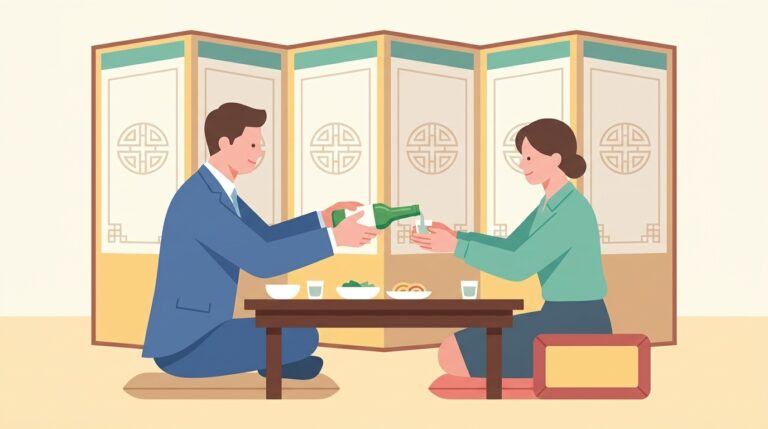
When pouring or receiving a drink from a senior business partner, use two hands. Place your right hand on the bottle and lightly support your right forearm or wrist with your left hand. When receiving, hold the glass with both hands and bow your head slightly. Always make subtle eye contact to read their Nunchi (social vibe) before taking a sip turned to the side!
4-2. Culture Code: The Magic of ‘Anju’ (Food Pairing)
In Korea, alcohol is rarely served without Anju (food paired with drinks). From spicy Kimchi-jjigae with Soju to crispy Chimaek (Chicken + Beer), offering appropriate food pairs shows high-level consideration in business hospitality.
Phase 5: Interactive Roleplay Scenario
Setting: You are host-guiding your global director, Sarah, at a traditional Korean BBQ house in Seoul alongside Director Kim.
- Director Kim: (손으로 잔을 받으며) 자, 마이클 씨도 한 잔 받으세요.
(Ja, Ma-i-keul ssi-do han jan bat-eu-se-yo.)
🎭 Action: Director Kim holds the bottle with two hands to pour you a drink. - You: 아, 감사합니다, 이사님! (두 손으로 잔을 잡는다)
(A, gam-sa-ham-ni-da, I-sa-nim!)
🎭 Action: You hold your glass with both hands to receive the drink. - Sarah: Michael, why is Director Kim pouring with two hands? Is that a rule?
- You: 네, 한국에서는 어른이나 상사에게 술을 따르거나 받을 때 두 손을 사용하는 게 예의예요.
(Ne, Han-guk-e-seo-neun eo-reun-i-na sang-sa-e-ge sul-eul tta-reu-geo-na bat-eul ttae du son-eul sa-yong-ha-neun ge ye-ui-ye-yo.)
🎭 Action: You smile warmly and explain naturally to Sarah. - Sarah: Oh, I see! What about when we drink?
- You: [Your choice here!]
🔀 Branching Choices:
- Option A: 그냥 편하게 아이컨택하면서 마시면 돼요!
- Option B: 한국에서는 상사 앞에서 고개를 살짝 돌리고 마시는 문화가 있어요.
- Option C: 이사님이 먼저 다 마실 때까지 기다려야 해요.
Feedback:
* Best Choice (Option B): Excellent! B2-level accuracy. You explained the subtle non-verbal etiquette accurately without overcomplicating it.
* Bad Choice (Option A): Danger! Skipping this detail might cause your foreign colleague to make an unintentional faux pas in front of senior executives.
* Risk Choice (Option C): Partially true, but overly rigid! Drinking at the same pace or turning away is the primary courtesy.
Phase 6: 10-Second Emotion Shadowing Drill
- [😊 Friendly & Explanatory]
한국에서는 / 잔이 비면 / 서로 채워주는 게 / 예의예요.
(Han-guk-e-seo-neun / jan-i bi-myeon / seo-ro chae-wo-ju-neun ge / ye-ui-yeyo.) -
[🥺 Polite & Soft Decline]
죄송하지만 / 제가 오늘 약을 먹어서 / 술은 좀 어려울 것 같아요.
(Joe-song-ha-ji-man / je-ga o-neul yak-eul meog-eo-seo / sul-eun jom eo-ryeow-ul geot gat-a-yo.)
Phase 7: K-Culture Mini Dictionary
- 건배 (Geon-bae) | Toast / Cheers | Used universally when clinking glasses. (Literal: “Dry the glass”).
- 밑잔 빼기 (Mit-jan ppae-gi) | Leaving alcohol at the bottom | Pretending to drink while leaving half a shot; discouraged in playful drinking settings.
- 파하는 분위기 (Pa-ha-neun bun-wi-gi) | Winding down atmosphere | The vibe when a business dinner is coming to an end.
- 숙취해소제 (Suk-chwi-hae-so-je) | Hangover cure drink/pills | Popular items purchased at convenience stores before or after business dinners.
Phase 8: Traveler’s Survival Kit
Survival Expressions TOP 3
- 여기 소주 한 병 더 주세요! (Yeo-gi so-ju han byeong deo ju-se-yo!) – One more bottle of Soju here, please!
- 물 좀 가져다 주실 수 있나요? (Mul jom ga-jeo-da ju-sil su in-na-yo?) – Could you bring us some water?
- 혹시 추천하시는 안주가 있나요? (Hok-si chu-cheon-ha-si-neun an-ju-ga in-na-yo?) – Do you have any recommended food pairings?
Editor’s Travel Note
For effortless navigation to popular dining spots during business trips, install the Naver Map App Download. It provides accurate local walking and public transit routes that outshine standard global map services in Korea.
Phase 9: A Step Deeper (Reflection)
Korean drinking culture isn’t about getting drunk; it’s an extension of dynamic team cohesion (Jeong). Moving from 1-cha to 2-cha breaks down the rigid corporate hierarchy constructed during office hours, allowing open communication. Understanding this helps you view business entertaining as an invitation to authentic relationship-building.
💬 Your Turn: What is the most surprising drinking etiquette rule in your culture compared to Korea’s? Share your thoughts in the comments below!
Phase 10: FAQ & Common Mistakes
Q: What should I do if I don’t drink alcohol at all for personal or religious reasons?
A: Simply hold your glass with both hands when offered, accept the drink, and set it down. You can polite explain: “종교/건강상의 이유로 술을 못 마셔서 음료수로 대신하겠습니다” (I will drink soda instead due to health/religious reasons).
Q: Is pouring your own drink really that bad?
A: It’s not a crime, but doing Jajak (pouring yourself) in front of superiors can imply that those around you are failing to take care of you.
Q: Do I always have to go to the 2nd round (2차)?
A: No! It is increasingly acceptable to politely decline after 1-cha by citing morning commitments.
🚨 Common Mistakes TOP 3
- Pouring with one hand to a boss: Always support your arm with your left hand.
- Clinking glasses higher than senior executive’s glass: Keep the rim of your glass slightly lower than theirs when clinking!
- Drinking face-to-face: Remember to turn your head away slightly.
Phase 11: Action Mission
- Bronze Mission: Practice saying “잔이 비면 서로 채워주는 게 예의예요” out loud 3 times.
- Silver Mission: Share this drinking etiquette guide with a colleague traveling to Korea.
- Gold Mission: Use the two-handed gesture correctly next time you join a dinner with Korean partners!
🎮 K-Culture Mission: Watch an episode of a office Korean drama (e.g., Misaeng) and spot 3 non-verbal gestures discussed today!
Phase 12: Interactive Quiz Challenge
-
Situation Quiz: When receiving alcohol from a business senior, how should you hold your glass?
Click to view Answer & Explanation
Hold it with two hands and slightly bow your head to show respect!
-
Fill-in-the-Blank: “In Korea, it’s common to move to a second venue, known as _____ (2-cha).”
Click to view Answer & Explanation
Answer: 2차 (Ee-cha)
-
True or False: You should make direct, strong eye contact while drinking alcohol in front of a senior colleague.
Click to view Answer & Explanation
False! You should turn your body/head slightly away while drinking.







