

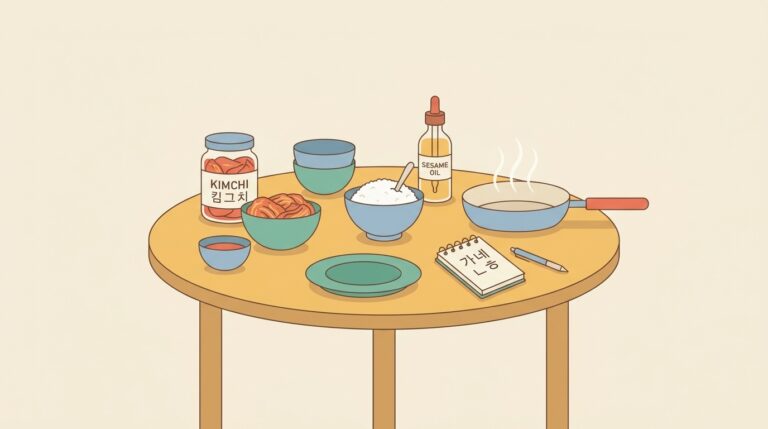
안녕하세요! I’m your Daily Hangul editor and your Korean culture bestie! Today, we are diving into the ultimate comfort food that every K-Drama lead cooks when they’re hungry at 1 AM: Kimchi Fried Rice (김치볶음밥)!
Have you ever stood in a Korean grocery store or stared into your fridge, feeling overwhelmed trying to gather the right ingredients? You know you need Kimchi, but what about the rest? You want to ask for ripe kimchi or pork belly, but the words get stuck in your throat! Don’t worry—you are not alone. Hundreds of our A2 learners told us they knew how to eat Kimchi Fried Rice, but got totally lost when trying to buy or prepare the ingredients in Korean.
Today, I’m giving you the exact, real-life phrases and secrets used by native Koreans so you can preapare your ingredients with total confidence. Let’s get cooking!
1. 잘 익은 김치 있어요? (Jal ik-eun kimchi isseoyo?)
- Pronunciation: Jal ik-eun kimchi isseoyo? (Sounds like: “Jahl eek-oon kimchi ees-seh-yo?”)
- Meaning: Literal: “Is there well-ripened kimchi?” | Nuance: “Do you have sour/aged kimchi?”
- K-Culture Moment: In K-Dramas, when someone makes Kimchi Fried Rice, they always dig for the old, sour kimchi at the bottom of the fridge container because fresh kimchi just doesn’t hit the spot!
- Editor’s Insight: Fresh kimchi (겉절이) is crunchy and sweet, but for fried rice, you need fermented, sour kimchi (푹 익은 김치 or 신김치). Asking for “잘 익은 김치” makes you sound like a true foodie!
- Situation Spectrum: Casual ✅ | Semi-formal ✅ | Formal ⚠️
- 🤔 Think About It: In your country, do you use older ingredients for specific dishes to get richer flavors?
2. 돼지고기 조금만 쓸게요. (Dwaejigogi jogeumman sseulgeyo.)
- Pronunciation: Dwaejigogi jogeumman sseulgeyo. (Sounds like: “Dway-jee-go-gee joh-geum-mahn ssul-geh-yo”)
- Meaning: Literal: “I will use just a little pork.” | Nuance: “I’ll just use a bit of pork.”
- K-Culture Moment: Preparing ingredients together with a roommate or friend while deciding who chops what!
- Editor’s Insight: The word ‘만 (man)’ means ‘only’. ‘조금만 (jogeum-man)’ politely signals that you don’t need a huge portion.
- Situation Spectrum: Casual ✅ | Semi-formal ✅ | Formal 🚫
- 🤔 Think About It: Notice how Korean recipes often adjust protein based on personal taste rather than strict measurements?
3. 찬밥 남아 있어요? (Chanbap nama isseoyo?)
- Pronunciation: Chanbap nama isseoyo? (Sounds like: “Chahn-bahp nah-mah ees-seh-yo?”)
- Meaning: Literal: “Is cold rice remaining?” | Nuance: “Is there any leftover cold rice?”
- K-Culture Moment: The magic secret ingredient for fried rice in any Korean household!
- Editor’s Insight: Freshly steamed warm rice gets mushy when fried. Cold, leftover rice (찬밥) creates that perfect, chewy texture.
- Situation Spectrum: Casual ✅ | Semi-formal ✅ | Formal ⚠️
- 🤔 Think About It: Why do you think ‘밥 (rice)’ is used so much in Korean phrases about daily life?
📖 Textbook Korean: 김치가 있습니까? (Is there kimchi?)
🗣️ Real Korean: 신김치 있어요? (Do you have sour kimchi?)
💡 Why the difference? Textbook phrasing is overly formal and vague. Real Koreans specifically ask for sour kimchi (신김치) when buying for fried rice!
📖 Textbook Korean: 밥을 사용합니다. (I use rice.)
🗣️ Real Korean: 찬밥으로 해야 맛있어요. (It’s delicious only if you use cold rice.)
💡 Why the difference? Koreans speak with passion about culinary texture! Stating 찬밥 shows real culinary know-how.
4-1. Nunchi & Gestures
When asking for ingredients at a small local market (마트), lightly hold your hands together or point gently with your whole hand rather than a single finger. When talking about quantities like “a little bit” (조금만), pinch your thumb and index finger close together—it’s a universal and friendly Korean gesture!
4-2. Culture Code: The Legend of ‘찬밥’ (Chanbap)
In Korea, food is love. Historically, 찬밥 (cold rice) meant leftover food, but in modern cooking culture, it has been elevated to the gold standard for fried rice! You’ll often hear K-pop idols mention making simple late-night Kimchi Bokkeumbap using whatever 찬밥 and kimchi are left in the dorm fridge.
Setting: You are in a Korean kitchen with your friend Minjun, preparing ingredients for Kimchi Fried Rice.
- Minjun: 오늘 김치볶음밥 만들까? 재료 뭐 있어? (Oneul kimchi-bokkeumbap mandeulka? Jaeryo mwo isseo?)
🎭 Excited, looking inside the fridge - You: 잠깐만! 잘 익은 김치 있어요. (Jamkkanman! Jal ik-eun kimchi isseoyo.)
🎭 Proudly pulling out a jar of aged kimchi - Minjun: 오, 완벽해! 밥은 따뜻한 밥 쓸까? (O, wanbyeokhae! Babeun ttatteut-han bap sseulka?)
🎭 Holding a fresh rice cooker bowl - You: 아니요, 찬밥 남아 있어요? 찬밥이 좋아요! (Aniyo, chanbap nama isseoyo? Chanbapi joh-ayo!)
🎭 Shaking head playfully and pointing to a cold bowl - Minjun: 역시 먹을 줄 아네! 고기도 넣을까? (Yeoksi meogeul jul ane! Gogido neoeulka?)
🎭 Grinning brightly - You: 네! 돼지고기 조금만 쓸게요. (Ne! Dwaejigogi jogeumman sseulgeyo.)
🎭 Making a small gesture with fingers - Minjun: 좋아, 내가 김치 썰게. 너는 고기 준비해 줘! (Joh-a, naega kimchi sseolge. Neoneun gogi junbihae jwo!)
🎭 Handing you a cutting board - You: 네, 같이 맛있게 만들어요! (Ne, gachi mas-issge mandeorayo!)
🎭 Smiling brightly
🔀 Interactive Branching Point
Minjun asks: “참기름도 넣을까?” (Should we add sesame oil too?)
* Choice A: 네, 참기름 꼭 넣어야 해요! (Yes, we definitely must add sesame oil!)
* Choice B: 아니요, 참기름은 필요 없어요. (No, we don’t need sesame oil.)
* Choice C: 참기름이 뭐예요? (What is sesame oil?)
Feedback:
* Best (Choice A): Perfect! Sesame oil (참기름) adds the iconic rich aroma to Korean fried rice!
* Risk (Choice B): Oh no! Skipping sesame oil loses 50% of the authentic flavor!
* Bad (Choice C): Oops! Missed a chance to show your K-food knowledge.
Practice saying these aloud with real emotion!
[😊 Super Excited]잘 익은 김치 / 있어요! (Jal ik-eun kimchi / isseoyo!)[🤔 Curious]찬밥 / 남아 있어요? (Chanbap / nama isseoyo?)[🤏 Cute & Gentle]돼지고기 / 조금만 / 쓸게요! (Dwaejigogi / jogeumman / sseulgeyo!)
- 신김치 (Sin-kimchi) | Sour / Well-fermented Kimchi | Essential for cooking fried rice or stews.
- 찬밥 (Chanbap) | Cold leftover rice | The secret to non-mushy, perfect fried rice texture.
- 재료 (Jaeryo) | Ingredients | Word used when checking what you need before cooking.
- 참기름 (Chamgireum) | Sesame oil | The magic finish-oil for almost all Korean savory dishes.
- “신김치 있어요?” (Do you have sour kimchi?)
- “찬밥 있어요?” (Do you have cold rice?)
- “조금만 주세요.” (Please give me just a little bit.)
💡 Editor’s Travel Note: Shopping for ingredients in Korea? Search for nearby local markets or supermarket chains using Naver Map App Download. Use mobile payments or cash easily at counter checkout!
In Korean culture, food preparation is deeply connected to sharing warmth (정, Jeong). Preparing ingredients together isn’t just prep work—it’s a bonding ritual. By offering to use leftover cold rice (찬밥) or asking for just a little bit of meat (조금만), you show consideration for the host or your cooking partner.
💬 Your Turn: What is your absolute favorite ingredient to add to fried rice? Let me know in the comments below!
Q: Can I use fresh kimchi instead of well-ripened kimchi?
A: You can, but it won’t have that tangy Korean restaurant flavor! Pro tip: Add a teaspoon of vinegar if your kimchi is too fresh!
Q: Is cold rice really that important?
A: Yes! Cold rice has less moisture, allowing the grains to fry crisp without turning into porridge.
Q: What if I don’t eat pork?
A: You can substitute pork (돼지고기) with tuna (참치) or spam (스팸)! Just say “참치 조금만 쓸게요.”
🚨 Common Mistakes
- ❌ “따뜻한 밥으로 김치볶음밥 만들어요.” -> Makes soggy rice.
- ✅ Correct Action: Use 찬밥 (cold rice).
- ❌ Calling any kimchi just 김치 when buying for cooking.
- ✅ Correct Action: Ask for 신김치 or 잘 익은 김치.
- 🥉 Bronze: Say “잘 익은 김치 있어요?” out loud 3 times in front of your mirror.
- 🥈 Silver: Post a photo of your fridge ingredients on SNS with the caption “오늘의 재료!”
- 🥇 Gold: Order or prepare Kimchi Fried Rice ingredients entirely using Korean phrases!
🎮 K-Culture Mission: Watch a Korean cooking vlog on YouTube today and spot how many times they say “찬밥” or “참기름”!
1. What kind of rice makes the best Kimchi Fried Rice? (Click to open)
Answer: 찬밥 (Cold rice)! It prevents the fried rice from becoming mushy.
2. Fill in the blank: “돼지고기 ______만 쓸게요.” (I’ll use just a little pork.) (Click to open)
Answer: 조금 (Complete phrase: 조금만).
3. True or False: Freshly made kimchi (겉절이) is best for Kimchi Fried Rice. (Click to open)
Answer: False! Aged, sour kimchi (신김치 / 잘 익은 김치) gives the best flavor.







