

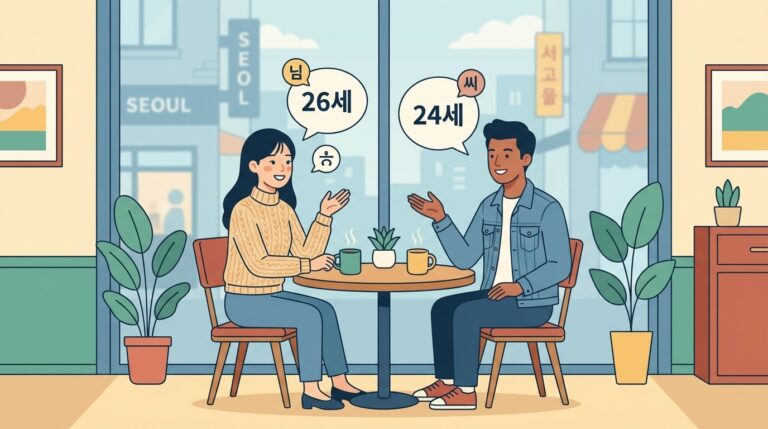
안녕하세요! 매일한글 에디터입니다. Have you ever been in a situation where you meet two Korean friends who are the exact same age according to the calendar, but one speaks Jondaetmal (polite language) and the other uses Banmal (casual speech) to each other? Welcome to the chaotic yet fascinating world of ‘Fast Years’ (빠른 년생 – Ppareun Nyeonsaeng)!
Imagine this: You join a K-Pop fan club meet-up in Seoul. You meet Minji (born March 1995) and Junho (born January 1996). Junho says, “I went to school early, so Minji is my classmate! We speak Banmal!” But then you (born November 1995) try to speak Banmal with Junho, and suddenly everyone goes quiet. Yikes! This hierarchy twist, known as jokbo kkoim (족보 꼬임 – family tree/hierarchy tangle), confuses even native Koreans. Don’t worry! By the end of this guide, based on real feedback from hundreds of learners, you will navigate Korean age hierarchy like a true local!
1. 빠른 년생이에요 (Ppareun nyeonsaeng-ieyo)
- Pronunciation: [Ppa-reun nyeon-saeng-ee-yo] (Sounds like “Ppa-roon” + “Nyeon-saeng”)
- Meaning: “I am a ‘fast year’ born person.”
- K-Culture Moment: In K-Dramas, when characters born in early months (Jan/Feb) try to claim seniority or equality with people born a year earlier because they entered school together.
- Editor’s Insight: Due to the old school system (before 2009), kids born in Jan-Feb started school with kids born the previous year. It creates a social loop where birth year doesn’t equal school grade year!
- Situation Spectrum: Casual ✅ | Semi-formal ✅ | Formal ⚠️
- 🤔 Think About It: Does your culture strictly group social hierarchy by birth year, or do school grades play a bigger role?
2. 족보가 꼬였어요 (Jokboga kkoyeosseoyo)
- Pronunciation: [Jok-bo-ga kko-yeoss-eo-yo] (Jok-bo sounds like ‘jock-bo’, Kkoy-eoss-eo-yo feels like twisting a thread)
- Meaning: “The social hierarchy/family tree got tangled.”
- K-Culture Moment: On variety shows like Running Man, when guest stars discover mutual friends of different ages and can’t decide who is the Hyeong (older brother) or Dongsaeng (younger sibling).
- Editor’s Insight: Jokbo means family register. Saying it’s twisted (kkoyeoda) is a lighthearted, humorous way to acknowledge an awkward age-speech paradox.
- Situation Spectrum: Casual ✅ | Semi-formal ✅ | Formal 🚫
- 🤔 Think About It: How do you resolve social awkwardness when social ranks clash in your country?
3. 말을 놓다 (Mal-eul not-da)
- Pronunciation: [Mal-eul not-da] (Mal = speech, not-da = to drop/let go)
- Meaning: To drop honorifics / to switch to casual speech (Banmal).
- K-Culture Moment: A romantic K-Drama moment where the male lead gently asks, “우리 말 놓을까요?” (Shall we drop formal speech?).
- Editor’s Insight: Dropping formal speech isn’t just about grammar; it signifies dropping emotional barriers!
- Situation Spectrum: Casual ✅ | Semi-formal ✅ | Formal 🚫
- 🤔 Think About It: Is there a specific phrase in your language that marks the transition from strangers to close friends?
📖 교과서 한국어 (Textbook): “우리 나이가 비슷하니 반말을 합시다.” (Since our ages are similar, let’s use casual speech.)
🗣️ 진짜 한국어 (Real-Life): “우리 그냥 말 편하게 할까요?” (Shall we just speak comfortably?)
💡 왜 다를까? Asking to “speak comfortably” (pyan-ha-ge) focuses on mutual relief rather than asserting age dominance.
📖 교과서 한국어 (Textbook): “저는 1996년 1월에 태어났습니다.” (I was born in January 1996.)
🗣️ 진짜 한국어 (Real-Life): “저 빠른 96이라 95랑 친구예요!” (I’m a ‘fast 96’, so I’m friends with ’95s!)
💡 왜 다를까? Natives use shorthand like “빠른 96” (Fast 96) to immediately justify why they speak Banmal with older birth-year peers.
4-1. Nunchi & Gestures
When the jokbo gets tangled, maintain a soft smile and use open hand gestures instead of pointing. Tilt your head slightly in a friendly, puzzled manner—this shows you are trying to be polite, not confrontational.
4-2. K-Culture Deep Dive
In Korean university culture or K-Pop groups, ‘Fast Years’ cause major drama! For instance, if two members are born in 1998 and Jan 1999, they might agree to be ‘friends’ (Chingu = same age rank). But if the Jan 1999 member introduces another 1999-born friend, the whole network tangles! This complex social dynamic is why Koreans love asking “몇 살이에요?” (How old are you?) right away.
Setting: A cozy cafe in Hongdae with two new Korean friends, Sujin and Minho.
- Sujin: 저는 95년생이에요. 민호 씨는요? (I was born in ’95. What about you, Minho?)
🎭 Smiles warmly - Minho: 저는 빠른 96이에요! (I’m a fast ’96!)
- Sujin: 아! 그럼 우리 학교 같이 다녔겠네요? (Ah! Then we must have gone to school at the same time?)
- Minho: 맞아요! 그래서 95년생이랑 친구해요. (Right! So I make friends with ’95-borns.)
🎭 Nods confidently - Alex (You): 어? 저는 그냥 95년 11월생인데… (Oh? I’m just born in Nov ’95…)
🎭 Looking confused - Minho: 그럼 족보가 좀 꼬이네요! (Then the hierarchy gets a bit tangled!)
🎭 Laughs softly - Sujin: 괜찮아요! 우리 그냥 다 말 놓을까요? (It’s okay! Shall we all just speak casually?)
- Alex (You): 좋아요! 우리 편하게 지내요. (Sounds good! Let’s be comfortable.)
🎭 Relief smile
🔀 Interactive Choice: How should Alex respond to Minho’s “빠른 96” claim?
– A: “그럼 제가 형/언니네요!” (Then I am your Hyeong/Eonni!) ➔ [Risk] Might sound too aggressive if you just met.
– B: “아, 빠른 년생이시구나! 그럼 서진이랑 친구니까 우리도 친구 해요.” ➔ [Best] Respects the school-year logic while opening doors for casual speech!
– C: “아니요, 년도가 다르니까 존댓말 쓰세요.” ➔ [Bad] Ruin the friendly vibe completely.
Practice saying these with natural rhythm and feeling! ( / = pause )
1. [😊 Cheerful & Light] 저 빠른 96이라 / 95랑 친구예요! (Jeo ppareun gu-yuk-i-ra / gu-o-rang chin-gu-yeo-yo!)
2. [😅 Playfully Embarrassed] 아… / 이러면 족보가 꼬이는데! (A… / i-reo-myeon jok-bo-ga kko-i-neun-de!)
3. [🤝 Friendly & Soft] 우리 / 그냥 말 편하게 할까요? (U-ri / geu-nyang mal pyeon-ha-ge hal-kka-yo?)
- 빠른 년생 (Ppareun Nyeonsaeng): Early-year birth (Jan-Feb) that aligns with the previous school year.
- 족보 (Jokbo): Genealogically meant ‘family tree’, but socially means ‘peer hierarchy group’.
- 말을 놓다 (Mal-eul Not-da): To lower honorifics and switch from Jondaetmal to Banmal.
- 동갑 (Dong-gap): Being the exact same age (birth year).
- Survival Phrase 1: “말 편하게 하셔도 돼요!” (You can speak casually to me!) – Pro Tip: Great for showing modesty when meeting someone younger or same age.
- Survival Phrase 2: “몇 년생이세요?” (What birth year are you?) – Pro Tip: Asking birth year avoids ‘Korean age vs International age’ confusion!
- Survival Phrase 3: “우리 동갑이네요!” (We are the same age!) – Pro Tip: Instant friendship builder.
-
Editor’s Travel Note: When traveling around Seoul, finding local gathering spots is easier when you check location reviews. Download the 네이버 지도 앱 (Naver Map App) to navigate meetups seamlessly!
In many Western cultures, age is just a number, and calling an older friend by their first name is normal. In Korea, age determines social grammar. However, ‘Fast Years’ show that Korean culture isn’t completely rigid—it values shared experiences (like school grade) over pure biological metrics. It’s about finding common ground!
💬 Your Turn: Have you ever experienced an awkward age dynamic in Korea or with your Korean friends? Share your story in the comments below!
Q: What should I do if a ‘Fast Year’ person is younger than me by birth year, but wants to use Banmal?
A: If you are comfortable with it, agree to switch to Banmal together! Say “좋아요, 말 편하게 해요!” (Sure, let’s speak comfortably!).
Q: Is ‘Fast Year’ still used for babies born recently?
A: No! The legal school entry system changed in 2009. Now, children enter school strictly by calendar birth year (Jan 1 – Dec 31). So ‘Fast Years’ mostly applies to people born before 2003.
Q: Can I unilaterally start using Banmal if we agree we are ‘Fast Year’ peers?
A: Always ask permission first! Switching without mutual agreement can feel rude.
🚨 Common Mistakes TOP 3:
1. Mistake: Using Banmal instantly upon hearing someone is born in Jan/Feb. ➔ Action: Ask “말 놓을까요?” first.
2. Mistake: Insisting on biological birth year over school year strictly. ➔ Action: Be flexible; let the native guide the dynamic.
3. Mistake: Forgetting Jondaetmal in business settings even if you are ‘Fast Year’ peers. ➔ Action: Keep formal speech in professional environments!
- Bronze: Practice saying “저 빠른 90년생이에요” aloud 3 times.
- Silver: Watch a K-Drama scene where characters ask each other’s age and leave a comment below with the phrase you heard.
- Gold: Try asking a Korean friend: “우리 말 편하게 할까요?”
🎮 K-Culture Mission: Watch an episode of a Korean variety show (like Going Seventeen or Running Man) and spot a moment where members argue over age hierarchy!
Q1. What does ‘족보가 꼬이다’ mean?
A) To order tangled noodles
B) Social hierarchy/age alignment gets confused
C) To forget someone’s name
Click to view Answer & Explanation
Answer: B! It literally means ‘family tree gets twisted’, used when age/grade hierarchy collides.
Q2. Fill in the blank: “우리 그냥 말 _____ 할까요?” (Shall we speak comfortably?)
A) 어렵게 (Difficultly)
B) 편하게 (Comfortably)
C) 빠르게 (Fast)
Click to view Answer & Explanation
Answer: B! ‘편하게’ means comfortably.







