

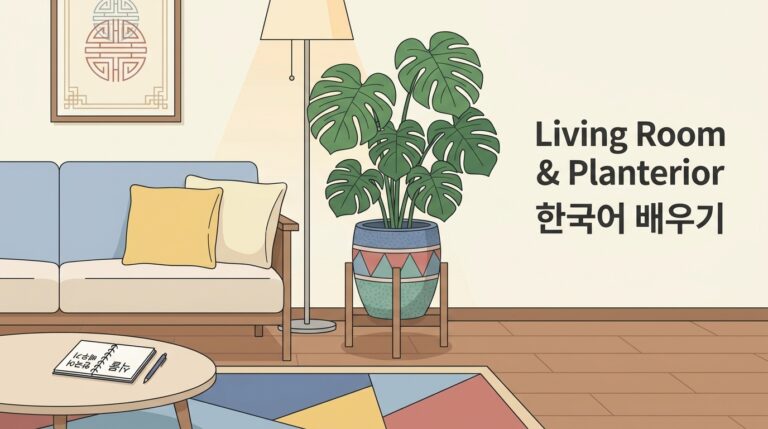
Phase 1: 공감 (Empathetic Opening)
안녕하세요! 매일한글 에디터입니다.
Have you ever walked into a sleek apartment in Seoul—perhaps the kind featured on 오늘의집 (Ohouse) or a lifestyle vlog—and felt an instant sense of peaceful vitality? The secret behind these modern Korean sanctuaries isn’t just minimalist furniture or warm mood lighting. It is the art of 플랜테리어 (Planterior = Plant + Interior) and the deep emotional bond with 반려식물 (companion plants).
As a language learner reaching the C2 level, you know that Korean living spaces have shifted dramatically over the past decade. Urban density in city centers like Seoul means living in compact apartments or 원룸 (studio apartments). To counter the concrete grayness outside, modern Koreans treat their houseplants not merely as decorative props, but as living companion entities—giving rise to sophisticated linguistic nuances like calling oneself a 식집사 (plant butler).
When discussing interior trends in high-level business meetings, aesthetic design reviews, or sophisticated conversations with native friends, relying on basic terms like 화분 (flowerpot) or 식물 (plant) won’t capture the full emotional and architectural nuance. This guide is crafted from real student feedback and real-world Korean interior design rhetoric to equip you with elegant, natural, and culturally rich C2-level expressions that will make native speakers pause in admiration.
Phase 2: 핵심 표현 3선 심층 분석 (Top 3 C2 Expressions)
1. 공간에 온기를 불어넣다
- Pronunciation: [Gong-gan-e on-gi-reul bul-eo-neo-da] (Imagine gently blowing warmth onto cold hands on a frosty day: ‘Gong-gan’ [space] + ‘on-gi’ [warmth] + ‘bul-eo-neoh-da’ [to blow in])
- Meaning: To breathe vitality and spatial warmth into a room (Literal: To blow warmth into a space).
- K-Culture Moment: Used frequently by interior designers on house tour shows like I Live Alone (나 혼자 산다) when evaluating how greenery transforms sterile concrete spaces.
- Editor’s Insight: At C2, you step beyond saying 방을 아름답게 꾸미다 (to decorate a room beautifully). 공간에 온기를 불어넣다 treats the architectural space as a living canvas that receives dynamic warmth through organic textures like wood and leaves.
- Situation Spectrum: Casual ⚠️ | Semi-formal ✅ | Formal ✅
- 🤔 Think About It: In Korean spatial psychology, a room without organic life is considered 차갑다 (cold/unwelcoming). How does your native language describe turning a sterile room into a lived-in sanctuary?
2. 반려식물을 들이다
- Pronunciation: [Ban-ryeo-sing-mu-reul deu-ri-da] (Smoothly connect the words: ‘Ban-ryeo’ [companion] + ‘sing-mul’ [plant] + ‘deu-ri-da’ [to welcome inside])
- Meaning: To welcome a plant as a living companion into one’s home.
- K-Culture Moment: Commonly heard in modern lifestyle vlogs when someone buys a rare Monstera Albo or Olive Tree to cultivate at home.
- Editor’s Insight: Notice the verb 들이다 (to welcome in) instead of 사다 (to buy). In Korean, 사다 objectifies the item, whereas 들이다 implies opening your home and life to a new presence, elevated by the prefix 반려 (companion), which was historically reserved for pets (반려견) and spouses (반려자).
- Situation Spectrum: Casual ✅ | Semi-formal ✅ | Formal ✅
- 🤔 Think About It: Why do you think modern Korean society expanded the term 반려 (companion) from animals to flora? What does this reflect about urban solitude?
3. 플랜테리어로 힐링 포인트를 주다
- Pronunciation: [Plan-te-ri-eo-ro hil-ling po-in-teu-reul ju-da] (Natural loanword flow with native postposition: ‘Plan-te-ri-eo’ + ‘-ro’ [via/with])
- Meaning: To establish a focal point of green rejuvenation within an interior design scheme.
- K-Culture Moment: Featured in architectural write-ups for boutique cafes in Seongsu-dong or modern office designs aiming to reduce employee burnout.
- Editor’s Insight: C2 Korean blends specialized loanwords with native grammar smoothly. 힐링 포인트 (healing point) serves as an aesthetic and emotional accent in space planning.
- Situation Spectrum: Casual ✅ | Semi-formal ✅ | Formal ✅
- 🤔 Think About It: How do modern loanwords in Korean capture fast-evolving contemporary lifestyle trends more dynamically than traditional dictionary definitions?
Phase 3: 교과서 한국어 vs 진짜 한국어 (Textbook vs. Real Korean)
Situation 1: Praising someone’s beautiful room plant accent
- 📖 교과서 한국어: 이 화분 때문에 방 분위기가 좋습니다.
(This flowerpot makes the room atmosphere good.) - 🗣️ 진짜 한국어: 이 식물 하나로 공간 전체가 한결 화사하고 생기 있게 살아나네요!
(With just this single plant, the entire space feels noticeably brighter and vibrant!) - 💡 왜 다를까?: Native C2 speakers avoid simple adjectives like 좋다. Adverbs like 한결 (noticeably/much more) combined with descriptive verb phrases like 생기 있게 살아나다 (come alive with vitality) show sophisticated aesthetic perception.
Situation 2: Explaining your newfound obsession with growing houseplants
- 📖 교과서 한국어: 저는 요즘 집에서 식물을 많이 키웁니다.
(I grow many plants at home these days.) - 🗣️ 진짜 한국어: 요즘 본의 아니게 완전 ‘식집사’의 길로 접어들었어요.
(Unintentionally, I’ve completely embarked on the path of a true ‘plant butler’ lately.) - 💡 왜 다를까?: Expressions like 식집사 (plant butler) reflect contemporary Korean slang and lifestyle culture, turning a simple hobby into a relatable identity marker.
Phase 4: K-Culture 딥다이브 & 비언어적 매너 (Culture Deep Dive & Manner)
4-1. 눈치(Nunchi) & Non-Verbal Etiquette in Botanical Spaces
When visiting a Korean housewarming party (집들이) or a high-end botanical cafe, touching leaves carelessly is considered poor etiquette (실례). Instead, demonstrate refined 눈치 by admiring the placement from a respectful distance. When admiring a companion plant, gently gesture toward the base of the pot with an open hand (never pointing with a single finger) and tilt your head slightly in aesthetic appreciation.
4-2. Cultural Code: The Rise of ‘식집사’ (Plant Butlers) and Apartment Culture
Over 50% of South Korea’s population resides in high-rise apartment complexes (아파트). In these structural environments, concrete walls and balconies offer limited contact with natural ecosystems. The term 식집사 (a compound of 식물 [plant] and 집사 [butler]) emerged during the pandemic era and has solidified into a major interior aesthetic trend. Caring for plants like 몬스테라 or 마르기나타 provides emotional grounding (애착) and serves as a personalized micro-sanctuary within urban concrete jungles.
Phase 5: 실전 롤플레이 시나리오 (Roleplay Scenario)
Scenario: You are visiting the stylish architectural home of your interior designer friend, Ji-ho (지호), in Yeonnam-dong. You are discussing his modern planterior aesthetic.
- 지호: 어서 와요! 우리 집은 처음이지? 거실이 좀 썰렁해 보일까 봐 신경 썼는데 어때요?
(Welcome! First time at my place, right? I was worried the living room might look a bit bare—what do you think?) - 나 (You): 🎭 [손을 모으고 거실 전체를 천천히 둘러보며] 전혀요! 들어서자마자 공간에 온기가 느껴지는데요?
([Clasping hands gently, scanning the living room slowly] Not at all! The moment I walked in, I felt such warmth in the space.) - 지호: 정말요? 사실 창가 쪽에 큰 여인초를 하나 들였거든요.
(Really? Actually, I welcomed a large Bird of Paradise plant by the window.) - 나 (You): 🎭 [식물 쪽으로 다가가 가볍게 감탄하며] 아, 역시! 그 식물 하나가 이 집의 완벽한 힐링 포인트 역할을 해주네요.
([Stepping closer to the plant, expressing mild admiration] Ah, I see! That single plant acts as a perfect healing point for this home.) - 지호: 맞아요. 요즘 퇴근하고 물 주는 재미에 살아요. 저 거의 식집사 다 됐죠?
(Exactly. Nowadays I live for the joy of watering it after work. I’ve basically become a plant butler, haven’t I?) - 나 (You): 🎭 [미소를 지으며 공감하는 어조로] 완전히요! 단순한 인테리어를 넘어 식물과 교감하는 느낌이 들어요.
([Smiling with an empathetic tone] Absolutely! Beyond simple interior design, it really feels like you’re emotionally connecting with the plant.) - 지호: 알아봐 주니 뿌듯하네요. 다음엔 플랜테리어 팁 좀 더 공유해 줄게요.
(I’m so glad you recognized it. I’ll share more planterior tips next time.) - 나 (You): 🎭 [고개를 끄덕이며] 좋아요! 저도 조만간 반려식물 하나 품어봐야겠어요.
([Nodding] Sounds great! I should embrace a companion plant of my own real soon.)
🔀 Interactive Branching Point (인터랙티브 분기점)
Ji-ho asks: “식물 잘 키우는 팁 같은 거 있어요?” (Do you have any tips for keeping plants alive?)
- Option A: “걍 물 잘 주면 자라지 않나요?” (Don’t they just grow if you give them water?)
- Option B: “통풍과 과습 조절이 핵심이라고 들었어요. 식물의 상태를 세심하게 살피는 게 중요하죠.” (I heard ventilation and avoiding overwatering are key. Paying subtle attention to the plant’s state is crucial.)
- Option C: “화분을 많이 사서 아무 데나 두면 돼요.” (Just buy a lot of pots and put them anywhere.)
Feedback:
* Option A (Risk): Too casual and dismissive of the effort required for plant care; kills the C2 sophisticated mood.
* Option B (Best): Perfect C2 vocabulary (통풍, 과습 조절, 세심하게 살피다) showing architectural and biological awareness.
* Option C (Bad): Sounds clumsy and ignores spatial interior aesthetics.
Phase 6: 10초 감정 섀도잉 드릴 (10-Sec Emotional Shadowing Drill)
Practice reading this sentence aloud with precise pause markers (/) and emotional tone tags:
[😊 감각적이고 따뜻한 어조로]
“거실 구석에 / 큰 여인초 하나 들였는데, / 차가웠던 공간 전체가 / 한결 화사하게 살아나는 거 있죠?”
(Geosil guseoge / keun yeoincho hana deu-ryeon-neunde, / chagawotdeon gonggan jeonchega / han-gyeol hwasahage sarananeun geo itjjo?)
(Translation: I welcomed a large Bird of Paradise into the living room corner, and the entire space that felt cold noticeably brightened and came to life!)
Phase 7: K-Culture 미니 사전 (Mini Dictionary)
- 식집사 (Sik-jip-sa) | Plant Butler | Modern portmanteau (식물 + 집사) describing passionate indoor gardeners who pamper their greenery.
- 식테크 (Sik-tech) | Plant Technology/Investment | The phenomenon of breeding and selling rare variegated plants (like Monstera Albo) as financial investments.
- 플랜테리어 (Plan-te-ri-eo) | Planterior | Interior design emphasizing living plants as primary aesthetic accents.
- 반려식물 (Ban-ryeo-sing-mul) | Companion Plant | Houseplants viewed as life companions offering emotional comfort.
Phase 8: 여행자를 위한 생존 키트 (Traveler’s Survival Kit)
TOP 3 Essential Phrases for Trendy Plant Cafes & Studios
- “이 공간과 잘 어울리는 반려식물 추천해 주실 수 있나요?”
(Can you recommend a companion plant that matches this space well?)- Pro Tip: Use when asking curators at plant shops in Seongsu or Hannam-dong.
- “초보 식집사도 키우기 쉬운 공기정화 식물이 있을까요?”
(Are there air-purifying plants that are easy for beginner plant butlers to grow?) - “분갈이 서비스도 함께 진행해 주시나요?”
(Do you also offer repotting service?)
Editor’s Travel Note
When hunting for top-tier planterior inspiration in Seoul, explore neighborhoods like Seongsu-dong (성수동) and Yeonnam-dong (연남동). Use the 네이버 지도 앱 다운로드 to search for ‘식물원 카페’ (botanical cafes) or ‘플랜테리어 스튜디오’ to discover hidden green oases tucked inside minimalist concrete alleys.
Phase 9: 한 발 더 깊이 (Deep Thought Essay)
In modern Korean culture, the shift from viewing plants as mere exterior commodities to intimate indoors 반려식물 speaks volumes about urban transformation. As personal living quarters in metropolis environments become hyper-digitized and dense, the innate human craving for organic connection finds solace in living foliage. Nurturing a plant is no longer just a hobby; it is a mindful declaration that even within high-paced urban lives, we choose to cultivate quiet warmth and breathing room.
💬 Your Turn: What plant or element gives your own living space a sense of emotional warmth (온기)? Share your thoughts in Korean in the comments below!
Phase 10: FAQ & 흔한 실수 (FAQ & Mistakes)
Q: Can I use ‘반려식물’ in formal corporate presentation settings?
A: Yes! In fact, modern real estate developers, interior design firms, and corporate ESG reports frequently use 반려식물 and 플랜테리어 to emphasize mental wellness and eco-friendly spaces.
Q: What is the exact difference between ‘키우다’ and ‘들이다’?
A: 키우다 means the physical act of raising/growing something over time. 들이다 focuses on the specific decision to bring a living entity into your spatial domain and lifestyle.
Q: Is ‘식집사’ considered slang or standard Korean?
A: It originated as neologism/slang, but it is now widely recognized and used in broadcast journalism, lifestyle magazines, and retail marketing.
🚨 흔한 실수 (Common Mistakes Top 3)
- Wrong: 식물을 샀어요 그래서 방이 아름다워요. (Too simple for C2)
- Correct Action: Use spatial metaphors: “식물을 들인 덕분에 공간에 온기가 돌아요.“
- Wrong: 이 식물은 방의 화분 포인트입니다. (Unnatural loanword usage)
- Correct Action: Combine properly: “이 식물이 공간의 멋진 힐링 포인트가 되어주네요.”
- Wrong: 반려식물을 먹이다. (Using ‘feed’ instead of ‘water’)
- Correct Action: Use “반려식물에 물을 주다” or “식물을 가꾸다“.
Phase 11: 액션 미션 & 참여 유도 (Action Mission)
- Bronze Mission: Read the Phase 6 Shadowing sentence aloud 3 times, focusing on natural rhythm and emotional warmth.
- Silver Mission: Leave a comment below introducing your favorite plant using the word 반려식물 or 식집사.
- Gold Mission: Next time you post a home aesthetic photo on Instagram, caption it in Korean using: “공간에 온기를 불어넣는 플랜테리어 🌱”
🎮 K-Culture Mission: Watch a room tour video on YouTube by searching “룸투어 플랜테리어” and spot how many times the creator uses the terms 들이다 or 힐링 포인트!
Phase 12: 인터랙티브 퀴즈 챌린지 (Quiz Challenge)
Test your C2 interior & planterior mastery!
Q1. Fill in the blank with the most natural C2 verb phrase:
“단조롭던 사무실에 초록색 식물들을 놓으니 공간에 _________.”
1) 물이 들었다
2) 온기가 불어넣어졌다 (온기가 돌다)
3) 화분이 되었다
🔍 Q1 정답 및 해설 확인 (Click to expand)
정답: 2)
해설: Bringing plants into a monotonous space endows it with emotional warmth (공간에 온기가 돌다/온기를 불어넣다).
Q2. True or False:
The term ‘식집사’ combines the words for ‘plant’ (식물) and ‘butler’ (집사).
( True / False )
🔍 Q2 정답 및 해설 확인 (Click to expand)
정답: True
해설: ‘식집사’ is a trendy modern compound word reflecting how urban Koreans devotedly care for their houseplants.







