

Master Spontaneous Korean: Talk Like an MBTI ‘P’ Type!
Phase 1: Empathy & Storytelling
안녕하세요! I’m your lead editor at Daily Hangul (매일한글).
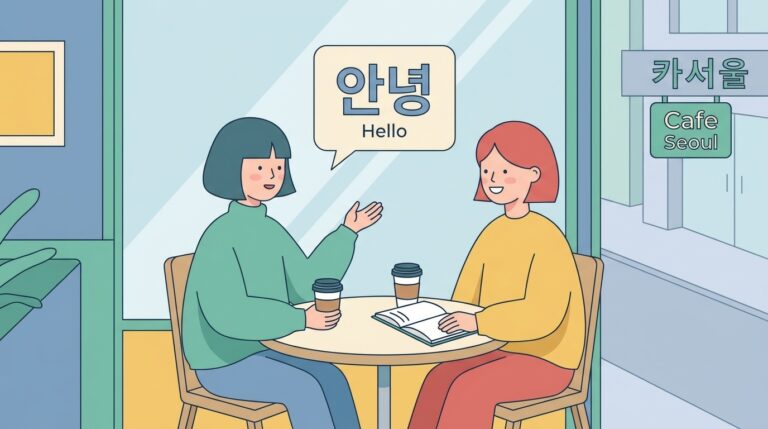
Have you ever been sitting in a cozy cafe in Hongdae when a Korean friend suddenly turns to you and asks, “지금 뭐 해? (What are you doing right now?)” You look at your phone, notice it’s already 9 PM, and reply, “Nothing much.” Immediately, they flash a bright smile and say, “그냥 가자! (Let’s just go!)” Before you know it, you are on your way to a late-night street food cart in Pocha!
If you are an MBTI ‘P’ (Perceiving) type, or if you have Korean friends who love spontaneous plans (often called 번개 in Korean), knowing how to react naturally can make your social life in Korea so much fun. Many beginner Korean learners get stuck trying to formulate complex, textbook-style sentences like “I do not have plans tonight, so we can go.” But real Koreans keep it quick, emotional, and casual!
In this guide, built from real student feedback and real Seoul lifestyle moments, you will master 3 essential beginner-friendly expressions for spontaneous moments. By the end of this article, you will sound like a native Korean ‘P’ type in no time!
Phase 2: Core Expressions Deep Dive
1. 그냥 가자! (Geunyang gaja!)
- Pronunciation: [geun-yang gah-jah] (Sounds like “good-young” without the ‘d’, followed by “gah-jah”)
- Meaning: Literal: “Just let’s go!” | Nuance: “Let me skip the planning and just do it right now!”
- K-Culture Moment: Frequently used in K-Dramas when main characters ditch their busy schedules to go on an impromptu beach trip or late-night chicken-and-beer run.
- Editor’s Insight: The word 그냥 (geunyang) means “just” or “without reason.” Adding it before any action verb softens the decision and highlights spontaneity.
- Situation Spectrum: Casual ✅ | Semi-formal ⚠️ | Formal 🚫
- 🤔 Think About It: In your culture, do people like making plans weeks in advance, or do they enjoy last-minute hangouts like Koreans?
2. 갑자기? (Gapjagi?)
- Pronunciation: [gap-jah-gi] (Sounds like “gahp-jah-gee”)
- Meaning: Literal: “Suddenly?” | Nuance: “Wait, out of nowhere? Right now?”
- K-Culture Moment: Used constantly in Korean variety shows when cast members get surprised with sudden missions or unexpected trips.
- Editor’s Insight: You say this with an arched eyebrow and a playful smile when your friend suggests something totally unexpected.
- Situation Spectrum: Casual ✅ | Semi-formal ⚠️ | Formal 🚫
- 🤔 Think About It: How do you react when someone changes plans without notice?
3. 지금 뭐 해? (Jigeum mwo hae?)
- Pronunciation: [jee-geum mwo hae] (Sounds like “jee-geum” and “mwo-hae”)
- Meaning: Literal: “What are you doing now?” | Nuance: “Are you free to hang out right this second?”
- K-Culture Moment: The iconic text message sent at 10 PM that starts every spontaneous night out in K-Pop culture.
- Editor’s Insight: This is the ultimate ‘P’ type opening sentence. It implies you want to meet up immediately if they are free.
- Situation Spectrum: Casual ✅ | Semi-formal ⚠️ | Formal 🚫
- 🤔 Think About It: Is texting someone last minute considered friendly or impolite in your home country?
Phase 3: Textbook Korean vs. Real Native Korean
Situation 1: Suggesting a sudden trip/outing
* 📖 Textbook Korean: 계획을 바꾸고 지금 나갑시다. (Let’s change our plan and go out now.)
* 🗣️ Real Native Korean: 그냥 가자! (Let’s just go!)
* 💡 Why is it different? Native speakers value speed and shared excitement over formal grammatical precision during casual hangouts.
Situation 2: Asking if someone is free immediately
* 📖 Textbook Korean: 지금 시간이 있으십니까? (Do you have time right now?)
* 🗣️ Real Native Korean: 지금 뭐 해? (What are you doing now?)
* 💡 Why is it different? Among friends, asking what someone is doing sounds much more natural and warm than asking if they have time.
Phase 4: K-Culture Deep Dive & Non-Verbal Manners
4-1. Nunchi & Body Language
When saying “그냥 가자!”, bump your friend’s shoulder playfully or grab your jacket quickly to show excitement. When asking “갑자기?”, tilt your head slightly with a smile—this shows you are pleasantly surprised rather than annoyed!
4-2. Cultural Code: The Power of “번개 (Beongae)”
In Korea, spontaneous meetups are called 번개 (Beongae), which literally translates to “lightning.” Because Korea has fast transport systems and safe nightlife, lightning hangouts for late-night snacks (야식) like Tteokbokki or Fried Chicken are a core part of youth culture.
Phase 5: Real-Life Roleplay Scenario
Setting: You are hanging out at a lounge with your energetic Korean friend, Minjee (민지), who is a classic MBTI ‘ENFP’.
- Minjee: 야, 오늘 날씨 너무 좋다! (Ya, oneul nalssi neomu joda!)
🎭 [Looking out the window with excitement](Hey, the weather is so nice today!) - You: 맞아, 날씨 좋다. (Maja, nalssi joda.)
🎭 [Nodding warmly](True, the weather is nice.) - Minjee: 지금 뭐 해? 우리 한강 갈까? (Jigeum mwo hae? Uri Hangang galka?)
🎭 [Grabbing her bag abruptly](What are you doing now? Shall we go to the Han River?) - You: 갑자기? 지금? (Gapjagi? Jigeum?)
🎭 [Widening eyes playfully](Out of nowhere? Right now?) - Minjee: 응! 치킨 시켜 먹자! (Eung! Chikin sikyeo meokja!)
🎭 [Clapping hands excitedly](Yeah! Let’s order fried chicken there!) - You: 좋아! 그냥 가자! (Joha! Geunyang gaja!)
🎭 [Standing up enthusiastically](Sounds great! Let me just go!) - Minjee: 완전 좋아! 택시 타자! (Wanjeon joha! Taeksi taja!)
🎭 [High-fiving you](Awesome! Let’s take a taxi!) - You: 그래, 가자! (Gurae, gaja!)
🎭 [Laughing together](Okay, let’s go!)
🔀 Interactive Choice Point
Minjee suddenly suggests buying fireworks at the Han River store! What do you reply?
- Option A: 좋아! 그냥 사자! (Joha! Geunyang saja! / Great! Let’s just buy them!)
- Option B: 안 됩니다. 규칙을 확인합시다. (An doemnida. Gyuchigeul hwaginhapsida. / Not allowed. Let’s check rules.)
- Option C: 계획에 없었어요. (Gyehoege eopseosseoyo. / It wasn’t in the plan.)
Feedback:
* Option A (Best Choice): Perfect! You matched her ‘P’ energy naturally and used the versatile 그냥 (geunyang) core expression!
* Option B (Bad Choice): Too formal and cold for a fun night out with a close friend.
* Option C (Risk Choice): Sounds a bit buzzkill-ish unless said with a big joke smile!
Phase 6: 10-Second Emotion Shadowing Drill
Practice reading these out loud with the correct emotion cues and pauses (/):
[😊 Excitement]지금 뭐 해? / 우리 그냥 가자!
(Jigeum mwo hae? / uri geunyang gaja!)[😮 Surprised]갑자기? / 진짜 지금 가?
(Gapjagi? / jinjja jigeum ga?)[🥳 Enthusiastic]좋아! / 지금 바로 출발하자!
(Joha! / jigeum baro chulbalhaja!)
Phase 7: K-Culture Mini Dictionary
- MBTI (엠비티아이): Personality test popular in Korea as a standard conversation starter.
- 번개 (Beongae): Literal: Lightning | Meaning: A spontaneous, unplanned hangout.
- P형 (P-hyeong): MBTI Perceiving type known for flexibility and spontaneous decisions.
- 야식 (Yasic): Late-night food or snack eaten spontaneously with friends.
Phase 8: Traveler Survival Kit
Top 3 Survival Phrases
- 여기요, 그냥 이거 주세요. (Yeogiyo, geunyang igeo juseyo.) – Excuse me, I’ll just take this one. [Pro Tip: Great when choosing menu quickly!]
- 지금 바로 돼요? (Jigeum baro doeyo?) – Is it available right now?
- 같이 가요! (Gachi gayo!) – Let’s go together!
Editor’s Travel Note
When making spontaneous plans in Seoul, don’t rely solely on global maps. Download the Naver Map app navigation guide to quickly check real-time subway schedules and late-night buses for your impromptu adventures!
Phase 9: A Step Deeper (Thought & Essay)
In Korea, making spontaneous plans like 번개 모임 is a sign of intimacy. In many Western cultures, asking someone to hang out last minute might seem intrusive or disrespectful of their personal schedule. However, in Korean culture, asking “지금 뭐 해?” implies that you feel close enough to reach out without formal formalities. It celebrates closeness and shared experiences in the moment.
💬 Your Turn: Are you a planned ‘J’ type or a spontaneous ‘P’ type when you travel? Share your MBTI in the comments below!
Phase 10: FAQ & Common Mistakes
Q: Can I use “그냥 가자” to my boss or teacher?
A: No! “그냥 가자” is casual speech (반말). To superiors, use formal Korean like “지금 가실까요? (Jigeum gasilkkayo?)”.
Q: Does “갑자기?” sound rude?
A: It depends on your voice tone! If you say it with a smile and light tone, it sounds playful. If said flatly, it might sound surprised or blunt.
Q: What is the difference between “그냥” and “막”?
A: “그냥” means “just / without special reason,” while “막” means “carelessly / recklessly.”
🚨 Common Mistakes TOP 3
- Saying “갑자기” in formal presentations: Use “갑작스럽게” instead.
- Using informal ending “-자” with older people: Only use “-자” (e.g., 가자) with friends of same or younger age.
- Pronouncing “그냥” as “근양”: Make sure the first syllable is smooth [geun-yang].
Phase 11: Action Missions
- 🥉 Bronze Mission: Practice saying “그냥 가자!” 3 times in front of your mirror.
- 🥈 Silver Mission: Text a Korean study buddy or friend “지금 뭐 해?” today.
- 🥇 Gold Mission: Use “갑자기?” naturally while watching your favorite K-Drama episode!
🎮 K-Culture Mission: Watch a reality show (like Running Man) and spot how many times the cast members say “갑자기?”!
Phase 12: Interactive Quiz Challenge
Q1. What is the native casual phrase for “Let’s just go!”?
* A) 계획을 만듭시다.
* B) 그냥 가자!
* C) 안녕히 가세요.
Q2. True or False: “번개” means a planned meeting scheduled 3 months in advance.
* A) True
* B) False
Click for Answer & Explanation
- Q1 Answer: B) 그냥 가자! (Explanation: It is the perfect casual phrase for spontaneous action.)
- Q2 Answer: B) False (Explanation: “번개” means lightning, representing a spontaneous, last-minute hangout!)







