

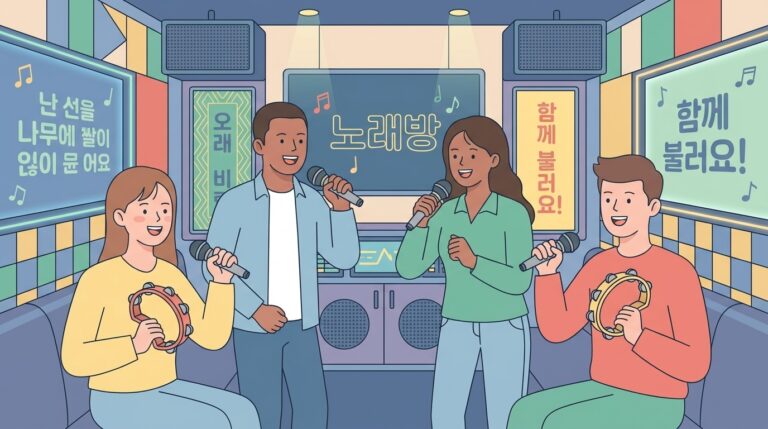
안녕하세요! 매일한글 에디터입니다. Have you ever stepped into a glowing Korean karaoke room (노래방) with a group of local friends, held the huge remote control, and completely frozen? The screen flashes with top 100 popular charts, your friends are passionately singing high-pitched K-Pop anthems or tear-jerking ballads, and suddenly the remote gets passed to you with an encouraging eyes: “What’s your go-to song?” You scroll endlessly through foreign song codes while the timer ticks away. Choosing a song off the popular chart (인기 차트) or having a ready-to-go signature song (애창곡) is more than just entertainment in Korea—it’s a social bonding ritual. Don’t worry! Based on real feedback from hundreds of intermediate learners, I’ve crafted this guide so you can effortlessly navigate popular charts, pick the perfect track, and become the star of any Noraebang night.
1. 애창곡 (Aechang-gok)
- Pronunciation: [Ae-chang-gok] (Sounds like “ae-ch” from aerodynamic + “ang” + “gok” like gawk)
- Meaning: Literally “dearly sung song,” meaning your personal go-to karaoke track or signature song.
- K-Culture Moment: In modern K-Dramas, whenever co-workers gather after work for a team dinner (회식), everyone eventually reveals their secret ‘애창곡’ to hype up the room.
- Editor’s Insight: While “favorite song” is ‘좋아하는 노래’, ‘애창곡’ specifically implies a song you frequently perform and nail at karaoke. Having at least one Korean ‘애창곡’ is the ultimate shortcut to impress locals!
- Situation Spectrum: Casual ✅ | Semi-formal ✅ | Formal ✅
- 🤔 Think About It: Why do you think Korean culture values having a designated karaoke song for social gatherings compared to Western solo performance cultures?
2. 차트 싹쓸이하다 (Chateu ssak-sseuri-hada)
- Pronunciation: [Cha-teu ssak-sseu-ri-ha-da] (“Ssak” sounds like a sudden sweeping swoosh sound)
- Meaning: Literally “to sweep the chart clean,” meaning to dominate the music charts or pick songs that dominate the top slots.
- K-Culture Moment: When a legendary idol group releases a comeback album and occupies positions 1 through 10 on MelOn or TJ Karaoke charts, Koreans say they ‘차트를 싹쓸이했다’.
- Editor’s Insight: ‘싹쓸이’ combines ‘싹’ (completely/cleanly) and ‘쓸다’ (to sweep). At Noraebang, picking songs that swept the charts guarantees everyone will sing along with you.
- Situation Spectrum: Casual ✅ | Semi-formal ✅ | Formal ⚠️
- 🤔 Think About It: How does chart-sweeping reflect the high-energy collective trend culture (대세) in Korea?
3. 분위기 띄우다 (Bun-wi-gi tti-u-da)
- Pronunciation: [Bun-wi-gi tti-u-da] (“Tti-u-da” sounds like floating a balloon upward into the air)
- Meaning: To lift the atmosphere; to pump up the crowd.
- K-Culture Moment: On variety shows like Running Man, cast members who pick upbeat dance tracks from the 90s or modern K-pop to energize the room are praised for ‘분위기 잘 띄운다’.
- Editor’s Insight: If you start a karaoke session with a slow ballad when everyone wants to dance, you might kill the mood (분위기 깨다). Knowing when to ‘분위기 띄우다’ shows high emotional intelligence (눈치).
- Situation Spectrum: Casual ✅ | Semi-formal ✅ | Formal ✅
- 🤔 Think About It: Is lifting the group’s collective energy considered an individual responsibility during social outings in your home country?
📖 교과서 한국어 vs 🗣️ 진짜 한국어
Situation 1: Asking someone about their signature karaoke song
* 📖 교과서 한국어: “당신이 노래방에서 가장 좋아하는 노래는 무엇입니까?”
* 🗣️ 진짜 한국어: “노래방 가면 보통 무슨 노래 불러요? 애창곡 있어요?”
* 💡 왜 다를까? Textbook phrases sound like an official interview! Native speakers naturally ask what you usually sing (보통 무슨 노래 불러요?) or ask directly for your signature song (애창곡).
Situation 2: Suggesting to pick a popular chart song to pump up the room
* 📖 교과서 한국어: “인기 차트에 있는 노래를 선택해서 분위기를 좋게 만듭시다.”
* 🗣️ 진짜 한국어: “우리 분위기 띄우게 인기 차트에서 하나 골라볼까?”
* 💡 왜 다를까? Korean adults use casual ending nuances like ‘~볼까?’ to suggest fun activities together, emphasizing shared bonding rather than making formal proposals.
4-1. 눈치 (Nunchi) & Gestures in Noraebang
- Tambourine Mastery: When someone else is singing, rhythmically shaking or hitting the tambourine to their beat shows high Nunchi. Don’t look at your phone!
- Passing the Remote: Gently holding the big remote with two hands when passing it to a friend shows respect and warm courtesy.
- Echoing the Chorus (떼창): Joining in loudly during the chorus, while keeping quiet during the verses, strikes the perfect balance of enthusiasm.
4-2. K-Culture Deep Dive: Chart Dynamics
In Korea, two major companies dominate Noraebang machines: TJ Media and Geumyoung (KY). Their monthly top 100 charts reflect real-time cultural trends. Interestingly, emotional ballads often dominate nighttime Noraebang charts, while high-tempo dance tracks dominate early-evening gatherings. Choosing a song from the ‘실시간 인기 차트’ (real-time top charts) ensures that even if you don’t speak perfect Korean, everyone present knows the words and will sing with you!
캐릭터: Min-jun (Local Korean Friend) & You
Setting: A lively Noraebang in Hongdae after dinner.
- Min-jun: 🎭 (Grabs the remote and smiles warmly) “OO 씨, 다음 순서인데 혹시 생각해 둔 노래 있어요?”
- You: 🎭 (Points at the screen curiously) “아직 못 정했어요. 요즘 인기 차트에 무슨 노래 있어요?”
- Min-jun: 🎭 (Navigates the remote expertly) “요즘 이 댄스곡이 차트 싹쓸이 중이에요! 이거 같이 부를래요?”
- You: 🎭 (Laughs with excitement) “좋아요! 분위기 띄우기에는 신나는 댄스곡이 최고죠.”
- Min-jun: 🎭 (Hands over the second microphone) “맞아요! 혹시 한국 노래중에 따로 애창곡도 있어요?”
- You: 🎭 (Nods proudly) “그럼요, 발라드 중에 하나 연습해 온 거 있어요!”
- Min-jun: 🎭 (Eyes widen with expectation) “와, 대박! 그럼 댄스곡 부르고 바로 예약해 둘게요.”
- You: 🎭 (Grips microphone with confidence) “네, 기대해 주세요! 오늘 끝까지 신나게 달려봐요!”
🔀 인터랙티브 분기점: Min-jun offers to reserve your song right now. How do you respond?
- Choice A: “네! 지금 바로 ‘예약’ 버튼 눌러주세요.” (Yes! Please press the ‘Reserve’ button right now.)
- Choice B: “아니요, 지금 당장 ‘시작’ 버튼 누르고 바로 부를게요!” (No, press ‘Start’ right now and I’ll sing immediately!) interrupt the current song.
- Choice C: “노래 부르기 싫으니까 그냥 취소해 주세요.” (I don’t want to sing, so just cancel it.)
Feedback:
* Choice A (BEST): Perfect! Reserving (예약) queues your song smoothly without cutting off the current background mood.
* Choice B (RISK): Caution! Pressing ‘Start’ (시작) instantly cuts off whatever track is currently playing or ending. Always use ‘예약’!
* Choice C (BAD): Killing the mood abruptly lowers the group energy after everyone got hyped up.
Repeat these sentences aloud with exact emotional rhythm! (/ indicates micro-pauses)
[😊 기쁘고 신나게]“요즘 / 인기 차트 1위 곡이 / 뭔지 볼까요?”
(Yo-jeum / in-gi cha-teu il-wi gog-i / mwon-ji bol-kka-yo?)[🔥 의욕 넘치게]“오늘 / 제 애창곡으로 / 분위기 확실히 띄워볼게요!”
*(O-neul / je ae-chang-gog-eu-ro / bun-wi-gi hwak-sil-hi tti-wo-bol-ge-yo!)[🥺 아쉽고 애교 섞어서]“벌써 / 마지막 곡이에요? / 1분만 시간 연장해 주세요!”
(Beol-sseo / ma-ji-mak gog-i-e-yo? / il-bun-man si-gan yeon-jang-hae ju-se-yo!)
- 애창곡 (Ae-chang-gok) | Signature Karaoke Song | A song you know intimately and perform with confidence during social karaoke nights.
- 인기 차트 (In-gi Cha-teu) | Popularity Chart | The top-ranked song list built into karaoke machines updating monthly.
- 예약 (Ye-yak) | Reservation / Queueing | Pressing the yellow button on the remote to add your song to the upcoming playlist queue.
- 우선 예약 (U-seon Ye-yak) | Priority Reservation | Pushing your queued song to play immediately after the current song finishes.
Survival Expressions TOP 3
- “이 노래 예약해 주세요.” (Ee no-rae ye-yak-hae ju-se-yo.) = Please queue this song.
- Pro Tip: Use this when handing the remote code to the person sitting closest to the screen.
- “템포/키 좀 낮춰 주세요.” (Tem-po/Key jom nat-chwo ju-se-yo.) = Please lower the tempo/pitch.
- Pro Tip: Essential if the song pitch is too high for your comfortable singing range!
- “서비스 시간 더 주셨어요!” (Seo-bi-seu si-gan deo ju-syeot-seo-yo!) = They gave us free bonus time!
- Pro Tip: Korean Noraebang owners often gift 10-30 extra free minutes near the end of your paid session.
Editor’s Travel Note
When traveling in Seoul, finding the best venue is easy if you use local navigation tools. Check out 네이버 지도 앱 다운로드 및 활용법 to search for nearby ‘Coin Noraebang’ (코인노래방) where you can pay per song (usually 1,000 KRW for 3 songs) to practice your signature song solo before heading out with friends!
In many Western cultures, karaoke is framed as a performance art where individual talent takes center stage. However, in Korea, Noraebang is a deeply relational space where harmony overrides perfection. Sing off-key? Nobody cares as long as you’re engaged! Choosing a popular chart song or bringing out your personal signature song is an invitation for others to cheer, shake tambourines, and share emotional resonance. It is collective stress relief wrapped in melody.
💬 Your Turn: What is your ultimate Korean signature song (애창곡) or K-Pop track you dream of singing at a Seoul Noraebang? Tell me in the comments below!
Q: What if I don’t know any Korean songs at all?
A: No problem at all! Korean karaoke machines feature extensive English, Japanese, Chinese, and Spanish song catalogs. Simply toggle the language button on the remote. However, picking just one famous chorus line of a Korean song (like BTS or BLACKPINK) will make your local friends wild with excitement!
Q: What is the difference between regular Noraebang and Coin Noraebang?
A: Regular Noraebangs charge per hour (approx. 20,000–30,000 KRW) and are meant for larger groups with snack/drink services. Coin Noraebangs (코인노래방) allow you to pay per song via cash or card, making them ideal for solo practice or quick 15-minute visits.
Q: Can I press the ‘시작’ (Start) button while someone is talking?
A: It’s best to wait until everyone is ready. Pressing ‘시작’ immediately triggers loud speakers and lights, so double-check if the room is prepped before blasting the music!
🚨 Common Mistakes & Fixes
- ❌ Pressing ‘시작’ instead of ‘예약’ while a song is playing.
- 👉 Correct Action: ALWAYS hit the green/yellow 예약 (Reserve) button to avoid accidentally stopping your friend’s current track mid-chorus!
- ❌ Monopolizing the remote control and queuing 5 songs in a row.
- 👉 Correct Action: Queue 1 song at a time and pass the remote around to respect everyone’s turn.
- ❌ Singing silently into the microphone without energy.
- 👉 Correct Action: Pitch accuracy doesn’t matter! Express enthusiasm and feel free to use tambourines.
- Bronze Mission: Look up the current TJ Karaoke Top 10 chart online and pick 1 song you recognize.
- Silver Mission: Practice singing 1 chorus of your chosen Korean ‘애창곡’ using our Shadowing Drill audio cadence.
- Gold Mission: Visit a local Korean coin karaoke or Korean gathering and successfully press ‘예약’ to sing your track!
🎮 K-Culture Mission: Watch a clip from your favorite Korean variety show (e.g., I Live Alone or Running Man) and spot the exact moment someone mentions their ‘애창곡’ or shakes a tambourine!
1. Situation Judgment
Q: You are at a Noraebang with Korean co-workers. Your friend is currently singing passionately. What should you DO?
* A) Look down at your smartphone silently.
* B) Shake the tambourine to the beat and react to their song.
* C) Press the ‘취소’ (Cancel) button because you want to sing next.
🔍 See Answer & Explanation
Correct Answer: B
Explanation: Showing active enthusiasm with tambourines and applause demonstrates great social awareness (Nunchi) and builds group rapport!
2. Fill-in-the-blank
Q: Complete the phrase: “노래방에서 분위기 ________ 신나는 댄스곡을 올렸어요.” (I picked an exciting dance song to pump up the atmosphere.)
* A) 띄우게
* B) 버리게
* C) 닫게
🔍 See Answer & Explanation
Correct Answer: A
Explanation: ‘분위기 띄우다’ is the set phrase meaning to lift or pump up the atmosphere.
3. True / False Cultural Quiz
Q: In Korea, pressing ‘우선 예약’ (Priority Reservation) overrides the existing queue to put your song next.
* [ True / False ]
🔍 See Answer & Explanation
Correct Answer: True
Explanation: ‘우선 예약’ jumps your song to the very front of the queued line. Use it sparingly when time is running short!







