

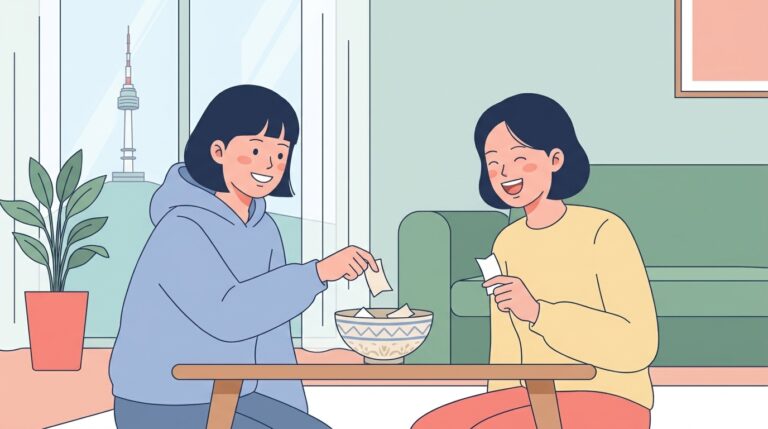
안녕하세요! I’m your lead editor at Daily Hangul! Have you ever lived with roommates or spent time at a shared guesthouse in Korea? If so, you already know the universal truth: nobody eagerly volunteers to scrub the bathroom. Picture this: it’s Sunday evening in a cozy Seoul apartment. Water stains are building up on the tiles, the mirror is foggy, and everyone is suddenly staring intensely at their phones, pretending to be deeply occupied. Who is going to take the bullet and clean the bathroom this week? Negotiation in Korean requires tact, humor, and just the right touch of persuasion! Based on feedback from hundreds of intermediate Korean learners living in Korea, mastering these chore negotiations is a huge milestone. Today, we’re going to equip you with smooth, natural B1-level expressions to decide who gets bathroom duty without breaking a sweat or ruining roommate harmony.
1. 제비뽑기로 정하자 (Jebi-ppob-gi-ro jeong-ha-ja)
- Pronunciation: [Je-bi-ppob-gi-ro jeong-ha-ja] (Sounds like: “Jae-bee ppob-gee-roh jung-hah-jah”)
- Meaning: Literal: “Let’s decide by drawing lots.” / Real Nuance: “Let’s draw straws to keep things fair and avoid arguing.”
- K-Culture Moment: Seen in iconic K-variety shows like 2 Days & 1 Night (1박 2일) whenever members want to avoid a punishment task like dishes or outdoor sleeping.
- Editor’s Insight: ‘제비뽑기’ comes from ancient traditions of picking folded paper slips. Saying this shows you want a zero-bias, completely neutral resolution.
- Situation Spectrum: Casual ✅ | Semi-formal ⚠️ | Formal 🚫
- 🤔 Think About It: How do people in your country randomly pick someone for unpleasant tasks? Is drawing straws as common as rock-paper-scissors?
2. 이번에는 네 차례잖아 (I-beon-e-neun ne cha-rye-jan-ah)
- Pronunciation: [I-beon-e-neun ne cha-rye-jan-ah] (Sounds like: “Ee-beon-eh-neun ney chah-ryeh-jahn-ah”)
- Meaning: Literal: “This time is your turn, isn’t it?” / Real Nuance: “Hey, I did it last time, so it’s definitely your turn now!”
- K-Culture Moment: A staple phrase in Korean slice-of-life K-Dramas when housemates sit around the living room table arguing over chores.
- Editor’s Insight: The ending ‘-잖아’ adds a subtle ‘as you already know’ nuance. Use a playful tone so it doesn’t sound overly aggressive!
- Situation Spectrum: Casual ✅ | Semi-formal ⚠️ | Formal 🚫
- 🤔 Think About It: Notice how Korean uses ‘-잖아’ to appeal to shared awareness. Does your native language have a similar grammatical tag?
3. 양보할 테니까 다음엔 네가 해 (Yang-bo-hal te-ni-kka da-eum-en ne-ga hae)
- Pronunciation: [Yang-bo-hal te-ni-kka da-eum-en ne-ga hae] (Sounds like: “Yahng-boh-hal teh-nee-kkah dah-eum-en neh-gah hae”)
- Meaning: Literal: “I will yield, so you do it next time.” / Real Nuance: “I’ll take the bullet today, but you owe me big time next round.”
- K-Culture Moment: Common in office roommate setups or K-drama flatmates negotiating weekend responsibilities.
- Editor’s Insight: ‘양보’ means concession or compromise. This phrase displays maturity and strengthens group bonds by creating mutual obligation.
- Situation Spectrum: Casual ✅ | Semi-formal ✅ | Formal ⚠️
- 🤔 Think About It: Korean social dynamics emphasize reciprocity (Gibeu-en-teikeu). How does making trade-offs work in your culture?
📖 교과서 한국어 vs 🗣️ 진짜 한국어
Situation 1: Suggesting rock-paper-scissors to pick a cleaner
* 📖 교과서 한국어: 가위바위보를 해서 화장실 청소부를 결정합시다.
* 🗣️ 진짜 한국어: 깔끔하게 가위바위보로 정하자!
* 💡 왜 다를까? Textbook Korean sounds like a official corporate memo. Real Koreans use ‘깔끔하게’ (cleanly/fairly) to suggest a quick, clean-cut decision everyone accepts.
Situation 2: Asking someone to trade chores
* 📖 교과서 한국어: 제가 화장실을 청소할 테니 당신은 설거지를 하십시오.
* 🗣️ 진짜 한국어: 내가 화장실 청소할 테니까, 네가 설거지 담당해 줘!
* 💡 왜 다를까? Koreans naturally split chores into ‘담당’ (duty/charge). Using ‘해 줘’ makes it a warm request rather than a cold command.
4-1. 눈치 (Nunchi) & Non-Verbal Manners
When negotiating chores, eye contact and micro-expressions are everything. If a roommate lets out a soft sigh while looking at the dirty tile floor, that’s your cue that their Nunchi radar is active. Avoid grinning too widely when you win a game of rock-paper-scissors; instead, offer a mild ‘sorry’ gesture (one hand slightly raised, tilt head 15 degrees) to maintain cozy home vibes.
4-2. K-Culture Deep Dive: The Shared Chore Board
In Korean co-living spaces and university dorms, you will often find a ‘청소 당번표’ (Cleaning Duty Board) attached to the fridge with cute Kakao Friends magnets. Shared spaces rely on community accountability. Negotiating isn’t about avoiding work forever; it’s about making sure duty rotation feels fair and transparent to everyone living under one roof.
Background & Characters
- Setting: Sunday afternoon living room in a shared apartment in Hongdae, Seoul.
- Min-jun (민준): Your warm but practical Korean roommate who wants a clean bathroom before the week starts.
- You (학습자): Trying to negotiate fairly while keeping your weekend lazy energy intact.
Dialogue
- Min-jun: 야, 오늘 화장실 청소 누구 담당이지? (Ya, o-neul hwa-jang-sil cheong-so nu-gu dam-dang-i-ji?) (🎭 Scratching head while looking towards the bathroom)
- “Hey, whose turn is it to clean the bathroom today?”
- You: 글쎄, 지난주에 내가 한 것 같은데? (Geul-sseh, ji-nan-ju-e nae-ga han geot gae-teun-de?) (🎭 Tilting head thoughtfully)
- “Hmm, I think I did it last week?”
- Min-jun: 아니야, 지난주엔 내가 했어! 순서대로면 이번엔 네 차례잖아. (A-ni-ya, ji-nan-ju-en nae-ga haess-eo! Sun-seo-dae-ro-myeon i-beon-en ne cha-rye-jan-ah.) (🎭 Pointing at the chore schedule on fridge)
- “No way, I did it last week! If we follow the order, it’s your turn this time.”
- You: 아, 진짜? 기억이 잘 안 나네. (A, jin-jja? Gi-eok-i jal an na-ne.) (🎭 Laughing sheepishly)
- “Ah, really? I don’t remember clearly.”
- Min-jun: 그럼 애매하니까 깔끔하게 제비뽑기로 정하자. (Geu-reom ae-mae-ha-ni-kka kkal-kkeum-ha-ge je-bi-ppob-gi-ro jeong-ha-ja.) (🎭 Reaching for small slips of paper)
- “Then since it’s vague, let’s settle it cleanly by drawing lots.”
- You: 좋아! 지는 사람이 화장실 청소하기다. (Jo-ah! Ji-neun sa-ram-i hwa-jang-sil cheong-so-ha-gi-da.) (🎭 Nodding enthusiastically)
- “Deal! The loser cleans the bathroom.”
- Min-jun: 짜잔, 내가 뽑은 건 ‘pass’! 네가 당첨이다! (Jja-jan, nae-ga ppob-eun geon ‘pass’! Ne-ga dang-cheom-i-da!) (🎭 Showing paper with a triumphant grin)
- “Ta-da! Mine says ‘pass’! You’re the lucky winner!”
- You: 으아, 어쩔 수 없지. 내가 할 테니까 다음엔 네가 양보해! (Eu-a, eo-jjeol su eob-ji. Nae-ga hal te-ni-kka da-eum-en ne-ga yang-bo-hae!) (🎭 Sighing with a playful smile)
- “Ugh, can’t be helped. I’ll do it, but you yield to me next time!”
🔀 Interactive Branching Choice
When Min-jun says he cleaned last week, how do you respond?
* Option A: “아닌데? 너 전달에도 안 했잖아!” (No way, you didn’t do it two months ago either!)
* Option B: “그래? 그럼 이번엔 내가 할게! 대신 다음엔 네 차례야.” (Really? Then I’ll do it this time! But it’s your turn next.)
* Option C: “몰라, 나 바빠서 못 해.” (I don’t know, I’m too busy so I can’t.)
Feedback:
* Option A (Risk): Brings up past grudges and ruins roommate harmony. High chance of cold war!
* Option B (Best): Cool, cooperative, and sets a clear boundary for the future. Perfect B1 tone!
* Option C (Bad): Sounds irresponsible and cold. Avoid this unless you want to clean everything yourself later!
Shadow these sentences out loud to get the exact emotional cadence right!
[🥺 playful complaint]지난주에 / 내가 / 한 것 같은데…? (Ji-nan-ju-e / nae-ga / han geot gae-teun-de…?)[😎 confident suggestion]깔끔하게 / 제비뽑기로 / 정하자! (Kkal-kkeum-ha-ge / je-bi-ppob-gi-ro / jeong-ha-ja!)[😏 playful bargaining]내가 / 할 테니까 / 다음엔 / 네가 양보해! (Nae-ga / hal te-ni-kka / da-eum-en / ne-ga yang-bo-hae!)
- 당번 (Dang-beon) | Duty / Person on duty | Used for turns in household chores, office duty, or classroom tasks.
- 청소 도구 (Cheong-so do-gu) | Cleaning tools | Refers to sponges, plungers, floor brushes, and detergents.
- 분리수거 (Bun-ri-su-geo) | Recycling separation | Korea’s strict waste sorting system, often paired with household chore rotations.
- 공동생활 (Gong-dong-saeng-hwal) | Communal living | The social concept of co-existing respectfully in shared residential spaces.
Survival Expressions TOP 3
- 화장실 세제 어디 있어요? (Hwa-jang-sil se-je eo-di iss-eo-yo?) – Where is the bathroom detergent?
- Pro Tip: Useful at Airbnb stay places when you need to tidy up.
- 가위바위보 하실래요? (Ga-wi-ba-wi-bo ha-sil-lae-yo?) – Would you like to play rock-paper-scissors?
- Pro Tip: Great lighthearted icebreaker when splitting small tasks during trips with Korean friends.
- 제가 먼저 할게요. (Je-ga meon-jeo hal-ge-yo.) – I will go first.
- Pro Tip: Polite way to volunteer for taking a shower or starting chores.
Editor’s Travel Note
When staying long-term or living in Korea, finding home supplies or chore items is super easy. Use the 네이버 지도 앱 다운로드 to locate your nearest Daiso (다이소) or local supermart for affordable bathroom cleaning tools!
In Korean culture, handling house chores isn’t just about labor; it reflects Jeong (정) and mutual respect. Korean culture values harmony in shared living spaces, where taking initiative to clean without making a scene builds immense social credit.
💬 Your Turn: How do you and your flatmates handle chore assignments in your country? Leave a comment below using the phrase “제비뽑기로 정하자”!
Q: What if my roommate refuses to clean after losing rock-paper-scissors?
A: In Korea, a game outcome is considered a informal binding agreement (‘약속’). You can playfully say, “약속은 약속이지!” (A promise is a promise!) with a smile.
Q: Is ‘네 차례잖아’ too rude to say to older housemates?
A: Yes! If your roommate is older (Eonni/Noona/Oppa/Hyung), switch to semi-formal: “이번엔 누나/형 차례잖아요~” with a polite tone.
Q: What is the most important bathroom chore etiquette in Korea?
A: Wet-style bathrooms are common in Korea! Always rinse down foam completely and ensure the drainage hole (하수구) is cleared of hair.
🚨 Common Mistakes Warning Panel
- ❌ Mistake: Saying “너 화장실 청소해” (You clean bathroom) to a roommate.
- ✅ Correct Action: Use “화장실 청소 같이 정할까?” (Shall we decide bathroom cleaning together?) to avoid sounding bossy.
- ❌ Mistake: Confusing ‘당번’ (duty person) with ‘아르바이트’ (part-time job).
- ✅ Correct Action: Use ‘당번’ when talking about routine household duties.
- ❌ Mistake: Forgetting to sound playful when using ‘-잖아’.
- ✅ Correct Action: Keep your intonation rising at the end so it doesn’t sound like an accusation.
- Bronze Mission (Self Practice): Say “제비뽑기로 정하자!” aloud 3 times in front of your mirror with a cheerful expression.
- Silver Mission (SNS Share): Post a photo of your clean room/bathroom on Instagram with the hashtag
#DailyHangulChoreMaster! - Gold Mission (Real Life): Use “내가 할 테니까 다음엔 네가 양보해” in your next conversation with a Korean friend or roommate!
🎮 K-Culture Mission: Watch a Korean reality show (like Share House or I Live Alone) and spot at least one moment where roommates play rock-paper-scissors (가위바위보) for chores!
Q1. Fill in the blank: “약속대로 깔끔하게 ____로 정하자!”
1) 분리수거
2) 제비뽑기
3) 아르바이트
Q2. True or False: In Korea, it is polite to tell an older roommate “네 차례잖아!” without honorifics.
(True / False)
🔍 Click here for Answers & Explanations
- Q1 Answer: 2) 제비뽑기 (Let me settle it cleanly by drawing lots!)
- Q2 Answer: False! With older roommates, always use honorifics like “차례잖아요”.







