

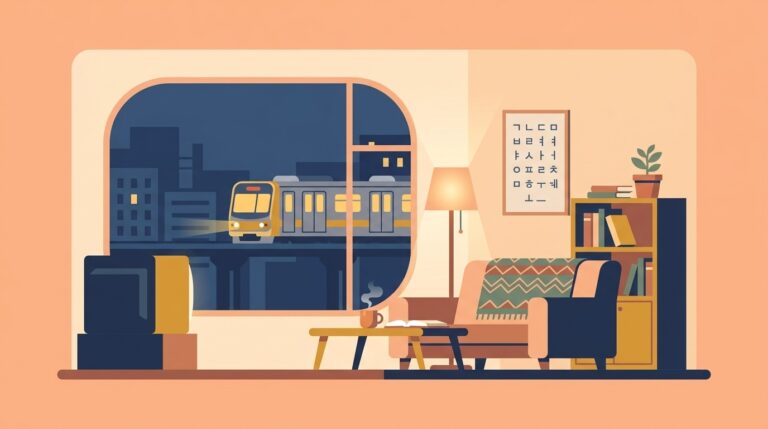
How to Politely Say Goodbye in Korean Before You Miss the Last Train
안녕하세요! Editor Min here from Daily Hangul! Imagine this: You are having an absolute blast at your Korean friend’s apartment. The home-cooked tteokbokki was incredible, the K-pop playlist is on point, and the conversation is flowing smoothly. But suddenly, you glance at your phone and panic sets in—it’s 11:15 PM! In Korea, public transportation is super reliable, but when makcha (the last train) is gone, you are left with either a long taxi line or an accidental sleepover.
Many intermediate Korean learners hit a wall here. You want to be polite, show gratitude for the hospitality, but also make a swift exit without ruining the warm mood. Expressing urgency while keeping Korean politeness intact can feel tricky! Don’t worry—this guide is based on real feedback from international students and expats in Seoul who faced this exact dilemma. Today, you’ll master practical, natural phrases so you can head out gracefully while keeping your friendships tight!
Phase 2: Core Expressions Deep Dive
1. 막차 끊기기 전에 가야 해요
- Pronunciation: [Mak-cha kkeun-ki-gi jeon-e ga-ya hae-yo] (Sounds like ‘Mak-cha kun-ki-gi’—think of ‘mak’ like ‘mock’ and ‘cha’ like ‘charcoal’)
- Meaning: “I should get going before the last train stops running.” (Literally: Before the last train gets cut off, I must go.)
- K-Culture Moment: Seen in almost every modern Korean drama when characters are hanging out at a neighborhood bar or a friend’s studio apartment.
- Editor’s Insight: Using the verb 끊기다 (to be cut off) adds an authentic touch. It shows that your departure is caused by an external deadline (makcha), so your host won’t take your leave personally!
- Situation Spectrum: Casual: ✅ | Semi-formal: ✅ | Formal: ⚠️
- 🤔 Think About It: In your home culture, do you usually blame public transit or just say you’re tired when leaving a party early?
2. 벌써 시간이 이렇게 됐네요!
- Pronunciation: [Beol-sseo si-gan-i i-reok-ke dwaen-nae-yo]
- Meaning: “I can’t believe it’s already this late!” (Literally: Time has already become like this!)
- K-Culture Moment: The classic verbal bridge used in Korean social settings right before standing up to pack your bag.
- Editor’s Insight: This phrase subtly signals your intention to leave without making a abrupt announcement. It implies, “Time flies when I’m having fun with you!”
- Situation Spectrum: Casual: ✅ | Semi-formal: ✅ | Formal: ✅
- 🤔 Think About It: How does softening your intention to leave change the emotional atmosphere of a gathering?
3. 아쉽지만 오늘은 이만 들어갈게요
- Pronunciation: [A-swip-ji-man on-ul-eun i-man deul-eo-gal-ge-yo]
- Meaning: “It’s a pity, but I should head home for today.” (Literally: It’s regrettable, but today I’ll go in up to this point.)
- K-Culture Moment: Used when leaving a cozy dinner party where everyone wants you to stay for one more round.
- Editor’s Insight: The word 아쉽다 expresses warmth and fondness. Combining it with 들어가다 (to go in/head home) creates the perfect polite exit.
- Situation Spectrum: Casual: ⚠️ | Semi-formal: ✅ | Formal: ✅
- 🤔 Think About It: Why is acknowledging sadness or reluctance (아쉽다) such an important part of Korean social etiquette?
Phase 3: Textbook Korean vs. Real Korean
Situation 1: Saying you must go home now
- 📖 Textbook Korean: 저는 지금 집에 가야 합니다. (Jeo-neun ji-geum jib-e ga-ya hab-ni-da.)
- 🗣️ Real Korean: 저 이제 슬슬 가봐야 할 것 같아요. (Jeo i-je seul-seul ga-bwa-ya hal geot gat-a-yo.)
- 💡 Why the difference? Directly stating “I must go home” sounds overly blunt in Korean. Adding 슬슬 (gently/slowly) and ~할 것 같아요 (it seems like I should) softens the statement, making it sound very natural and polite.
Situation 2: Mentioning the subway schedule
- 📖 Textbook Korean: 지하철 마지막 기차 시간이 되었습니다. (Ji-ha-cheol ma-ji-mak gi-cha si-gan-i doe-eoss-seub-ni-da.)
- 🗣️ Real Korean: 막차 시간 다 됐어요! (Mak-cha si-gan da dwaess-eo-yo!)
- 💡 Why the difference? Koreans rarely say “마지막 기차” for urban subways; they almost exclusively use the compound word 막차 (last train/bus) in everyday spoken Korean.
Phase 4: K-Culture Deep Dive & Non-Verbal Manners
4-1. Nunchi (눈치) & Gestures
When it’s time to head out, non-verbal cues are just as important as your words:
* The Subtle Watch Check: Gently pat your pockets or check your smartphone screen while sighing softly (“벌써 시간이…”).
* The Two-Handed Gratitude Bow: As you stand up, bow slightly while holding both hands in front of you to thank your host for the meal or hospitality.
* Tidying Up Your Space: Gathering your glass or plate and bringing it to the kitchen counter before putting on your coat shows immense respect.
4-2. Culture Code: The Legend of “Makcha”
In Korean urban life, Makcha (막차) isn’t just a transport schedule—it’s a cultural boundary line! Around 11:30 PM to midnight, subway stations transform as people run in suits and heels to catch the final train. If you miss it, you enter Noraebang (karaoke) territory or face pricey late-night taxi surcharges. Korean hosts completely understand the urgency of Makcha, so invoking it is your ultimate polite escape card!
Phase 5: Real-Life Roleplay Scenario
Setting: Minjun’s apartment near Hongdae. It is 11:20 PM.
Characters: Minjun (Host, cheerful Korean friend) & You (Guest)
- Minjun: 과자 좀 더 줄까? 맥주 한 캔 더 마시자!
(Gwa-ja jom deo jul-kka? Maek-ju han kaen deo ma-si-ja!)
“Should I get more snacks? Let’s drink one more can of beer!”
🎭 Action: Opens the fridge enthusiastically. -
You: 아, 너무 좋은데요… 잠깐만요, 지금 몇 시죠?
(A, neo-mu jo-eun-de-yo… jam-kkan-man-yo, ji-geum myeot si-jo?)
“Ah, I’d love to… wait a second, what time is it now?”
🎭 Action: Checks phone clock with wide eyes. -
Minjun: 지금 11시 20분! 왜, 시간 벌써 이렇게 됐어?
(Ji-geum sib-il-si i-sip-bun! Wae, si-gan beolsseo i-reok-ke dwaess-eo?)
“It’s 11:20! Why, did time fly that fast?” -
You: 와, 벌써 시간이 이렇게 됐네요! 저 막차 끊기기 전에 가야 해요.
(Wa, beolsseo si-gan-i i-reok-ke dwaen-nae-yo! Jeo mak-cha kkeun-ki-gi jeon-e ga-ya hae-yo.)
“Wow, I can’t believe it’s already this late! I need to go before the last train stops.”
🎭 Action: Begins gathering coat and backpack gently. -
Minjun: 벌써? 지하철 아직 다니지 않아?
(Beolsseo? Ji-ha-cheol a-jik da-ni-ji a-na?)
“Already? Isn’t the subway still running?” -
You: 제 방향 막차가 11시 40분에 끊겨요. 아쉽지만 오늘은 이만 들어갈게요!
(Je bang-hyang mak-cha-ga sib-il-si sa-sip-bun-e kkeun-kyeo-yo. A-swip-ji-man oneur-eun i-man deul-eo-gal-ge-yo.)
“The last train going my way leaves at 11:40. It’s a pity, but I should head out for today!”
🎭 Action: Stands up and bows politely with a warm smile. -
Minjun: 아쉽다! 오늘 진짜 재미있었어. 조심히 가!
(A-swip-da! O-neul jin-jja jae-mi-is-seoss-eo. Jo-sim-hi ga!)
“Ah, what a pity! I had so much fun today. Get home safely!” -
You: 오늘 초대해 줘서 정말 고마워요. 다음에 또 봐요!
(O-neul cho-dae-hae jwo-seo jeong-mal go-ma-weo-yo. Da-eum-e tto bwa-yo!)
“Thank you so much for inviting me today. See you next time!”
🔀 Interactive Choice Point
Minjun says: “택시 타고 가! 더 놀다 가라~” (“Take a taxi! Stay longer~”) How do you respond?
* Option A: “싫어요. 택시비 아까워요.” (I don’t want to. Taxis are a waste of money.)
* Option B: “마음은 더 있고 싶은데, 내일 일찍 일정이 있어서요! 다음에 또 불러주세요.” (I’d love to stay longer, but I have an early schedule tomorrow! Please invite me again next time.)
* Option C: “안돼요! 가야 해요!” (No way! I must go!)
👉 Click to see Feedback on your choice!
- Best Choice – Option B: Perfect! You validate the host’s hospitality while giving a clear, reasonable excuse that preserves warm feelings.
- Bad Choice – Option A: Too blunt! Mentioning money directly can sound overly cold and dismissive of their invitation.
- Risk Choice – Option C: A bit harsh! Raising your voice or using abrupt refusal words can startle your host.
Phase 6: 10-Second Emotional Shadowing Drill
Practice these lines with realistic facial expressions and tone breaks (/ marks pauses):
[😲 Realization & Soft Urgency]
벌써 / 시간이 이렇게 됐네요! / 저 막차 끊기기 전에 / 가야 해요.
(Beolsseo / si-gan-i i-reok-ke dwaen-nae-yo! / Jeo mak-cha kkeun-ki-gi jeon-e / ga-ya hae-yo.)-
[🥺 Regretful & Warm]
아쉽지만 / 오늘은 / 이만 들어갈게요.
(A-swip-ji-man / o-neul-eun / i-man deul-eo-gal-ge-yo.) -
[😊 Grateful & Happy]
오늘 초대해 줘서 / 정말 고마워요! / 조심히 들어가세요!
(O-neul cho-dae-hae jwo-seo / jeong-mal go-ma-weo-yo! / Jo-sim-hi deul-eo-ga-se-yo!)
Phase 7: K-Culture Mini Dictionary
- 막차 (Mak-cha) | Noun | The final bus or train of the night. Usage: “막차 타러 가자!” (Let’s go catch the last train!)
- 2차 (I-cha) | Noun | The second round/venue of a social gathering. Usage: “오늘 2차는 우리 집에서 하자!” (Let’s do round 2 at my house today!)
- 슬슬 (Seul-seul) | Adverb | Gently, slowly, or gradually starting an action. Usage: “슬슬 출발할까요?” (Shall we head out slowly?)
- 막차 뼈때리기 (Mak-cha ppyeot-tae-ri-gi) | Slang | Using the last train as an unassailable excuse to exit an awkward situation.
Phase 8: Traveler’s Survival Kit
Top 3 Emergency Expressions
- 막차 몇 시예요? (Mak-cha myeot si-yeo-yo?) – What time is the last train?
- 지하철역까지 걸어서 얼마나 걸려요? (Ji-ha-cheol-yeok-kka-ji geol-eo-seo ol-ma-na geol-ryeo-yo?) – How long does it take to walk to the subway station?
- 택시 잘 잡혀요? (Taek-si jal jab-hyeo-yo?) – Is it easy to catch a taxi around here?
💡 Editor’s Travel Note:
Don’t get stranded! Public transport timing in Seoul is accurate down to the minute. Always check transit schedules in real-time. Make sure to download the Naver Map app download before hanging out late in Korea, as standard global map apps often lack live Korean subway train countdowns.
Phase 9: One Step Deeper
In Korean culture, hospitality (Jeong / 정) runs deep. When a Korean friend invites you to their home, they genuinely want you to stay as long as possible. However, Korean society also places high value on mutual consideration (Baeryeo / 배려). Respecting each other’s sleep schedules and public transport realities shows that you value your friend’s well-being as much as your own fun. When you say goodbye smoothly, you lay the groundwork for your next invitation!
💬 Your Turn: Have you ever almost missed the last train in a foreign country? Share your stories in the comments below!
Phase 10: FAQ & Common Mistakes
Q: Can I use “잘 있어” when leaving my friend’s house?
A: If you are close friends of the same age, yes! But if the host is slightly older or an acquaintance, use polite language: “초대해 주셔서 감사합니다, 들어가세요!”
Q: What if my friends insist I stay overnight (자고 가!)?
A: Express gratitude first! Say: “마음은 정말 고마운데, 내일 준비할 게 있어서 다음에 자고 갈게요!” (Thank you so much, but I have things to prepare tomorrow, so I’ll stay over next time!)
Q: Is it rude to check my phone for train times during dinner?
A: Not at all! Just add a quick polite excuse: “죄송해요, 막차 시간 잠깐 확인했어요.” (Sorry, I was just checking the last train time.)
🚨 Top 3 Common Mistakes
- Saying “안녕히 계세요” to an equal-age friend at their home. (Sounds too formal/distant! Use “고마워, 나 먼저 갈게!” instead.)
- Abruptly leaving without giving a reason. (Always mention time or schedule to cushion your exit.)
- Forgetting to text your host when you arrive home. (Sending a quick text like “저 집에 잘 도착했어요!” completes good etiquette!)
Phase 11: Action Mission
- Bronze: Practice saying “벌써 시간이 이렇게 됐네요!” 3 times in front of a mirror with a shocked facial expression.
- Silver: Record your voice saying “막차 끊기기 전에 가야 해요” and listen back to match the natural speed.
- Gold: The next time you hang out with Korean friends, use “슬슬 가봐야 할 것 같아요” to initiate your departure!
🎮 K-Culture Mission: Watch a modern Korean slice-of-life drama (like Reply 1988 or Hospital Playlist) and spot a scene where characters check the time and get up to catch the makcha!
Phase 12: Interactive Quiz Challenge
Q1. Which word means ‘the last train or bus’ in Korean?
1) 첫차 (Cheot-cha)
2) 막차 (Mak-cha)
3) 기차 (Gi-cha)
Q2. Fill in the blank with the most natural expression:
“아쉽지만 오늘은 _____ 들어갈게요.”
1) 이만 (i-man)
2) 두만 (du-man)
3) 그만 (geu-man)
🔍 Click to view Quiz Answers & Explanations
- Q1 Answer: 2) 막차 (Mak-cha) (첫차 means the first train of the day!)
- Q2 Answer: 1) 이만 (i-man) (이만 들어갈게요 is the fixed natural phrase meaning “I’ll head home for now/up to this point”.)







