

How to Stay Safe and Speak Up During Natural Disasters in Korea
안녕하세요! 매일한글 에디터입니다. Welcome back to another essential lesson with your favorite Korean culture navigator!
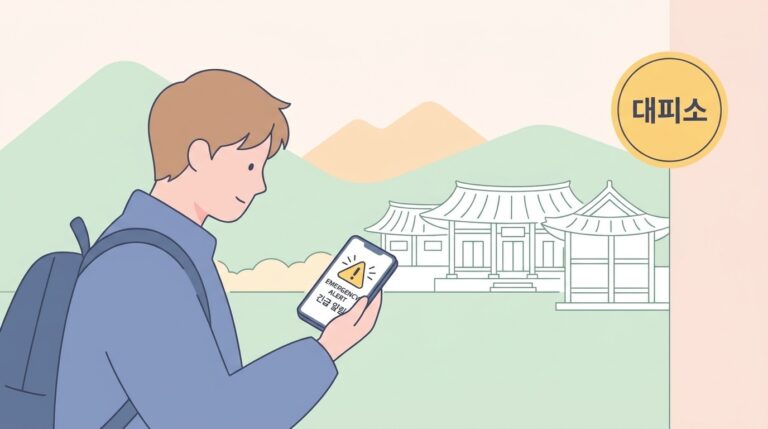
Imagine this scenario: You are cozying up in your Seoul Airbnb or studio apartment, enjoying a peaceful afternoon, when suddenly your smartphone lets out a loud, high-pitched alarm. You glance down and see a bright red popup: [행정안전부] 지진 발생 / 긴급대피 바람. Panic sets in for a second—what does it say? Where should you go? If you have ever felt your heart jump during an Emergency Disaster Alert (재난문자) in Korea, you are not alone. Many intermediate learners tell us that while they can order food or chat about K-dramas with ease, emergency situations leave them lost for words.
That is exactly why we created this practical guide. Based on real feedback from foreign residents and travelers in Korea, mastering a few core safety phrases and understanding local disaster protocols can give you ultimate peace of mind. Let’s make sure you stay safe, confident, and articulate—even in an emergency!
Phase 2: Core Expressions Deep Dive
1. 대피소가 어디에 있어요? (Daepiso-ga eodie isseoyo?)
- Pronunciation: Dae-pi-so-ga eo-di-e it-seo-yo? (Think of “Dae” like day, “pi” like pea, and “so” like soap).
- Meaning: Literal: Where is the shelter? / Nuance: “Where is the nearest designated emergency evacuation shelter?”
- K-Culture Moment: In tense disaster films like Concrete Utopia or emergency disaster relief scenes in K-dramas, characters urgently scan urban surroundings looking for subterranean safe zones marked with yellow shelter banners.
- Editor’s Insight: The word 대피소 (shelter) usually refers to underground subway stations, designated public school gymnasiums, or basement facilities capable of protecting citizens during natural disasters like typhoons or earthquakes.
- Situation Spectrum: Casual ⚠️ | Semi-formal ✅ | Formal ✅
- 🤔 Think About It: How are emergency shelters designated in your home country compared to Korea’s vast network of underground subway stations?
2. 재난문자 내용 좀 확인해 주실 수 있나요? (Jaenanmunja naeyong jom hwaginhae jusil su innayo?)
- Pronunciation: Jae-nan-mun-ja nae-yong jom hwa-gin-hae ju-sil su in-na-yo?
- Meaning: Literal: Can you check the contents of the disaster text message for me? / Nuance: A polite, natural B2-level way to ask a bilingual local or bystander to translate a high-stress alert.
- K-Culture Moment: Whenever the emergency alarm blares on a crowded subway line or inside a busy cafe in Hongdae, almost everyone checks their phones simultaneously. Showing your phone to a nearby staff member with this phrase gets you instant aid.
- Editor’s Insight: Using ~해 주실 수 있나요? strikes the perfect balance between politeness and urgency without sounding demanding.
- Situation Spectrum: Casual ⚠️ | Semi-formal ✅ | Formal ✅
- 🤔 Think About It: Why do you think South Korea relies so heavily on real-time cell broadcast disaster alerts?
3. 머리를 보호하고 진동이 멈출 때까지 기다리세요. (Meorireul bohogo jindongi meomchul ttaekkaji gidariseyo.)
- Pronunciation: Meo-ri-reul bo-ho-ha-go jin-dong-i meom-chul ttae-kka-ji gi-da-ri-se-yo.
- Meaning: Literal: Protect your head and wait until the vibration stops. / Nuance: Official guidance command used in public address systems and official drills.
- K-Culture Moment: This is the exact phrase spoken during safety broadcast drills in public institutions or shown on safety infographics during earthquake preparedness week.
- Editor’s Insight: Key vocabulary here is 진동 (shaking/vibration). Recognizing this word allows you to grasp safety announcements instantly even over loud speakers.
- Situation Spectrum: Casual 🚫 | Semi-formal ✅ | Formal ✅
- 🤔 Think About It: How do clear, calm imperative forms (-세요) help maintain public order during unexpected panics?
Phase 3: Textbook Korean vs. Real Native Korean
Situation 1: Asking if a typhoon is approaching
- 📖 Textbook Korean: 태풍이 언제 도착합니까? (Taepungi eonje dochakhamnikka?)
- 🗣️ Real Native Korean: 태풍 영향권에 언제 들어간대요? (Taepung yeonghyanggwone eonje deureogandaeyo?)
- 💡 Why the Difference?: Native speakers rarely speak of a typhoon “arriving” like a train. Instead, they refer to entering the typhoon’s radius or sphere of influence (영향권).
Situation 2: Telling someone to take shelter quickly
- 📖 Textbook Korean: 신속하게 대피하십시오. (Sinsokhage daepihasipsio.)
- 🗣️ Real Native Korean: 일단 지하철역이나 안쪽으로 들어가 있어요! (Ildan jihacheolyeogina anjjogeuro deureoga isseoyo!)
- 💡 Why the Difference?: Official announcements use formal commands, but in real life, locals offer rapid, practical directions urging you to take refuge inside robust structures like subway stations.
Phase 4: K-Culture Deep-Dive & Non-Verbal Etiquette
4-1. Nunchi (눈치) & Safety Gestures
During an earthquake shake, body language speaks louder than words. Cover your head immediately using a backpack, thick folder, or cushions while crouching down (머리 보호). If an evacuation order is given, follow the calm, organized flow of the crowd toward building exits or subway station entrances. Pushing or shouting creates panic—maintaining quiet situational awareness (눈치) keeps everyone moving smoothly.
4-2. Cultural Code: Korea’s Underground Shelter Network
South Korea possesses one of the world’s most sophisticated subterranean infrastructure systems. Because urban real estate is densely built, most subway stations, underground shopping malls, and apartment basement parking lots serve dual purposes as civil defense and natural disaster shelters. Look out for yellow-and-black signs reading 대피소 near station stairs.
Phase 5: Real-Life Roleplay Scenario
Setting: A sudden earthquake tremor shakes a cafe in Mapo-gu, Seoul.
Characters:
* Alex (Foreign Student, B2 level): Staying calm and seeking information.
* Min-ho (Cafe Barista NPC): Helpful local guide managing safety.
Dialogue:
1. Alex: 어? 방금 건물 흔들린 거 맞죠? 지진인가요?
(Eo? Banggeum geonmul heundeullin geo matjjo? Jijiningayo?)
“Huh? The building just shook, right? Is it an earthquake?”
🎭 Looking up at hanging lamps nervously
- Min-ho: 네, 맞아요! 모두 테이블 밑으로 들어가세요! 머리부터 보호해야 합니다!
(Ne, majayo! Modu teible miteuro deureogaseyo! Meoributeo bohohaeya hamnida!)
“Yes, that’s right! Everyone get under the tables! Protect your head first!”
🎭 Shouting calmly while ducking down -
Alex: 알겠습니다! 혹시 건물 밖으로 지금 나가야 하나요?
(Algetseumnida! Hoksi geonmul baggeuro jigeum nagaya hanayo?)
“Understood! Should we go outside right now?”
🎭 Crouching under table holding backpack over head -
Min-ho: 아니요, 지금 나가면 낙하물 때문에 위험해요. 진동이 멈출 때까지 조금만 기다려요.
(Aniyo, jigeum nagamyeon nakhamul ttaemune wiheomhaeyo. Jindongi meomchul ttaekkaji jogeumman gidaryeoyo.)
“No, going outside now is dangerous due to falling debris. Let’s wait until the shaking stops.”
🎭 Holding sturdy table legs firmly -
Alex: 네, 방금 폰으로 재난문자가 왔어요. 내용 좀 확인해 주실 수 있나요?
(Ne, banggeum poneuro jaenanmunjaga wassoyo. Naeyong jom hwaginhae jusil su innayo?)
“Okay, an emergency alert text just arrived on my phone. Could you check the contents for me?”
🎭 Showing smartphone screen to Min-ho -
Min-ho: 여진 가능성이 있으니까 가까운 대피소로 이동하라고 하네요. 근처 초등학교 강당이 대피소예요.
(Yeojin ganeungseongi isseunicca gakkaun daepisoro idongharago haneyo. Geuncheo chodeunghakgyo gangdangi daepisoyeyo.)
“It says to move to a shelter due to potential aftershocks. The nearby elementary school gym is our shelter.”
🎭 Pointing toward the emergency route poster -
Alex: 다행이네요. 진동이 좀 줄어든 것 같은데, 지금 이동할까요?
(Dahaeng-ineyo. Jindongi jom jureodeun geot gateunde, jigeum idonghalccayo?)
“What a relief. The shaking seems to have calmed down, shall we move now?”
🎭 Looking around carefully before standing up -
Min-ho: 네, 엘리베이터는 절대 쓰지 말고 계단으로 조심히 내려가요!
(Ne, ellibeiteoneun jeoldae sseuji malgo gyedaneuro josimhi naeryagayo!)
“Yes, never use the elevator—let’s walk down carefully using the stairs!”
🎭 Guiding toward the stairwell exit
🔀 Interactive Choice Point
The tremor stops. You want to confirm the safest nearby location. What do you say?
- Option A: “저기요, 근처 대피소가 어디에 있는지 알려주세요!”
- Feedback (BEST): Perfect! Polite, clear, and uses appropriate B2 vocabulary for asking assistance during an emergency.
- Option B: “야, 어디로 가야 안 죽어?”
- Feedback (BAD): Extremely rude slang! In emergency situations, informal speech can shock people and delay help.
- Option C: “지금 지하철 타러 가면 되나요?”
- Feedback (RISK): Risky! Train services are often halted during seismic events, so rushing to ride subways without checking status can be hazardous.
Phase 6: 10-Second Emotion Shadowing Drill
Practice these lines with realistic emotion and correct pause beats (/):
[🚨 Urgently & Decisively]
모두 / 테이블 밑으로 들어가세요! / 머리를 보호하세요!
(Modu / teible miteuro deureogaseyo! / Meorireul bohohaseyo!)-
[😰 Anxiously & Politely]
재난문자 내용 좀 / 확인해 주실 수 있나요?
(Jaenanmunja naeyong jom / hwaginhae jusil su innayo?) -
[🧘 Calmly & Reassuringly]
진동이 멈췄으니까 / 계단으로 차분하게 / 대피해요.
(Jindongi meomchwosseunicca / gyedaneuro chabunhage / daepihae-yo.)
Phase 7: K-Culture Mini Dictionary
- 재난문자 (Jaenanmunja) | Emergency Broadcast Alert | Cell-broadcast push messages issued directly by public safety authorities in South Korea.
- 대피소 (Daepiso) | Evacuation Shelter | Designated safe havens including designated underground spaces, school auditoriums, and community centers.
- 여진 (Yeojin) | Aftershock | Smaller earthquakes that follow the main seismic event.
- 국민재난안전포털 (Gungmin Jaenananjeon Portal) | National Disaster Safety Portal | The official government website providing real-time emergency updates and safety guidelines.
Phase 8: Traveler Survival Kit
TOP 3 Survival Expressions
- 가장 가까운 대피소가 어디예요?
(Gajang gakkaun daepisoga eodiyeyo?) – Where is the nearest shelter?
Pro Tip: Use this when speaking to building concierges, station officers, or emergency responders. - 도와주세요! 사람이 갇혔어요!
(Dowajuseyo! Sarami gachyeosseoyo!) – Help! Someone is trapped!
Pro Tip: Critical expression during search-and-rescue situations. - 다친 사람이 있어요. 구급차 불러주세요!
(Dachin sarami isseoyo. Gugupcha bulleojuseyo!) – Someone is injured. Please call an ambulance!
Pro Tip: Remember 119 for emergency dispatch services in South Korea.
Editor’s Travel Note
Before traveling in Korea, download the official government safety app! You can check the 국민재난안전포털 공식 안내 for disaster information or install the ‘Emergency Ready App’ (안전디딤돌) to receive safety warnings translated into English.
Phase 9: One Step Deeper
In South Korean emergency communication, community solidarity (공동체 의식) is paramount. During sudden crises, formal hierarchy softens into clear, direct imperative guidelines that preserve calmness and group coordination. Language reflects this social agreement: safety commands use respectful yet direct endings like -세요 so everyone acts as one disciplined unit.
💬 Your Turn: Have you ever received an Emergency Disaster Alert (재난문자) while staying in Korea? How did you respond? Let us know in the comments below!
Phase 10: FAQ & Common Mistakes
Q: Can foreigners without a local Korean SIM card receive emergency disaster text alerts?
A: Yes! Cell broadcast emergency alerts (재난문자) are pushed via local cell towers to all active modern smartphones within South Korea regardless of SIM registration. However, text messages are natively in Korean, which is why downloading the ‘Emergency Ready App’ (안전디딤돌) is recommended for English translation support.
Q: What emergency number should I dial for disaster rescue in South Korea?
A: Call 119 for immediate fire, medical, and emergency rescue services. For non-life-threatening general disaster information, call 110 (Government Call Center), which offers multi-language interpretation services.
Q: Are subway stations reliable places to take shelter during an earthquake?
A: Yes! Modern Korean subway infrastructure is built under rigorous seismic design standards (내진 설계) and serves as primary official civil defense and earthquake shelters.
🚨 Common Mistakes TOP 3
- Mistake: Attempting to use elevators during an earthquake or aftershock.
Correct Action: Always use designated stairs (계단 사용). - Mistake: Ignoring emergency alerts because the Korean text looks complex.
Correct Action: Ask a local nearby: “재난문자 내용 좀 봐주세요” (Please check this disaster alert for me). - Mistake: Running out onto crowded city streets while ground tremors are active.
Correct Action: Drop, cover, and hold under sturdy furniture until shaking completely stops to avoid falling glass or masonry.
Phase 11: Action Mission
- Bronze Mission: Record yourself saying “가장 가까운 대피소가 어디예요?” 3 times out loud with confident intonation.
- Silver Mission: Download the ‘안전디딤돌’ (Emergency Ready App) on your smartphone and locate the nearest shelter from your location.
- Gold Mission: Practice the 8-turn roleplay scenario in Phase 5 with a language partner or tutor!
🎮 K-Culture Mission: Watch a clip of a Korean survival movie (e.g., Exit or Concrete Utopia) and spot the yellow 대피소 shelter sign in the background!
Phase 12: Interactive Quiz Challenge
1. What is your FIRST action when you feel strong earthquake shaking inside a Seoul cafe?
A) Run into the elevator immediately.
B) Duck under a sturdy table and protect your head.
C) Stand still in the center of the room.
Click for Answer & Explanation
Answer: B! Protect your head under a solid table until shaking ceases before evacuating via stairs.
2. Fill in the blank: “재난문자 ____ 좀 확인해 주실 수 있나요?” (Can you check the disaster text _____ for me?)
A) 요리 (Cooking)
B) 내용 (Content)
C) 가격 (Price)
Click for Answer & Explanation
Answer: B (내용). ‘내용’ means content or details of the message.
3. True or False: Korean subway stations are officially designated emergency shelters.
Click for Answer & Explanation
Answer: True! Underground subway stations are built to high safety standards and serve as official evacuation shelters (대피소).







