

Phase 1: Empathy & Story Opening
안녕하세요! I’m your Daily Hangul editor! Have you ever taken a city bus in Seoul, only to witness a sudden, synchronized movement of passengers standing up while the bus is still going 40 km/h around a curve?
If you’re sitting comfortably waiting for the vehicle to come to a complete stop, you might suddenly feel a wave of anxiety. Fellow passengers start lining up at the exit door, card in hand, tapping the reader before the wheels even pause. You might wonder: “Am I doing something wrong? Will I miss my stop if I don’t stand up right now?”
Welcome to one of the most iconic daily manifestations of Korea’s famous Pali-Pali (빨리빨리 – Hurry, Hurry) Culture: getting up before the bus stops!
This guide is crafted directly from real feedback by international learners and expats living in Korea. By the end of this post, you will understand the unspoken transport manners, master essential bus phrases with authentic B1-level confidence, and navigate Korean public transit like a local pro!
Phase 2: Deep-Dive into 3 Core Expressions
1. 저 이번에 내려요! (Jeo ibone naeryeoyo!)
- Pronunciation: [Jeo ee-bon-eh nae-ryeo-yo] (Sounds like “Jaw e-bon-eh neh-ryaw-yo”)
- Meaning: Literal: “I’m getting off this time!” | Actual Nuance: “Excuse me, I need to get off at this upcoming stop!”
- K-Culture Moment: You’ll hear this in K-dramas when the lead character is trapped in a crowded bus and needs to push through the crowd toward the back door.
- Editor’s Insight: Using “저 이번에 내려요” is polite yet firm. It signals people ahead of you to make way without sounding rude.
- Situation Spectrum:
- Casual: 나 이번에 내려! (🚫 Only with close friends)
- Semi-formal: 저 이번에 내려요! (✅ Perfect for bus passengers/driver)
- Formal: 제가 이번 정류장에서 내립니다. (⚠️ Too stiff for a moving bus)
- 🤔 Think About It: In your home country, do passengers inform others around them before getting off, or do they just quietly push through?
2. 문 좀 열어주세요! (Mun jom yeoreojuseyo!)
- Pronunciation: [Mun jom yeo-reo-ju-se-yo] (Sounds like “Moon jom yaw-raw-joo-seh-yo”)
- Meaning: Literal: “Please open the door a little.” | Actual Nuance: “Driver, please open the back door!”
- K-Culture Moment: The driver closed the door quickly because nobody stood near the exit, and someone shouts this from the back!
- Editor’s Insight: Adding ‘좀’ (jom) softens the request, making it polite rather than bossy, even when shouted across a bus.
- Situation Spectrum:
- Casual: 문 좀 열어줘! (🚫 Do not say to bus driver)
- Semi-formal: 기사님, 문 좀 열어주세요! (✅ Ideal for real-life situations)
- Formal: 문을 열어 주시겠습니까? (⚠️ Unnaturally formal on a bus)
- 🤔 Think About It: Why do you think Korean buses close doors so quickly compared to buses in western countries?
3. 잠시만요, 지나갈게요! (Jamsimanyo, jinagalgeyo!)
- Pronunciation: [Jam-si-man-yo, ji-na-gal-ge-yo] (Sounds like “Jahm-see-mahn-yo, jee-nah-gahl-geh-yo”)
- Meaning: Literal: “Just a moment, I will pass by.” | Actual Nuance: “Excuse me, squeezing through!”
- K-Culture Moment: Seen frequently in busy Seoul subway stations and crowded city buses during rush hour (출퇴근 시간).
- Editor’s Insight: Instead of saying “미안합니다” (I’m sorry), Koreans use “잠시만요” to request physical space in public spaces.
- Situation Spectrum:
- Casual: 잠시만, 지나갈게! (🚫 Friend only)
- Semi-formal: 잠시만요, 지나갈게요! (✅ Most practical & polite)
- Formal: 죄송합니다만 잠시 지나가겠습니다. (⚠️ Very polite, useful in corporate elevators)
- 🤔 Think About It: How does your culture handle personal space in crowded public transportation?
Phase 3: Textbook Korean vs. Real Korean
Situation 1: Telling the driver you are getting off at the next stop
- 📖 Textbook Korean: 다음 정류장에서 내리겠습니다. (Daeum jeongryujang-eseo naerigessseumnida.)
- 🗣️ Real Korean: 저 다음에서 내릴게요! (Jeo daeum-eseo naerilgeyo!)
- 💡 Why the difference? Full official terms like ‘정류장’ (bus stop) are often shortened to ‘다음’ (next) in quick spoken Korean. Ending with ‘-ㄹ게요’ sounds natural and conversational.
Situation 2: Asking someone ahead of you if they are getting off
- 📖 Textbook Korean: 당신은 이번 정류장에서 내리십니까? (Dangsineun ibon jeongryujang-eseo naerisimnikka?)
- 🗣️ Real Korean: 혹시 내리세요? (Hoksi naeriseyo?)
- 💡 Why the difference? Never use ‘당신’ (you) in Korean conversation! Asking ‘혹시 내리세요?’ (Are you by any chance getting off?) is short, polite, and instantly understood.
Phase 4: K-Culture Deep Dive & Non-verbal Manners
4-1. Nunchi (눈치) & Bus Gestures
In Korea, bus riding involves subtle Nunchi (눈치 – tact/situational reading).
* The Standing Move: When the announcement plays for your stop, passengers start preparing. Getting up right as the bus slows down signals to the driver: “Someone is exiting, keep the back door open!”
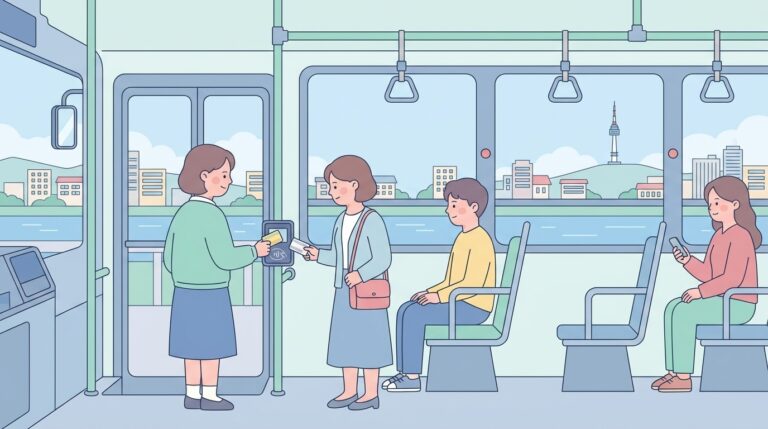
* The Card Tap Gesture: Hold your transit card (T-money) in hand, ready to tap the exit reader (하차태그) before stepping off.
* The Nod: If someone steps aside for you, a quick slight head tilt or eye contact combined with “감사합니다” (Gamsahamnida) completes the interaction smoothly.
4-2. Cultural Code: Why the Rush?
Korea’s Pali-Pali culture isn’t about being impatient; it’s rooted in mutual efficiency and consideration. Bus drivers operate on tight schedules, and traffic in metropolitan areas like Seoul is heavy. Passengers standing up early helps the bus stay on schedule and prevents unnecessary delays for everyone else on board!
Phase 5: Real-Life Roleplay Scenario
Setting: A busy Friday evening on Seoul City Bus No. 7016. You are sitting in the middle section, and your stop is coming up next.
Characters: You (Learner) & Bus Passenger (Passenger Standing in Front of You)
- Turn 1 (Bus Speaker): 🔊 이번 정류장은 홍대입구역입니다. 다음은 동교동삼거리입니다. (Next stop is Hongdae Univ. Station.)
- Turn 2 (You – 🎭 Stand up and hold the bus ring tightly): 저기요, 혹시 이번에 내리세요?
(Jeogiyo, hoksi ibone naeriseyo? / Excuse me, are you getting off this time?) - Turn 3 (Passenger – 🎭 Turns head with a polite wave of hand): 아, 아니요. 저 다음에서 내려요.
(A, aniyo. Jeo daeum-eseo naeryeoyo. / Oh, no. I’m getting off at the next one.) - Turn 4 (You – 🎭 Squeezing through gently): 아, 네! 그럼 잠시만요, 먼저 지나갈게요.
(A, ne! Geureom jamsimanyo, meonjeo jinagalgeyo. / Ah, okay! Excuse me then, I’ll pass through first.) - Turn 5 (Passenger – 🎭 Steps back to give space): 네, 먼저 가세요.
(Ne, meonjeo gaseyo. / Yes, go ahead.) - Turn 6 (You – 🎭 Tapping T-money card on reader): 💳 띵동! (Transit Card Beep)
- Turn 7 (You – 🎭 Realize the door isn’t opening yet, shout to driver): 기사님! 저 내려요! 문 좀 열어주세요!
(Gisanim! Jeo naeryeoyo! Mun jom yeoreojuseyo! / Driver! I’m getting off! Please open the door!) - Turn 8 (Bus Driver – 🎭 Opens door with air hiss sound): 네, 내리세요~ 천천히 내리세요!
(Ne, naeriseyo~ Cheoncheonhi naeriseyo! / Yes, getting off~ Take your time!)
🔀 Interactive Choice Point
What would you do if the bus door closes right before you reach it?
* Choice A: Quietly stay on the bus until the next stop to avoid attention.
* Choice B: Shout politely: “기사님! 문 좀 열어주세요!” (Gisanim! Mun jom yeoreojuseyo!)
* Choice C: Push the back door handle forcefully while yelling in English.
Feedback:
* Best (Choice B): Perfect! Korean bus drivers appreciate a clear voice over the bus noise. They will instantly open the door for you.
* Bad (Choice A): You’ll end up walking back from the wrong stop! Don’t be afraid to speak up.
* Risk (Choice C): Dangerous and rude! Never force bus doors manually.
Phase 6: 10-Second Emotion Shadowing Drill
Practice these lines with rhythm and emotion! Pay attention to the pauses (/).
[😰 Panicked & Hurried]
저기요! / 저 이번에 내려요! / 문 좀 열어주세요!
(Jeogiyo! / Jeo ibone naeryeoyo! / Mun jom yeoreojuseyo!)-
[😊 Politeness & Gentle Tone]
잠시만요 / 지나갈게요 / 감사합니다!
(Jamsimanyo / jinagalgeyo / gamsahamnida!) -
[🤔 Natural & Inquiring Tone]
혹시 / 이번 정류장에서 / 내리세요?
(Hoksi / ibon jeongryujang-eseo / naeriseyo?)
Phase 7: K-Culture Mini Dictionary
- 빨리빨리 (Pali-Pali) | Hurry-Hurry | The mindset of high speed and efficiency in Korean modern society.
- 하차태그 (Hacha Tag) | Exit Card Tap | Tapping your transit card when getting off to receive transfer discounts.
- 기사님 (Gisanim) | Driver Nim | Respectful title used to address bus, taxi, or delivery drivers.
- 환승 (Hwanseung) | Transit Transfer | Switching between buses/subways within 30 minutes for free or discounted fare.
Phase 8: Survival Kit for Travelers
Top 3 Bus Survival Phrases
- 기사님, OO 가나요? (Gisanim, OO ganayo?) – Driver, does this go to OO?
- 이번에 내려요! (Ibone naeryeoyo!) – I’m getting off at this stop!
- 카드 다시 대주세요 (Kadeu dasi daejuseyo) – Please tap your card again (if error occurs).
Editor’s Travel Note
Navigating Korean transit is super smooth when you use local apps! Google Maps isn’t always accurate for live Korean transit updates. Instead, use the Naver Map app download or KakaoBus to check live arrival times down to the exact second!
Phase 9: A Step Deeper (Reflective Essay)
At first glance, getting up before the bus comes to a complete stop might seem risky or impatient to visitors. However, this transit habit reflects a deep cultural agreement on time-saving and group efficiency in urban Korea. When everyone gets ready ahead of time, the entire city moves faster and smoother. It is a unique blend of speed, technology, and unspoken community harmony.
💬 Your Turn: Have you ever experienced a “Pali-Pali” moment while traveling? How does public transportation in your city compare to Korea’s fast-paced bus culture? Tell us in the comments below!
Phase 10: FAQ & Common Mistakes
Q: Is it illegal or dangerous to stand up while the bus is moving in Korea?
A: Technically, safety guidelines recommend staying seated until the bus stops. However, in practice, most local commuters stand up right as the bus approaches the stop to ensure they don’t miss their exit.
Q: What happens if I forget to tap my card when getting off (하차태그)?
A: You won’t get a transfer discount for your next ride, and a penalty fare (usually double the base fare) will be charged on your next tap.
Q: How should I address the bus driver politely?
A: Always call them 기사님 (Gisanim), never ‘아저씨’ (Ajusshi) or ‘저기요’ (Jeogiyo) when addressing them directly.
🚨 Common Mistakes TOP 3
- ❌ Mistake: Yelling “Stop here!” in English.
- ✅ Correct Action: Say clearly “저 이번에 내려요!” or “문 열어주세요!”
- ❌ Mistake: Standing up too early (3 stops in advance) and blocking others.
- ✅ Correct Action: Only stand up when the bus announces “이번 정류장은…” (This stop is…).
- ❌ Mistake: Forgetting to hold the handrails while standing up on a moving bus.
- ✅ Correct Action: Always grip a handrail (손잡이) tightly—Korean bus drivers accelerate and brake quickly!
Phase 11: Action Mission & Engagement
- 🥉 Bronze Mission: Practice saying “저 이번에 내려요!” 3 times out loud in front of a mirror.
- 🥈 Silver Mission: Share this post on your social media and tag a friend who needs Korean bus survival skills!
- 🥇 Gold Mission: On your next trip to Korea, successfully board a bus, tap your T-money card, and exit smoothly using Korean!
🎮 K-Culture Mission: Watch a clip of a modern Korean urban drama (e.g., Extraordinary Attorney Woo or My Liberation Notes) and spot how passengers exit the bus!
Phase 12: Interactive Quiz Challenge
Q1. What is the most natural way to tell passengers ahead of you that you need to squeeze past them to exit?
1) 저기요, 미안합니다!
2) 잠시만요, 지나갈게요!
3) 너 내려라!
Click to view Answer & Explanation
Answer: 2) 잠시만요, 지나갈게요!
Explanation: “잠시만요, 지나갈게요!” is the standard, polite, and natural phrase used when moving past people in crowded Korean transport.
Q2. True or False: You don’t need to tap your transit card when getting off the bus if you aren’t transferring.
Click to view Answer & Explanation
Answer: False!
Explanation: Even if you aren’t transferring, tapping off ensures you aren’t charged a distance penalty fare on your next trip!







