

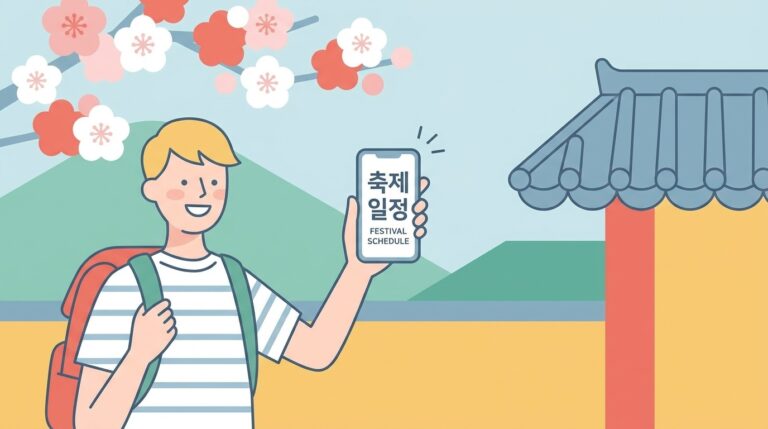
Phase 1: Empathy (Story-driven Opening)
안녕하세요! I’m your Daily Hangul editor, your 10-year local culture navigator!
Picture this: You arrive in Seoul during autumn, excited to see the famous fireworks or the glowing pink muhly grass festival. You checked a blog post from last month, put on your favorite outfit, and rode the subway for an hour—only to find an empty park! A banner nearby says something in Korean, but you cannot figure out if the event started earlier, was moved, or was postponed due to light rain.
Asking about event timings in a second language can feel intimidating, especially when crowd noise and fast-talking staff are involved. Many A2 learners tell us they freeze when trying to ask simple questions like “When does it start?” or “Is there a schedule?”
Don’t worry! Today, we are unlocking practical Korean phrases specifically tailored for checking festival schedules. Based on real feedback from thousands of Korean learners, this guide will give you the exact words, local etiquette, and confidence you need to never miss a K-festival moment again!
Phase 2: Top 3 Essential Expressions Deep Dive
1. 축제가 언제 시작해요? (Chukje-ga eonje sijak-haeyo?)
- Pronunciation: [Chook-jae-ga eon-jae see-jak-hae-yo?] (Think of ‘chook’ like ‘chug’ and ‘jae’ like ‘gem’ without the m!)
- Meaning: Literal: When does the festival start? | Nuance: Friendly and standard way to ask any staff member or local about event start times.
- K-Culture Moment: In K-dramas, you often hear characters running toward a riverside stage yelling this exact sentence to their friends before a K-pop concert begins!
- Editor’s Insight: Combining “축제” (festival) with “언제” (when) and “시작해요” (starts) is the most versatile starter formula. You can replace “축제” with any event name, like “공연” (performance).
- Situation Spectrum: Casual (⚠️ 축제 언제 해?) / Semi-formal (✅ 축제가 언제 시작해요?) / Formal (✅ 축제가 언제 시작합니까?)
- 🤔 Think About It: How does asking “When does it start?” differ when you use soft endings like ‘-요’ (-yo) versus sharp command structures in your native language?
2. 일정표가 어디에 있어요? (Iljeongpyo-ga eodie isseoyo?)
- Pronunciation: [Eel-jeong-pyo-ga eo-dee-ae ee-sseo-yo?]
- Meaning: Literal: Where is the timetable/schedule? | Nuance: Polite request asking where to find a physical pamphlet, banner, or QR code menu of events.
- K-Culture Moment: At the Boryeong Mud Festival or Busan Fireworks Festival, information booths hand out colorful paper maps with an “일정표” printed on the back.
- Editor’s Insight: “일정” means schedule/routine, and “표” means chart/table. Combine them and you get “timetable.” Showing your phone map while saying this speeds up responses dramatically!
- Situation Spectrum: Casual (⚠️ 일정표 어디 있어?) / Semi-formal (✅ 일정표가 어디에 있어요?) / Formal (✅ 일정표가 어디에 있습니까?)
- 🤔 Think About It: In Korea, asking for physical schedule sheets is still very popular alongside scanning QR codes! Does your country rely more on apps or printed guides at events?
3. 비가 오면 축제를 해요? (Bi-ga omyeon chukje-reul haeyo?)
- Pronunciation: [Bee-ga oh-myeon chook-jae-reul hae-yo?]
- Meaning: Literal: If it rains, do they do the festival? | Nuance: Essential weather check! Asks if an outdoor event will proceed despite rainy weather.
- K-Culture Moment: Spring weather in Korea can be unpredictable during cherry blossom season. Korean news reports often use the term “우천 시” (in case of rain) when updating festival schedules.
- Editor’s Insight: Using “-면” (-myeon) creates an “if” conditional. This basic A2 grammar pattern is super handy for outdoor travel planning!
- Situation Spectrum: Casual (⚠️ 비 오면 축제 해?) / Semi-formal (✅ 비가 오면 축제를 해요?) / Formal (✅ 비가 오면 축제를 진행합니까?)
- 🤔 Think About It: Rainy weather policies can be strict or flexible depending on the region. How do outdoor event organizers in your country communicate weather updates?
Phase 3: Textbook Korean vs. Real Native Korean
Situation 1: Asking when the main event starts
- 📖 Textbook Korean: “행사가 몇 시에 시작합니까?” (Haengsa-ga myeot si-e sijak-hapnika?)
- 🗣️ Real Native Korean: “본 행사는 몇 시에 해요?” (Bon haengsa-neun myeot si-e haeyo?)
- 💡 Why is it different? While the textbook phrase is grammatically perfect, native Koreans in casual or semi-formal festival settings prefer using simpler verbs like “해요” (do/happen) instead of formal endings like “-습니까”. Adding “본” (main) helps specify the main show rather than booth setup times!
Situation 2: Asking if an event is canceled
- 📖 Textbook Korean: “축제가 취소되었습니까?” (Chukje-ga chuiso-doe-eot-seumnika?)
- 🗣️ Real Native Korean: “오늘 축제 취소됐어요?” (Oneul chukje chuiso-dwaesseoyo?)
- 💡 Why is it different? Native speakers shorten “취소되었습니다” to “취소됐어요” in conversation. Dropping grammatical subject particles (like -가/-이) makes your sentence sound smooth and natural.
Phase 4: K-Culture Deep Dive & Non-Verbal Manners
4-1. Nunchi & Gestures
When visiting a busy festival booth in Korea, eye contact and subtle body language are key:
* Two-Handed Courtesy: When receiving a printed schedule or map from festival staff, hold out both hands lightly or support your right elbow with your left hand. This demonstrates respect instantly.
* The Phone Tilt: If you are pointing at a specific time or event on your smartphone screen, tilt the phone toward the staff member and give a gentle nod while saying “이거 몇 시에 해요?” (What time does this happen?).
4-2. Cultural Code Analysis: The Seasonal Festival Routine
Koreans love seasonal transitions! In spring, it’s flower festivals (꽃축제); in summer, beach and music events (해변축제); in autumn, foliage and light festivals (단풍/빛축제); and in winter, ice fishing and lantern festivals (얼음/등불축제).
Because popular festivals attract big crowds, schedules are updated in real-time on official Instagram pages or portal blogs. Checking for notice banners labeled “우천 시 일정 변경” (Schedule change in case of rain) before heading out is a classic habit among savvy Korean travelers.
Phase 5: Real-Life Roleplay Scenario
Setting: Information booth at the Yeouido Spring Flower Festival in Seoul.
Characters: You (Traveler) & Min-ho (Friendly Festival Staff NPC).
- Turn 1 (You): 안녕하세요! 혹시 축제 일정표가 어디에 있어요? / [An-nyeong-ha-se-yo! Hok-si chuk-je il-jeong-pyo-ga eo-di-e is-seo-yo?]
(Hello! By any chance, where is the festival schedule?)🎭 Pointing politely toward the desk - Turn 2 (Min-ho): 아, 여기 포스터 아래 QR 코드를 스캔하시면 돼요! / [A, yeo-gi po-sieu a-rae QR ko-deu-reul seu-kaen-ha-si-myeon dwae-yo!]
(Ah, you can just scan the QR code under this poster!)🎭 Gesturing toward a tabletop stand - Turn 3 (You): 아, 그렇군요! 혹시 오늘 드론 쇼는 몇 시에 시작해요? / [A, geu-reoh-gun-yo! Hok-si o-neul deu-ron syo-neun myeot si-e si-jak-hae-yo?]
(Ah, I see! By any chance, what time does the drone show start today?)🎭 Looking curious - Turn 4 (Min-ho): 저녁 8시에 시작해요. 30분 동안 진행됩니다. / [Jeo-nyeok pal-si-e si-jak-hae-yo. Sam-sip-bun dong-an jin-haeng-doem-ni-da.]
(It starts at 8 PM. It lasts for 30 minutes.)🎭 Smiling and pointing to the evening slot on the digital flyer - Turn 5 (You): 혹시 비가 오면 드론 쇼를 해요? / [Hok-si bi-ga o-myeon deu-ron syo-reul hae-yo?]
(What if it rains, will they still do the drone show?)🎭 Looking up at cloudy skies - Turn 6 (Min-ho): 비가 많이 오면 취소될 수 있어요. 7시에 인스타그램으로 공지해요! / [Bi-ga ma-ni o-myeon chui-so-doel su is-seo-yo. Chil-si-e in-seu-ta-geu-ram-eu-ro gong-ji-hae-yo!]
(If it rains heavily, it might be canceled. We announce it on Instagram at 7 PM!)🎭 Tapping a phone screen - Turn 7 (You): 아, 알겠습니다. 정말 감사합니다! / [A, al-get-seum-ni-da. Jeong-mal gam-sa-ham-ni-da!]
(Ah, I understand. Thank you so much!)🎭 Nodding lightly with a warm smile - Turn 8 (Min-ho): 네, 즐거운 축제 되세요! / [Ne, jeul-geo-un chuk-je doe-se-yo!]
(Sure, have a wonderful time at the festival!)🎭 Waving goodbye warmly
🔀 Interactive Branching Choice
Staff member Min-ho says the show might be canceled if it rains. What do you do?
* Choice A: Say “지금 취소해 주세요” (Please cancel it right now).
* Choice B: Ask “인스타그램 아이디가 어떻게 돼요?” (What is the Instagram ID?).
* Choice C: Walk away without saying anything.
Feedback:
* Choice A (Risk): Incorrect context! “취소해 주세요” means asking someone to cancel a booking. The staff doesn’t control the weather or the event directly!
* Choice B (Best): Perfect! Asking for the official handle allows you to monitor real-time updates directly on your phone.
* Choice C (Bad): Ending conversations abruptly in Korea can feel cold. Always wrap up with a quick “감사합니다!” (Thank you!).
Phase 6: 10-Second Emotion Shadowing Drill
Practice saying these lines aloud with appropriate emotion and pause breaks (/):
[😊 Excited & Curious]
저기요! / 축제가 / 몇 시에 / 시작해요?
(Jeo-gi-yo! / chuk-je-ga / myeot si-e / si-jak-hae-yo?)-
[🥺 Slightly worried]
오늘 / 비가 오는데 / 축제 / 해요?
(O-neul / bi-ga o-neun-de / chuk-je / hae-yo?) -
[🎉 Enthusiastic & Grateful]
일정표 / 감사합니다! / 재미있게 볼게요!
(Il-jeong-pyo / gam-sa-ham-ni-da! / jae-mi-it-ge bol-ge-yo!)
Phase 7: K-Culture Mini Dictionary
- 축제 (Chukje) | Festival / Carnival | Used everywhere from college campus festivals (대학 축제) to city-wide seasonal celebrations.
- 일정표 (Iljeongpyo) | Timetable / Schedule chart | Look for this heading on pamphlets or noticeboards at event entry gates.
- 우천 시 (Ucheon-si) | In case of rain | A Sino-Korean term commonly seen on official posters regarding backup plans or cancellations.
- 먹거리 장터 (Meokgeori jangteo) | Food stall market | The designated zone at Korean festivals featuring street foods like tteokbokki, skewers, and pajeon.
Phase 8: Traveler’s Survival Kit
Survival Phrases TOP 3
- 몇 시부터 시작이에요? (Myeot si-bu-teo si-jak-i-e-yo?) — What time does it start from?
- 오늘 행사 끝났어요? (O-neul haeng-sa kkeut-na-sseo-yo?) — Is today’s event over?
- 위치가 어디예요? (Wi-chi-ga eo-di-ye-yo?) — Where is the location?
Editor’s Travel Note
Before heading to any major event, make sure to download the Naver Map App Download on your smartphone. Korean local festivals often tag temporary stages and booth locations directly on Naver Maps, which is far more accurate in South Korea than Google Maps!
Phase 9: One Step Deeper (Cultural Reflection)
In Korean culture, festivals are not just about entertainment—they represent a collective celebration of nature’s rhythm. Whether gathered under spring blossoms or gathering around autumn lanterns, sharing time in outdoor spaces reflects the deep Korean value of Jeong (정)—communal warmth and connection. When you step up to ask a local about event times, you aren’t just getting information; you are taking part in that shared seasonal excitement!
💬 Your Turn: Which Korean seasonal festival do you want to visit first—Spring Cherry Blossoms, Summer Mud Festival, or Autumn Fireworks? Tell us in the comments below!
Phase 10: FAQ & Common Mistakes
Q: What if I don’t understand the fast Korean response from the booth staff?
A: Simply say, “천천히 말씀해 주세요” (Cheon-cheon-hi mal-sseum-hae ju-se-yo / Please speak slowly) or hold up your phone screen so they can point to the time!
Q: Is there an entrance fee for most Korean seasonal festivals?
A: Many city seasonal festivals (like flower or river festivals) are free to enter, but specific performances or experience booths may charge a small cash or card fee.
Q: How early should I arrive before a main festival performance?
A: Popular Korean festivals draw huge crowds. Arriving at least 1 to 2 hours early is recommended to secure good seating or viewing spots.
🚨 Common Mistakes TOP 3
- ❌ Mistake 1: Asking “언제 오픈해요?” (When does it open?) for outdoor open parks.
- 👉 Correct Action: Say “축제 몇 시에 시작해요?” (What time does the festival start?).
- ❌ Mistake 2: Using overly stiff formal endings like “시작합니까?” with young booth volunteers.
- 👉 Correct Action: Keep it naturally friendly with A2 standard politeness: “-시작해요?”.
- ❌ Mistake 3: Assuming outdoor events continue regardless of heavy rain.
- 👉 Correct Action: Check official social channels for “우천 취소” (Rain cancellation) notices.
Phase 11: Action Mission
- 🥉 Bronze Mission: Practice saying “축제가 몇 시에 시작해요?” out loud 3 times in front of a mirror.
- 🥈 Silver Mission: Write down a mock schedule in Korean using 3 festival keywords (축제, 일정표, 시작).
- 🥇 Gold Mission: Check a real Korean festival poster online and spot the start time and location details!
🎮 K-Culture Mission: Watch a clip of your favorite Korean drama or travel vlog, listen for any mention of “몇 시” (what time) or “축제” (festival), and type it down in your study notebook!
Phase 12: Interactive Quiz Challenge
Question 1 (Situation Judgment)
You want to ask festival staff where to find the printed timetable sheet. What should you say?
* A) 비가 오면 축제 해요?
* B) 일정표가 어디에 있어요?
* C) 오늘 축제 끝났어요?
Click to reveal answer & explanation
Correct Answer: B
* Explanation: “일정표가 어디에 있어요?” directly translates to “Where is the schedule/timetable?” Option A asks about rain, and Option C asks if the event is over.
Question 2 (Fill-in-the-blank)
Fill in the blank: “드론 쇼가 몇 시에 _______?” (What time does the drone show start?)
* A) 시작해요
* B) 예뻐요
* C) 있어요
Click to reveal answer & explanation
Correct Answer: A
* Explanation: “시작해요” (sijak-haeyo) means “starts.” The full sentence asks what time the show starts.
Question 3 (True or False Cultural Quiz)
True or False: In Korea, outdoor festivals always proceed even during heavy storms without any schedule changes.
Click to reveal answer & explanation
Correct Answer: False
* Explanation: Safety comes first! Outdoor events frequently update schedules or cancel in case of heavy rain (“우천 시”), posting notices on social media or local web portals.







