

Don’t Panic at the Korean Post Office: Easy Guide to Finding Postal Codes
Phase 1: 공감 (스토리 몰입형 오프닝)
안녕하세요! 매일한글 에디터입니다. Have you ever stood inside a shiny, busy Korean post office (우체국 – Upyeonguk) holding a cute postcard or parcel for your favorite idol or friend back home, only to freeze when asked for the 5-digit postal code (우편번호)?
Imagine this scenario: You’ve prepared a wonderful gift package. The post office clerk smiles warmheartedly and says, “우편번호 써주세요” (Please write down the postal code). Suddenly, you realize you only have the old building address saved in your phone notes! In Korea, addresses were revamped into street-name addresses (도로명 주소), and finding the exact 5-digit postal code can feel overwhelming for international visitors.
Don’t worry at all! Based on real learner experiences and feedback from hundreds of K-Culture fans, this step-by-step guide will equip you with the exact A2-level Korean phrases, cultural tips, and interactive drills you need. By the end of this guide, you will comfortably walk into any Korean post office and find postal codes like a local!
Phase 2: 핵심 표현 3선 심층 분석
1. 우편번호가 몇 번이에요? (Upyeonbeonhoga myeot beon-ieyo?)
- Pronunciation: [Oo-pyeon-beon-ho-ga myeot beon-ee-yeo?] (Sounds like ‘Oop-yuhn-bun-ho’ + ‘mutt bun-ee-yoh’)
- Meaning: “What is the postal code?”
- K-Culture Moment: You often see this phrase in Korean modern web-dramas when main characters fill out delivery forms at convenience stores or local post offices.
- Editor’s Insight: ‘우편’ means postal mail, and ‘번호’ means number. Adding ‘몇 번이에요?’ politely asks for a specific numeric code.
- Situation Spectrum: Casual ⚠️ | Semi-formal ✅ | Formal ✅
- 🤔 Think About It: How does asking for numerical information politely differ between Korean and your native language?
2. 도로명 주소를 알고 계신가요? (Doromyeong jusoreul algo gyesingayo?)
- Pronunciation: [Do-ro-myeong ju-so-reul al-go gye-sin-ga-yo?]
- Meaning: Direct: “Do you know the street-name address?” / Nuance: “Could you provide the official street-name address to look up the zip code?”
- K-Culture Moment: Post office staff frequently ask this because Korea switched from area-based addresses (지번) to street-name addresses (도로명 주소).
- Editor’s Insight: ‘도로명’ literally translates to ‘street name’. Staff use honorific ‘계신가요?’ to be polite to customers.
- Situation Spectrum: Casual 🚫 | Semi-formal ✅ | Formal ✅
- 🤔 Think About It: Korea updated its entire addressing system in 2014 to boost delivery efficiency. How does your country organize street numbers?
3. 여기에 주소를 적어 주세요. (Yeogie jusoreul jeogeo juseyo.)
- Pronunciation: [Yeo-gi-e ju-so-reul jeog-eo ju-se-yo.] (Sounds like ‘Yuh-gee-eh joo-soh-reul jug-uh joo-seh-yoh’)
- Meaning: “Please write the address here.”
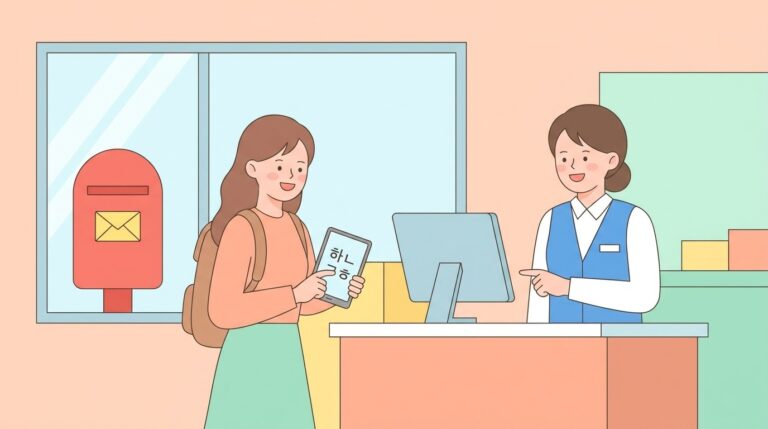
- K-Culture Moment: Staff point at a digital tablet or paper form when guiding you where to write your sender/receiver info.
- Editor’s Insight: ‘적다’ means to write down. Combining it with ‘~아/어 주세요’ creates a friendly, polite request.
- Situation Spectrum: Casual ⚠️ | Semi-formal ✅ | Formal ✅
- 🤔 Think About It: Notice how physical handwriting forms are seamlessly blended with digital screens in modern Korean public services!
Phase 3: 교과서 한국어 vs 진짜 한국어
Situation 1: Asking staff to search for a zip code
* 📖 교과서 한국어: “제가 우편번호를 모릅니다. 찾아주십시오.”
* 🗣️ 진짜 한국어: “저… 우편번호를 잘 모르겠는데, 같이 찾아주실 수 있나요?”
* 💡 왜 다를까? Textbook Korean can sound overly rigid. Real native speakers use softeners like “저…” (Um…) and polite modals like “~해 주실 수 있나요?” to sound gentle.
Situation 2: Confirming if the postal code is 5 digits
* 📖 교과서 한국어: “우편번호는 다섯 자리 숫습니까?”
* 🗣️ 진짜 한국어: “우편번호 5자리 맞죠?”
* 💡 왜 다를까? In casual daily exchanges, Koreans prefer short phrases with ending particles like “맞죠?” (Right?) to quickly double-check details.
Phase 4: K-Culture 딥다이브 & 비언어적 매너
4-1. 눈치(Nunchi) & Gestures at the Post Office
- Two-Handed Courtesy: When handing over your parcel, form, or ID card to the clerk, always use both hands (or support your right elbow with your left hand). This shows respect.
- Screen Interaction: Most Korean post offices have touchscreens at counters. If the clerk gestures toward a small screen, they are inviting you to type or double-check your street name address.
4-2. Culture Code: Sending Fan Mail & K-Travel Souvenirs
Sending letters or merch in Korea is a cultural staple! Whether you are sending fan mail to a K-Pop agency in Gangnam or mailing heavy cosmetics back home to keep your suitcase light, understanding post office keywords gives you instant freedom and confidence.
Phase 5: 실전 롤플레이 시나리오
Characters: Alex (Traveler) & Post Office Clerk (우체국 직원)
- Clerk: 안녕하세요! 어떤 것 도와드릴까요?
(An-nyeong-ha-se-yo! Eot-teon geot do-wa-deu-ril-kka-yo?)
[Hello! How can I help you today?] 🎭 Smiling politely behind the counter - Alex: 이 상자를 미국으로 보내고 싶어요.
(I sang-ja-reul mi-gug-eu-ro bo-nae-go sip-eo-yo.)
[I want to send this box to the US.] 🎭 Placing the box gently on the scale - Clerk: 네, 여기에 받으실 분 주소랑 우편번호 적어 주세요.
(Ne, yeo-gi-e bat-eu-sil bun ju-so-rang u-pyeon-beon-ho jeog-eo ju-se-yo.)
[Sure, please write the recipient’s address and postal code here.] 🎭 Handing a pen and shipping label - Alex: 저… 한국 보내는 주소 우편번호도 써야 하나요?
(Jeo… han-guk bo-nae-neun ju-so u-pyeon-beon-ho-do sseo-ya ha-na-yo?)
[Um… do I also need to write the postal code for the Korean sender address?] 🎭 Looking slightly hesitant - Clerk: 네! 보내는 분 한국 우편번호 5자리도 필요해요.
(Ne! Bo-nae-neun bun han-guk u-pyeon-beon-ho da-seot-ja-ri-do pil-yo-hae-yo.)
[Yes! We need the 5-digit Korean postal code for the sender too.] 🎭 Nodding and pointing to the address space - Alex: 제가 호텔 우편번호를 잘 모르는데, 어떻게 찾아요?
(Je-ga ho-tel u-pyeon-beon-ho-reul jal mo-reu-neun-de, eot-teo-ke chat-a-yo?)
[I don’t know my hotel’s postal code, how can I find it?] 🎭 Showing hotel address on smartphone - Clerk: 여기 검색 화면에 도로명 주소를 입력하시면 나와요.
(Yeo-gi geom-saek hwa-myeon-e do-ro-myeong ju-so-reul im-ryeok-ha-si-myeon na-wa-yo.)
[If you type the street-name address on this search screen, it will show up.] 🎭 Tapping the customer touchscreen - Alex: 아, 나왔어요! 감사해용!
(A, na-wat-eo-yo! Gam-sa-hae-yong!)
[Ah, it came up! Thank you!] 🎭 Bowing slightly with a cheerful smile
🔀 Interactive Branching Point
The clerk asks: “주소 검색 어려우시면 제가 도와드릴까요?” (If address search is difficult, shall I help you?)
- Option A: “네, 부탁드립니다! 감사해요.” (Yes, please! Thank you.)
- Feedback: BEST! Clear, polite, and warmly accepted assistance.
- Option B: “아니요. 괜찮아요.” (No. It’s okay.)
- Feedback: BAD. Sounding slightly direct or blunt without adding polite particles.
- Option C: “우편번호 몰라요. 그냥 보내주세요.” (I don’t know postal code. Just send it.)
- Feedback: RISK. The post office system requires zip codes; your package might be delayed or rejected!
Phase 6: 10초 감정 섀도잉 드릴
- Sentence 1: [😊 Friendly & Curious]
우편번호를 / 어디에 / 적어야 해요?
(U-pyeon-beon-ho-reul / eo-di-e / jeog-eo-ya hae-yo?) - Sentence 2: [🥺 Polite Request]
도로명 주소로 / 다시 / 찾아볼게요!
(Do-ro-myeong ju-so-ro / da-si / chat-a-bol-ge-yo!)
Phase 7: K-Culture 미니 사전 (핵심 키워드 4개)
- 우편번호 (Upyeonbeonho) | Postal Code / Zip Code
Korea uses a 5-digit national postal code system established in 2015. - 도로명 주소 (Doromyeong Juso) | Street-Name Address
The modern address standard based on road names and building numbers. - 택배 (Taekbae) | Parcel / Express Courier
Korea’s super-fast delivery culture for packages. - 등기 (Deunggi) | Registered Mail
Tracked official mail service requiring recipient signature upon delivery.
Phase 8: 여행자를 위한 생존 키트
Top 3 Survival Expressions
- 우편번호 알려주세요. (Upyeonbeonho al-ryeo-ju-se-yo.) – Please tell me the postal code.
- 여기 주소 있어요. (Yeogi juso isseoyo.) – I have the address here.
- 택배 보내고 싶어요. (Taekbae bonaego sipeoyo.) – I want to send a parcel.
Editor’s Travel Note
Before heading to the post office, bookmark your hotel address in Korean! You can download the 네이버 지도 앱 다운로드 to search any building name in Korea; it displays the exact 5-digit postal code instantly alongside the street-name address!
Phase 9:
Frequently Asked Questions (FAQ)
Q: What does "우편번호가 몇 번이에요? (Upyeonbeonhoga myeot beon-ieyo?)" mean in Korean and how do you pronounce it?
A: In Korean, "우편번호가 몇 번이에요? (Upyeonbeonhoga myeot beon-ieyo?)" is pronounced [Oo-pyeon-beon-ho-ga myeot beon-ee-yeo?] and means: "What is the postal code?"
Q: What does "도로명 주소를 알고 계신가요? (Doromyeong jusoreul algo gyesingayo?)" mean in Korean and how do you pronounce it?
A: In Korean, "도로명 주소를 알고 계신가요? (Doromyeong jusoreul algo gyesingayo?)" is pronounced [Do-ro-myeong ju-so-reul al-go gye-sin-ga-yo?] and means: Direct: "Do you know the street-name address?" / Nuance: "Could you provide the official street-name address to look up the zip code?"
Q: What does "여기에 주소를 적어 주세요. (Yeogie jusoreul jeogeo juseyo.)" mean in Korean and how do you pronounce it?
A: In Korean, "여기에 주소를 적어 주세요. (Yeogie jusoreul jeogeo juseyo.)" is pronounced [Yeo-gi-e ju-so-reul jeog-eo ju-se-yo.] and means: "Please write the address here."







