

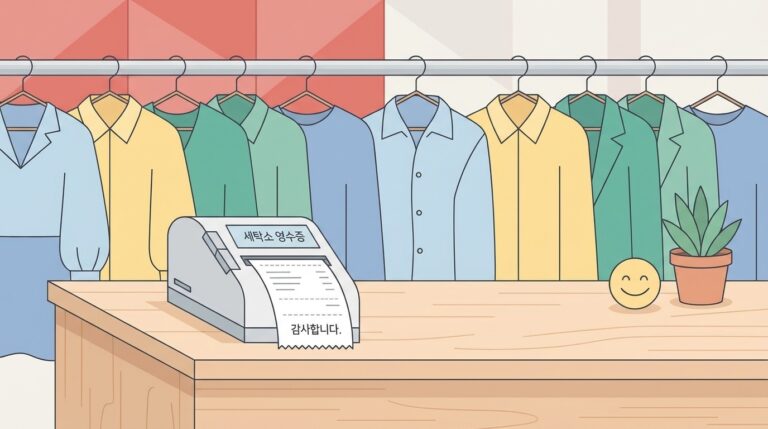
Mastering the Korean Dry Cleaners: How to Ask for a Receipt Easily
Phase 1: Empathy & Storytelling Opening
안녕하세요! I’m your lead editor at Daily Hangul, your 10-year Korean culture navigator!
Imagine this scene: You are living or traveling in Seoul. You just handed over your favorite coat to the friendly neighborhood laundry shop (세탁소, setakso). You paid using your card, but as you turn around to leave, a sudden panic hits you: “Wait… how do I prove this is my coat when I come back? What if they don’t remember me?”
You want to ask for a receipt, but your mind goes blank. In your home country, asking for a receipt might be automatic, but in fast-paced Korea, store clerks often assume you don’t need one unless you ask!
Don’t worry at all! Based on real feedback from hundreds of beginner learners, asking for a receipt is actually one of the easiest 3-word sentences you can learn in Korean. Mastering this simple phrase will not only save your favorite clothes, but it will also boost your confidence to navigate everyday Korean neighborhood services like a local!
Phase 2: Core Phrases Deep Dive
1. 영수증 주세요 (Yeongsujeung juseyo)
- Pronunciation: [Yeong-su-jeung joo-seh-yo] (Sounds like “Young-swoo-jeng” + “Joo-say-yo”)
- Meaning: Literal: “Receipt, please give me.” / Natural: “Can I get a receipt, please?”
- K-Culture Moment: In K-dramas, characters always keep their dry cleaner receipts tucked in their wallets or phone cases to collect tailored suits!
- Editor’s Insight: “주세요” (Juseyo) is the magic key phrase in Korea. Attach it to any noun (Coffee, Water, Receipt) and you instantly have a polite request!
- Situation Spectrum: Casual ⚠️ | Semi-formal ✅ | Formal ✅
- 🤔 Think About It: In cafes, Koreans often say “영수증 버려주세요” (Please throw away the receipt), but at laundry shops, they hold onto them. Why do you think receipts matter more at service shops?
2. 얼마예요? (Eolmayeyo?)
- Pronunciation: [Eol-ma-yeh-yo?] (Sounds like “Ull-mah-yeh-yo?”)
- Meaning: Literal: “How much is it?”
- K-Culture Moment: You hear this constantly in traditional markets, boutiques, and street food stalls.
- Editor’s Insight: Short, simple, and crucial. Use a rising intonation at the end to sound natural.
- Situation Spectrum: Casual ⚠️ | Semi-formal ✅ | Formal ✅
- 🤔 Think About It: Is asking for prices directly considered polite or blunt in your culture?
3. 언제 찾을 수 있어요? (Eonje chajeul su isseoyo?)
- Pronunciation: [Eon-je cha-jeul soo it-seo-yo?]
- Meaning: Literal: “When can I pick it up?”
- K-Culture Moment: Asking the store owner when dry-cleaned items will be ready for pick-up.
- Editor’s Insight: The verb “찾다” (chakta) means “to search,” but in this context, it means “to pick up / collect.”
- Situation Spectrum: Casual 🚫 | Semi-formal ✅ | Formal ✅
- 🤔 Think About It: Korea is famous for fast service (Pali-pali culture). Most laundry takes only 1-2 days!
Phase 3: Textbook Korean vs Real Korean
Situation 1: Asking for a receipt
- 📖 Textbook Korean: 영수증을 주시겠습니까? (Yeongsujeungeul jusigessneumnika?)
- 🗣️ Real Korean: 영수증 주세요! (Yeongsujeung juseyo!)
- 💡 Why different?: While the textbook version is grammatically formal, real native speakers prefer the warm, polite, and practical “~주세요” in everyday shops.
Situation 2: Asking when clothes will be ready
- 📖 Textbook Korean: 언제 의류를 회수할 수 있습니까? (Eonje uiryureul hoesuhal su issneumnika?)
- 🗣️ Real Korean: 언제 찾을 수 있어요? (Eonje chajeul su isseoyo?)
- 💡 Why different?: “회수” (hoesuu) sounds like business logistics talk! “찾다” (chakta) is the natural daily verb used by everyone.
Phase 4: K-Culture Deep Dive & Manner Tips
4-1. Nunchi & Gestures
When receiving your paper receipt or credit card back from the dry cleaner owner, always receive it with both hands (or support your right forearm with your left hand). This non-verbal gesture shows deep respect and good Nunchi (cultural etiquette)!
4-2. Neighborhood Dry Cleaners (동네 세탁소)
In Korea, local laundry shops are neighborhood social hubs. The owner (사장님, Sajangnim) often does clothes alterations (수선, suseon) as well. If your pants are too long, you can leave them at the same place!
Phase 5: Real-Life Roleplay Scenario
Setting: Inside a warm local Korean laundry shop in Seoul. The smell of clean steam irons fills the air.
NPC: Friendly Dry Cleaner Boss (세탁소 사장님)
- You: 안녕하세요! (Annyeonghaseyo! / Hello!) 🎭 [Smile warmly]
- Boss: 네, 어서 오세요! 무슨 옷이에요? (Ne, eoseo oseyeo! Museun osieyo? / Yes, welcome! What clothes do you have?)
- You: 이 코트 세탁해 주세요. (I koteu setak-hae juseyo. / Please dry clean this coat.) 🎭 [Hand over coat]
- Boss: 네, 알겠습니다. (Ne, algetseumnida. / Yes, got it.)
- You: 얼마예요? (Eolmayeyo? / How much is it?) 🎭 [Take out card]
- Boss: 만 원이에요. (Man won-ieyo. / It’s 10,000 won.)
- You: 카드 결제해 주세요. 그리고 영수증 주세요! (Kadeu gyeolje-hae juseyo. Geurigo yeongsujeung juseyo! / Card payment please. And please give me a receipt!)
- Boss: 네, 여기 영수증하고 카드요! (Ne, yeogi yeongsujeung-hago kadeu-yo! / Yes, here is your receipt and card!)
🔀 Interactive Choice Point
The boss hands back your card and receipt, asking: “전화번호가 어떻게 돼요?” (What is your phone number?)
- Choice A: Say your phone number clearly in Korean digits. (Best)
- Choice B: Walk out without answering. (Bad)
- Choice C: Hand over your passport. (Risk)
-
Feedback:
- Choice A (Best): Great! Korean dry cleaners log your order under your phone number so you can pick it up easily.
- Choice B (Bad): The owner won’t know whose coat it is when it’s done!
- Choice C (Risk): No need for official ID! A simple phone number is all they use.
Phase 6: 10-Second Emotion Shadowing Drill
- [😊 Polite & Friendly] 안녕하세요! / 영수증 주세요. (Annyeonghaseyo! / Yeongsujeung juseyo.)
- [🤔 Curious & Gentle] 얼마예요? / 언제 찾을 수 있어요? (Eolmayeyo? / Eonje chajeul su isseoyo?)
Phase 7: K-Culture Mini Dictionary
- 세탁소 (Setakso) | Dry cleaners / Laundry shop | Everyday local service shop.
- 영수증 (Yeongsujeung) | Receipt | Important paper proof for picking up items.
- 사장님 (Sajangnim) | Boss / Store Owner | The universal polite title for small business owners in Korea.
- 수선 (Suseon) | Clothing alterations | Hemming pants, fixing zippers, adjusting fit.
Phase 8: Traveler’s Survival Kit
Survival TOP 3
- 영수증 주세요. (Yeongsujeung juseyo.) – Receipt, please.
- 얼마예요? (Eolmayeyo?) – How much is it?
- 여기요! (Yeogiyo!) – Excuse me! (Calling staff)
Editor’s Travel Note
Need to find a laundry shop near your Airbnb in Seoul? Open your phone and use the Naver Map App Download to search for “세탁소” near your location. Almost all local dry cleaners accept cards and mobile payments!
Phase 9: A Step Deeper (Thinking Question)
In Korea’s digital-first culture, paper receipts are rapidly disappearing in daily coffee shops. However, local service shops like dry cleaners, repair centers, and pharmacies still rely heavily on paper receipts and phone numbers. Understanding when to ask for a receipt shows how well you understand the practical flow of Korean urban life!
💬 Your Turn: Have you ever tried visiting a local shop in Korea? Share your story in the comments below!
Phase 10: FAQ & Common Mistakes
Q: What if I lose my laundry receipt?
A: Don’t panic! In 99% of modern Korean dry cleaners, your order is linked to your mobile phone number. Just tell the boss your phone number when you return.
Q: Do Korean dry cleaners accept international credit cards?
A: Yes! Almost all dry cleaners accept standard credit cards, Visa, Mastercard, and local mobile payments.
Q: How do I ask them to shorten my pants at a dry cleaner?
A: Simply point to your pants hem and say: “바지 수선해 주세요” (Baji suseon-hae juseyo).
🚨 Common Mistakes TOP 3
- Saying “Receipt” in English: Clerks might not understand English pronunciation instantly. Always use 영수증 (Yeongsujeung).
- Forgetting to take the receipt: In Korea, staff might quickly toss it if you don’t say “주세요” early!
- Taking items with one hand: Always use two hands when taking back your receipt or card.
Phase 11: Action Mission & Engagement
- 🥉 Bronze Mission: Practice saying “영수증 주세요” 3 times out loud in front of a mirror!
- 🥈 Silver Mission: Write “영수증 주세요” on a sticky note and put it on your desk.
- 🥇 Gold Mission: Visit a Korean grocery or store and ask for your receipt in Korean!
🎮 K-Culture Mission: Watch a scene in a Korean drama where a character picks up clothes, and spot if they hand over a receipt!
Phase 12: Interactive Quiz Challenge
🔍 Quiz 1: What is the most polite, simple way to ask for a receipt in Korean?
Answer: 영수증 주세요 (Yeongsujeung juseyo)
Explanation: Noun + 주세요 is the universal polite pattern for asking for items in Korea.
🔍 Quiz 2: (True or False) You must show your passport to pick up dry cleaning in Korea.
Answer: False
Explanation: You only need your receipt or your phone number!







